
Lecture
25.1. Proper motion and radial velocities of stars. Peculiar velocities of stars and the Sun in the Galaxy. Rotation of the Galaxy.
Comparison of the equatorial coordinates of the same stars, determined over significant intervals of time, has shown that α and δ change over time. A significant part of these changes is caused by precession, nutation, aberration, and annual parallax. If the influence of these causes is excluded, the changes diminish but do not disappear entirely. The remaining displacement of a star on the celestial sphere over a year is called the proper motion
of the star µ. It is expressed in arcseconds per year.
Proper motions differ from star to star in magnitude and direction.
Only a few dozen stars have proper motions greater than 1” per year.
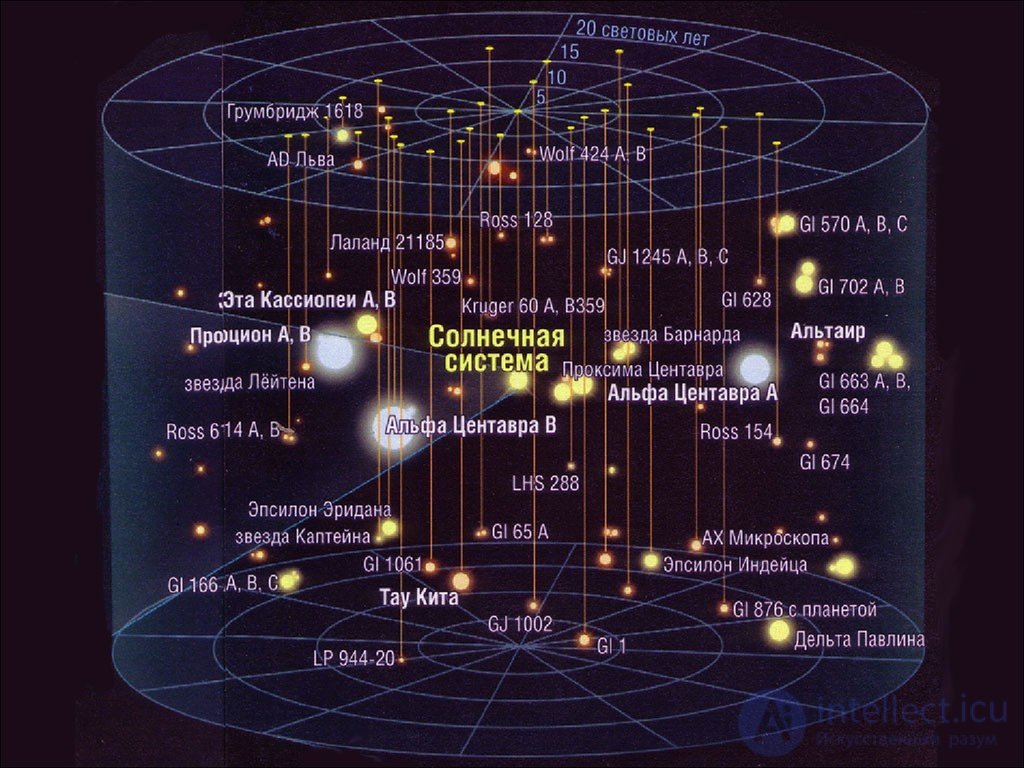
The largest known proper motion belongs to “Barnard's flying star”
µ = 10”.27. Most stars have proper motions equal to hundredths and
thousandths of an arcsecond per year.
Over long intervals of time, equal to tens of thousands of years, the patterns of the constellations change greatly.
The proper motion of a star occurs along an arc of a great circle at a constant
speed. The right ascension changes by an amount µα, called the proper motion in right ascension, and the declination - by an amount µδ,
called the proper motion in declination.
The proper motion of a star is calculated by the formula:
µ = √(µα
2
+ µδ
2
).
If the proper motion of a star per year and its distance r in parsecs are known, it is easy to calculate the projection of the star's spatial velocity onto the
tangential plane. This projection is called the tangential velocity Vt and
is calculated by the formula:
Vt
= µ”r/206265” pc/year = 4.74 µ r km/s.
To find the spatial velocity V of a star, one must know its radial velocity Vr
, which is determined from the Doppler shift of lines in the
star's spectrum. Since Vt and Vr
are mutually perpendicular, the spatial velocity of the star equals:
V = √(Vt
2 + Vr
2
).
The fastest stars are the RR Lyrae-type variables. Their average
velocity relative to the Sun equals 130 km/s. However, these stars move
against the rotation of the Galaxy, so their velocity turns out to be small (250 -130
= 120 km/s). Very fast stars, with velocities of around 350 km/s relative to
the center of the Galaxy, are not observed, because a velocity of 320 km/s is sufficient
to leave the gravitational field of the Galaxy or to move in a highly elongated orbit.
Knowledge of the proper motions and radial velocities of stars allows one to judge the
motions of stars relative to the Sun, which itself also moves through space.
Therefore the observed motions of stars are made up of two parts, of which one is a consequence of the Sun's motion, and the other is the individual
motion of the star.
In order to judge the motions of stars, one must find the velocity of the Sun's motion and
exclude it from the observed velocities of the stars' motion.
The point on the celestial sphere toward which the Sun's velocity vector is directed is called the solar apex, and the opposite point - the antapex.
The apex of the Solar System is located in the constellation Hercules, and has coordinates:
α = 2700
, δ = +300
. In this direction the Sun moves at a speed of about 20
km/s, relative to stars located no farther than 100 pc from it. During the year
the Sun travels 630,000,000 km, or 4.2 AU.
If some group of stars moves with the same velocity, then, being on
one of these stars, one cannot detect the overall motion. It is different,
if the velocity changes as though the group of stars were moving around a common
center. Then the velocity of stars closer to the center will be smaller than that of stars farther from the center. The observed radial velocities of distant stars demonstrate such motion. All stars, together with the Sun, move perpendicular
to the direction toward the center of the Galaxy. This motion is a consequence of the general
rotation of the Galaxy, the speed of which changes with distance from its center
(differential rotation).
The rotation of the Galaxy has the following features:
1. It occurs clockwise, when viewed at the Galaxy from the direction of its
north pole, located in the constellation Coma Berenices.
2. The angular velocity of rotation decreases with increasing distance from the center.
3. The linear velocity of rotation at first increases with increasing distance from the center.
Then, at approximately the distance of the Sun, it reaches its greatest value of about
250 km/s, after which it slowly decreases.
4. The Sun and the stars in its vicinity complete a full revolution around the center
of the Galaxy in approximately 230 million years. This interval of time is called the galactic year.
Stars located near the Sun are distinguished by high brightness and belong to Population I. They are usually found in the outer regions of the Galaxy. Stars located far from the Sun, near the center of the Galaxy and in the corona, belong to Population II. The division of stars into populations was carried out by Baade while studying the Andromeda Nebula. The brightest
stars of Population I are blue and have absolute magnitudes up to -9m
, while the brightest
stars of Population II are red with an absolute magnitude of -3m
. In addition, Population
I is characterized by an abundance of interstellar gas and dust, which are absent in
Population II.
A detailed division of stars in the Galaxy into populations includes 6 types:
1. Extreme Population I - includes objects contained in the spiral arms.
This includes interstellar gas and dust concentrated in the spiral
arms, from which stars form. The stars of this population are very young.
Their age is 20 - 50 million years. The region where these stars exist is limited to a thin galactic layer: a ring with an inner radius of 5000 pc,
an outer radius of 15,000 pc, and a thickness of about 500 pc.
These stars include stars of spectral classes O through B2, supergiants of late spectral classes, Wolf-Rayet type stars, emission-line
stars of class B, stellar associations, and T Tauri type variables.
2. Stars of ordinary Population I are somewhat older, their age being 2-3 cosmic
years. They have moved away from the spiral arms and are often found close to the central plane of the Galaxy.
These include stars of subclasses B3 through B8 and normal class A stars,
open clusters with stars of the same classes, stars of classes A through F with strong metal lines, and less bright red supergiants.
3. Disk population stars. Their age is from 1 to 5 billion years, i.e., 5-25 cosmic
years. The Sun belongs to these stars. This population includes a multitude of inconspicuous stars located within 1000 pc of the central plane in the galactic belt with an inner radius of 5000 pc and an outer radius of 15,000 pc. These stars include ordinary giants of classes G through K,
main-sequence stars of classes G through K, long-period
variables with periods over 250 days, semiregular variable stars,
planetary nebulae, novae, and old open clusters.
4. Stars of intermediate Population II include objects located at distances over 1000 pc on both sides of the central plane of the Galaxy.
These stars move in elongated orbits. They include most
old stars, aged from 50 to 80 cosmic years, high-velocity stars, with weak lines, long-period variables with periods from
50 to 250 days, W Virginis type Cepheids, RR Lyrae type variables, white dwarfs, and globular clusters.
5. Population of the galactic corona. This includes objects that arose in the early
stages of the Galaxy's evolution, when it was less flattened than it is now. These objects include subdwarfs, globular clusters of the corona, stars
of the RR Lyrae type, stars with extremely weak lines, and stars with the highest
velocities.
6. Nuclear population stars include the least known objects. In the spectra
of these stars, observed in other galaxies, sodium lines are strong, and cyanogen
bands (CN) are intense. These may be class M dwarfs. Such objects include RR Lyrae type stars, metal-rich globular clusters, planetary nebulae, class M dwarfs, giant stars of classes G and M with strong
cyanogen bands, and infrared objects.
The most important structural elements of the Galaxy are the central bulge, spiral arms, and disk. The Galaxy's central bulge is hidden from us by dark, opaque matter. Its southern half is best seen as a bright
star cloud in the constellation Sagittarius. The second half can be observed in infrared light. These halves are separated by a powerful band of dust matter, which is opaque even to infrared rays. The linear dimensions
of the central bulge are 3 by 5 kiloparsecs.
The region of the Galaxy at a distance of 4-8 kpc from the center is distinguished by a number of features. It contains the greatest concentration of pulsars and gaseous remnants
from supernova explosions, intense nonthermal radio emission, and more frequent
occurrences of young, hot O and B stars. Molecular hydrogen clouds exist in this region. The concentration of cosmic rays is elevated
in the diffuse matter of this region.
At a distance of 3-4 kpc from the center of the Galaxy, radio astronomy methods have detected an arm of neutral hydrogen with a mass of about 100,000,000 solar masses,
expanding at a speed of about 50 km/s. On the other side of the center, at
a distance of about 2 kpc there is an arm with a mass 10 times smaller, receding
from the center at a speed of 135 km/s.
In the central region there are several gas clouds with masses of 10,000 - 100
000 solar masses, receding at a speed of 100 - 170 km/s.
The central region with a radius less than 1 kpc is occupied by a ring of neutral
gas, which rotates at a speed of 200 km/s around the center. Inside it there is an extensive H II region in the shape of a disk with a diameter of about 300 pc. In the
central region nonthermal radiation is observed, which indicates an increase in
the concentration of cosmic rays and the strength of magnetic fields.
The combination of phenomena observed in the central regions of the Galaxy suggests the possibility that more than 10,000,000 years ago, from the center of the Galaxy,
there was an outburst of gas clouds with a total mass of about 10,000,000 solar
masses and at a speed of about 600 km/s.
In the constellation Sagittarius, near the center of the Galaxy, there are several powerful
sources of radio and infrared radiation. One of them - Sagittarius A - is located at the very center of the Galaxy. It is surrounded by a ring-shaped molecular
cloud with a radius of 200 pc, expanding at a speed of 140 km/s. In the central regions an active process of star formation is underway.
At the center of our Galaxy there is most likely a nucleus resembling a globular
star cluster. Infrared receivers have detected an elliptical
object there with dimensions of 10 pc. Inside it there may be a dense star cluster with a diameter of 1 pc. It could also be an object of unknown relativistic
nature.
The nature of the Galaxy's spiral structure is associated with spiral density
waves propagating in the stellar disk. These waves are similar to sound waves, but due to rotation they take on a spiral shape. The medium in which
these waves propagate consists not only of gas-dust interstellar
matter, but also of the stars themselves. Stars also form a peculiar gas, distinguished from ordinary gas in that collisions never occur between its particles.
A spiral density wave, like an ordinary longitudinal wave, represents
an alternation of successive compressions and rarefactions of the medium. Unlike the gas and stars, the spiral wave pattern rotates in the same direction as
the whole Galaxy, but noticeably more slowly and with a constant angular velocity, like
a solid body.
Therefore matter constantly catches up with the spiral arms from the inner side
and passes through them. However for stars and gas this passage through the spiral
arms occurs differently. Stars, like gas, become compressed in the spiral wave, their concentration increases by 10 - 20%. The gravitational potential increases
correspondingly. But since collisions do not occur between stars,
they retain their angular momentum, slightly change their path within the spiral arm, and leave it in practically the same direction in which
they entered.
Gas behaves differently. Because of collisions, upon entering the arm it loses angular momentum, decelerates, and begins to accumulate at the inner boundary
of the arm. Incoming new portions of gas lead to the formation at this boundary of a shock wave with a large density jump. As a result, at the spiral
arms edges of gas compaction form and thermal instability arises. The gas quickly becomes opaque, cools, and passes into a dense
phase, forming gas-dust complexes favorable for star formation. Young and hot stars excite the glow of the gas, causing bright nebulae to appear, which together with the hot stars outline the spiral structure, repeating the spiral density wave in the stellar
disk.
The spiral structure of our Galaxy has been studied by means of studying other spiral galaxies. Studies have shown that the spiral arms
of neighboring galaxies consist of hot giants, supergiants, dust, and gas. If these objects were removed, the spiral arms would disappear. Red and yellow stars
fill the regions in and between the arms uniformly.
To clarify the spiral structure of our Galaxy one needs to observe
hot giants, dust, and gas. This is quite difficult to do, because the Sun is located in the plane of the Galaxy and various spiral arms are projected onto one another. Modern methods do not allow precise determination of distances to distant giants, which hinders the creation of a spatial picture. In addition, large masses of dust of nonuniform
structure and varying density lie in the plane of the Galaxy, which further complicates the study of distant objects.
Great hopes are offered by the study of hydrogen at the 21 cm wavelength. With its
help one can measure the density of neutral hydrogen in various locations of the Galaxy. This work was carried out by the Dutch astronomers Hulst,
by Müller, Oort and others. The result was a picture of the distribution of hydrogen, outlining the contours of the spiral structure of the Galaxy. Hydrogen is present in large quantities near young hot stars, which define the structure of the spiral arms. The radiation of neutral hydrogen
is long-wavelength, lies in the radio range, and interstellar dust matter
is transparent to it. The 21-centimeter radiation reaches us from the most distant regions of the Galaxy without distortion.
The Galaxy is continuously changing. These changes proceed slowly and gradually. Researchers find them difficult to detect, because human
life is very short compared to the life of stars and galaxies. When addressing
cosmic evolution, one must choose a very long unit of time. Such a unit is the cosmic year, i.e. the time for one complete revolution of the Sun
around the center of the Galaxy. It equals 250 million Earth years. The stars of the Galaxy are constantly intermixing, and in one cosmic year, moving even at a small relative speed of 1 km/s, two stars will move apart by 250 pc.
During this time, some star groups may disintegrate, others may form anew. The appearance of the Galaxy will change significantly. In addition to mechanical changes, the physical state of the Galaxy changes over a cosmic year. Stars of classes O and B can shine brightly only for a period equal to some fraction of a
cosmic year. The age of the brightest observed giants is about 10 million
years. However, despite this, the configuration of the spiral arms can remain fairly stable. Some stars will leave these regions, others
will arrive to take their place, some stars will die, others will be born from the enormous
mass of gas-and-dust complexes of the spiral arms. If the distribution
of the positions and motions of objects in some galaxy does not undergo
large changes, then this stellar system is in a state of dynamic equilibrium. For a certain group of stars, the state of dynamic
equilibrium can be maintained for 100 cosmic years. However, over a
longer period, equal to thousands of cosmic years, the state of dynamic equilibrium will be disturbed due to chance close encounters of stars. It will be
replaced by a dynamically quasi-permanent state of statistical equilibrium, more stable, in which the stars are more thoroughly mixed

Comments