
Lecture
A convenient rule for approximating the distances of the planets from the Sun was proposed by J. Titius in 1766 and described by J. Bode in 1772.
rm = (4 + nm)/10,
where n1 = 0, n2 = 3, nm = 2 nm-1.
The resulting values give approximate distances, expressed in a.u.
Merc. Ven. Earth Mars aster. Jup. Sat. Uranus Neptune Pluto.
n 0 3 6 12 24 48 96 192 - 384
Distance
by the rule 0.4 0.7 1 1.6 2.8 5.2 10.0 19.6 - 38.8
True
distance 0.39 0.72 1 1.52 — 5.2 9.54 19.18 - 39.67
Evolution of the atmospheres of the terrestrial planets:
The different atmospheres of Earth, Mars and Venus are caused by differences in the carbon dioxide (CO2) cycle - the exchange of it between the planet's crust and its atmosphere.
Carbon dioxide is a “greenhouse” gas - it lets sunlight through, but
absorbs the planet's infrared radiation and re-radiates part of this heat
back toward the surface.
The temperate climate that has become established on Earth is linked to the peculiarities of gas exchange on the planet. When the surface cools, the amount of carbon dioxide
in the atmosphere increases, and when the surface temperature rises, its amount decreases.
Mars has lost the ability to return gas to its atmosphere and is in a frozen state.
Venus lacks a mechanism for removing carbon dioxide from the atmosphere, and
a very high temperature has become established there.
According to the most reliable modern theories, Venus once had a lot
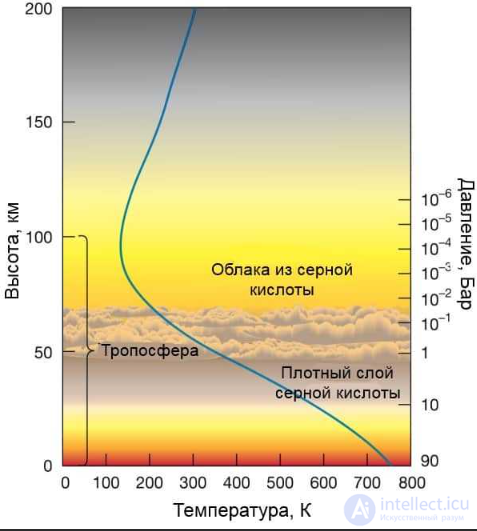
of water, but lost it because of its proximity to the Sun and the high surface temperature. In a hot atmosphere the air cools slowly as it rises. The cold trap is located at an altitude of 100 km (on Earth - 9-17
km). Such a height causes moisture to move up into higher layers
of the atmosphere, where H2O molecules undergo photodissociation and the hydrogen escapes
into space. In less than 30 million years this process is capable of destroying an ocean
of water.
On the surface of Mars the pressure of carbon dioxide is too low to sustain a greenhouse effect. But scientists believe that Mars once had
a large atmosphere, since ancient riverbeds have been found. Over time the planet's interior cooled and became unable to release into the atmosphere large
quantities of carbon dioxide. All the carbon dioxide washed out of the atmosphere
became trapped in the soil. But according to spectroscopic studies from Earth, Martian rocks do not contain large amounts of carbonate rock. Therefore this theory needs to be tested in the future.
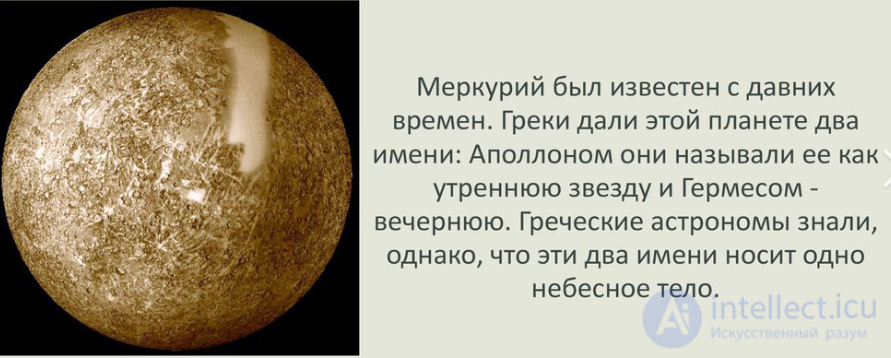
Mercury got its name from the Romans in honor of the swift messenger of the gods, because it moved across the sky faster than any other planet.
Mercury is the innermost planet in our solar system and the second smallest. Only Pluto is smaller than Mercury.
Saturn and Jupiter have moons that are larger than Mercury,
for example, Titan and Ganymede.
Io, Europa and Callisto are close in size to Mercury.
Mercury is the planet closest to the Sun, which is why it is very difficult to observe from Earth - it is always lost in the Sun's bright rays. At most, Mercury
moves away from the Sun by 28
0.
Astronomers used to think that the planet always faced the Sun with one side, and that its period of revolution around the Sun equaled its period of rotation on its axis, and
amounted to 88 days.
However, radio observations of Mercury with the telescope at Arecibo showed that this
is not so. It turned out that the rotation period equals 59 Earth days, i.e. 2/3 of the orbital
period. As a result of this resonance, a solar day on Mercury equals 176
Earth days.
Mercury revolves around the Sun in a highly elongated orbit (eccentricity = 0.21), so at perihelion the Sun's diameter is 1.5 times greater than at
aphelion. The surface of Mercury receives more than twice as much
heat at perihelion as at aphelion. The axis of rotation is perpendicular to the plane of the orbit.
The spacecraft “Mariner 10” flew past at a distance of 756 km from the surface of Mercury, so details as small as 50 - 150 m can be made out in the transmitted images.
The surface of Mercury resembles that of the Moon, but has almost no seas. There are areas of the surface where craters are not observed. There are features
unique to Mercury - scarps, or cliffs, separating two otherwise identical areas of the surface.
The largest crater on Mercury, Beethoven, is 625 km across.
Mercury has less pronounced relief forms than the Moon; its mountains are smaller.
This is evidently caused by the greater force of gravity (2.3 times).
During the long nights the temperature on Mercury drops to -173°C, and during sunlit days
it rises to +430°C. At such temperatures tin, lead and zinc melt.
Daily temperature variations amount to 600°C.
The diameter of Mercury was measured by the radar method and is 4878 km, which
is 1.4 times the diameter of the Moon.
But the mass of Mercury is 4.5 times greater than that of the Moon. This means the planet's density is greater (5.43 g/cm3
)and is approximately equal to Earth's.
Mercury must contain a very large amount of iron (60% of its mass).
Atmosphere: A very rarefied hydrogen-helium atmosphere has been detected.
This fact was discovered on Earth by N.A. Kozyrev, who observed transits of Mercury across the solar disk.
The atmosphere is rarefied due to the low surface gravity and the low
escape velocity (4.2 km/s).
The atmospheric pressure at the surface on the sunlit side is less than a trillionth of Earth's pressure. On the night side, the pressure is an order of magnitude higher.
Magnetic field: “Mariner-10” detected a magnetic field at Mercury, about
100 times weaker than Earth's. Given the planet's average density of 5.43
g/cm3, it can be assumed that Mercury has an iron core whose size is equal to the size of the Moon (diameter - 3600 km). The core is surrounded by a thin layer of
mantle - 640 km.
A strong magnetic field cannot exist on Mercury because of the planet's slow rotation, even if it has a large liquid core.
Ice: - The circumpolar regions of the planet are covered with water ice. The planet's axis
is perpendicular to the orbital plane, so despite the fact that the midday
temperature reaches 500 C, sunlight never penetrates the interior of circumpolar craters. The temperature there does not rise above -160 C. The sources of water vapor may be the interior, comets, and asteroids.
Since Mercury's orbit is inclined to the plane of the ecliptic by 7
, this made it possible
to observe the circumpolar regions of the planet from Earth using radar methods.
The reflected signal was reflected by water ice 2 meters thick. This ice
is very ancient and accumulates at the bottom of craters over millions of years. (Sky &
Telescope, Vol.88, No.4)
Research: - The European Space Agency will study Mercury starting in 2006 for 10 years.
An artificial satellite will be launched and a landing on the surface
of the planet will be carried out. (Nature, Vol.371, No. 6499).
Venus is the third brightest luminary in the sky. In the equatorial regions of Earth
it shines so brightly that objects cast shadows from its light. The ancient Chaldeans on bas-reliefs always depicted three luminaries - the Sun, Venus, and the Moon. Close attention was paid to the study of Venus and its influence on human life.
In Babylon the planet was named after the goddess Ishtar.
Venus is observed either in the evening, after sunset, or in the morning, before sunrise. Ancient astronomers assumed that these were two different planets.
The phases of Venus were first seen by Galileo, who encoded his discovery in an anagram:
Haec immatura a me jam frustra leguntur, o,y
This unfinished and hidden thing has been read by me.
Cynthiae figuras aemulatur mater amorum
The mother of love imitates the shapes of Cynthia.
A Venusian day equals 243 Earth days and is longer than its year, which equals 224.7
days.
Venus rotates from east to west. An observer on the surface of the planet
would see the Sun rise in the west and set in the east.
The sidereal period of revolution of Venus equals 224.7 days, and the synodic period - 440
days.
Venus approaches Earth at its closest distance - 42 million km, but at this
time observations of it are difficult because it is visible as a narrow crescent and
is located very close to the Sun.
In mass and size Venus is very close to Earth.
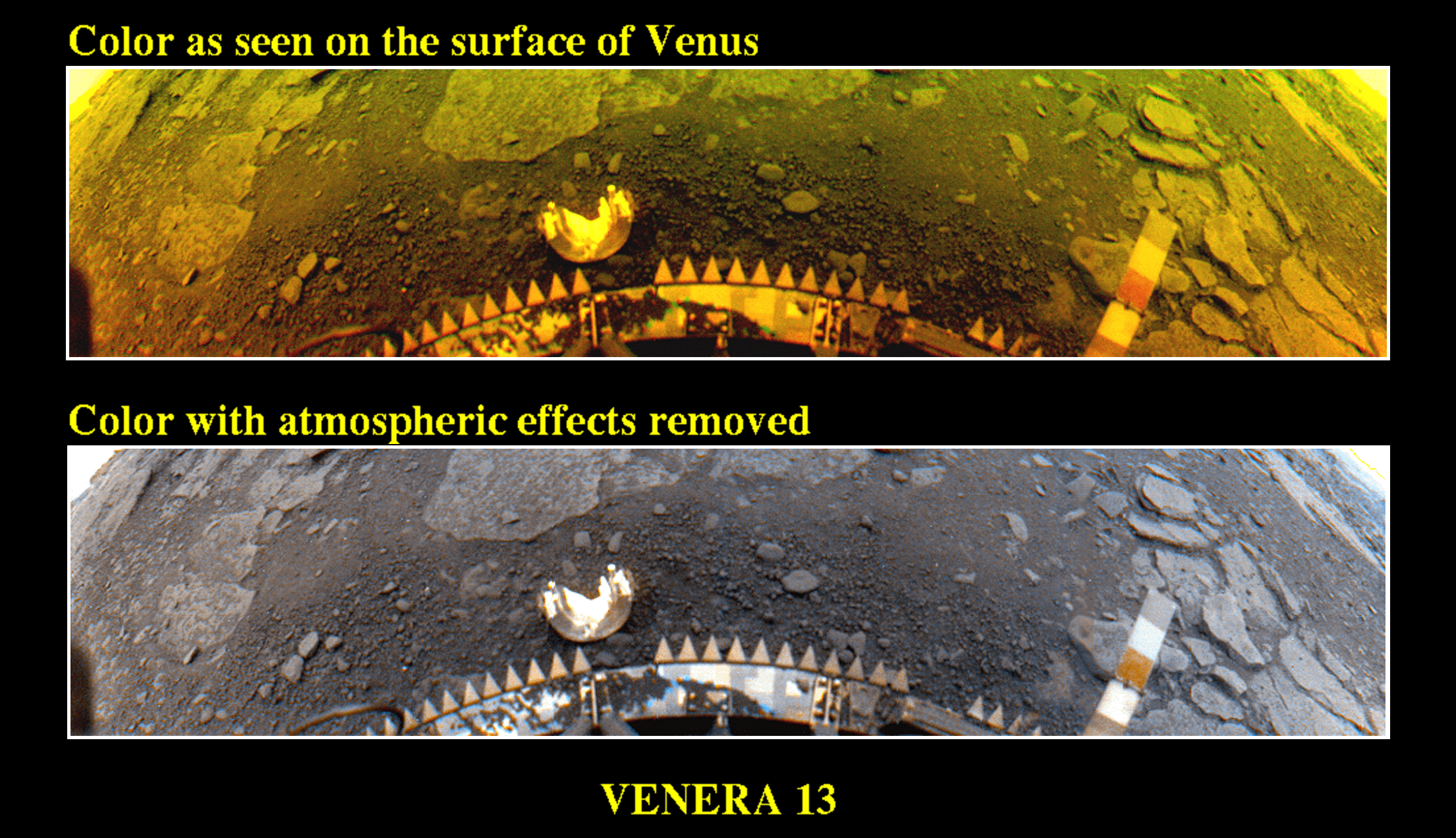
The planet has such a dense atmosphere that surface features can never
be seen through it. Therefore, various hypotheses have long been put forward about what the surface of Venus should be like. Until the mid-20th century
it was suggested that Venus had conditions similar to Earth's during
the Carboniferous period. Pictures were drawn with dinosaurs and pterodactyls, horsetails and club mosses.
It was only possible to observe details of Venus's atmosphere for the first time using
ultraviolet radiation.
The ultraviolet clouds of Venus rotate with a period of 4 days.
Radar observations of Venus showed that it rotates on
its axis in the opposite direction compared to Earth. The tilt of the equator to the orbital plane equals 177
.
Only recently has it become possible to penetrate the veil of Venusian clouds.
This was done by the spacecraft “Pioneer - Venus” (1978), Venera 15 and 16
(1983-1984), and Magellan (1990-1994).
The Venusian surface consists of vast plains covered by lava flows and areas of highlands and mountains.
The surface of Venus is covered with numerous impact craters. Small ones (up to 2 km) are almost absent among them due to the dense atmosphere.
85% of the surface is covered by volcanic rocks.
Lava flows extend for hundreds of kilometers.
Flows from volcanoes have created long winding channels extending for
hundreds of kilometers.
Giant calderas, more than 100 km in diameter, have been found on the surface.
The mountainous regions of Venus are similar in size to Earth's continents, while the lowlands resemble oceans. The lowland parts of the surface occupy 1/6 of the surface.
Venusian volcanoes rise to a height of about 4000 km and significantly
larger than Earth's.
The most elevated parts of Venus are Ishtar Terra with the Maxwell Mountains. These mountains rise 11 km. Ishtar Terra is twice the size of the Tibetan Plateau on Earth and lies at a greater elevation.
The surface temperature of Venus is +467°C. This temperature changes little from day to night and falls off rapidly with altitude.
Elements such as cadmium, lead, tin, and zinc are in a molten
state.
The atmospheric pressure at the surface is 90 atm. This corresponds to the pressure
at the bottom of Earth's ocean at a depth of 900 m.
Spectral observations from Earth and spacecraft have made it possible to determine the composition of Venus's atmosphere.
Carbon dioxide - 96.4%
Nitrogen - 3.4%
Water - from 0.1 to 1%
Hydrogen - 0.03%
In small amounts, sulfur dioxide, oxygen, carbon monoxide, argon,
ammonia, helium, hydrogen sulfide.
It was established that the clouds of Venus consist of droplets of sulfuric acid.
The illumination of Venus's surface is 10% of Earth's illumination.
According to data transmitted by landers, the surface of Venus consists of basalts. No signs of weathering of rocks have been found. Near the surface
the winds are very weak - 0.3 - 1.4 m/s.
At altitudes from 10 to 50 km. the winds increase to 50 - 60 m/s.
Venus's magnetic field is very weak. Its strength is 105
times less than Earth's. Therefore, the bow shock of the solar wind is located at a distance of 1.5 planetary radii, 10 times closer than at Earth. The magnetosphere is almost
entirely absent.
The fact that Venus has no large magnetic field is consistent with its slow
rotation.
History - 300 - 500 million years ago a powerful planet-wide flood spewed
much lava from the vents of many volcanoes and covered the entire surface of the planet.
The planet lacks relief fragments belonging to the first 85%
of its history. (Nature, Vol.372, No. 6508)
13.4 Relief and atmosphere of Mars.
Mars shines with a red light and therefore, by all the peoples who observed it,
was identified with the god of war.
The planet gained great popularity in 1877, during the great opposition. Giovanni Schiaparelli carried out careful observations of Mars
and discovered canals crossing the entire surface of the planet. Initially
the astronomer did not at all assume that they must be artificial. However,
as always happens, the press distorted the scientific facts and raised a fuss.
In 1892 Schiaparelli again observed the surface of Mars and came to
believe that the canals were artificial structures. The American astronomer W.
Pickering even made out “oases” at the places where the canals met.
P. Lowell summarized the discoveries, claiming that the Martians use meltwater from
the polar caps and irrigate the “oases”, where Martian cities are located.
Modern research has shown that there are no canals on Mars, and not even plant life.
Under conditions of low atmospheric pressure, water boils at a temperature of +20
C and cannot exist in liquid form.
The most favorable conditions for observing Mars occur every
2 years and 50 days, when it is at opposition.
The polar caps are best seen on the surface. They are subject to seasonal changes. When winter comes to one of the hemispheres, the corresponding polar cap begins to grow and reaches 57° latitude in the northern hemisphere and 45°
in the southern. With the arrival of spring the caps begin to melt.
The polar caps consist of ordinary ice and frozen carbon dioxide, or
“dry ice”. In autumn, when the polar caps are forming, one can observe
bluish-white clouds in the planet's atmosphere.
Dust storms are often observed on the surface. Clouds of dust can completely
hide the surface of Mars from an observer. The “Mariner 9” flight program
was nearly disrupted by a severe dust storm that arose during the
spacecraft's approach to Mars. Storms are most frequent during the planet's passage
through perihelion, when it is summer in the southern hemisphere. Near the northern polar
cap water and dust accumulate.
The permafrost layer can reach thicknesses of kilometers.
The southern polar cap consists of carbon dioxide, while the northern one is of water
ice and dust.
Water flows beneath the soil layer from the northern regions and evaporates in the “oases”.
Dust enters the atmosphere upon the evaporation of water during the heating by the Martian
summer of the southern equatorial regions. Wind speed reaches 50 - 90 m/s.
Scientists have long argued about the origin of the riverbeds on Mars. Some say that
in the past the planet had a more powerful atmosphere and conditions were favorable for the preservation of water in liquid form. Others suggest that there is a large subsurface layer of water, which is heated by the planet's interior and by radioactive rocks lying in the crust. From time to time, as a
result of catastrophes this layer breaks through and large
streams of water erupt from within.
New confirmations have recently been obtained of the hypothesis that water once flowed on Mars,
real water. Scientists studied a meteorite that fell among the ice of Antarctica about 10 years ago. Studies showed that it is a fragment ejected
from Mars. Its age is more than 4.5 billion years. The meteorite was found to contain a very high content of carbonates – chemical compounds that can form only under conditions in which large flows of
water once ran on Mars.
The red color of Mars's surface is caused by red iron oxides.
Craters predominantly cover the southern hemisphere. This means that, geologically, the northern hemisphere is younger.
Mars has the greatest elevation range in the Solar System, and
it reaches 27 km (on Earth – 19 km).
The largest Martian volcano – Olympus Mons rises 21 (24) km
above the plains (Everest on Earth has a height of 8.8 km above sea level). The base of the mountain has a diameter of about 500 km and rises 6 km.
Associated with the volcanoes and the Tharsis rise are enormous systems of fractures and ridges,
some of which stretch for 4000 km and rise 10 km.
The valley (Valles Marineris) stretches for 4000 km and has a depth of 2 to 7 km.
Hellas Planitia – an impact crater in the southern hemisphere, has a depth of 6 km and a diameter of 2000 km.
The temperature of the Martian surface was found from measurements by “Viking 1”.
The lowest temperature is observed near the south pole, where carbon dioxide can condense = -139°C. In the oases in the region of Lake Phoenix and
Noachis Terra the temperature range is from -53°
to +22°C in summer and from -103 to
-43°C in winter.
Atmosphere: The average atmospheric pressure on Mars is 6 mbar – 0.6% of Earth's.
Gravity equals 0.38 of Earth's. The mass of the atmospheric column above a unit
area is 0.2%.
The atmosphere consists of:
Carbon dioxide – 95%
Nitrogen 2.7%
Argon 1.6%
Oxygen 2%
The water vapor content varies greatly.
The synodic period relative to Earth equals 780 days.
A Martian year equals 687 days.
Mars's equator is inclined to the plane of its orbit at an angle of about 24°
.
Mars's period of rotation about its own axis is 24h 37min.
The distance to Mars varies from 55.7 million to 101.2 million km because of the large
eccentricity of its orbit. Mars comes closest to Earth during great
oppositions, when the opposition coincides with the planet's passage through perihelion. This occurs at intervals of 15 - 17 years.
13.5 The satellites of Mars – Phobos and Deimos.
Mars has two satellites – Phobos and Deimos, which were discovered in 1877
by Asaph Hall during a great opposition of the planet.
The satellites are grayish in color and reflect light similarly to carbonaceous chondrites. The satellites' long axes are always oriented toward Mars.
The origin of the satellites remains a mystery. Some scientists believe they are
captured asteroids, while others believe they are fragments of a single satellite that broke apart in a collision.
The spacecraft “Viking 1” obtained detailed images of the satellites' surfaces in 1977. Planetary specialists processed them so that
the seams between individual photographs and the difference in brightness between individual
fragments would not be visible. As a result, good-quality photographs
of Phobos were obtained.
The most prominent feature of Phobos is the crater Stickney. Its diameter is 10 km,
while the diameter of the satellite itself is 22 km. Long grooves extend from the Stickney crater,
150 - 200 m wide and up to 10 km or more in length.
Several hypotheses have been proposed about the origin of the grooves. One holds that
they are layers of lava from the celestial body from which the fragment – Phobos – broke off.
Another hypothesis suggests that the grooves are evidence of a process, already underway, of the
satellite breaking apart under the action of tidal forces. Eventually tidal forces may cause Phobos to disintegrate and turn into a ring
of asteroids.
The association of the grooves with the Stickney crater may also indicate a meteoritic origin.
13.6 The problem of the search for life in the Solar System.
* The main goal of the “Viking” missions to Mars was to search for life on that
planet.
Three complex biological experiments were carried out: pyrolytic release, gas exchange, and labeled release.
1. Pyrolytic release.
The experiment was designed to detect a photosynthesis process involving carbon contained in the atmosphere. Soil samples were kept for 5 days in an environment identical to that on the planet's surface, but carbon monoxide and dioxide, labeled with the radioactive
isotope carbon-14, were added to the atmospheric gas. The samples were illuminated with a xenon lamp simulating
sunlight; ultraviolet radiation was absorbed by a filter, in order to
exclude non-biological effects. The soil was then heated to 625°C. At
this temperature, any organic substances, if they had formed, would decompose, and the resulting vapors would be radioactive.
2. Gas exchange.
This experiment is based on the assumption that Martian life should
use water as a solvent. A soil sample was placed in a porous vessel located in an incubation chamber filled with an atmosphere
of carbon dioxide, krypton and helium at Martian atmospheric pressure.
During the first seven days the vessel was kept in this chamber above a mixture
of organic nutrients dissolved in water, after which the chemical composition of the gas above the soil was determined using a gas chromatograph.
The content of hydrogen, nitrogen, oxygen, methane, carbon
dioxide and krypton, taken as a reference, was monitored. If microorganisms were present in the
soil, the gas composition of the atmosphere in the chamber should have changed. In the absence of signs of biological activity, the liquid level could rise to
the bottom of the porous vessel.
3. Label decomposition.
The experiment is based on the assumption that water is necessary for the existence of
Martian life. It was assumed that microorganisms should assimilate
organic molecules and ions from a nutrient solution (“broth”) and
release, as a result of this cycle, a gas containing carbon from the nutrient solu-
tion. This solution, labeled with the radioactive isotope carbon-14, was used to moisten a soil sample placed in a closed dark chamber with a Martian
“atmosphere”. The level of radioactivity in the chamber was then measured to determine whether any carbon compounds had been released as a result of the life activity of Martian organisms.
All three experiments gave a positive result. But the researchers decided that
they were non-biological in nature.
Chromatographic analysis found no trace of organic compounds - products of the life activity of microorganisms in the Martian
soil. The same instrument, when testing Antarctic soil, found a significant amount of fossil organic compounds.
* On August 7, 1996, a report was received that traces of primitive life had been found in a meteorite that arrived from Mars.
A group of NASA scientists found probable evidence that
primitive life could have existed on Mars about 3.6 billion years
ago.
Scientists discovered organic molecules, some mineral features of biological activity, and possibly microscopic bacteria-like organisms inside an ancient Martian rock that fell to Earth as a meteorite.
This may be indirect evidence of past life on Mars.
The two-year study was led by JSC
planetary scientists Dr. David McKay, Dr. Everett Gibson and Dr. Kathie Thomas-Keprta
of Lockheed-Martin, in collaboration with a Stanford team led by
professor of chemistry Dr. Richard Zare.
"There is no solid proof of past life on Mars. What we have obtained -
is a combination of a large number of facts that we found," says
McKay. "They include the discovery by Stanford scientists of a unique
sample of an organic molecule, whose carbon composition is the basis of life. We also found several unusual mineral samples that are products of the life activity of primitive microscopic organisms on Earth. “
"It is very difficult to prove that life existed 3.6 billion years ago on
Earth, and it is even harder to do so for Mars," says Zare.
"The existing standard of proof that we applied includes
having a precisely dated sample containing microfossils, mineralogical characteristics of life, and evidence of complex organic chemistry."
"Over the course of two years, we applied modern technology to carry out these studies, and we believe that we have found quite reasonable
evidence of past life on Mars," adds Gibson.
"We are not claiming that we have finally proven this. We are giving this evidence to the scientific community, for other researchers to verify its truth. Then, within a year or two, we hope to resolve the question
definitively.”
The rock, contained in a 4.2-pound, potato-shaped meteorite, was dated at approximately 4.5 billion years old, when Mars had only
just formed. Between 3.6 billion and 4 billion years ago the planet
was warmer and wetter.
Since water was linked to the carbon of the Martian atmosphere, carbonate minerals were deposited in cracks in the surface, through which
water flowed from the depths of Mars.
The researchers' finding indicates that living organisms may also help in the formation of carbonates on Earth as well.
About 16 million years ago, a huge comet or asteroid struck
Mars and ejected rocks from the surface layer into outer space.
Over millions of years the rocks traveled through interplanetary space and collided with Earth's atmosphere 13,000 years ago, falling into Antarctica as meteorites.
The meteorite, named ALH84001, was found in 1984 in Antarctica during an annual
expedition searching for meteorites. The possible Martian origin of the meteorite was not
accepted until 1993. This is one of 12 meteorites identified as matching the
unique Martian chemistry measured by the Viking spacecraft, which landed on Mars in
1976. ALH84001 is the oldest of the 12 Martian meteorites, three times older
than any other. Many of the research group's discoveries became possible only because
of the application of the latest technological advances. They used a high-resolution electron
microscope and a laser mass spectrometer. Just a few years ago, many of
the features now reported would have been indistinguishable. Past studies of this meteorite
yielded no results. The recent discovery of an extremely tiny bacterium on Earth,
called nanobacteria, prompted the research group to carry out this work with even
greater care than before. Life on Mars: For and Against. A piece of
rock that formed on Mars 4.5 billion years ago was thrown into
space by an asteroid impact, wandered there for 16 million years, was
captured by Earth's gravitational field, and fell onto the ice of Antarctica.
It lay there for 10-20 thousand years. It was found in 1984.
For
1. Tiny dots, the size of a period in this font, have been found dotting the walls of cracks in the Martian rock. These are carbonate rosettes. The center of the rosette consists of manganese compounds, surrounded by a layer of iron carbonate, and then by a ring of iron sulfide. Some terrestrial bacteria living in ponds are capable of leaving such traces while processing iron and manganese compounds present in the water
2. Polycyclic aromatic hydrocarbons have been found in the meteorite, compounds that often occur in organisms or in the products of their decomposition. Chemist R. Zare insists that these are the remains of decomposed living organic matter.
3. Under a powerful electron microscope, the tiniest droplet-shaped crystals of magnetite and iron sulfide have been found. Some terrestrial bacteria produce crystals of the same kind.
4. In the carbonate part of the meteorite, elongated and egg-shaped structures a few dozen nanometers long have been found under an electron microscope. These could be fossilized remains of Martian ultra-microscopic organisms.
Against
Biologist K. Nealson says that such deposits can arise through purely chemical processes. Chemist B. Simoneit of the University of Oregon points out that at high temperature such compounds can form spontaneously from water and carbon. In some meteorites arriving from the asteroid belt, even amino acids and hundreds of other complex organic compounds have been found. Geologist E. Shock says that crystals of this shape can arise as a result of other processes.
Their volume is a thousand times smaller than that of the smallest terrestrial bacteria, which is the lowest size limit for a structure that could be considered alive. These could be ultra-small mineral crystals, with their unusual shape being precisely a consequence of their ultra-small scale. B. Jakosky and K. Hutchins of the University of Colorado determined from isotopic composition that these carbonates formed at temperatures up to 250°C, which is too much for anything living. Terrestrial microbes live at 150°C.
According to new images obtained from the Galileo spacecraft, crater-free areas of
Europa's surface suggest a younger, thinner ice surface than previously thought. The
images were obtained during the closest flyby of Europa on February 20,
1997, when the spacecraft was within 363 miles of the Jovian moon.
These features make it possible to suppose that an ocean lies beneath
the thin ice. Dr. Ronald Greeley (Arizona University) reported that the
ice is mobile, meaning that Europa has had, and may still
have, a very thin icy crust covering liquid water or slush.
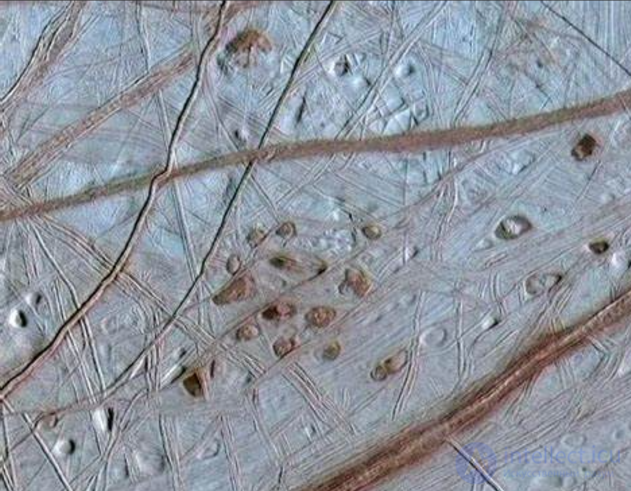
"We are intrigued by these blocks of ice, similar to those
observed on the polar seas of Earth during spring thaws," says
Dr. Greeley. "The size and geometry of these features lead us
to suppose that on Europa there is a thin icy layer
covering water or melted ice. Something caused this layer to break
apart." "These blocks appear to be moving and can be compared
to terrestrial icebergs," reported Dr. Michael Carr, a geologist from the
USA. The causes driving the ice blocks into motion remain
a mystery. The new images of Europa's surface have also
sparked a lively debate among scientists. Dr. Clark Chapman is
among those who believe that the smoother areas with fewer
craters indicate that Europa's surface is even younger than previously
thought. The extraordinary surface geology of Europa points to extremely
a young and very lively world in a changing, flowing stream. "
Scientists want to find evidence of current activity on Europa, perhaps
a geyser eruption. They also want to know whether Europa's surface has changed since
the time of the Voyager flybys, as well as since the start of the Galileo mission.
From NASA press releases, April 9, 1997

Comments