
Lecture
Artificial Earth satellites obey the same laws as natural ones, but their orbits have some peculiarities.
Satellites are placed into orbit using multistage rockets. The last rocket stage gives the satellite a certain velocity at a given height h
above the Earth's surface. The body will become a satellite if its velocity is sufficient.
If the launch velocity exactly equals the circular velocity at that height h, then
the body will move in a circular orbit. If the velocity exceeds the circular one,
the body will move in an ellipse, with the perigee of the ellipse being at the point
of orbital insertion.
The mass of the satellite is very small compared to the mass of the Earth.
Circular velocity of a satellite at a distance r = R + h:
vc = √(fm/(R+h)) = √(gR2/(R+h)),
where m is the mass of the Earth, R is its radius.
For an imaginary satellite moving in a circle right at the surface of
the Earth (h = 0), at R = 6.378.108 cm the velocity should be equal to
v1k = 7.91 km/s.
This is the first cosmic velocity relative to Earth.
Due to the presence of Earth's atmosphere, a satellite moving right at the surface
cannot really exist. Therefore satellites are launched at some height h>150 km.
The circular velocity at height h is less than the first cosmic velocity and is determined by the
formula:
vc = v1k √(R/(R+h)).
The elements of a satellite's orbit depend on the place and time of its launch, and on the magnitude and
direction of the initial velocity.
The relationship between the semi-major axis of the satellite's orbit a and its initial velocity
is determined by the formula:
vo
2 = Gm(2/r0 - 1/a),
where r0 is the distance from the point of the satellite's orbital insertion to the center of the Earth.
Usually a satellite is launched perpendicular to the radial direction.
Elliptical orbit of a satellite.
Eccentricity for a horizontal
launch: e = 1 - q/a.
where q is the distance to perigee
(the closest point of the orbit to the center of the Earth).
The distance to apogee Q = a(1 + e) = R + hA.
hA is the height of apogee above the Earth's surface.
The satellite's orbital period is calculated using
Kepler's third law:
T = 2πa
3/2/Ρ√g.
at R = 6370 km and g = 981 cm/s
2
- T = 1.659.
10-4
a
3/2 (min)
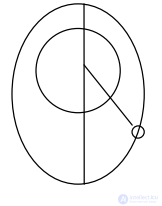
The dependence of the shape of a satellite's orbit on the initial velocity with which it is launched
into orbit is shown in the figure.
If at point K the satellite is given a
horizontal velocity equal to the
circular velocity for that distance from the
center of the Earth, it will move
in a circular orbit (1). If the initial
velocity at point K is less than circular,
the satellite will move in an ellipse (2),
and at a very low velocity in an ellipse (3),
highly elongated and intersecting
the Earth's surface. The launched satellite
will fall to the Earth's surface without completing
even one revolution. If the velocity at point
K is greater than the corresponding circular velocity,
but less than the parabolic velocity, the satellite will move in an ellipse (4).
The main causes changing a satellite's elliptical orbit are the Earth's equatorial bulge and the influence of atmospheric drag.
The second cause causes a change in the satellite's altitude and a change in the shape of the orbit. The main drag and decrease in the satellite's speed occurs
near perigee. The height of the satellite's apogee noticeably decreases with each revolution. The semi-major axis decreases and the orbit becomes rounder. When the apogee height
becomes comparable to the perigee height, the satellite experiences braking,
loses its speed along the entire orbit. The satellite approaches the
Earth's surface in a spiral, enters the dense layers of the atmosphere, and burns up.
The trajectory of a spacecraft consists of two main sections - active and passive. Motion in the active section is determined by the thrust of the jet engines and the Earth's gravitational pull. The passive section begins from the moment the last stage's engine is switched off. In the passive section the spacecraft moves under the action of the gravity of the Earth and other bodies of the Solar
System.
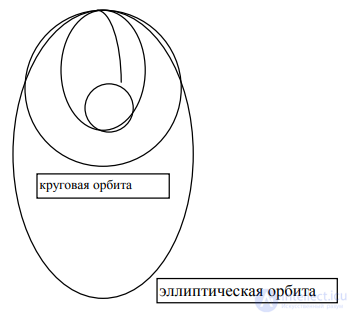
In order for a spacecraft to overcome Earth's gravity and go out into
outer space, it is necessary at the beginning of the passive section to give
it a velocity equal to or greater than
v = vc√2 =√(2Gm/(R+h)) ,
where h is the height of the initial point of the passive section.
At the Earth's surface h = 0 and v2k = v1k √2 = 11.2 km/s.
circular orbit
elliptical orbit
This is the second cosmic velocity relative to Earth.
The velocity of a spacecraft at any point on the passive section (without taking
perturbations into account) is determined by the formula:
v
2
= Gm(2/r - 1/a).
In order for a spacecraft, having overcome Earth's gravity and entered
the Sun's sphere of influence, not to fall onto its surface, it must have at this
moment a velocity relative to the Sun that is different from zero.
The velocity at which a spacecraft launched from Earth can escape
beyond the boundaries of the Solar System depends strongly on the direction in which the craft leaves Earth's sphere of influence relative to the direction of Earth's orbital motion, and lies within 16.6 km/s. The minimum speed v3k = 16.6 km/s is called the third cosmic velocity relative to Earth.
1. Interstellar flights have a number of substantial features that set them sharply apart from flights within the Solar System.
Interstellar flights are only possible at a speed comparable to the speed of
light. According to Einstein's theory of relativity, time flowing aboard the ship passes at a different rate than for people who remain on Earth.
This gives astronauts the possibility of covering enormous distances, equal to hundreds and thousands of light years, and surviving.
Suppose a spacecraft moves with constant acceleration a, and at the midpoint
of its journey to the destination begins to decelerate with the same acceleration.
The American astronomer Carl Sagan gives formulas for the flight time t,
by the astronauts' own clocks:
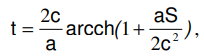 , where S is the length of the journey.
According to the calculations, at a = g the starship will reach the nearest stars in a few
years, the core of the Galaxy, 30,000 light years away, in 21 years, and the Andromeda
Nebula in 28 years.
By the time the ship completes its round trip, on Earth a time will have passed equal to twice the distance to the destination, expressed in light years.
To the Andromeda Nebula and back the astronauts will travel, by Earth clocks, 3 million years. To the cluster of galaxies in Coma Berenices, several hundred
million years.
For intergalactic flights
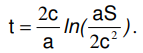
At S = 2·10^26 cm (the distance to the cluster in Com Ber) t = 38 years.
Flight at near-light speed is fraught with enormous difficulties.
Accelerating and decelerating the rocket requires huge amounts of energy. The difficulties that arise here are hardly surmountable.
Even with a ratio, acceptable to us, of the rocket's initial mass M0 to the mass
remaining after the fuel has burned, M1, the rocket's speed after the fuel
has burned, V, will amount to only a small fraction of the speed of light. This holds true even when using nuclear reactions as the energy source.
From the formula of rocket propulsion theory it follows that:
V/W = ln (M1/M0),
where W is the exhaust velocity of the rocket's working substance.
The maximum possible value of W for a uranium reaction is about 13,000
km/s.
This means that for the rocket's speed after fuel burnout V to be of the order of the speed of light, M0 would need to be hundreds of times greater than M1, which is unacceptable. So only a photon rocket, for which W = c, could provide interstellar flight at a speed close to c.
But this raises new difficulties.
From the theory of rocket propulsion it follows that the rocket's acceleration b is given by:
b = 2P/W,
where P is the ratio of the rocket engines' power to the rocket's total mass.
In the case of a photon rocket
b = P/c.
If we want b = g, we would need P = 3 million W/g. This is an extremely large
value.
With an engine power of 15 million W (as in a modern nuclear submarine
), the ship's mass would have to be 5 grams.
At today's level of technology, photon rockets cannot be built.
However, in the 19th century people planned to fly to the Moon using a steam engine. Perhaps the 21st century will open up new possibilities.
Jet engines are unsuitable for interstellar flight.
Bussard proposed that it might be possible to use the interstellar
medium as thermonuclear fuel. The starship would not need to carry its own fuel supply.
Interstellar gas consists of hydrogen atoms. The rocket would need a thermonuclear device that fuses deuterium nuclei out of hydrogen nuclei.
A special feature of such a craft is that the intake surface for interstellar gas would need to be very large. If the rocket's mass is
100 tons, the intake surface for the interstellar gas would need to be about 700 km.
A very great difficulty is the possibility of the craft
colliding, at light speed, with atoms and dust grains of the interstellar medium.
At a concentration of 1 atom per cm3, the flux of energy in the form of cosmic rays
through the rocket's forward surface would be 2·10^11 erg/cm2.
Shielding devices are hardly conceivable.
There is a proposed design for ionizing the oncoming atoms with some kind of device
and deflecting them aside with a strong magnetic field.
2. Have extraterrestrials visited Earth in the past?
Analyzing many ancient legends and myths, one might suppose that yes.
M. M. Agrest believes they may have left a monument to themselves on the far side of the Moon, so that humanity would notice it only once it had reached a high
level of development.
C. Sagan believes that about 10^6 technically advanced civilizations exist in the Galaxy at any given time. The lifetime of such a civilization can
reach 10^7 years. If each civilization sends out one ship every year
for the exploration of space, then the average interval between visits to any given star would be 105 years.
The average interval between visits to a planet with intelligent life would be
shorter and would amount to several thousand years. This means that such visits
could have occurred on Earth.
3. It is not necessarily the astronauts themselves who must fly, and not necessarily far.
At a distance of up to the nearest extraterrestrial civilizations, about 10 light years, suitable stars for life are Epsilon Eridani, Tau Ceti, and Epsilon Indi.
If we take a distance of about 100 light years, there would be several thousand such stars.
To explore the nearest planetary systems, automatic probes can be sent. The technique of placing a probe into a circular orbit around a star has already been developed.
A highly organized civilization could send artificial satellites
to many of the nearest stars. The speed of travel could reach 100 - 200
,000 km/s. This speed is great, but not comparable to the speed of light, and therefore there would be no relativistic effects.
It would take several centuries for artificial satellites to be orbiting all the stars within 100 light
years.
The goal of astrophysics is the study of the physical nature and evolution of individual cosmic objects, including the Universe as a whole.
Over the last few decades it has become a leading branch of astronomy.
The discovery of spectral analysis and the invention of photography in the 19th century, and the emergence of photoelectricity, radio astronomy, and extra-atmospheric research methods in the 20th century, led to the flourishing of astrophysics. Astronomy became all-wave,
i.e. observations are conducted across the entire range of electromagnetic waves.
Alongside the development of practical astrophysics, theoretical astrophysics also developed,
thanks to the creation of the theory of radiation and atomic structure.
Theoretical astrophysics consists of branches studying the physics of stars,
the Sun, planets, nebulae, cosmic rays, and cosmology.
Practical astrophysics includes astrophotometry, astrospectroscopy,
astrophotography, and calorimetry.
The newest branches of astrophysics are radio astronomy, balloon astronomy, X-ray astronomy,
extra-atmospheric astronomy, and gamma-ray and neutrino astronomy.

Comments