
Lecture
The physical phenomenon of a luminous band of stars visible in the sky is called the band
of the Milky Way, or simply the Milky Way. The Milky Way in Belarus is best seen
in summer, especially in July and August. It looks like a bright, glowing band crossing the entire
sky, brighter in some places and fainter in others. Along the Milky Way, bright star clouds and
dark rifts are observed. The Milky Way forms an almost complete circle in the sky. It is
called the galactic circle, or the galactic equator. Points located 90 degrees from the galactic equator on
either side of it are called the north and south galactic poles. The position of an object
can be determined by galactic latitude and longitude. By international agreement, the starting point, or zero of
galactic longitude, is taken to be the point on the galactic equator corresponding to the direction toward
the center of the Galaxy. The galactic equator is inclined to the celestial equator by about 62
degrees. Visual and photographic star counts show that the faintest stars are more strongly concentrated toward the
band of the Milky Way. Since faint stars are more distant, such observations prove that the Milky
Way is a flattened system of stars. William Herschel wrote about this back in the 18th century.
It has great depth. Some stars are located at distances of hundreds, others at distances of thousands
of parsecs from the Sun. Since the Milky Way appears to us as a ribbon girdling the
sky and dividing it into two almost equal parts, this means the Sun must be located near
the central plane of the system. The system of the Milky Way contains approximately 100 billion stars,
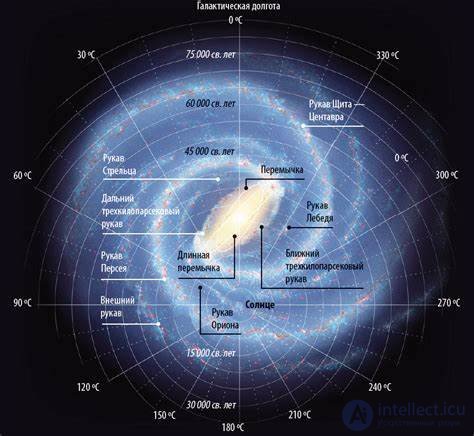
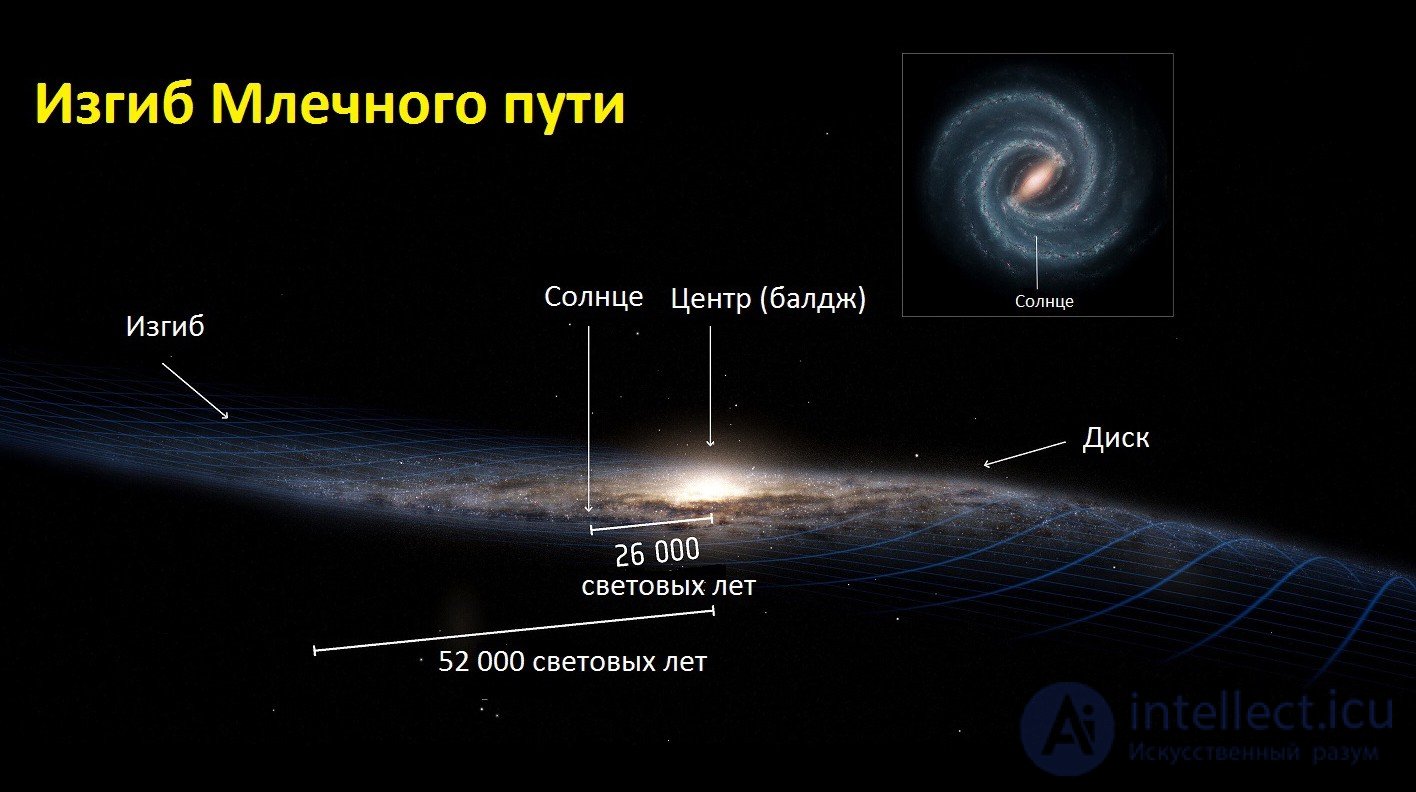
gas, and dust. Study of the Milky Way has shown that the Sun does not lie
at the center of the Galaxy, but somewhere closer to the edge, farther than the midpoint
of the distance between the edge and the center. The center of the Galaxy lies in
the direction of the constellation Sagittarius, where the Milky Way has its greatest width and brightest
star clouds. The fact that the center lies precisely in the direction of Sagittarius is also
proven by the distribution of globular star clusters, novae, and planetary nebulae. This is also evidenced
by the rotation of the Galaxy and the intense radio emission coming from the direction of
Sagittarius. The center of the Milky Way lies between 8000 and 11000 pc from the Sun.
The most probable value is considered to be 10,000 pc. The Sun is removed from the
plane of the Galaxy by a distance of about 10 pc. In total, the Milky Way
has a length of about 30,000 pc. Near the Sun there exists a system of spiral
arms superimposed on a uniform conglomerate of otherwise unremarkable stars. The spiral arms can easily be
traced if one schematically maps the positions of blue-white supergiants and the regions of highest density
of interstellar gas and dust. The rotation of stars occurs around the center of the Galaxy.
The Sun moves at a speed of 250 km/s. Knowledge of the distances to stars makes
it possible to find their distribution in space and to determine the structure of the Galaxy.
In order to characterize the number of stars in various parts of the Galaxy, the concept
of stellar density is introduced. Stellar density is the number of stars located in a unit
volume of space. The unit of volume adopted is 1 cubic parsec. Stellar density has been
studied best for the vicinity of the Sun, since the distances to nearby stars are known.
Counts have shown that in the vicinity of the Sun, the stellar density is about 0.06
stars per cubic parsec. Each star accounts for 16 pc3. The average distance between stars is
about 2.5 pc. To find out how the density changes in various directions, the number of
stars per unit area (per 1 square degree) is counted in various regions of the sky.
As one approaches the band of the Milky Way, a strong increase in the concentration of
stars is observed. The increase in concentration occurs when approaching the galactic plane and the center
of the Galaxy. An important method in the study of the Galaxy is the counting of
objects of various types. Most objects are located near a thin planar layer. These include stars
of early spectral classes O and B, cepheids not belonging to globular clusters, type II supernovae,
open star clusters, stellar associations, and dark dust nebulae. These objects form the flat subsystem of
the Galaxy. These are young objects. Stars of the RR Lyrae type, W Virginis type, µ
Cephei, type I supernovae, subdwarfs, and globular clusters occupy the volume of an ellipsoid for which
the galactic plane is the diametral cross-section. These objects constitute the spheroidal component and are concentrated
toward the center of the Galaxy. Novae, stars of the RV Tauri type, long-period variables, white
dwarfs, stars of spectral classes C and S, and planetary nebulae are located within more or less flattened ellipsoids.
Stars of classes O and B are located at certain distances from the center,
forming spiral arms. The spiral structure is also confirmed by studying the distribution of diffuse matter and the magnetic field within it.
Star clusters are groups of dynamically bound
stars, containing a large number of objects and differing in their
appearance and stellar composition.
By appearance, clusters are divided into open and globular. Open
clusters contain from 20 to 2000 stars and are easily resolved into individual stars even with
a weak telescope, while globular clusters may include from 10,000 to 1,000,000 stars and require a powerful instrument to study.
Open clusters are found near the band of the Milky Way, while globular clusters are found at
a distance of 5 to 20 degrees from it. About 800 open clusters are known in total,
but their probable number is several tens of thousands.
The Pleiades are at a distance of 130 pc, the Hyades - 40 pc.
To separate stars belonging to a cluster from field stars that happen to
project onto the same area of sky, one can construct a spectrum -
luminosity diagram for the cluster's stars. For open clusters, the main sequence stands out clearly on the diagram. The giant branch is almost completely
absent. By identifying the stars belonging to the cluster and finding the normal
position of the main sequence, one can obtain the distance modulus, and
hence the distance to the cluster itself. If the distance is found, the linear dimensions of the cluster can be found. They range from 2 to 20 pc.
Globular clusters stand out strongly due to the large number of compactly arranged stars, forming a spherical or elliptical
system, with a strong concentration of stars toward the center.
The diameters of globular clusters are about 40 pc. Due to their great brightness,
almost all globular clusters are observed, and their number in the Galaxy is about 100.
Globular clusters form a spherical subsystem and are concentrated toward
the center of the Galaxy.
The color - apparent magnitude diagram has a special shape. It shows a
horizontal branch characteristic of globular clusters, and a giant branch joining the main sequence. Globular clusters always contain
many variable stars, especially of the RR Lyrae type, which make it possible to determine distances to the clusters.
The youngest and most extensive open star clusters are called
stellar associations. Associations are difficult to distinguish against the background of other stars
photographically, but this can be done using spectral methods. In O-associations, hot stars of spectral classes O and B are grouped together. They
are many times larger in size than ordinary open clusters, extending over tens and hundreds of parsecs.
T-associations consist of young forming stars of the T Tauri type.
In the region of our Galaxy extending 2000 pc from the Sun, 80-85% of the matter is contained in stars and their remnants, while the remaining 15-20% falls to the
share of interstellar gas and dust. 99% of this interstellar matter is gaseous,
1% is dust. Clouds of cosmic dust manifest themselves in various
ways. Sometimes they glow as faint nebulae, but more often they look like
regions devoid of stars, through which stars located
behind them may not be visible.
In photographs of the starry sky, especially in the region of the Milky Way, one can notice strong inhomogeneity in the distribution of stars, caused by the presence of
dark opaque matter. Objects of this type are the dark nebulae known as the "Horsehead" and the "Coalsack". The "Coalsack" is located at a distance of 150 pc and its size is 8 pc. In the sky it occupies
an area larger than 3 degrees. The nebula looks like a black spot compared to the surrounding bright regions, reducing the light by about a factor of 3. The dimming of
the light corresponds to 1m
,2.
There are many such regions in the Milky Way, forming a long band.
The presence in interstellar space of matter that absorbs light is confirmed by the phenomenon of interstellar reddening of light. It consists in the fact that
the spectral composition of the radiation of many stars, especially distant ones, turns out not to be
the same as that of stars of the same spectral class. The difference lies in a deficiency of radiation in the blue part of the spectrum, which leads to an apparent reddening. The change in the spectral composition of the radiation is caused by the same
matter that causes the absorption of light. It turns out to be more
strong for blue rays and less strong for red ones. Light experiences such attenuation
when passing through a medium consisting of small solid particles (dust grains), if their diameter is 0.8 micrometers.
In the vicinity of the Sun the attenuation of light amounts to 1m
,5 per 1,000 pc.
The strongest absorption is near the plane of the Galaxy. It is especially great
in the direction of the center of the Galaxy and varies over a wide range. As
distance from the plane of the Milky Way increases, the total amount of interstellar absorption falls rapidly due to the decreasing thickness of the absorbing layer along the line of sight. Toward the pole of the Galaxy, absorption of visible light amounts to 0m
,4 over the entire extent of the layer. Dust belongs to the flat subsystem of the Galaxy, distributed within a disk a few hundred parsecs thick. The distribution of dust has a patchy character.
In some cases it is possible to see part of a dust nebula, illuminated
by some bright star located nearby. The diameter of the illuminated region is usually no more than 1 pc. Often curved
filaments are observed in such nebulae, i.e. the matter is distributed unevenly. The spectra of the nebula and the illuminating star are very similar. The glow is caused by dust grains reflecting the star's radiation. These nebulae are called reflection nebulae. Many such clouds (8-10 per 1000 pc) are often found in the spiral arms
of the Galaxy together with gas nebulae, forming gas-dust complexes tens to hundreds of pc in size.
Large concentrations of dust are observed in small formations called globules, which are visible against the background of bright nebulae. The concentration
of dust here is tens and hundreds of times greater than in dust clouds.
Besides dust nebulae there are also gas nebulae. The most famous is the
Orion Nebula, with an extent of about 6 pc. A total of about 400 such objects are known.
In the spectra of gas nebulae there are bright emission lines, proving the gaseous nature of their glow. Inside a gas nebula or nearby
it one can always find a hot star of spectral class O or B0, which is the cause of the nebula's glow. These hot stars possess powerful ultraviolet radiation, which ionizes and causes
the surrounding gas to glow.
The energy of an ultraviolet quantum from the star, absorbed by an atom of the nebula,
goes mostly toward ionizing the atom. As a result of the recombination processes taking place, instead of the originally absorbed hard ultraviolet quantum, atoms of the nebula emit several less energetic quanta of visible light. This process is called fluorescence. Thus in
the nebula the ultraviolet quanta of the star are broken up and
converted into radiation corresponding to the spectral lines of the visible spectrum.
The concentration of particles in nebulae is 100 - 1000 per cm. cubed. This is millions of times
less than in the solar corona and billions of times less than modern vacuum pumps can provide. The temperature in nebulae is 10,000 K and
the average electron velocity is 500 km/s.
Hot stars ionize the gas around themselves at great distances (up to several tens of parsecs). Ionized gas is transparent to ultraviolet
radiation, neutral gas absorbs it. Therefore the ionization region surrounding a hot
star has a sharp boundary, beyond which the gas remains
neutral. Thus gas in the interstellar medium can be either fully ionized (H II zones) or neutral (H I zones). There are few hot stars, so gas nebulae and H II zones make up approximately 1-5% of the interstellar
medium. These objects are located in the spiral arms of our Galaxy and
other spiral galaxies.

Comments