
Lecture
The planet was discovered by William Herschel in 1781. Uranus has an equatorial diameter
of 51,800 km and a year equal to 84.01 Earth years.
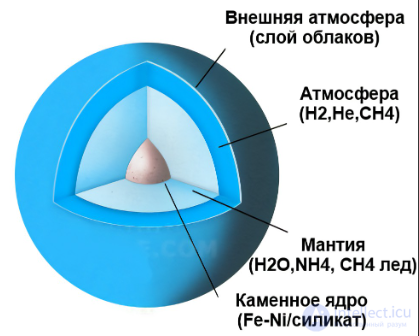
The mass of Uranus = 14.5 Earth masses.
Average distance from the Sun 2.87 billion km.
The length of a day on Uranus is 17 hours 14 min.
The atmosphere of Uranus consists of 83% hydrogen, 15% helium, 2% methane, and a small
amount of acetylene and other hydrocarbons.
Winds at middle latitudes on Uranus blow in the direction of the planet's rotation at
speeds from 40 to 160 m/s.
The planet has an atmosphere similar to that of Jupiter.
The albedo is high, and absorption bands of methane are visible in the spectrum. When observed
visually the planet appears greenish. Methane in the upper atmosphere absorbs red light, which is why Uranus has a blue-green color.
Spectral lines of hydrogen are visible, ammonia has not yet been detected.
The cloud temperature is -193C.
The planet has no internal energy sources, or they are small.
The clouds of the planet's upper atmosphere consist of methane, and at the equator their altitude
is lower than at the poles.
Uranus rotates about an axis tilted at an angle of 98 degrees
to the orbital plane.
A weak magnetic field is observed. The magnetosphere is very complex. The field strength is 0.23 Oe. The axis of the magnetic dipole is offset by almost 8000 km from the center of the planet toward the north pole and is tilted to the rotation axis by 60 degrees
. The polarity of the magnetic dipole should reverse twice per rotation of the planet about its axis.
The magnetic tail is twisted by Uranus's rotation into a long corkscrew behind the planet.
The source of the magnetic field is unknown.
The rings of Uranus were first discovered in 1977 aboard the Kuiper Airborne Observatory at an altitude of 12.5 km.
Scientists discovered 4 circular rings and one slightly elongated one. Later four more rings
were discovered. "Voyager 2" discovered one more ring
in 1986. A total of 10 rings are now known. They are located at distances from
41,000 to 52,000 km from the center of Uranus.
The rings have different colors: white, greenish-blue, light brown. Most
likely they consist of particles of different chemical composition.
Seven of the rings are very narrow (0.5 - 3 km wide) and opaque. One ring
has a width of 12 km. The outermost ring differs greatly from the rest.
Its width equals 85 km. (while the width of all the others is 67 km), varies, and depends linearly on the distance from Uranus.
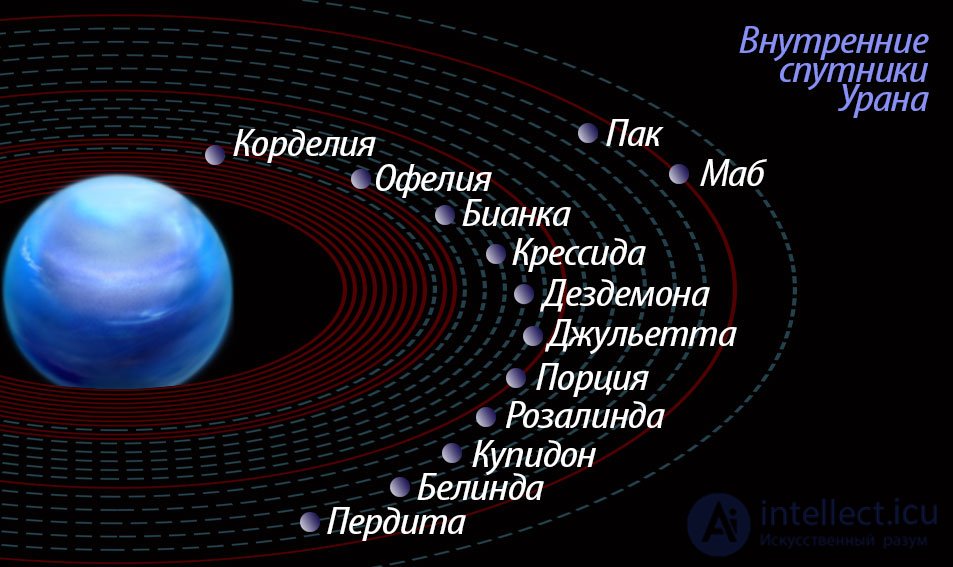
Satellites. Uranus has at least 15 moons. The two largest moons,
Titania and Oberon, were discovered by W. Herschel in 1787.
Today a total of 18 satellites of Uranus are known.
They are small and difficult to observe. The satellites move in the prograde direction, their orbits lie almost in a single plane, tilted to the orbital plane of Uranus by 98 degrees
.
Given the position of the plane of Uranus's satellites, one can assume that
they all formed together with the planet and were not captured afterward.
The masses and radii are known more or less precisely only for the five largest satellites - Miranda, Ariel, Umbriel, Titania, and Oberon. The masses of most of the satellites are estimated very approximately from mutual perturbations, and
the radii are so poorly known that determining their density makes no sense.
Miranda - (diameter - 480 km) has the most complex surface of all
known bodies in the Solar System. The surface is covered with craters, wavy hills, valleys, grooves, depressions, ridges, and cliffs. The height
of the cliffs exceeds 5 km. The elevation difference is up to 10 km.
The complex surface is explained by the fact that the satellite may have been destroyed in
a collision with a large meteoroid body, and then reaccumulated
again. It is possible that volcanoes are active on the satellite.
15.3 Terrain and atmosphere of Neptune.
The planet was discovered on September 23, 1846 by Johann Gottfried Galle, at the Berlin Observatory.
It has an equatorial diameter of 49,500 km.
Neptune orbits the Sun with a period of 165 years
A day on Neptune is 16 hours and 6.7 minutes.
The inner two thirds of Neptune are composed of a mixture of molten rock, water, liquid ammonia, and methane. The outer third is a mixture of heated gases, composed of
hydrogen, helium, water, and methane.
Methane gives Neptune's clouds their blue color.
This is a dynamic planet with several large, dark spots.
The largest spot, known as the Great Dark Spot, is the size
of Earth and similar to the Great Red Spot on Jupiter.
It is thought to be a powerful anticyclone in the planet's atmosphere. At the boundary
of the anticyclone white clouds are visible, at altitudes from 50 to 100 km above the main cloud layer.
Further south lies a weaker anticyclone - "Dark Spot 2"
Voyager found a small, irregularly and inconstantly shaped cloud, moving in an eastward direction. The cloud makes a full circuit around Neptune
every 16 hours.
Long bright clouds, similar to cirrus clouds on Earth, were observed high in Neptune's atmosphere.
The strongest winds on the planet blow here. Most of them blow in the direction opposite to the planet's rotation. Near the Great Dark Spot
wind speeds reach 2,000 km/h.
Neptune's mass reaches 17.3 Earth masses.
The albedo is high, and methane absorption bands are visible in the spectrum. When observed
visually the planet appears greenish. Spectral lines of hydrogen are visible; ammonia has not yet been detected.
The cloud-top temperature is -193°C.
Theoretically Neptune should be 12°
colder. Apparently it possesses internal heat sources that give off as much energy as it receives from the
Sun.
One version of the explanation for internal energy sources is the evolutionary contraction of the planet. It is unclear only why this does not occur on Uranus.
Neptune's magnetic field is similar to Uranus's, its axis is tilted by 47°
to the rotation
axis.
“Voyager 2” discovered rings around Neptune. So far only 5 rings are known. They
are located at distances from 41,900 to 62,900 km.
The rings are made of dust.
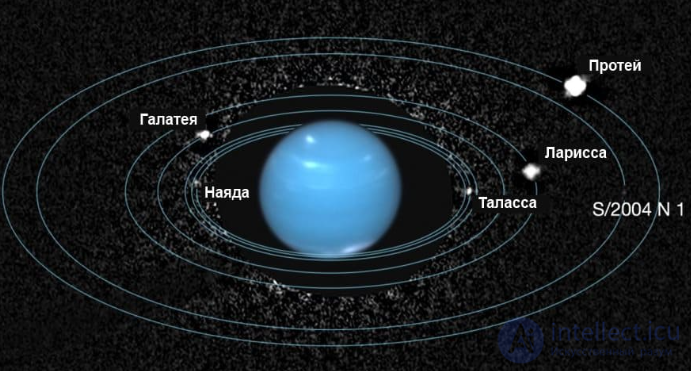
At present 8 satellites of Neptune are known, 6 of them discovered by Voyager.
Neptune's satellite Triton is one of the largest satellites in the Solar
System. It is significantly larger than the Moon (radius 2700 km), and its mass is
almost 2 Moon masses.
Its density equals 2.07 g/cm
3
.
Triton has a slight methane atmosphere, and its surface is rocky, not icy.
Dark deposit streaks, fractures, and light-colored areas are visible on the surface,
possibly covered by a layer of nitrogen frost.
The satellite's south pole faces the Sun and is surrounded by a polar cap.
Dark spots of regular shape are observed on the surface – eruptive
centers, from which plumes of dust and gas are ejected to heights of 7-8 kilometers.
Auroras have been observed in the atmosphere in the ultraviolet range.
Triton has a silicate core with a radius of up to 1000 km. The core is surrounded by a mantle, and the
mantle by a global water ocean, saturated with ammonia and methane.
The ocean is covered by an icy shell.
Triton's motion is retrograde. Because of this motion, tidal friction caused by Neptune may destroy the moon. It is possible that in 10 - 100 million
years Triton, spiraling inward, will be destroyed.
The satellite Nereid has a diameter of 340 km. There is no information yet about its mass.
The orbits of these satellites differ greatly. Triton orbits at an inclination to Neptune's equatorial plane
of 28°
. Distance to the planet 356,000 km.
Nereid moves in prograde motion, at a distance of 5,570,000 km.
“Voyager 2” discovered 6 more satellites. The four closest satellites lie within the Roche zone and consist almost entirely of water ice. Their structure
resembles that of comets more closely.
Proteus – has an irregular shape, resembling an egg. A crater 200 km in diameter has been found on its surface.
Pluto is the smallest planet in the Solar System. It has a large
satellite, Charon. Therefore the Pluto–Charon system is often called a double
planet.
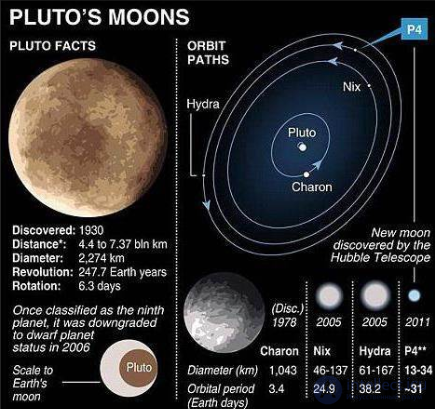
The Space Telescope obtained new images of Pluto and Charon. Observational data give Pluto's size as 2320 km and Charon's as 1270 km.
(Sky & Telescope, Vol. 88, № 5)
Pluto's mass is small and, as it is refined further, keeps decreasing.
Scientists studied Pluto's perturbations of the orbits of Neptune and Uranus and found them to be quite insignificant. It can be said that Pluto barely
perturbs the orbits of these two planets. The first measured perturbations, which led to the discovery of Pluto, turned out to be incorrect, and Pluto's existence was
predicted by chance.
The mean density of Pluto is 2.06 g/cm3
, and of Charon – 2.18 g/cm3
.
This indicates that both bodies consist mainly of ice. Spectral observations have shown that there is frozen methane on the planet.
Charon has a bluer color than Pluto. This means they have different
compositions. A group led by W. Wilde of the University of Chicago, studying Pluto's albedo, found that different areas of the planet have different reflectivity at different times. This means Pluto's atmosphere is able
to transport surface frost from place to place. (Sky & Telescope,
Vol. 88, № 5)
Pluto's temperature is about -228°C.
Charon's orbital radius is 19,130 km, and its period of revolution around Pluto is 6.387 days.
Pluto's orbit is highly elongated and crosses Neptune's orbit. It has been suggested
that Pluto is a lost satellite of Neptune, or that the two planets might collide. However, according to modern calculations, Neptune and Pluto
are in a gravitational resonance with a period close to 20,000 years, and therefore will never collide, and were probably never connected in the past.
NASA planned to send a spacecraft to Pluto, but in 1994
abandoned this plan because of excessive costs and the anticipated
low scientific return.

Comments