
Lecture
The Sun is an ordinary star, observed from Earth as a disk, whose size changes slightly over the course of a year due to the change in the distance from Earth to
the Sun.
When the Earth is at perihelion (early January), the apparent diameter of the Sun
is 32'35", and at aphelion (early July) - 31'31".
At the average distance from the Earth the apparent diameter of the Sun is 960", which
corresponds to a linear radius = 696,000 km.
Rsol = 149.6.
106
km
.
960"/206265" = 696,000 km.
Volume of the Sun:
Vsol = 4/3 π Rsol
3 = 1.41.
1018
km
3 = 1.41 .
1027
m
3
.
Mass of the Sun:
msol = 1.99 .
1033
g = 2 .
1030
kg.
Average density of matter:
ρsol = msol/(4/3 π Rsol
3
) = 1.41 g/cm3
Acceleration of gravity on the surface of the Sun:
gsol= f msol / Rsol
2 = 2.74.
104
cm/s
2 = 274 m/s
2.
Temperature of the Sun:
- Effective temperature, determined by the total radiation flux = 5770
K.
- By the position of the maximum of radiation in the spectrum 6750 K.
- Color temperatures for different wavelengths:
— 4700 - 5400 A temperature 6500 K.
— 4300 - 4700 A temperature 8000 K.
— in green rays - 6400 K.
— in the meter-wave radio range it reaches a million K.
The temperature of the solar matter changes with depth. Different radiation
brings us the temperature of different depths. Radio, ultraviolet, and visible radiation correspond respectively to deeper and deeper layers
of the Sun.
Near the very surface of the Sun there is a layer with a minimum temperature - 4500 K, which can be observed in ultraviolet rays. Above and below this layer the temperature rises.
Most of the solar matter must be strongly ionized. At a temperature of 5 - 6,000 K, atoms of many metals are ionized, and at a temperature of 10 -
15,000 K hydrogen is ionized. Solar matter is a plasma,
i.e., a gas most of whose atoms are ionized. Only in a thin layer near the
visible edge is the ionization weak and neutral hydrogen predominates.
Observations of individual features on the solar disk, as well as measurements of the shifts of spectral lines at various points on it, indicate the motion of solar matter around one of the solar diameters, called the axis of rotation of the Sun.
The plane passing through the center of the Sun and perpendicular to the axis of rotation is called the plane of the solar equator. It forms with the plane of the
ecliptic an angle of 70
15' and intersects the surface of the Sun along the equator. The angle between the equatorial plane and the radius drawn from the center of the Sun to a given
point on its surface is called heliographic latitude.
The angular velocity of rotation of the Sun decreases with distance from the equator and
approach to the poles.
On average ω = 140
.4 - 20
.7 sin2B, where B is the heliographic latitude. The angular velocity is measured by the angle of rotation per day.
The sidereal period of the equatorial region is 25 days, while near the poles
it reaches 30 days. Due to the rotation of the Earth around the Sun, its rotation
appears slower and equals 27 and 32 days respectively (synodic period).
In the visible region the Sun's radiation has a continuous spectrum, against the background of which several tens of thousands of dark absorption lines, called Fraunhofer lines, are noticeable. The continuous spectrum reaches its greatest intensity in the blue-green part, at wavelengths of 4300 - 5000 A. In both directions from the maximum the intensity of the spectrum decreases.
Observations above the atmosphere have shown that the Sun radiates in the invisible short-wave and long-wave regions of the spectrum. In the shorter-wavelength
region the spectrum changes sharply. The intensity of the continuous spectrum falls
rapidly, and the dark Fraunhofer lines are replaced by emission lines.
The strongest line of the solar spectrum is located in the ultraviolet region. This is the resonance line of hydrogen Lα with a wavelength of 1216 A.
In the visible region the most intense are the resonance lines H and K of ionized calcium. After them in intensity come the first lines of the Balmer
series of hydrogen Hα, Hβ, Hγ, then the resonance lines of sodium, lines of magnesium, iron, titanium, and other elements. The remaining numerous lines are identified with the spectra of about 70 known chemical elements from
Mendeleev's table. The presence of these lines in the solar spectrum indicates the
presence in the solar atmosphere of the corresponding elements.
It has been established
that hydrogen, helium, nitrogen, carbon, oxygen, magnesium,
sodium, iron, calcium, and other elements are present on the Sun.
The predominant element on the Sun is hydrogen. It accounts for 70% of the mass of the Sun. Next is helium - 29% of the mass. All the remaining elements together account for a little more than 1%.
The flux of radiation from the Sun is customarily characterized by the solar constant
Q, by which is meant the total amount of solar energy passing in
1 minute through an area of 1 cm
2
perpendicular to the rays, located at the
mean distance of the Earth from the Sun.
According to modern measurements, its value is known to an accuracy of 1%:
Q = 1.95 cal/(cm2 .
min) = 1.36 .
106
erg/(cm2 . s) = 1360 W/m
2
Multiplying this value by the area of a sphere with a radius of 1 AU, we obtain the total
amount of energy radiated by the Sun in all directions per unit time, i.e. its integrated luminosity. It equals 3.8 .
1026 J/s.
A unit area of the Sun's surface (1 m
2
) radiates 6.28 .
107 W.
The Sun's integrated luminosity is remarkably constant.
Weak fluctuations of the solar constant lie within 1%.
At the Earth's surface the flux of solar radiation decreases due to absorption and scattering in the Earth's atmosphere and amounts on average to 800 - 900 W/m
2
.
The photosphere is the main part of the solar atmosphere in which the visible radiation, which has a continuous character, is formed. Thus,
it radiates practically all the solar energy that reaches us.
The photosphere is a thin layer of gas several hundred kilometers thick, and is fairly opaque.
The photosphere is visible when the Sun is observed directly in white light as
its apparent “surface”.
When observing the solar disk, its darkening toward the edge is noticeable. As
one moves away from the center, the brightness decreases very rapidly. This effect is explained
by the fact that in the photosphere the temperature increases with depth.
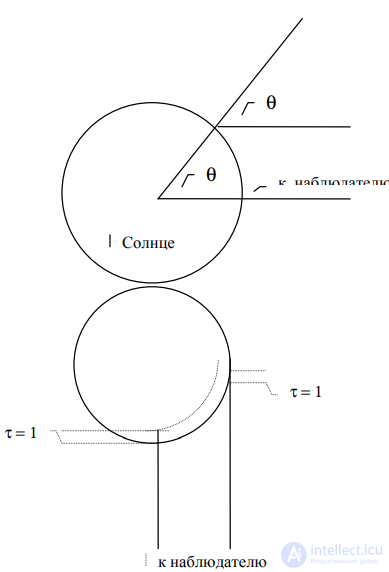
Different points of the solar disk
are characterized by the angle θ that
the line of sight makes with the normal to the
Sun's surface at the location in question. At the center of the disk this
angle equals 0, and the line of sight coincides
with the Sun's radius. At the edge θ = 90
and the line of sight glides along a tangent to the Sun's layers. Most
of the radiation from a given layer
of gas comes from the level located at the optical depth τ=1
When the line of sight crosses the layers
of the photosphere at a large angle θ,
the optical depth τ=1 is reached
in more outer layers, where the temperature is lower. As a result
the intensity of radiation from the edges
of the solar disk is less than the intensity of radiation from its middle.
The decrease in brightness of the solar
disk toward the edge can, to a first approximation, be represented by the formula:
I (θ) = I0(1 - u + cos θ),
where I (θ) is the brightness at the point at which the line of sight makes an angle θ with the normal, I0
is the brightness of the radiation from the center of the disk, and u is a proportionality coefficient depending on wavelength.
The photosphere emits strongly, and consequently also absorbs radiation throughout the
entire region of the visible continuous spectrum.
For each layer of the photosphere located at a given depth, its temperature can be found. The temperature in the photosphere increases with depth and
averages 6000 K.
The thickness of the photosphere equals several hundred km.
The density of the photosphere's matter is 10-7
g/cm3
.
Sun
θ
θ
to the observer
τ = 1
τ = 1
to the observer
1 cm3 of the photosphere contains about 1016 hydrogen atoms. This corresponds to
a pressure of 0.1 atm.
Under these conditions all chemical elements with low ionization potentials become ionized. Hydrogen, however, remains in a neutral state.
The photosphere is the only region on the Sun with neutral hydrogen.
Visual and photographic observations of the photosphere make it possible to detect
its fine structure, resembling closely packed cumulus clouds.
The bright rounded formations are called granules, and the entire structure is called granulation. The angular sizes of granules are no more than 1” of arc, which corresponds to 700 km. Each individual granule exists for 5-10 minutes, after which it
breaks up and new granules form in its place. Granules are surrounded by dark gaps. Within the granules matter rises, while around them it sinks. The speed of these motions is 1-2 km/s.
Granulation is a manifestation of the convective zone located beneath the photosphere.
In the convective zone, matter is mixed as a result of the rising and sinking of individual masses of gas.
The cause of the onset of convection in the outer layers of the Sun is two
important circumstances. On the one hand, the temperature immediately below
the photosphere rises very rapidly with depth, and radiative transfer cannot ensure
the escape of radiation from the deeper, hotter layers. Therefore the energy is carried by the moving inhomogeneities themselves. On the other hand, these inhomogeneities turn out to be persistent if the gas within them is not fully, but only partially,
ionized.
When transitioning into the lower layers of the photosphere, the gas becomes neutralized and is not able to form stable inhomogeneities. therefore in the very uppermost parts of the convective zone convective motions are inhibited and convection abruptly stops.
Oscillations and disturbances in the photosphere give rise to acoustic waves.
The outer layers of the convective zone represent a kind of resonator in
which 5-minute oscillations in the form of standing waves are excited.
The density of matter in the photosphere decreases rapidly with height and the outer
layers turn out to be strongly rarefied. In the outer layers of the photosphere the temperature reaches 4500 K, and then begins to rise again.
There is a slow rise in temperature to several tens of thousands of degrees, accompanied by ionization of hydrogen and helium. This part of the atmosphere
is called the chromosphere.
In the upper layers of the chromosphere the density of matter reaches 10-15
g/cm3
.
In 1 cm
3
of these layers of the chromosphere there are about 109
atoms, but the temperature
rises to a million degrees. Here begins the outermost part of the Sun's atmosphere, which is called the solar corona.
The cause of the heating of the outermost layers of the solar atmosphere is the energy of acoustic waves arising in the photosphere. As they propagate upward,
into layers of lower density, these waves increase their amplitude to several kilometers and turn into shock waves. As a result of the emergence of shock waves, dissipation of the waves occurs, which increases the chaotic velocities of particle motion, causing a rise in temperature.
The integral brightness of the chromosphere is hundreds of times less than the brightness of the photosphere.
Therefore, to observe the chromosphere it is necessary to apply special
methods that make it possible to extract its weak radiation from the powerful flow of photospheric radiation.
The most convenient methods are observations during moments of eclipses.
The extent of the chromosphere is 12 - 15,000 km.
When studying photographs of the chromosphere, inhomogeneities are visible, the smallest of which are called spicules. Spicules have an elongated shape, stretched in the
radial direction. Their length is several thousand km, their thickness
about 1,000 km. At speeds of several tens of km/s spicules rise
from the chromosphere into the corona and dissolve in it. Through spicules an exchange of matter between the chromosphere and the overlying corona takes place. Spicules form a larger
structure, called the chromospheric network, generated by wave motions caused by significantly larger and deeper elements of the subphotospheric convective zone than granules.
The corona has a very low brightness, so it can be observed only during the
total phase of solar eclipses. Outside of eclipses it is observed using
coronagraphs. The corona has no sharp outlines and has an irregular
shape, strongly changing with time.
The brightest part of the corona, no more than 0.2 - 0.3
solar radii from the limb, is customarily called the inner corona, and the rest, quite
extended part - the outer corona.
An important feature of the corona is its radial structure. The rays are of
various lengths, up to a dozen or more solar radii.
The inner corona is rich in structural formations resembling arches, helmet streamers, and separate clouds.
The radiation of the corona is scattered light from the photosphere. This light is strongly
polarized. Such polarization can only be caused by free electrons.
In 1 cm
3 of coronal matter there are about 108
free electrons. The appearance of such a quantity of free electrons must be caused by ionization. This means that there are about 108
ions in 1 cm3 in the corona. The total concentration of matter must be 2 .
108
.
The solar corona is a rarefied plasma with a temperature
of about a million kelvins. A consequence of the high temperature is the great extent of the corona. The extent of the corona is hundreds of times greater than
the thickness of the photosphere and amounts to hundreds of thousands of kilometers.

Comments