
Lecture
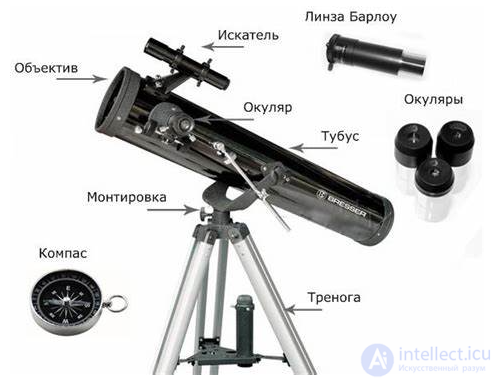
The most common school telescopes are:
1. A refracting telescope on an equatorial mount with an objective diameter of 80
mm and a focal length of 800 mm.
2. A refracting telescope on an azimuthal mount with an objective diameter of 60 mm
and a focal length of 600 mm.
3. A reflecting telescope “Alcor” on an azimuthal mount with a main mirror diameter of 65 mm and a focal length of 502 mm.
In addition to these, spotting scopes and binoculars can be used for observing the starry sky.
The magnification of a telescope is determined from the relation:
W = F/f,
where F is the focal length of the objective, f is the focal length of the eyepiece.
The limiting angular resolution r characterizes the minimum angular distance
between two stars or surface details of a planet at which they
are seen separately.
r = 140”/D,
where D is the diameter of the objective.
The penetrating power of a telescope is determined by the limiting stellar magnitude m
of stars visible through it on a clear, moonless night, which is calculated by the formula:
m = 2.1 + 5lgD,
where D is the diameter of the objective in millimeters.
School telescopes make it possible to observe stars down to magnitude 11-12.
For photographing celestial objects, a mirror camera such as the “Zenit”
can be attached to a school refracting telescope using standard reproduction rings.
The number of rings between the objective and the camera is selected depending on the magnification required.
When photographing at the prime focus of the telescope's objective, when the camera's
own lens is removed entirely, the size of the image is determined by the formula:
h = Ftgρ,
where F is the main focal length of the telescope's objective, ρ is the apparent angular
diameter of the celestial body in arcseconds, h is the size of its image.
The diameter of the Moon's disk in a school 80 mm refractor will be 7 mm.
When using eyepiece magnification, the resulting sizes are larger.
Magnification
n = f/d,
where d is the distance from the camera's objective to the image formed
by the telescope's objective, f is the length of the tube. From the lens formula we get:
d = F1f/(f - F1),
where F1 is the focal length of the camera's objective, usually equal to 5 cm.
The size of the image on the negative:
h1 = (f - F1)h/F1.
The size of the image is determined only by the number of rings between the objective and the camera, i.e., by the length of the tube f.
If the magnification needs to be set in advance, the tube length will be:
f = F1/(n - 1).
Using a school refracting telescope with a focal length of F = 800
mm and a tube length of f = 20 cm, one can obtain a lunar disk on the negative with a size of about 21 mm.
Under poor atmospheric conditions, eyepiece magnification turns out to be ineffective.
29.2 Angle-measuring instruments.
To determine the noon altitude of the Sun, the altitude of Polaris, and to measure angles between celestial bodies, a school protractor or a simple angle-measuring instrument — a skaphe — can be used.
The simplest angle-measuring instruments, such as a quadrant and an astronomical staff,
can be constructed by hand.
29.3 Spectral instruments.
At school one can illustrate spectral analysis by observing the solar spectrum. For this purpose a two-tube spectroscope is used,
provided it has a good-quality prism and a properly adjusted collimator slit.
With this instrument one can clearly observe the absorption lines of the solar spectrum.
If the spectroscope's eyepiece is removed and a “Zenit” camera is placed in its stead, photographs of the solar spectrum can be obtained. Even at low
quality, up to 15 absorption lines can be detected.
1. Observations of the visible daily rotation of the starry sky.
a) Conduct an observation over the course of one evening and note how
the position of the constellations Ursa Minor and Ursa Major changes.
b) Determine the rotation of the sky by the passage of stars through the field of view of a stationary telescope. Knowing the size of the telescope's field of view, determine the rotational speed of the sky (in degrees per hour) using a stopwatch.
2. Observation of the annual change of the starry sky.
3. Observation of the change in the noon altitude of the Sun.
Over the course of a month, once a week at true noon, take measurements of the Sun's
altitude. Enter the measurement results into a table:
Date of observation, Noon altitude, Declination of the Sun.
Plot a graph of the change in the noon altitude of the Sun, plotting dates
on the X axis and the noon altitude on the Y axis.
To determine the time of true noon, use the formula:
Ttrue noon
= 12 + η + (n - λ).
In doing so, a correction of 1 hour must be introduced for daylight saving time.
4. Observation of the apparent position of planets relative to the stars.
5. Observation of the satellites of Jupiter.
Observations of Jupiter's satellites should be made with a telescope and their
position relative to the disk of the planet. The absence of some satellites means they are being eclipsed or occulted.
6. Determining the geographic latitude of a location.
6.1 By the altitude of the Sun at noon.
A few minutes before true noon, set up the theodolite in
the plane of the meridian. Calculate the time of noon in advance.
When the moment of noon arrives, or near it, measure the altitude h of the lower
edge of the disk. Correct the altitude found by the value of the Sun's radius (16’).
Calculate the latitude of the location using the relationship
φ = 90
- hc + δc,
where hc is the altitude of the center of the Sun, δc is the declination of the Sun at the hour of observation, interpolated taking into account its hourly change.
6.2 By the altitude of Polaris.
Using a theodolite or another angle-measuring instrument, measure the altitude of
Polaris above the horizon. This will be the approximate value of the latitude,
with an error of about 1
.
7. Determining the geographic longitude of a location.
7.1 Set up the theodolite in the plane of the meridian and use a clock to determine the moment
of the Sun's culmination (the moment the Sun crosses the vertical thread
of the theodolite). This will be the moment Tp, expressed in zone time.
7.2 Calculate the local solar time at this moment at the zero meridian T0, if the number of the given zone is 2.
T0 = Tp - n.
7.3 Determine the local mean time Tm at the moment of the Sun's culmination, which equals 12 + η.
7.4 Calculate the longitude of the location as the difference of local times:
λ = Tm - T0.
8. Observing the surface of the Moon through a telescope.
Using a map of the Moon, become familiar with some well-observed lunar
formations.
Compare the results of observation with the available map.
9. Photographing the Moon.
10. Observing sunspots and the rotation of the Sun about its axis.
11. Observing the solar spectrum and identifying the principal Fraunhofer lines.
12. Photographing the starry sky using a homemade astrograph
or a school telescope with an eyepiece attachment.

Comments