
Lecture
The most common method makes it possible to determine
The most common method for determining distances to stars is
the method of annual parallax. It relies on knowledge of the distance from the Earth to
the Sun. Modern radar data give a value of AU = 149,597
870.5 +- 1.6 km. The doubled astronomical unit serves as a baseline, from the ends of which the parallactic angles of the nearest
stars can be measured, and the distances to them determined. The distances are found from a triangle in
which one side and two adjacent angles are known.
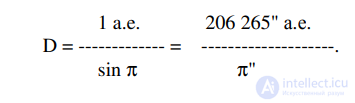
The distance corresponding to an annual parallax of 1" is called a parsec
(pc).
1 pc = 206,265 AU = 3.086 . 1013 km.
If D is expressed in parsecs, then D = 1/π".
A distance of 1000 parsecs is called a kiloparsec, and a distance of
1,000,000 parsecs is a megaparsec.
The distance that light travels in one year, propagating at a speed
of about 300,000 km/s, is called a light year.
1 light year = 9.46 . 1012 km = 63198 AU = 0.3064 pc.
1 pc = 3.26 light years.
The star nearest to us has a parallax equal to 0.75”, i.e. it is located at a distance of 4.3 light years, or 1.3 pc.
In modern astronomy, the photographic method is used to determine stellar parallaxes. It was developed in the early 19th century by Schlesinger on the long-focus refractor of the Yerkes Observatory.
Of the many millions of stars, parallaxes have been measured for only a few thousand.
Modern parallax catalogs include about 8000 stars. Only 60 - 80 trigonometric parallaxes are measured each year. Measurement errors
amount to 0.004” or more. Thus, the measured parallax of a star
located at a distance of 50 pc can have a value ranging from 0.016 to 0.024”.
The measurement error is very large. Accurate parallaxes can be found only for
nearby stars (up to 20 pc).
The use of new methods of positional measurement using modern light detectors and satellite astronomy will make it possible to measure the parallaxes of stars located at distances of 75 - 100 pc.
The distances between stars are very great. The interplanetary probe Pioneer 10,
having left the boundaries of the Solar System, will arrive near one of the closest
stars - Barnard's Star, located at a distance of 1.8 pc, in the year 12490.
Stars are spherically symmetric gaseous (plasma), incandescent bodies,
existing in a state of thermal and hydrostatic equilibrium.

These are the most common objects in the Universe. They contain
more than 98% of the mass of cosmic matter. The rest is scattered in interstellar space.
The existence of an individual star for billions of years as a stable
object is a consequence of the equilibrium between the forces of gravitational contraction, gas and radiation pressure, the amount and rate of energy generation,
and the processes of heat removal (radiation). A star is a stable, self-regulating system. The slightest change in even one of the mentioned factors inevitably causes a change in the other factors and an internal restructuring of the star.
To the naked eye the sky appears as a multitude of luminous points. The apparent brightness of a star, or more precisely the illumination that the star produces on a unit area of the receiver, is assessed by the apparent stellar magnitude.
The apparent stellar magnitude does not reflect an absolute characteristic of the star.
It depends on the distance at which the star is located from the observer. Therefore, the concept of absolute stellar magnitude is introduced, by which
is meant the stellar magnitude that the star would have if it were placed
at a distance equal to 10 parsecs.
The absolute and apparent magnitudes are related by the formula:
M = m + 5 - 5lg r.
It can be rewritten in the following form:
M - m = 5 - 5 lg r.
The difference M - m is called the distance modulus.
The interstellar medium is filled with gas and dust. As a star's radiation passes through it, it is partly scattered and partly absorbed. Therefore, to obtain
realistic results, a parameter describing the character of the medium, A(m), is introduced into the formulas above.
M - m = 5 - 5 lg r - A(m).
The physical characteristics of a star and its life path are determined by the mass
the star had at the moment of its birth, and by its initial chemical composition.
Restrictions are placed on the possible mass by the physical processes occurring during the contraction of the fragment of the molecular cloud from which the star was born.
The range of possible masses is 10-2 - 102
solar masses. At masses below the stated limit, the conditions necessary for the onset and progress of thermonuclear reactions do not arise
in the central regions of the forming star.
At a mass greater than the limit, the powerful radiation of the core actively counteracts further concentration of matter on the surface of the star, or, if
the mass and density are too great, the cloud, in the process of evolution, collapses into a
black hole.
Observations show that the masses of the largest stars - blue giants of luminosity class V
- do not exceed 60 solar masses, while the masses of red dwarfs are
on the order of 0.1 solar mass.
Direct determinations of stellar radii, with some exceptions,
are impossible. All stars are located at very great distances, and even the
largest optical telescopes cannot resolve their angular sizes.
Only recently has it been possible to obtain an image of the true disk of the star Betelgeuse using
the Hubble Space Telescope. The image shows an enormous ultraviolet atmosphere with a mysterious hot spot on its surface. The huge bright spot is larger than ten Earth diameters and has
a temperature 2,000 K higher than the surrounding surface of the star.
The nature of the spot is unknown. It may be caused by pulsations detected in the giant star, or by the effect of a powerful magnetic field.
Seeing the star's disk is possible because Betelgeuse is so large
a star that if it were located at the Sun's position, at the center of the Solar System, its outer atmosphere would extend beyond the orbit of Jupiter.
The angular diameters of the 20 - 30 nearest stars have been determined using stellar
interferometers.
The interferometer's operating principle is based on the interference of starlight, reflected by a pair of widely spaced mirrors.
Sometimes, to determine the angular sizes of a star, it is possible to use the appearance
of the interference pattern that arises during the occultation of a star by the Moon.
Linear radii can be determined for eclipsing variable stars from the duration of the eclipse.
If for a star at distance r the angular diameter d” is found, then its linear
diameter can easily be calculated by the formula
D = d”r/ 206 265”.
Stellar radii vary over a wide range. The largest stars are
red supergiants with radii 100 - 1000 times greater than the Sun's.
The smallest stars are white dwarfs and neutron stars, whose radii are
100 - 10000 times smaller than the Sun's.
Luyten's star in the constellation Cetus has a diameter 10 times smaller than Earth's, while neutron stars have sizes of about 10 km.
The average density of red supergiants is 10-6
g/cm
3
, while that of neutron stars is more than
1014
g/cm3
, i.e., comparable in density to nuclear matter.
The differences in the physical characteristics of stars determine the entire diversity of our Galaxy.
The flux of energy radiated by a star in all directions is called luminosity.
lg(Ls/Lo) = 0.4 (Mo - Ms),
where Mo and Ms are the absolute stellar magnitudes of the Sun and of any star respectively, and Lo and Ls are their luminosities.
Usually the Sun's luminosity is taken as 1, and the luminosities of stars are expressed in units of the Sun's luminosity. Then:
lgLs = 0.4 (Mo - Ms),
The ratio of the luminosities of the brightest and the faintest stars reaches about 100
billion.
Blue giants and red supergiants have a luminosity of 800,000
times the Sun's. Red dwarfs of spectral class M have a luminosity of 0.0001
times the Sun's.
Until recently β Orionis was considered the brightest star. However, now
the brightest star in the Galaxy is considered to be the star Cygnus OB2 No. 12. It outshines some faint galaxies. Its radiation in the visible part of the
spectrum is 1 million times greater than the Sun's. If it were located at the position of α Centauri,
it would shine brighter than the full Moon. It is a blue supergiant, T = 13.
10^3 K. It is located at a distance of 50,700 light years. This star is surrounded by a dense cloud of dust,
which transmits only 0.0001 of the total light radiation. Possibly this cloud
formed due to mass loss by the star.
In 1988 a star belonging to the class of brown dwarfs was identified. These are the faintest objects accessible to observation. Its brightness is
20,000 times weaker than the Sun's. Its mass is 20 times smaller. It is located at a distance of
68 light years from the Sun. Its small mass does not allow nuclear reactions to ignite.
Such stars may make up the hidden mass of galaxies (according to some estimates, up to 90% of the total mass).
In 1994 - 1995 research at the Palomar Observatory and with the space
telescope yielded a photograph of a brown dwarf. This star is called Gliese
229B (GL229B), and is a small companion of the cold red star
Gliese 229, located at a distance of 19 light years from Earth in the constellation Lepus.
The dwarf's mass is 20 - 50 Jupiter masses.
GL229B is too massive and hot to be a planet, but too small and cool to shine like a star. Its luminosity is 100,000 times
less than that of the Sun. This brown dwarf is the faintest object ever detected orbiting another star and has a spectrum resembling that of Jupiter. Infrared spectroscopic studies have shown that the dwarf contains a lot of methane. Methane is not found in stars, but it is present in the giant planets of the Solar System.
The mass of the star is about 8% of the mass of the Sun.
Brown dwarfs form in the same way as other stars, but do not have
enough mass to generate the high internal temperatures needed to ignite nuclear reactions.
Brown dwarfs have the same heating mechanism as giant planets
- through gravitational contraction.
The temperature of stars is usually understood to mean the effective temperature.
The effective temperature of a body is defined as the temperature of an absolutely
black body, each square centimeter of which radiates over the entire spectrum
the same energy flux as 1 cm
2
of the given body.
,
4
σ
ε
Teff =
where σ = 5.67 . 10-8 W/(m
2 . K
4
) is the Stefan-Boltzmann constant.
To determine the effective temperature, one must know the total radiation
flux and the radius of the star. These quantities can be measured accurately enough for only a few stars. For other stars, effective temperatures are found
by indirect methods based on the study of their spectra or color indices using a scale of effective stellar temperatures.
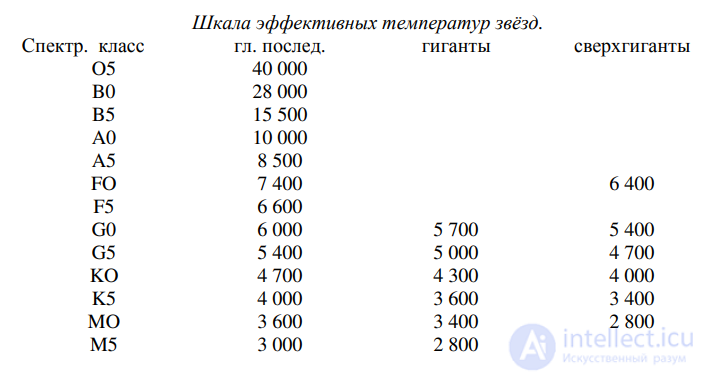
The scale of effective stellar temperatures is the dependence of the color
characteristics of stellar radiation, for example, the spectral class or color
index, on the effective temperatures. If the temperature scale is known, then, by determining the spectral class or color index of a given star from observations,
it is easy to find its temperature. The temperature scale is determined empirically
from stars with known effective temperatures, and also theoretically for stars of certain types.
Scale of effective stellar temperatures.
The temperature can be found, if the color index C is known, by the formula:
T = 72000
/(C + 0 m, 64) .
If the bolometric luminosity of a star, or its effective temperature, is known, the size of the star can be found.
Luminosity of the star:
L = 4πR
2
σTeff
4
.
If we apply the resulting expression to the Sun, whose luminosity and radius are known to us, we obtain:
Ls = 4πRs
2
σTs
4
.
Dividing these equations term by term, we obtain:
R = Rs(Ts/Teff)
2 √(L/Ls),
taking logarithms we get:
lg(R/ Rs) = 1/2 lg (L/Ls) + 2 lg (Ts/Teff).
If we express the radius and luminosity of the star in solar units, we obtain:
lgR = 1/2 lg L + 2 lg (Ts/Teff).
Stars have continuous spectra, on which dark and bright spectral lines are superimposed. The differences between stellar spectra lie in the number and
intensity of the observed spectral lines, as well as in the distribution of
energy in the continuous spectrum.
Part of the rays passing through a star's atmosphere is absorbed, and this
absorption can be continuous, when a more or
less extended portion of the spectrum is weakened, or selective, when narrow portions of the spectrum are absorbed.
The spectra of most stars can be arranged in a sequence,
along which the lines of some chemical elements gradually weaken, while
those of others strengthen. Similar spectra are grouped into spectral classes. Fine differences between them allow subclasses to be distinguished.
Stars belonging to different spectral classes differ in their
temperatures.
This classification was first applied at the Harvard Observatory at
the beginning of our century. Later the Harvard classification was supplemented and modified, and today it is a complex scheme with many indices and subdivisions. As a result of the work of Harvard astronomers, the "Henry
Draper Catalogue" appeared, containing the spectral characteristics of 225,320 stars of the northern and
southern celestial hemispheres and including practically all stars down to the 9th magnitude.
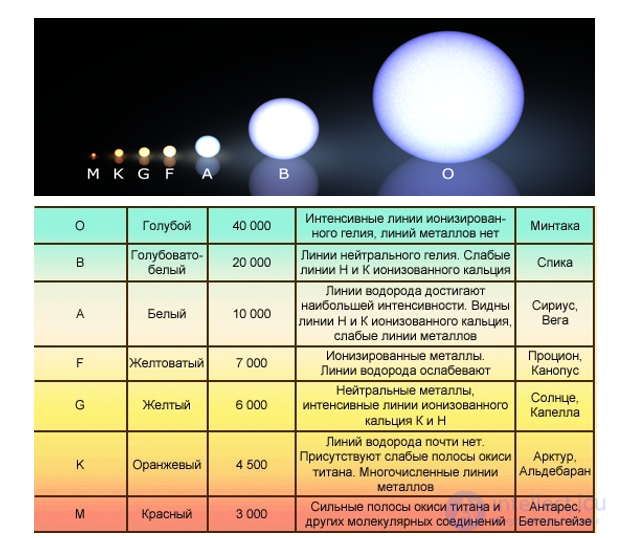
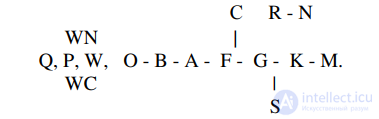
In the Harvard classification, spectral types are denoted by letters of the Latin alphabet
Class O. The high intensity of the ultraviolet region indicates a
high temperature. The light of these stars appears bluish. The most intense lines are those of ionized helium and multiply ionized carbon,
silicon, nitrogen, oxygen. There are weak lines of neutral helium and hydrogen.
Class B. The lines of neutral helium have the greatest intensity. The color
is bluish-white. A typical star is Spica.
Class A. The hydrogen lines reach maximum intensity. The color is white.
Typical stars are Vega and Sirius.
Class F. The hydrogen lines weaken. The lines of ionized metals (calcium, iron, titanium) strengthen. The color is yellowish. A typical star is Procyon.
Class G. The lines of ionized calcium are very intense. The color is yellow. A typical star is the Sun.
Class K. The violet end is weakened, indicating a strong decrease in temperature. The color is reddish. Typical stars are Arcturus and Aldebaran.
Class M. The metal lines weaken. The spectrum is crossed by absorption bands
of titanium oxide molecules and other molecular compounds. The color is red. A typical star is Betelgeuse (alpha Orionis).
In addition to the main classes there are branches off classes G and K, representing
stars with an anomalous chemical composition, differing from the chemical composition of most other stars.
Class C. Contains carbon stars. Their spectra show pronounced absorption lines of atoms and absorption bands of carbon molecules.
Class S. Zirconium stars. Instead of titanium oxide bands, bands of
zirconium oxide are present.
In classes R and N various molecular compounds are noticeable.
The letter Q denotes the spectral classes of novae.
The letter P denotes the spectral classes of the spectra of planetary nebulae.
The letter W denotes the spectra of Wolf-Rayet type stars - very hot stars, in whose spectra there are many emission lines.
In the spectra of WN stars, spectral lines of nitrogen are visible.
In the spectra of WC stars, spectral lines of carbon are visible. The photospheric temperatures of these stars are very high: from 60,000 to 100,000 K.
Within each spectral class one can establish a smooth sequence of subclasses, passing from one into another. Each class (except
O) is divided into 10 subclasses, denoted by digits from 0 to 9, which are placed after the letter.
Spectral class O is divided into subclasses from O4 to O9.5.
Various symbols are placed after such designations if the spectrum has special features. If emission lines are present, the letter e is added. Supergiant
stars are often distinguished by deep, narrow lines. This is noted
by the letter c (cF0). The gas pressure in the region of the stellar envelope where
the spectral lines form affects their width. At low density and low pressure the spectral lines are thin and sharply defined. This feature indicates a high luminosity.
The intensity of selected absorption lines allows one to judge the luminosity
of a star, whether it is a giant or a dwarf. In the first case the index g (giant) is placed before the spectral class, in the second - d (dwarf).
Other features not typical of a given class are denoted by the letter p
(peculiar) - peculiar spectra (A5p).
The axial rotation of stars leads to the broadening and blurring of spectral
lines. Therefore the indices n - diffuse lines, and s - sharp lines, have been introduced; they
are written next to the usual symbol of the spectral class.
In addition to the Harvard classification, another spectral classification of stars by luminosity was developed. It is called the Yerkes classification or
the “MKK classification” after the names of its developers - Morgan, Keenan, and Kellman.
This classification retains the spectral classes of the Harvard classification, but introduces the concept of a luminosity class, which is determined by the appearance
and relative intensity of certain spectral lines selected for this purpose. The luminosity class is a characteristic of the absolute stellar
magnitude.
Ia - bright supergiants (luminosity about 10,000)
Iab - intermediate supergiants.
Ib - faint supergiants (luminosity 5,000)
II - bright giants.
III - faint (normal) giants.
IV - subgiants.
V - dwarfs (most main-sequence stars).
VI - subdwarfs.
VIIa and VIIb - white dwarfs.

Comments