
Lecture
The annual motion of the Sun — is the apparent movement of the Sun among the stars against the background of the celestial sphere, caused by the orbital motion of the Earth around it.
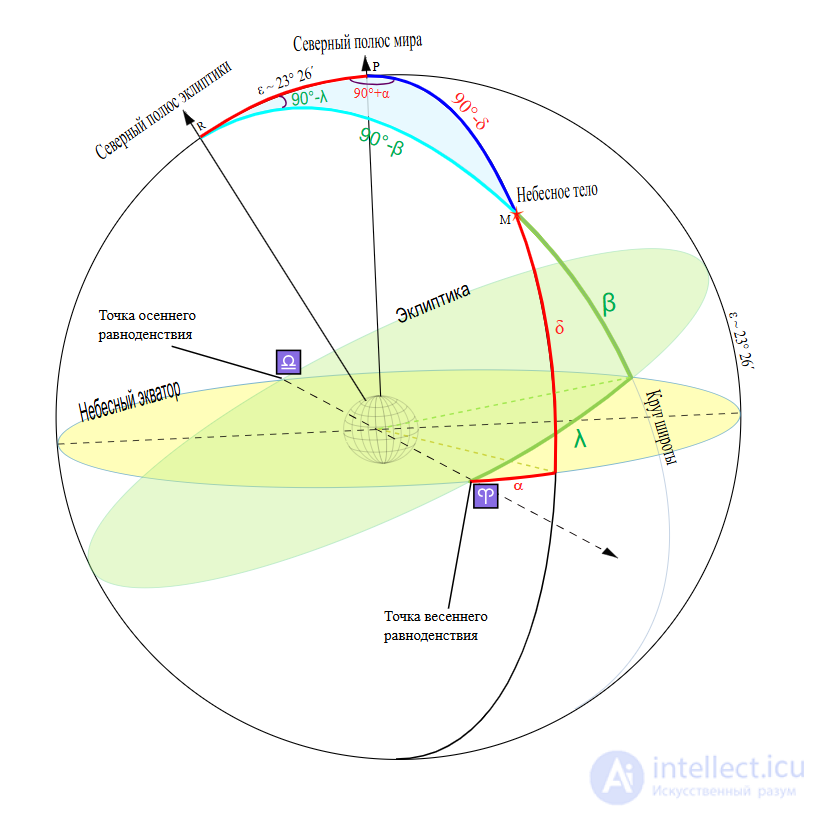
The ecliptic is the line of the Sun's apparent annual motion.
The equinox and solstice points
The zodiacal constellations
Sundial
Analemma
Calendar
The measurement of time is based on observations of the diurnal rotation of the celestial vault and the annual motion of the Sun, i.e., on the rotation of the Earth around its axis and on the revolution
of the Earth around the Sun.
The Earth's rotation about its axis occurs almost uniformly, with a period equal to the
period of rotation of the celestial vault. Therefore, from the angle through which the Earth has turned from some initial position one can judge the elapsed time. The initial position of the Earth is taken to be the moment when the plane of the terrestrial
meridian of the place of observation passes through a chosen point in the sky, or, which is the
same, the moment of the upper culmination of that point on the given meridian.
The duration of the basic unit of time, called a day, depends
on the chosen point in the sky. In astronomy, the points adopted are:
— the vernal equinox point (sidereal time),
— the center of the Sun's visible disk (true Sun, true solar time),
— the mean Sun — a fictitious point whose position in the sky can be
computed theoretically for any moment in time (mean solar time).
For measuring long intervals of time, the tropical year is used, based on the Earth's motion around the Sun.
The tropical year is the interval of time between two successive passages of the center of the true Sun through the vernal equinox point.
It contains 365.2422 mean solar days.
Because of the slow motion of the vernal equinox point toward the Sun,
caused by precession, relative to the stars the Sun ends up at the same point
in the sky after a time interval 20 min. 24 s. longer than the tropical year.
This is called the sidereal year and contains 365.2564 mean solar days.
Sidereal time.
The interval of time between two successive culminations of the
vernal equinox point on the same geographic meridian is called a sidereal day.
The beginning of the sidereal day on a given meridian is taken to be the moment of the upper
culmination of the vernal equinox point.
The time elapsed from the upper culmination of the point to any other position of it, expressed in fractions of a sidereal day, is called sidereal time s.
The angle through which the Earth turns from the moment of upper culmination of the
vernal equinox point to any other moment equals the hour
angle of the point at that moment.
s = t.
In practice, to establish the beginning of a sidereal day or sidereal time at some moment, one must measure the hour angle t of some star M whose right ascension is known.
Then t = Qm, α = m, and t = Q = s = α + t.
Sidereal time at any moment equals the right ascension of some star plus its hour angle.
At the moment of the upper culmination of a star its hour angle = 0, so s = α.
True solar time
The interval of time between two successive culminations of the Sun
(the center of the solar disk) on the same geographic meridian is called a true solar day.
The beginning of the true solar day on a given meridian is taken to be the moment
of the lower culmination of the Sun (true midnight).
The time elapsed from the lower culmination of the Sun to any other position of it, expressed in fractions of the true solar day, is called true
solar time Ts.
True solar time Ts on a given meridian at any moment numerically
equals the hour angle of the Sun ts + 12h.
True solar days vary in length, because:
1. The Sun moves not along the celestial equator, but along the ecliptic, inclined at
an angle of 23 deg. 26 min.
2. The Sun's motion along the ecliptic is nonuniform.
Mean solar time.
To obtain a day of constant length while still connected to the Sun's motion, astronomy introduces two fictitious points
- the mean ecliptic Sun and the mean equatorial Sun.
The mean ecliptic Sun moves uniformly along the ecliptic at the mean
speed of the Sun.
The mean equatorial Sun moves uniformly along the equator at the constant speed of the mean ecliptic Sun and passes through the vernal equinox point at the same time as it.
The interval of time between two successive culminations of the mean equatorial Sun on the same geographic meridian is called the mean solar day.
The length of the mean solar day equals the average value of the length of the true solar day over a year.
The beginning of the mean solar day on a given meridian is taken to be the moment
of the lower culmination of the mean equatorial Sun (mean midnight).
The time elapsed from the lower culmination of the mean equatorial Sun to
any other position of it, expressed in fractions of the mean solar day,
is called mean solar time Tm.
Mean solar time Tm on a given meridian at any moment numerically
equals the hour angle of the Sun tm + 12h.
The equation of time.
The difference between the hour angles of the mean equatorial Sun tm and the true
Sun tc is called the equation of time η.
η = tm - tc.
Universal time.
The local mean solar time of the Greenwich meridian is called universal or world time T0.
The local mean solar time of any point on Earth is determined by:
m = T0 + λh.
Zone time.
There are countless local systems of timekeeping, as many as there are meridians.
In 1884 a zonal system of mean timekeeping was proposed. Time
is reckoned only on 24 principal geographic meridians, spaced from one another in longitude exactly 15 deg. apart, approximately in the middle of each time zone.
The Greenwich meridian is taken as the principal meridian of the zero zone.
The local mean solar time of the principal meridian of any time
zone is called zone time Tn.
Tm - Tn = λ − nh
Tn = T0 + nh
Decree time.
For the more rational distribution of electricity used for lighting enterprises and residential buildings, daylight saving time is introduced in summer.
In the USSR on 16.07.1930 a government decree moved the clock hands 1 hour
forward relative to zone time.
The annual motion of the Sun underlies the understanding of natural cycles, the creation of calendars, and the measurement of time, which plays a key role in human life.
Lunar, solar, and lunisolar calendars, the history of their origin and
development.
A system for counting long intervals of time is called a calendar.
Ancient peoples measured intervals of time by observing the motion of the celestial bodies. The Bible says of this: "And God said, Let there be lights in the firmament
of the heaven to divide the day from the night; and let them be for signs, and for seasons, and for days, and years" (Genesis 1:13). This indicates that in the minds of ancient people the celestial
bodies were needed to establish a calendar.
To measure long intervals of time, people use the period of revolution of the Moon around the Earth and of the Earth around the Sun. These phenomena are complex, and
so confusion arose since ancient times in establishing the exact number of
days and months in a year. A full year, i.e. the time of the Sun's apparent revolution
around the Earth, does not contain a whole number of days or a whole number of equal
months.
According to modern data, one tropical year (the interval of time between
two passages of the Sun through the vernal equinox point) equals
365.2422 days. The month is based on the Moon's revolution around the Earth. But
each lunar month has 29 - 30 days. This means a year cannot contain 12 equal lunar months.
Some peoples, for example the Jews and Arabs, lived and still live by the lunar calendar. The year in this calendar contains exactly 12 lunar months lasting 29 - 30 days. Because the lunar year has fewer days than the tropical year, the Arabs have no fixed start of the year at all — it constantly shifts through the seasons. Within one person's lifetime, the year can begin in spring, summer, winter, or autumn. Other peoples combined
the solar and lunar cycles, trying to find a compromise.
The Romans originally reckoned time by lunar years. The New Year began on March 1. To this day some months of the modern calendar are named
according to this tradition (September - the seventh, December - the tenth, etc.). Subsequently
the first day of the year was moved to January 1, since from 153 BC on this day
the consuls took office.
Gaius Julius Caesar carried out a reform of the ancient Roman calendar, which was based
on the motion of the Moon. Starting January 1, 45 BC, he introduced a solar calendar.
The average length of the year according to this calendar equals 365.25 days.
To avoid the error associated with the fractional number of days, every 4 years
one day was added. A year with 366 days has since been called a leap year. The extra day was inserted not on February 29, as is done now, but between the 24th and 25th
day. The Romans counted days differently from us. The starting point
was not the first day of the month, but some notable event, which could even fall in another month. Usually three days of each
month were fixed, each corresponding to the beginning of a new lunar phase. The now-accepted counting of days from the first to the last of the month was established only
in the 6th century AD.
For example, the days in February were counted from the Calends of March. Thus February 24 was
in Roman terms called "the sixth day before the Calends of March".
And since in a leap year there were two twenty-fourths, the second one
was called "twice the sixth before the Calends of March". In Latin this
sounds like: "bis sextum Kalendae Mart". Later the year with the extra day came to be called annus bissextus. The Latin word bissextus turned in Russian
into "visokosny" (leap).
This calendar, in memory of Julius Caesar, is called the Julian calendar. The month of July
is also named in memory of the emperor. The month of August was named in honor of Emperor Octavian Augustus in the 8th century AD. The other months of the calendar are named according to
various traditions, for example January in honor of the god Janus, February in honor of the annual purification rites of Februa, March after the god Mars, May after the goddess Maia, June after the goddess Juno.
In the Julian calendar, one day is added in years whose number is divisible by 4 without a remainder.
However, the average length of the tropical year, measured by the
true revolution of the Earth around the Sun, differs from the Julian year by
0.0078 days. Over the lifetime of one generation this is imperceptible, but over 128 years the difference amounts to a full day.
In the Middle Ages the error had grown to seven days. This was noticed
by church figures.
By Christian tradition, the feast of Easter is linked to the day of the vernal equinox and is calculated relative to March 21.
This rule was adopted in the year 325 at the Council of Nicaea. Because of the inaccuracy of the Julian calendar, in the 16th century the vernal equinox, as
a natural phenomenon, fell on March 11, while Easter was calculated based on
ancient tradition, considering that it should be March 21.
The discussion of calendar reform continued for several centuries. Finally, on February 24, 1582, Pope Gregory XIII issued a bull proclaiming the new calendar and decreeing that after Thursday, October 4, 1582,
Friday, October 15 would follow.
The Gregorian calendar is based on a more precise knowledge of the tropical
year and is fully tied to astronomical phenomena. The date of the vernal
equinox always falls on March 21 and cannot shift. There is still a small discrepancy between the Gregorian and true tropical years. A difference of one day accumulates every 3,300 years. Such an error
is insignificant for us today.
A leap year is every fourth year, with the exception of years with a whole number of
centuries (1700, 1800,...). A year with a whole number of centuries is considered a leap year
only when the number of hundreds is divisible by 4 without remainder.
Another advantage of the Gregorian calendar is that the calculation of church holidays is based on the logic of the Ecumenical Councils.
In Russia this calendar was introduced starting Wednesday, January 31, 1918. The next
day was already February 14. In the time that had passed since Julius Caesar, the calendrical error had reached 13 days.
In Catholic countries the transition to the new calendar took place in the 16th century, and in
Scandinavia and Great Britain in the 18th century.
The Orthodox countries of Greece, Bulgaria, Romania, and Serbia adopted the new
style at the beginning of the 20th century.
The modern Orthodox church calendar contains many errors. Various anniversaries are celebrated incorrectly because the difference between the Gregorian and Julian calendars was not constant, but changed over time. In the 4th
century it was equal to 1 day, and by the 20th century it had reached 13 days. For example, the repose of the Venerable Sergius, Abbot of Radonezh, falls on September 25
(October 8), 1392. October 8 in the old style for the year 1392 does not
correspond to September 25 in the new style. In the 14th century the difference was only
9 days. This means the commemoration should take place on September 29 by the new calendar. Practically all dates earlier than the 18th century are celebrated with an error.
Eras. The starting point of each chronological system is called an era. Different peoples
had different eras, linked to some notable events or to the years of the reigns of kings and emperors. In Greece the era
of the Olympiads was used (beginning in 776 BC). Years were recorded as follows: Ol 5 3 — the 3rd year of the 5th
Olympiad. In Rome the era from the Founding of Rome (753 BC) was used, as well as counting
years from the appointment of consuls. The last consul was Flavius Basilius the Younger in 541 AD, and years were counted as post consulatum Basilii. In medieval Europe the era of Diocletian (August 29, 284 AD) was widespread. In Alexandria it was renamed the Era of the Righteous Martyrs, since the emperor
Diocletian persecuted Christians, and it survived in Egypt until the 19th century.
The Jews use the era from the Creation of the World, which begins in the year 3761
BC. Christians also use the era from the creation of the world, but have different traditions of counting years. All of them are based on counting biblical generations, but
have their own particularities. For example, the Byzantine tradition holds that in the year
the world began, the solar cycle (the number of years over which
the coincidence of leap years and the start of weeks repeats), the lunar cycle (the period
of recurrence of lunar phases), and the 15-year indiction should all begin. It turned out that the creation of the world occurred in the year 5508 BC.
The era from the Birth of Christ was introduced in 525 by the papal archivist Dionysius Exiguus. He equated year 248 of the era of Diocletian to the year 532 from the Birth of Christ. Researchers believe that Dionysius chose this date for the convenience of calculating the date of Easter, because no one has ever managed to
determine precisely the date of birth of Jesus Christ. The era from the Birth of Christ began to be used in some places in the
10th century, and universally in Catholic countries only from the 15th century onward.
When precisely determining the numerical value of the time interval between two distant dates, it is convenient to use a continuous count of days, which in astronomy are called Julian days.
The count of Julian days begins at mean Greenwich noon on January 1, 4713 BC; from the start of this period the counting and numbering of mean solar days is carried out so that each calendar date corresponds to a specific Julian day, denoted briefly as JD. Thus, the epoch 1900, January 0, 12hUT corresponds to the Julian date JD 2415020.0, and the epoch 2000, January 1, 12hUT corresponds to JD 2451545.0.
When solving certain problems in astronomy it is necessary to know
the number of mean solar days that have elapsed between two dates far apart from each other. This is easy to do with the help of Julian days. Julian days are days that are counted continuously through years, centuries, and
millennia from January 1, 4713 BC. The start of each Julian day is taken to be at mean Greenwich noon.
1 Julian year contains 365.25 mean solar days (the average length of a year in the Julian calendar), a Julian century – 36,525 mean solar days.
Julian days are part of the so-called Julian period, equal to 7980 years. The period was proposed in the 16th century by the Leiden professor Joseph Scaliger. He derived it as the product of three periods: 28×19×15 = 7980, and named it after his father, Julius. The 28-year period is called the solar cycle, at the end of which the distribution of weekdays across the days of the year repeats; the 19-year period is called the lunar cycle, after which the phase of the Moon repeats; the 15-year period comes from Roman law.

Comments