
Lecture
A variable star — is any star in which a change in apparent brightness over time has been detected. More strictly, stars can be considered variable if their apparent brightness outside the atmosphere in the ultraviolet, visible, or infrared range has changed with an amplitude large enough to be detectable given the precision of photometric observations achieved, over the time span during which observations of the corresponding accuracy were made.
The nature of stellar variability can differ greatly: brightness changes can be either strictly periodic or irregular, and they can have different amplitudes, periods, and durations of change. Variability is characterized by the light curve — a function of apparent magnitude versus time. Variability can be caused by a large number of different processes and is not a permanent property of a star, but arises and disappears at certain stages of its evolution. For example, if a star develops periodic pulsations, it changes its size and surface temperature, which causes its brightness to change as well. If in a binary system the stars eclipse one another, the brightness of the system periodically decreases. Mass transfer from one star to another can lead to nova and supernova outbursts. Besides these mechanisms of variability, many others exist as well.
The classification of variable stars takes into account various properties of stars, and hundreds of types of variables are distinguished within it, with some stars unable to be assigned to any of them. Classification systems were developed over a long time and were not coordinated with one another, and as a result the modern scheme adopted in the General Catalogue of Variable Stars is rather cumbersome and primarily empirical. The various types of stellar variability can be assigned to one of two large groups: physical variability or geometric variability. In the first case, a star's own luminosity changes due to some physical processes, and this group is subdivided into pulsating, eruptive and cataclysmic variables, as well as X-ray binaries. In the second case, the apparent brightness changes due to external effects; among geometric variables, rotating variables and eclipsing binaries are distinguished. Within each of these categories, individual types of variability are in turn also distinguished (for example, double-periodic stars).
Philosophical views that existed in antiquity assumed that stars were by their nature permanent objects, so no purposeful search for variable stars was undertaken. At the same time, new stars were known, which unexpectedly appeared in the sky and then disappeared after some time, but they were not regarded on a par with ordinary stars; instead they were considered «guest stars», like comets. Supernovae were also classified among the novae. The first discovered variable star, apart from novae and supernovae, was Mira. In 1596, David Fabricius discovered this star when it was of the second magnitude, and found that its brightness was gradually decreasing. It then ceased to be observable, and Fabricius stopped monitoring that region of the sky, but he rediscovered it in 1609. At first the number of known variable stars grew slowly, but the spread of photography toward the end of the 19th century made it possible to discover them in large numbers.
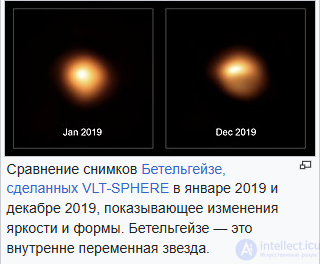
Physical variable stars are stars that change their luminosity
over short periods of time as a result of physical processes occurring within the star itself.
The following are distinguished:
- pulsating variables,
— Cepheids, RR Lyrae type, dwarf Cepheids, Mira-type, semiregular,
irregular,
- eruptive variables,
— novae, supernovae,
depending on the nature of the processes occurring inside the star.
All variable stars have special designations, if they had not been
designated earlier by a letter of the Greek alphabet.
The first 334 variable stars of each constellation are designated by a sequence of Latin letters R, S, T, ..., Z, RR, RS, ..., RZ, SS, ST, ...,
ZZ, AA, ..., AZ, QQ, ... with the name of the corresponding constellation added.
Subsequent variables are designated V 335, V 336, and so on.
The evolutionary transformation of a star into a giant is accompanied by an increase in its
volume and a decrease in the average density of its matter. During this time
fundamental changes occur in the star's internal structure, and this may be accompanied
by an imbalance between the forces of gravitational attraction and radiation
pressure. This leads to the star's variability.
The star's volume often oscillates periodically and irregularly. The star alternately swells and subsides. Such oscillations are called pulsational.
As the star's radius increases, the area of the photosphere also increases, as well as
the temperature, luminosity, and brightness. Radial pulsations of the photosphere and atmosphere
lead to changes in the radius. The outer layers move alternately away from the observer,
then toward it. This causes a change in radial velocity, which is determined from
measurements of the shifts of spectral lines.
The first pulsating star was discovered by Fabricius in 1596 in the constellation Cetus and named Mira. Its period is 331.6 days. Similar long-period stars are called Mira variables.
In 1784 Goodricke discovered the variability of δ Cephei. the brightness amplitude equals
5
d
.3663. Stars similar to it are called Cepheids.
Cepheids are pulsating giants of classes F and G, so they can be observed from great distances. Their periods range from 1.5 to 50 days.
The brightness amplitudes of Cepheids reach 1m
.5.
The Pole Star also belongs to the class of Cepheids.
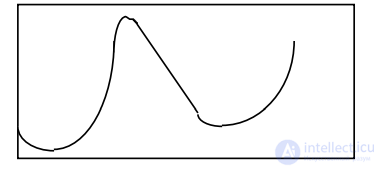
The apparent magnitude changes smoothly and periodically over time and corresponds to a change in the star's luminosity by several times. In sync with the brightness, the photosphere's temperature, color indices, and radial velocities change, and
consequently so do the radii of the photosphere and atmosphere. There is a change in the spectrum within 1 spectral class.
The pulsation of the star occurs owing to a valve mechanism, in which the opacity of the star's outer layers holds back part of the radiation from the inner
layers.
The role of such a valve is played by the layer of the star where helium is partially ionized.
Neutral helium is opaque to the star's ultraviolet radiation, which is held back and heats the gas. This heating and the resulting expansion
promote the ionization of helium, the layer becomes transparent, the flux of outgoing
radiation increases. But this leads to cooling and contraction, because of which
the helium becomes neutral again and the whole process repeats itself.
Only certain stars are suited to carrying out this mechanism,
occupying a special place on the Hertzsprung-Russell diagram.
Cepheids do not remain in the instability stage forever. A formula has been derived that allows the age T of a Cepheid to be calculated depending on the length of
the period:
lg T = - 0.714 lgP + 2.57.
T - age expressed in millions of years, starting from the moment when the star
first reached the main sequence in the course of its evolution.
From pulsation theory it follows that there is a relation between the period P and the average density ρ
of the matter:
P √ ρ = const.
When the average density changes, the period must change too.
A relation between period and luminosity was also established for Cepheids.
This relation is linear. The greater the period, the greater the luminosity and the absolute magnitude.
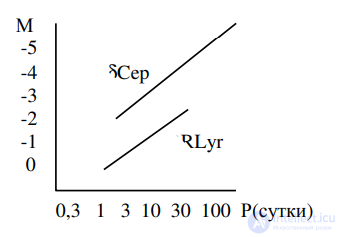
This relation is used to determine distances to distant objects when no other methods can be applied. The difficulty lies in the fact that it is very
hard to find the zero point for the placement of the lines on the diagram, because
trigonometric methods have not measured the distance to any single Cepheid.
More than 700 Cepheids are currently known in our Galaxy.
Cepheids are divided into groups:
1. Delta Cepheids (Cδ) or classical Cepheids. These stars are characterized by
a relation between the period and the shape of the light curve, discovered and studied by E.
Hertzsprung.
For Cepheids with periods ranging from 1.5 to 5 days the brightness curve
is smooth, while at longer period values a “bump” appears on the
descending branch of the brightness curve, which gradually shifts toward the maximum. Thus, by the value of the period and the shape of the brightness curve, a delta Cepheid can be distinguished from other objects.
These are young objects located close to the main plane of the Galaxy.
2. W Virginis type Cepheids (W Cepheids, CW). These stars do not fit into
the patterns of ordinary Cepheids, are located far from the plane of the Galaxy
and are much older. They are found in globular star clusters and belong to the spherical component of the Galaxy.
These stars are hottest not at maximum, but in the middle of the rise in brightness.
3. Low-amplitude zeta Cepheids (Cζ). a typical representative is the star
ζ Geminorum. They have symmetric brightness curves and are located in
space close to the central regions of the Galaxy's spiral arms.
RR Lyrae type stars.
These are giants of spectral class A. They occupy a narrow region on the Hertzsprung-Russell diagram, corresponding to nearly the same luminosity for all of them.
The periods of these stars range from 0.2 to 1.2 days. They
change brightness very quickly. The amplitude of the brightness change reaches 1 stellar magnitude.
In all stars of this type the radial velocities change, which indicates
pulsational changes in radius. During the rapid rise in brightness, a shock wave arises in the hydrogen envelope and bright emission
lines in the spectrum. The color indices change synchronously with the brightness, which is caused by a change in the photosphere's temperature. At maximum brightness the star is hotter
and whiter.
There are many such stars in globular clusters, and many of them have variable periods (the Blazhko effect). Like the Cepheids, these stars also show a period-luminosity relation.
Dwarf Cepheids. These stars have a very short period of brightness variation
from 0 d.055 to 0 d.2. The amplitudes of the brightness variation are small - from 0.2 to 0.7
stellar magnitudes.
The spectra of these stars are of class A, with modest luminosities - from +4 to +2.
Long-period variables (Mira variables). Stars of the o Ceti type.
The amplitudes of brightness variation can reach 10 stellar magnitudes. The periods are very
diverse and can range from 90 to 730 days.
These are red stars of spectral classes M, S, N. Due to their high luminosities
they belong to the class of supergiants.
The pulsation mechanism in these stars is somewhat different from that in Cepheids. The variability
of brightness is caused by fluctuations in temperature. As the temperature drops, atoms
combine into molecules. Molecules absorb radiation more actively than free atoms, and the transparency of the outer layers decreases, leading to a dimming of brightness. Energy is retained in the inner layers and gradually
accumulates, leading to heating. As the temperature rises,
the molecules break apart into atoms, and the medium becomes transparent.
Only those long-period variables whose
spectra show emission lines are classified as Mira variables.
The rest are simply called long-period variables.
In addition to regular variables, there is a significant number of stars
in which very complex, unpredictable changes in brightness occur.
They are called semiregular or irregular variables. Observing them
requires long series of uniform observations.
A typical such star is µ Cephei. Two types of fluctuations can be seen on the brightness curve.
These are smooth fluctuations in brightness with an amplitude of 1 stellar
magnitude. The moments of maxima cannot be represented by a single formula with
an exact period value. The period has to be replaced by a cycle - the average
duration of the time interval separating two neighboring moments of
maximum. The individual cycles of brightness change for this star range from
730 to 904 days. The curve of the average brightness change may also have a period
of 4500 days.
In cases where some average cycle value can be derived,
the star is called semiregular. If no average value can be found -
it is called irregular.
It is possible that one of the causes of such irregular brightness variation
is the rotation of supergiants, whose disks are covered with huge
light and darker spots.
There are also many variable stars among dwarfs, though about 10 times fewer than
among giants. They show their variability in the form of repeated outbursts,
which can be explained by various kinds of matter ejections - eruptions. Therefore this entire group of stars, together with novae and supernovae, is called
eruptive.
Among eruptive stars one finds the most varied types, both young and
old.
1. Young stars. These are stars that have not yet completed the process of gravitational
contraction. These include the variable T Tauri and similar stars.
These are dwarfs of spectral classes F - G, with emission lines in the spectrum.
Many such stars are found in the Orion Nebula, where the process of star formation is underway.
The change in luminosity is very irregular, and no pattern can be established. Chaotic changes in brightness can occur with amplitudes reaching 3 m
, and sometimes up to 1m
within an hour. Stars of the
T Tauri type are most often found in groups, especially within large gas-and-dust nebulae. These groups are called T associations. Small
bright nebulae are also observed directly around these stars, which indicates the existence of extensive gas envelopes around them.
The motion of matter in these envelopes, associated with the process of gravitational
contraction of the star, is the cause of the chaotic variability.
Flare stars of the UV Ceti type are found together with variables of the
T Tauri type. These are dwarfs of spectral classes K and M. Emission lines of
calcium and hydrogen are observed in their spectra. They are distinguished by the extraordinary speed
of the increase in luminosity during episodic flares. In less than a minute
the radiation flux can increase tenfold or more. After that, within half an hour it returns to its original state. During a flare the brightness of the emission lines intensifies. The nature of the phenomenon resembles chromospheric flares on
the Sun, but on a much larger scale.
The flare activity of these stars has long periods of intensification and weakening, similar to the 11-year solar activity cycle.
It is possible that the cause of the outbursts is non-thermal. Streams of fast-moving charged elementary particles burst out from the depths of the star, causing
powerful changes in the envelope.
These stars are slightly older than the previous ones and are at the final stages of gravitational contraction. Not very many have been found – about
75. They have low luminosity and can be observed only near the Sun.
There is a large group of flare stars whose flares last not minutes
but much longer. This group includes all the stars of the Pleiades cluster.
Wolf-Rayet (WR) type stars. They form a small group of stars
belonging to the brightest objects in the Galaxy. On average they have an absolute
magnitude of -4m
. Their number does not exceed 400. The spectra of these stars consist of broad bright lines belonging to atoms and ions with high
ionization potentials. The appearance of the spectral lines indicates an accelerating expansion of the envelopes surrounding these stars. The source of energy in the lines is the powerful ultraviolet radiation of a very hot star, whose effective temperature reaches 100,000 K. The radiation pressure of the hot radiation is the cause of the accelerated motion of atoms in the atmospheres
of these stars.
Fuors and antifuors. In 1936 an interesting phenomenon was discovered. A faint star of magnitude 16 m gradually increased its brightness 150-fold over several months and
now shines like a star of magnitude 10 m
. Its spectrum is characteristic of a supergiant of spectral
class F5 or G3. The star is called FU Orionis, and stars similar to it are called fuors.
The star CQ Tauri, on the contrary, was a star of magnitude 9 m
, and then gradually faded to 11m
and
remains faint. This star was named an antifuor.
These are eruptive old stars of a special type. Novae exhibit a sudden and sharp increase in luminosity of at least 7-8 stellar magnitudes.
Most often, during the outburst the apparent magnitude decreases by 10 m
-
13 m
, which corresponds to an increase in luminosity of tens to hundreds of thousands of times. After
the outburst these stars are hot dwarfs.
At the maximum phase of the outburst they resemble supergiants of spectral
classes A - F. If the outburst of the same nova has been observed more than once, it is called recurrent. Recurrent novae have a smaller increase in luminosity than
ordinary ones.
In total, about 300 novae are known, of which about 150 flared up in our
Galaxy and over 100 in the Andromeda Nebula. Among the seven known recurrent
novae, about 20 outbursts have been observed. Outbursts occur approximately once every
100 years. Many, if not all, novae are close binary stars.
After the outburst, weak variability is often detected.
During the outburst, the initial rise in brightness occurs very quickly, over 2-3 days.
Shortly before maximum, the rise in luminosity slows somewhat (the final rise). After maximum, a decrease in luminosity occurs, lasting
years. The drop in brightness over the first three magnitudes is smooth. Then follows a transitional stage, characterized by either a smooth decrease in luminosity by another
three magnitudes, or fluctuations in it. The final drop in brightness occurs
smoothly, and the star acquires the luminosity it had before.
During the outburst, a sudden explosion occurs, caused by an instability
arising in the star. This instability may arise in some hot stars as a result of internal processes determining the release of energy in the star, or as a result of the influence of some external factors.
The cause of a nova explosion may be an exchange of matter between the components
of close binary systems. If hydrogen-rich matter from the envelope of the main
star falls onto the surface of its companion – a white dwarf – a sudden release of thermonuclear energy may
occur. This energy is very large, but is
still immeasurably smaller than the star's total energy reserves, so the explosion of a nova is not
accompanied by a change in its overall structure, but affects only the surface layers.
A consequence of the heating of the gas resulting from the explosion is the ejection of
matter by the star, leading to the separation of its outer layers – an envelope with a mass of 0.0001 Msol. This envelope expands at an enormous speed of up to 2000 km/s.
This is evidenced by Doppler shifts of spectral lines toward the violet end of the spectrum. The star quickly sheds its envelope and as a result
forms a nebula around itself. Expanding gas nebulae have been
found around almost all nearby novae.
Knowing the distance to a nova, one can determine its initial and maximum luminosity, as well as estimate its radius before the outburst and its maximum radius.
Supernovae are stars that flare up like novae but reach at maximum an absolute magnitude of -18 m to -21m
. The increase in luminosity occurs
by tens of millions of times, more than 19 m
. The total energy radiated by a supernova during the outburst exceeds that of novae by thousands of times. The name “supernova” was given in 1934 by the Americans Zwicky and Baade.
More than 300 supernova outbursts have been photographically recorded in other
galaxies. The luminosity of supernovae was often comparable to the integrated luminosity of the entire galaxy in which the outburst occurred. For example, in 1895
a supernova was observed in the galaxy NGC 5253. The star was of magnitude 7.2 m
, while the
galaxy itself was 12 m
. A single star radiated 100 times more than all the stars of the galaxy
combined! According to Zwicky's rough estimates, supernovae flare up in a galaxy approximately once every 360 years.
Chronicles have revealed that several supernova outbursts have also occurred in our
Galaxy. This work was done by the Swedish astronomer Lundmark. Over the last 1000 years, at least 6 supernovae have been observed: in 1006, 1054,
1181, 1572, 1604, and 1667.
The most famous is the supernova of 1054, observed by Chinese astronomers in the constellation Taurus, which was brighter than Venus, so bright that it could be
seen even during the day. A record of this remains in the Chronicle of Song Hanyao: “On the 22nd day
of the seventh Moon of the first year of the Zhihe period, Yang Weide said: “I prostrate
myself: I observed in the constellation Tianguan the phenomenon of a guest star...
By order of the emperor I most respectfully made a prediction,
which amounts to the following: The guest star will not violate Aldebaran. This indicates that the country will gain great strength. I ask that this prediction be
kept on record in the department of historiography...”. In memory of it remains the Crab Nebula.
No less interesting was the appearance of the supernova of 1572. This star
was observed by Tycho Brahe in the constellation Cassiopeia. Within a few days the star became
brighter than Venus, and then faded over the course of two years.
Although a supernova outburst resembles a nova outburst, this phenomenon differs greatly in its physical nature and scale.
Based on the nature of the spectrum at the time of maximum, supernovae are divided into 2 types.
1. Near maximum they have a continuous spectrum, in which no
lines are visible. Later, wide emission bands appear, whose position
does not coincide with any known spectral lines. The width of the bands
corresponds to gas expansion at speeds of up to 6000 km/s. The light curve
after maximum is smooth, the decrease in brightness follows an almost linear law.
2. The luminosity at maximum is lower than that of type 1. The spectra are distinguished by enhanced ultraviolet emission. Absorption and emission lines are observed. At the final stage the light curves are steeper. Sometimes
secondary maxima are observed.
After type 1 supernova outbursts, rapidly expanding gas
nebulae remain. The shape of the emission lines of the Crab Nebula indicates
its expansion at a speed of about 1000 km/s. The Crab Nebula is
one of the powerful sources of radio emission in the Galaxy. The X-ray emission can be explained by the deceleration of relativistic electrons as they
move in a spiral around the field lines of weak magnetic fields.
Type 2 supernovae eject during outbursts an enormous mass of gas, exceeding the mass of the Sun. The gas, expanding, moves through space and can
exist in the form of a nebula for tens of thousands of years.
Type 2 supernovae flare up only in the arms of spiral galaxies, whereas in elliptical and irregular galaxies only type 1 supernovae flare up.
Elliptical galaxies contain mostly old stars with mass not much exceeding the mass of the Sun. All the more massive stars in them have long since
evolved. This means that type 1 supernovae before the explosion are very old
stars, whose mass exceeds the solar mass by only 10-20%. The same
type of stars flare up in spiral galaxies as well.
Type 2 supernovae are young objects. They are located in spiral arms,
where the process of star formation is still ongoing. The age of these stars is no more than tens of millions of
years. However, an outburst occurs in a star only when it leaves the
main sequence and enters the final stage of evolution. This means type 2 supernovae are very massive stars, with a mass 10 times or more that of the Sun. On the main sequence these are hot blue
giants of classes O and B.
Neutron stars were theoretically predicted back in the 1930s. According to the theory, if the initial mass of a star's core lies in
the range from 1.2 to 2.4 solar masses, after the nuclear fuel is exhausted,
the following occurs. The force of radiation pressure cannot balance the gravitational compression, and the inner regions collapse toward the center of the star, while
the outer envelope is ejected at a speed of up to 10,000 km/s as a
result of the explosion. A supernova phenomenon occurs. The inner regions of the star for
within a few seconds, are compressed to the state of nuclear matter. The linear dimensions of the star reach about 10 km.
In such a star, the gravitational compression force is opposed by the force of interaction
between neutrons and protons. That is why it is called a neutron star.
In practice, it is very difficult to detect a neutron star because of its small size. At a temperature of about 6000 K at a distance of about 10 light years, the stellar
magnitude would be only about 30 m
.
The discovery of neutron stars became possible only with the development of X-ray
and radio astronomy. In 1964 the first sources of X-ray radiation were discovered. It was immediately suggested that these were indeed neu-tron stars, since after compression the surface temperature of neutron stars
should reach about a billion K. Then the maximum of the radiation should fall on hard X-ray radiation.
In 1967 staff of the Cavendish Laboratory discovered pulsars. On the
radio telescope, very short pulses of radio emission, about 50 milliseconds in duration, repeating at a strictly constant
period of about 1 second, were observed. Initially it was assumed that these were
sources of artificial origin. However, purposeful searches
for similar objects made it possible to discover a large number of them. The periods of pulsars lie within the range from 0.002 to 4 s.
The change in the periods of pulsars is a very small quantity, less
than 10-14
per period.
More than 300 pulsars are currently known. The radiation of pulsars has a
non-thermal nature. Distances to them have been measured. They lie within the range
from hundreds to thousands of parsecs.
Some pulsars have been identified with nebulae - the remnants of supernova
outbursts. The most interesting pulsar - NP 0531 - lies in the Crab
Nebula. The optical radiation of this star is also pulsed. At maximum brightness it has a magnitude of 13. Its X-ray radiation exceeds the power of its optical radiation by 100 times.
The short periods of pulsation are related to the fact that the rotation of the neutron star
is very fast, reaching several tens of revolutions per second. The time interval between successive pulses equals the period of rotation
of the neutron star. The pulsation is explained by the presence of inhomogeneities, hot spots on the surface of neutron stars.
In some pulsars a slow increase in period has been detected (doubling over 1000 - 10,000,000 years) related to the braking effect of the magnetic field.
In 1962 the first cosmic source of X-ray radiation was discovered. It was named
“Scorpius X-1”.
By now more than 600 sources of X-ray radiation have been discovered. About half of them belong to other galaxies.
Many sources of X-ray radiation have been identified with radio and X-ray pulsars, some with nebulae - remnants of supernova outbursts. The cause of the glow of the latter is the thermal radiation of gas
heated to a temperature of several million degrees.
About a hundred bright galactic X-ray sources are associated with X-ray stars. These are close pairs of massive stars, of which one is
a relativistic object, and the other an ordinary star.
A feature of the radiation of these objects is the variability of their radiation.
Variations in the flux of optical and X-ray radiation are in no way connected
with each other. Analysis of the radiation shows that the sources of X-ray
radiation must be very compact objects, of the type of neutron stars.
Besides neutron stars, sources may be white dwarfs and black holes, located in a close pair with a normal star.
The cause of X-ray radiation is the process of mass loss
by a normal star and its capture by the relativistic object. Mass
loss can occur either in the form of a jet or in the form of a stellar wind. In the
first case the gas spirals around the relativistic object, forming a flat disk. Friction leads to a decrease in speed and the gas spirals in toward the star. This phenomenon is called accretion.
As a result of accretion, the potential energy of the falling gas is converted into heat. This leads to strong heating. At high temperatures the maximum
of the radiation of the gases falls in the X-ray range of the spectrum. If the star
has a magnetic field, then the gas moves along the magnetic field lines, is heated and
falls near the magnetic poles.
In neutron stars the magnetic axis and the rotation axis do not coincide, and the hottest
regions, near which accretion occurs, given favorable orientation, become visible at intervals equal to the period
of rotation of the neutron star, which produces the phenomenon of a pulsar.
During accretion onto a black hole, the pulsar phenomenon is not observed. The X-ray
radiation can fluctuate strongly.
The most likely black hole candidate is the X-ray source Cygnus X-1. Its mass equals 7-10 solar masses.
X-ray burst sources are also observed. The bursts occur irregularly. Such objects are called bursters and are identified
with globular star clusters.
guest star
Irregular variable
List of variable stars
Stellar pulsation

Comments