
Lecture
In the early 1980s, theories of the Kaluza-Klein type became especially popular, according to which the dimensionality of our space is greater than 4, but
part of the dimensions are "compactified," so that we cannot move in the corresponding directions.
Since the end of 1984, superstring theory has been developed, according to which the fundamental
objects of the theory are not point-like elementary particles, but string-like formations of very small size.
The successes of hot Big Bang theory, based on the homogeneous Friedmann model of the Universe, gradually led to the conviction that the Universe is arranged everywhere in the same way as in the vicinity of the Solar System. This conviction is in
full agreement with observational data.
Analysis of tables of elementary particles and properties of the observable part of the Universe
does not leave a feeling of unconditional harmony. Why is the Universe almost homogeneous and at the same time contains such inhomogeneities as planets, stars,
galaxies? These questions raise the question of whether our world could have been created
differently.
According to modern unified theories of elementary particles, the properties of the observable world are related to the specific way in which the symmetry between different types of interactions is broken and which of the many possible variants
of compactification of the original multidimensional space is realized in
the part of the Universe surrounding us.
Initially it was assumed that the choice of the type of symmetry breaking and the choice of the method of compactification should occur identically throughout the Universe. However, further study of this question showed that within the framework of the inflationary Universe scenario, the hypothesis of such uniformity may be incorrect.
The simplest and most natural scenario of the inflationary Universe now appears to be the chaotic inflation scenario. Inflation can occur in the ordinary theory of a massive scalar field ϕ, characterized by mass m, where the potential energy V(ϕ) of the field ϕ at large ϕ grows as
any power of the field V(ϕ) ~ ϕ
n
.
The behavior of the Universe depends on the initial distribution of the classical
field ϕ, and in the simplest theory of a massive scalar field ϕ with V(ϕ) = mϕ
2
/2
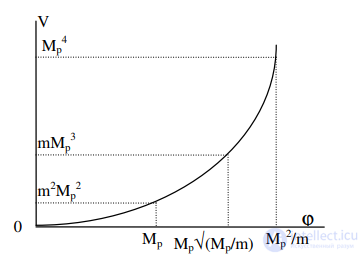
it can be described using a curve:
The region of initial values is forbidden. Quantum fluctuations of the metric are so large that
one cannot speak of classical space-time.
In regions of space in which the
field was initially in the interval Mp<ϕ 2
/m, the process
of decreasing field goes very slowV
ϕ
mMp
3
m
2Mp
2
Mp
4
0
Mp Mp√(Mp/m) Mp
2
/m
ly. The Universe at this time expands exponentially.
This stage is called the inflation stage.
In the simplest models, during the time of inflation the size of the Universe grows by a factor of 10100
000 - 1010 000 000 000!
When the field decreases to ϕ ~ Mp, where Mp ~ 10-5
g. - the Planck mass, it
begins to oscillate rapidly near the minimum of V(ϕ), and in the presence of interaction of this field with other physical fields, the energy accumulated in it
turns into heat, i.e., the Universe becomes hot.
In the region Mp√(Mp/m)< ϕ < Mp
2
/m, due to quantum effects, field inhomogeneities with a very long wavelength are generated, and
the amplitude of these
inhomogeneities, arising over the characteristic time ∆t~H-1
, is greater than the overall decrease of the field ϕ over the same time due to the "rolling" of the field toward the minimum
of V(ϕ). As a result, over the time ∆t~H-1 the total volume of the Universe increases by a factor of e3
(due to inflation), and in almost half of this volume the field ϕ does not decrease,
but grows, and the rate of inflation of the Universe in regions with an increased
field ϕ also increases.
This leads to the fact that most of the volume of the Universe, in which there was initially at least one region with ϕ > Mp√(Mp/m), is now in a state with the maximum possible field ϕ and continues to inflate. In these regions the expansion of the Universe never ends, i.e., the Universe exists
forever. On the other hand, those regions of the Universe in which the field ϕ becomes
smaller than ϕ ~ Mp√(Mp/m), after some time stop inflating,
acquiring a size l>10100000 cm. We live in one of such regions.
An important feature of this scenario is the strong fluctuations of the metric and
all other physical fields in most of the volume of the Universe, in which
now ϕ ~ Mp
2
/m. These fluctuations lead to the division of our Universe into
exponentially large regions with all possible types of vacuum
states and with all possible types of compactification of the "extra" dimensions. In each of such regions, the properties of space-time and the low-energy physics of elementary particles will be different.
In some of these regions the dimensionality of space-time may be
differs from four, then instead of weak, strong, and electromagnetic interactions there could exist interactions of completely different types with other
coupling constants.
Thus, according to this scenario, the global geometry of our world
differs radically from the geometry of the Friedmann world. The Universe turns out to be
composed, as it were, of separate Friedmann mini-universes with different
properties, and life of our type can arise in those mini-universes
whose conditions are good enough for this (the anthropic principle). Planets and atoms of our type can arise only in three-dimensional space.
Gravitational forces in spaces with a different number of dimensions decrease
too quickly with distance, and planetary systems are unstable.
F ~ 1/RN-1
The evolution of the Universe has no single (singular) beginning. The properties of spacetime and the laws of interaction of elementary particles in each
“bubble” - mini-universe can be different.
Each region of a mini-universe (domain) has a size of ~10 billion light years and exceeds the size of the Universe observable by us.
The term vacuum is used in modern physics in two senses. The first -
the most common - corresponds to very rarefied gases. The second
corresponds to a state in which real particles are completely absent.
In this case the physical vacuum corresponds to a condensate of particles with integer
spin (bosons). Such a condensate, owing to quantum effects, is characterized by the following properties:
1. It corresponds to a minimum in the energy dependence of the system on the function ϕ, which determines its state.
2. In the presence of real particles, the condensate tends to “draw” them to
itself, rather than “push” them out, as occurs in real gases. Therefore the physical vacuum is characterized by an exotic equation of state
p = - ε.
The vacuum state experiences continuous and opposing influences. On the one hand, the properties of the boson condensate are such that it tends to
retain all the particles contained in it, while on the other hand the equation of state
determines its instability. These opposing properties of the vacuum result in the fact that to form real particles out of the vacuum it is necessary to expend
energy, and a rather significant amount. On the other hand the vacuum continuously generates virtual particles, whose lifetime is very short, for example, for
electrons t = 10-22
s.
Virtual particles cannot be observed directly, however, their existence is manifested through interaction with real particles. One can say that the vacuum continuously “boils”, but does not “boil away”. The best-known
vacuum effect - the shift of energy levels in the hydrogen atom, caused by the interaction of moving atomic electrons with virtual
particles of the vacuum (the Lamb-Rutherford effect).
The vacuum is an absolutely homogeneous medium, characterized by its own energy density and gravitational characteristics. Therefore it is equivalent in its
properties to the Λ term introduced by Einstein into the equations of general relativity.
Modern concepts of the vacuum allow us to take a different view of the problem of the singularity and the first moments of the Universe's existence after
the Big Bang.
The Universe arises as a result of a perturbation of the vacuum. The energy of the vacuum is converted into real particles, which, interacting with one another, generate
baryon asymmetry. Not all vacuum perturbations can overcome the potential barrier and develop into mini-universes. 10-35 s after their
formation, mini-universes pass into the Friedmann regime. After
this the Universe expands according to the developed Big Bang model.
When the density of the Universe is greater than critical, expansion will change to contraction,
the density will increase and reach the Planck density. In this small volume
(~10-10cm) there will be vacuum-like matter, which may give rise to
a new mini-universe. And this process will continue continuously
and endlessly. In the transition from one mini-universe to other
similar objects, it is not at all necessary that the fundamental constants (constants, the number of interactions, the dimensionality of space, particle masses) repeat. Each new universe may have its own dimensionality and constant properties.
Since the time of Euclid the Universe was conceived as three-dimensional. Einstein's special relativity uses as its geometric structure the four-dimensional pseudo-Euclidean
space of events. The interval between two nearby events is expressed as follows:
ds2
= c2
dt2
- dx2
- dy2
- dz2
.
Time enters into the definition of physical space, being proper
for each frame of reference. The length of a segment and the duration of a time interval depend on
relative motion of reference frames. The structure of physical space is given by a Euclidean-type metric, fixed independently of any material interactions.
In general relativity, the properties of space-time are not given in advance, but are determined
for each specific case depending on the material circumstances.
Gravitational fields are taken into account here.
ds2
= gikdxi
dxk
,
where i,k = 0,1,2,3; gik = gik(x0
,x
1
,x
2
,x
3
).
Physical processes affect the metric of space. Within general relativity, bodies
deform space. The fundamental meaning of the geometrization of gravity is that space and time, as forms of the existence of matter, find
their direct representation in the objective reality of the physical
field of universal (gravitational) interaction and cannot themselves (without
the field) exist. In place of Newton's abstract space
stands the gravitational field, which forms the physical structure of space and
manifests itself through its restraining action on all material objects.
Every individualized particle changes the gravitational field, and the field
influences its motion.
At the beginning of the 20th century, many physicists wanted to create a unified theory of interactions, combining electromagnetic and gravitational interactions.
T. Kaluza proposed in 1921 to carry out this unification by postulating that
space-time has not four dimensions, but five. Experimental
data indicate four-dimensionality, but for the success of the unification, the size of the fifth dimension of the space-time continuum
does not matter. Einstein attempted to build a unified theory in the last years of his life.
In the 1970s, interest in multidimensional physics revived. It came to be understood
that in a unified field theory, quantum-mechanical
divergences and anomalies could be eliminated. In the simplest version of the unified theory, in addition to four-dimensional space-time, a seven-dimensional compact
space arises, which for some visualization can be identified with a seven-dimensional sphere.
The fundamental physics corresponding to the unified interaction
is formed at Planck quantities (l = 10-33
cm.) This quantity coincides with
the critical distance at which quantum electrodynamics loses meaning. Therefore, it is natural to assume that the size of the seven-dimensional compact sphere coincides in order of magnitude with the Planck length and therefore does not manifest itself directly when investigating physical geometry.
Some progress on this question emerged after the introduction of the idea of superstrings.
This idea is based on the notion that the basic element of physical
geometry is not a point, but a one-dimensional entity - a string. The superstring is the prototype of truly elementary particles (electrons and quarks). Previously
it was believed that such particles have zero size, but now - Planck-scale size.
In superstring theory, it has been possible to eliminate many divergences. The dimensionality corresponding to a consistent superstring theory is 506.
Of this number, four correspond to the space-time continuum,
while the rest correspond to a compact volume with Planck-scale dimensions. At
the moment the Metagalaxy formed (15 - 20 billion years ago), all spatial dimensions except three compactified, shrinking to
Planck sizes. Now, at large distances (up to the size of
the Metagalaxy), space is Euclidean and three-dimensional; at very small, Planck-scale distances, geometry is multidimensional and non-Euclidean.
The new theory must include, as a mandatory element, the variability of fundamental constants - masses, the dimensionality of space, and interaction constants. Direct observations and modern cosmology indicate that, starting from the time the Metagalaxy began expanding (~1s),
the constants have not changed. Consequently, the values of the fundamental constants could have been fixed at very early times, when mini-universes arose. Consequently, a complete unified theory of elementary particles and the theory of the origin of mini-universes are two different aspects of one phenomenon. The true and complete theory is a synthesis of cosmology and the theory of elementary particles.
The diversity and complexity of the physical systems that make up the observable
Universe are so striking that the task of discovering simple laws capable of describing all these systems seems hopeless.
If nature had chosen a different sequence of numbers for the fundamental
constants, the world would be different.
Such important structural units as stars like the Sun owe their properties to improbable coincidences of numbers, based on fundamental constants belonging to different branches of physics.
The initial parameters of the early Universe were matched with astonishing
precision. With even a very slight change in the initial parameters, the Universe could not have become what we observe it to be. Matter would have structured itself in a completely different way.
In the 1930s, Eddington and Dirac were struck by a curious and unexpected coincidence of certain very large numbers, calculated on the basis of
atomic physics and cosmology. It creates the impression that the Universe has been brought into equilibrium by some means.
The Universe is hierarchically organized and consists of many structural units, from
atoms to clusters of galaxies. Nothing in the Universe is at rest. Everywhere
there is a struggle of forces. The force of gravity tends to unite dispersed matter. Within matter there is a struggle between the force of gravity and other forces. Gravity has gained the upper hand in such small objects
as stars and planets. The density of matter in them is 10^30 times higher than in the Universe as a whole. Larger systems - galaxies and their clusters - have avoided gravitational collapse because they rotate and move relative to one
another. Gravitational collapse is opposed by centrifugal forces. The falling
of clusters of galaxies toward one another is prevented by the continuous expansion of the Universe
as a whole, so that each cluster is constantly receding from its neighbors.
The rate of recession of two typical galaxies, located at a certain
distance from one another, is characterized by the Hubble constant.
For example, two galaxies separated by a distance of 1 Mpc recede from one
another at a speed of 50 km/s.
The dimension of H - velocity divided by distance - is the inverse of the dimension of time. Consequently, the quantity that is the inverse of H gives the fundamental unit of time that determines the change in cosmological parameters. The value H-1
is approximately equal to 10^10 years. It follows from this that this long ago the large-scale structure of the Universe must have been very different from the present one, and galaxies were located significantly closer to one another. The rate of cosmological expansion is gradually slowing down. This means it was
significantly higher earlier than it is now.
Approximately 18 billion years ago the Universe had an infinitely high density and expanded infinitely fast.
The Hubble time, to within a factor of 3/2, equals the age of the Universe. This means
the Hubble constant is not actually constant.
The smaller the volume of the Universe was, the faster it expanded, and the higher was
the rate at which matter was flying apart.
The energy density of the matter of the Universe determines the total gravitational force
of the Universe. At high density, the deceleration of the expansion proceeds at a faster rate. If the density ρ is greater than the critical density ρcr, then over time
the expansion will stop and be replaced by contraction, leading to a catastrophic
collapse. If ρ significantly exceeds ρcr, this reversal proceeds faster. If, on the other hand, the energy density is very low, then the gravitational force of the Universe is small and the expansion proceeds unimpeded. The lower the energy density, the
faster the rarefaction of matter occurs in the course of expansion.
If ρ is very close to ρcr, then the Universe will either collapse at some point, or
will expand forever.
In order for the Universe to acquire its present structure at the given density of matter, its expansion must proceed at a quite definite rate.
If this rate is too small, the Universe, after a short stage of expansion, will begin to contract and will collapse. On the other hand, in the case of too rapid an
initial expansion, clumps of matter would have flown apart from one another at high speed and would soon have become isolated and unable to group into galaxies. In reality the initial expansion proceeded
at just such a rate that the result was a situation lying between
the two alternatives described.
28.5 The anthropic principle.
Ordinarily, in physics the observer is not taken into account. Analysis of the properties
of the observable Universe has led to the discovery of a relationship between the existence of the observer and specific physical laws.
In the existing world there are a great many coincidences and chance relationships, without
which the existence of the Universe in its observed form would be impossible.
With a small change in the properties of elementary particles, either stars and galaxies would
never have formed in the Universe, or supermassive bodies would have formed immediately, which would have begun to collapse catastrophically.
If certain resonance relationships in nuclear reactions were disturbed, it would
be impossible to create carbon in the interiors of stars, or, upon being created, it would immediately
burn up into oxygen. In both the first and the second case, carbon-based life would not have been able to develop.
F. Hoyle writes that “If you wanted to produce carbon and oxygen in roughly equal quantities by stellar nucleosynthesis, you would have to
to set two resonance levels, and precisely where these levels were in fact found...
A sober interpretation of the facts allows one to suppose that in physics, and
also in chemistry and biology, a “superintellect” has been experimenting, and that there are no blind forces in nature worth taking seriously”.
These and other facts led scientists to formulate the anthropic principle.
The weak anthropic principle: “What we expect to observe must
be restricted by the conditions necessary for our presence as
observers” B. Carter.
The strong anthropic principle: “The Universe must be such as to allow
an observer to exist at some stage of its evolution”.
This principle asserts that the Universe is adapted for the existence of
life, and that both the laws of physics and the initial conditions of its development are tuned
in such a way as to guarantee the emergence and evolution of life. This principle coincides with the religious worldview that God created the world for man.
The principle placed on a scientific footing the question of why our world is arranged
the way we observe it to be.
The principle of expediency: “The laws of physics are not only sufficient, but also necessary for the creation and long-term existence of the basic bound and stable states: atomic nuclei, atoms, stars, and galaxies”.
A slight change in the numerical value of the fundamental constants
leads to a radical change in the physical structure of the Metagalaxy.
Such a fine-tuning of the numerical value of the fundamental constants to the complex structure of the Metagalaxy leads to the necessity of admitting the existence of many mini-universes with different sets of fundamental constants.

Comments