
Lecture
The French comet hunters Messier and Mechain compiled a catalog
of nebulous objects observed in the sky with the naked eye or through a telescope in 1784, so that in future work they would not be confused with incoming comets. The objects in Messier's catalog turned out to be of the most varied nature.
Some of them - star clusters and nebulae - belong to our Galaxy,
while others are more distant objects and are stellar systems just like our Galaxy. Understanding of the true nature of galaxies did not come
immediately. Only in 1917 did Ritchey and Curtis, observing a supernova in the galaxy NGC 224, calculate that it was located at a distance of 460,000 pc, i.e. 15
times greater than the diameter of our Galaxy, and therefore far beyond its bounds. The question was finally resolved in 1924-1926, when E. Hubble, using a 2.5-
meter telescope, obtained photographs of the Andromeda Nebula, in which the spiral arms resolved into individual stars.
Today a great many galaxies are known, located at distances from us ranging from
hundreds of thousands to billions of light-years.
Many galaxies have been described and compiled into catalogs. The most commonly used is
Dreyer's “New General Catalogue” (NGC). Each galaxy has its own number.
For example, the Andromeda Nebula is designated NGC 224.
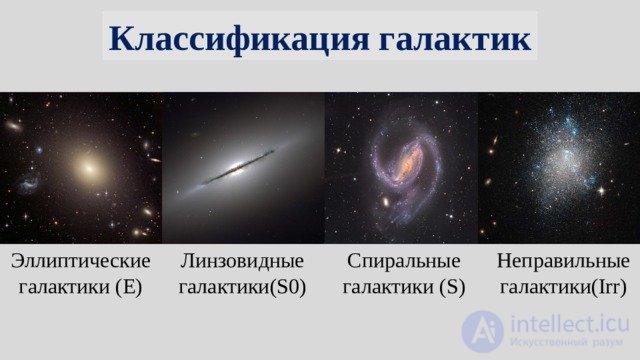
Observation of galaxies has shown that they are extremely diverse in shape and structure. By appearance, galaxies are divided into elliptical, spiral, lenticular, and irregular.
Elliptical galaxies (E) have, in photographs, the shape of ellipses without sharp boundaries. The brightness increases smoothly from the periphery toward the center. Internal
structure is usually absent. These galaxies are composed of red and yellow
giants, red and yellow dwarfs, a certain number of low-luminosity white stars, i.e. mainly of Population II stars. There are no blue-white supergiants, which normally create the structure of spiral arms. Externally, elliptical galaxies differ in the degree of their flattening.
The measure of flattening is the quantity
10 (a - b)/a,
which is easily found if the major axis a and minor axis b are measured on the photograph. The flattening index is appended after the letter denoting the galaxy's shape, for example, E3. It turned out that there are no strongly flattened galaxies, so the
largest index is 7. A spherical galaxy has an index of 0.
It is evident that elliptical galaxies have the geometric shape of an ellipsoid of revolution. E. Hubble posed the question of whether the diversity of observed shapes might be a consequence of the different orientations, in space, of galaxies that are all equally flattened. This problem was solved mathematically, and the answer obtained was that
among galaxies in clusters, those with flattening indices of 4, 5, 6, 7 are most common, and there are almost no spherical galaxies. Outside clusters,
almost only galaxies with indices 1 and 0 are found. Elliptical galaxies in clusters are giant galaxies, while those outside clusters are dwarf ones.
Spiral galaxies (S). These display a structure of spiral
arms extending from a central nucleus. The arms stand out against a less bright background because they contain the hottest stars, young clusters, and glowing gas nebulae.
Edwin Hubble divided spiral galaxies into subclasses. The measure used is the degree of development of the arms and the size of the galaxy's nucleus.
In Sa galaxies the arms are tightly wound and comparatively smooth, weakly developed. The nuclei are always large, usually making up about half of the observed
size of the whole galaxy. Galaxies of this subclass most closely resemble ellipticals. Usually two arms are observed, emerging from opposite
sides of the nucleus, though there are rarely more.
In Sb galaxies the spiral arms are noticeably developed, but have no branching.
The nuclei are smaller than in the previous class. Galaxies of this type often show many spiral arms.
Galaxies with strongly developed arms that split into several branches,
and with a nucleus small in comparison to them, belong to type Sc.
Despite the diversity of external appearance, spiral galaxies have a similar structure. Three components can be distinguished in them: a stellar disk, whose thickness is 5-10 times less than the diameter of the galaxy, a spheroidal component, and a flat component, which is several times smaller in thickness than the
disk. The flat component includes interstellar gas, dust, young
stars, and the spiral arms.
The flattening coefficient of spiral galaxies is always greater than 7. At the same time, for
ellipticals it is always less than 7. This indicates that in weakly flattened galaxies a spiral structure cannot develop. For it to appear, the system must be strongly flattened.
It has been proven that a strongly flattened galaxy cannot, in the course of its evolution, become weakly
compressed, and vice versa as well. This means elliptical galaxies cannot turn into spiral galaxies, nor spiral into elliptical. The different degrees of flattening are due to different amounts of rotation of the systems. Those galaxies which, during
formation, acquired a sufficient amount of rotation, took on a strongly
flattened shape, and spiral arms developed in them.
There are spiral galaxies in which the nucleus lies in the middle of a straight bar, and the spiral arms begin only at the ends of this bar. Such galaxies are designated SBa, SBb, SBc. The addition of the letter B indicates the presence of a bar.
Lenticular galaxies (S0). Externally they resemble elliptical galaxies, but have a
stellar disk. In structure they resemble spiral galaxies, but differ
from them in the absence of a flat component and spiral arms. Lenticular galaxies differ from spiral galaxies seen edge-on in the absence of a band of dark matter. Schwarzschild proposed a theory according to which
lenticular galaxies may form from spiral galaxies through the process of sweeping out gas-and-dust matter.
Irregular galaxies (Ir). Have an asymmetric appearance. They have no spiral arms, and hot stars and gas-and-dust matter are concentrated in separate groups or scattered throughout the disk. There is a spheroidal component of low brightness. These galaxies are distinguished by a high content of interstellar gas and young stars.
The irregular shape of a galaxy may be because it did not have time to assume a regular shape due to the low density of matter in it or because of its
young age. A galaxy can also become irregular due to distortion of its
shape as a result of interaction with another galaxy.
Irregular galaxies are divided into two subtypes.
Subtype Ir I is characterized by high surface brightness and the complexity
of its irregular structure. In some galaxies of this subtype a disrupted spiral structure can be detected. Such galaxies are often found
in pairs.
Subtype Ir II is characterized by low surface brightness. This property
hinders the detection of such galaxies, and only a few of them are known. Low surface brightness indicates low stellar density. This means
these galaxies should transition very slowly from an irregular shape to a
regular one.
In July 1995 a study was conducted with the Hubble Space
Telescope in search of faint irregular blue galaxies. It turned out that these
objects, located at distances of 3 to 8 billion light years from us,
are the most common. Most of them have an extremely saturated
blue color, which indicates that an intensive process of star formation is taking place in them. At close distances, corresponding to the present-day Universe,
these galaxies are not found.
Galaxies are far more diverse than the types considered above, and this diversity concerns shapes, structures, luminosity, composition, density, mass, spectrum,
and features of their radiation.
The following morphological types of galaxies can be distinguished, approaching them from
different points of view.
Amorphous, structureless systems – including E galaxies and most S0 galaxies. They have little or no diffuse matter and hot giants.
Haro galaxies – bluer than the rest. Many of them have narrow but bright lines in their spectra. They may be very rich in gas.
Seyfert galaxies – of various types, but characterized by the very great width of the strong emission lines in their spectra.
Quasars – quasi-stellar radio sources, QSS, indistinguishable in appearance from stars,
but emitting radio waves as the most powerful radio galaxies do. They are characterized by a bluish color and bright lines in the spectrum, having enormous
redshift. In luminosity they surpass supergiant galaxies.
Quasags – quasi-stellar galaxies, QSG – differ from quasars in the absence
of strong radio emission.
Galaxies located close to one another are sometimes connected by
a band of luminous matter. Often these luminous bands are
extensions of spiral arms. The color of the bands is bluish, and they consist of
hot giants and supergiants. Often the galaxies are immersed in a common “stellar haze.”
Interacting galaxies were studied by B.A. Vorontsov-Velyaminov. He compiled an
atlas of interacting galaxies, which included 355 objects. Since the Palomar sky atlas was used for the study, which includes many faint
galaxies not listed in the NGC, the interacting galaxies of Vorontsov-Velyaminov are given special designations, for example, VV 13.
In most cases, the peculiarities in the shapes of interacting galaxies are explained by perturbing tidal forces exerted on the stars of a galaxy by another. Many researchers believe that interacting galaxies are approaching each other, but V.A. Ambartsumian suggested that we are observing the process of one galaxy splitting into two or several. This process is accompanied by a violent, explosive event.
In most galaxies one can distinguish a bright central part, called the nucleus. This region is distinguished by a high stellar density, reaching 106
— 108
pc
-3
. Even at such densities, collisions do not occur.
Studies in recent years have shown that the nucleus is not simply a denser place in the galaxy; at the very center of the nucleus one can find yet another dense concentration — a nucleolus. When observing the nucleus of the Andromeda Nebula (whose size is 100 pc), a bright nucleolus with a diameter of 1–14 pc was distinguished. It
rotates as a rigid body, with a rotation period of 500,000 years. Its mass is 13
million solar masses. Its density is 1500 solar masses per pc3
, 20,000 times
greater than in the solar neighborhood. It behaves as though
it were an independent formation embedded within the galaxy.
Radio studies of our Galaxy have shown that a nucleolus with a size of 6 pc
exists at the center.
The nuclei of most galaxies contain emission lines in their spectra. A wavelength belonging to doubly ionized oxygen is particularly
common. To doubly ionize oxygen requires powerful ultraviolet radiation. The character of the emission lines indicates that the gases move at speeds of about 8000 km/s. Some violent
processes occur in the nuclei, the nature of which is unclear.
Observations of some galaxies have shown that grandiose explosions can occur
in nuclei. Thus, in the nucleus of the galaxy NGC 3034, an explosion is observed with an energy release greater than 1049 J, i.e., a million times greater than that of a
supernova outburst. It is quite possible that every galaxy experiences a nuclear explosion at some stage of its evolution. On average, statistically, one
exploding galaxy per thousand should be observed, which is why
few such objects are currently known. The emission lines in the spectra of galactic nuclei may indicate past explosions. Matter ejected by an explosion is thrown out from the center of the galaxy and, over 10 million years, is scattered over a great distance,
so that no trace remains of the explosive process.
Galaxies with active nuclei make up a few percent of the number of normal galaxies. Seyfert galaxies are especially common, with
a bright source of small angular size observed at their center. Its continuous spectrum is non-thermal in nature, i.e., it is not explained by the radiation of
hot bodies. The broad emission lines in the spectra indicate high gas velocities. An important feature of the radiation from nuclei is its variability. Sometimes the luminosity of a nucleus changes over several months or days. This
indicates that the main source of radiation in the nucleus is very small compared to the size of the galaxy.
,
Galaxies are often sources of radio emission. However, from large distances, greater than 5-6 Mpc, the radio emission of normal galaxies turns out to be
too weak for present-day observational means. On average, the radio emission of normal galaxies is a million times weaker than their optical emission.
Alongside normal galaxies there are special ones whose radio emission
is several orders of magnitude higher and lies in the range from 1028 to 1034
kW. In
most cases the optical emission of such galaxies is weak, and it is not always
possible to identify a radio galaxy with an optical source.
Radio galaxies are one of the varieties of galaxies with active nuclei. They usually belong to the class of massive elliptical galaxies. The emission mechanism is synchrotron and is associated with the ejection from the galaxy of clouds of
relativistic particles moving in a magnetic field. About
500 radio galaxies are known in total. The most outstanding radio galaxy is Cygnus A. This is the most powerful discrete source of radio emission, yet in the optical range it
has only an 18th magnitude, M = -20.5 magnitude. But the energy of the radio waves still
dominates over the optical emission. Baade and Minkowski proposed that
the radio emission arises from the interpenetration of two spiral
galaxies. In a high-speed collision of spirals, they heat up and glow.
A distinctive feature of this object is that the region of radio emission does not coincide with the visible galaxy, but is located as two elliptical lobes
on either side of the zone of optical emission. The centers of the radio-emitting regions are located at a distance of about 80,000 pc from the visible double nucleus, and their sizes are considerably larger than the optical dimensions — of the double nucleus and the surrounding halo.
The radio image of the radio galaxy Virgo A (Virgo A/M 87/NGC 4486) practically coincides with the optical one. In the visible nebula a radially oriented jet, consisting of clumps of luminous matter, is clearly visible. The jet
itself is also a source of radio emission.
A special class of objects is represented by quasars, discovered by the Dutch
astronomer M. Schmidt in 1963. It was established that, similar to point sources of light - stars - there exist in the universe point sources of
radio emission. These objects were initially called radio stars, and later
quasi-stellar objects, abbreviated to quasars. With the development of radio astronomy and the improvement of the angular resolution of radio telescopes, point sources of radio emission were identified with certain optical objects. These
objects radiate in the optical range hundreds of times more powerfully than galaxies, and the main part of the radiation comes from a nucleus no more than 0.1 pc in size, or smaller.
This quasar nucleus is surrounded by a gas envelope extending for hundreds of parsecs. Quasars have powerful radio emission, and some of them also emit infrared and X-ray radiation.
In 1965 A. Sandage discovered quasags - objects similar to quasars, but not
possessing noticeable radio emission.
Initially the spectra of quasars could not be deciphered, but it was later established that they could be explained by assuming that the spectral lines
have a redshift comparable to, or considerably greater than, that of
the most distant observed galaxies. If this redshift is related to
cosmological expansion, then quasars are the most distant known objects in the Universe, and their radiated power, reaching 1041 W, is greater than that of
any other known objects.
In the spectra of some quasars it has been possible to identify both emission lines and
absorption lines, and in these cases interesting features have been discovered. It turned out that the spectra of quasars may contain several groups of
absorption lines with different redshifts, which in turn
differ from the redshift of the emission lines. If all these redshifts are explained by the Doppler effect, then the relative velocities
of the regions emitting the light and the regions in which the absorption lines arise may amount to a significant fraction of the speed of light. This is related either to
large relative velocities within the quasar itself, or to the existence of clouds of intergalactic gas between the quasar and the observer, which
absorb the quasar's light.
Today more than 1500 quasars are known. They are located at distances of billions of light years. Ordinary galaxies cannot be observed from such
distances. Most quasars are located within a certain range of
distances. This suggests that they arose at a specific stage in the evolution of the Universe.
At present many researchers believe that quasars are the nuclei of galaxies in a stage of extremely intense activity. This similarity is suggested by the variability of the radiation, compactness, the non-thermal nature of the spectrum, and the strong broadening of the emission lines observed in quasar spectra. However, in most quasars the power of energy release is hundreds and
thousands of times greater than in active galactic nuclei. The stars of the galaxy surrounding a quasar are usually not visible, since quasars are located at great distances and the quasar's bright glare does not allow the faint light of the stars to be seen. Around
dozens of nearby quasars faint extended optical nebulae have been found. Their average size is about 90,000 pc, and their luminosity is several times
less than the luminosity of the brightest galaxies. It is not known whether there are stars
in these nebulae.
The mechanism by which quasars release such a large amount of energy is not entirely clear.
It is thought to be related to the release of gravitational
interaction energy of bodies. The necessary energy may be released when gas falls into a
very deep potential well, for example onto a massive black hole, or
when plasma bodies with a mass of hundreds of millions of solar masses are compressed under the action of their own gravity.
Recently a quasar was discovered in the nucleus of the radio galaxy Cygnus A. Its distance from
us is only 600 million light years. Studying the ultraviolet spectrum of the nucleus, scientists
discovered broad emission lines of ionized magnesium, belonging to
gas rotating at high speed. Given the high luminosity of the nucleus
and its large mass, scientists suggested that the discovered object is a quasar.
A study of a large number of quasars with the Hubble Space Telescope
in 1995 led to the conclusion that nearby quasars (z = 0.5) are associated with interacting elliptical galaxies. Many quasars are located in the centers of such stellar systems. This supports the view that quasars
are massive black holes onto which matter is accreting. The quasars studied are of diverse nature, radiating in the radio, optical, and X-ray ranges.
26.4 Determining the distances of galaxies.
Galaxies are located at very great distances from the Sun. Only in the nearest of them can individual stars be resolved; the rest appear as nebulous patches. Therefore, for a long time it was impossible to determine the distances
to galaxies. Only in the 1920s of the current century was it possible to distinguish familiar types of stars in neighboring galaxies and, from their characteristics, to determine
approximate distances.
At present there are several methods for determining the distances to
galaxies.
1. The distance is determined by studying objects of well-studied types, with a
known luminosity.
- For example, the luminosity of Cepheids is determined from the period-luminosity relation.
- For novae, the absolute stellar magnitude at maximum brightness is about -8m
,5,
bright globular clusters have an absolute magnitude of up to -9m
.
To determine the distance to such an object, it is enough to find the apparent stellar
magnitude and calculate the distance modulus, taking into account the effect of interstellar light absorption.
2. Distances to very distant galaxies are determined from the apparent angular
size or apparent stellar magnitude. For this it is necessary to know the characteristic
sizes or luminosities of galaxies of various types. Such distance estimates
are called relative.
3. Distances to galaxies are determined from the magnitude of the redshift of the lines
in their spectra. It has been established that all the lines in the spectra of distant galaxies are noticeably
shifted toward the red end of the spectrum. This phenomenon is related to the ongoing increase in the average distances between galaxies, which is called
the expansion of the Universe. The redshift is interpreted as a Doppler shift, related to the galaxy receding from us.
From observations it was established that the recession velocity Vr
, corresponding to
the redshift z = ∆λ/λ, increases on average linearly with the distance r
from the galaxy:
Vr = c .
∆λ/λ = H . r.
This relationship is called Hubble's law, and the proportionality coefficient H - the Hubble constant.
If we observe objects with the same absolute stellar magnitude, then
as the distance r increases, their apparent stellar magnitude will change proportionally to 5lgr. Therefore, if Hubble's law holds, the relationship between lg(∆λ/λ) and m should be expressed by a straight line with a proportionality coefficient between these quantities equal to 5. Such a relationship is indeed observed for the brightest galaxies, whose luminosity turned out to be approximately the same.
Knowing the redshift of galaxies, it is easy to determine how many times farther one of them
is than another. But to estimate the distance to each of them it is necessary to know
the value of the Hubble constant.
It turned out that for relatively nearby galaxies, whose distance
is satisfactorily measured by various methods, Hubble's law does not always
hold. And for distant galaxies, having large velocities Vr
,
there are no sufficiently reliable criteria for determining distances without the help of redshifts. Therefore, to this day, the estimates of H made by various
authors differ significantly, although practically all of them fall within the range from 50 to 100 km/(s
.Mpc).
The average value H = 75 km/(s
.Mpc) is often used.
At redshifts of about 1, Hubble's law no longer works, and more complex formulas must be applied.
In 1995 the most distant galaxy known to us, 8C 1435+635, was discovered in
the constellation Draco. Its redshift is 4.25. This shift corresponds to light that arrived from an era when the age of the Universe was about 7-10% of its present value.
26.5 Clusters of galaxies. The Metagalaxy.
Most galaxies belong to clusters. Today thousands of
galaxy clusters are known.
Clusters are divided into regular and irregular. Besides this division there are also classifications of clusters by various parameters, for example, by
the number of members with powerful radiation, by the presence of bright galaxies at the center, by
the presence of peculiar galaxies.
Regular clusters consist of a large number of galaxies (often more than
104
members), possessing spherical symmetry, with a strong concentration toward the center. The bright members of these clusters belong to types E and S0. At the center of the cluster
there is usually one or two of the brightest elliptical galaxies, surrounded by a halo. A typical representative of regular clusters is the cluster in the constellation Coma Berenices. Its size is about 4 Mpc. The number of galaxies is several
tens of thousands.
Irregular clusters have an irregular shape, and separate condensations are often found
in them. These clusters consist of galaxies of all types. They can
have many or few galaxies. An example of such a cluster is the cluster in
Virgo. It contains several thousand galaxies, with a size of about 3 Mpc.
In some clusters large masses of hot ionized
gas have been detected, heated to a temperature of about 10^8 K. The gas radiates in the X-ray range. The total mass of the gas makes up a noticeable fraction of the total mass of all the galaxies in the cluster.
An important question is whether clusters of clusters of galaxies exist. As of
today, more and more facts indicate that such clusters do exist. Measurements of the cosmic background radiation, which is a
remnant of the Big Bang, showed a 180-degree asymmetry, known
as the dipole. It manifests as a 0.1% heating of the cosmic background radiation compared to the average in one direction and equal cooling in the
opposite direction. These measurements were confirmed by studies
on the Cosmic Background Explorer satellite between 1989 and 1990, indicating that the entire Local Group is moving at a speed of 600 km/s in the direction of the constellation Hydra. This direction was calculated after correcting
for known motions: the rotation of the Sun around the center of the Galaxy and the motion
of our Galaxy toward the Andromeda Nebula.
This fact indicates that galaxies gather into groups and clusters, which in turn make up superclusters, leaving other regions devoid of galaxies. The unevenly distributed mass of matter surrounding the Local Group can cause an unbalanced attraction,
pulling the LG in one direction.
One research group used the motions of hundreds of galaxies to conclude that the Great Attractor exists, located at a distance of
about 60 Mpc. The Local Group appears to be caught in a cosmic tug-of-war
between the Great Attractor and the Perseus-Pisces supercluster located at about the same distance.
The largest-scale inhomogeneities in the distribution of galaxies have
a “cellular” character. The “cell walls” contain many galaxies and their clusters, while the interior is empty. The size of the cells is about 100 Mpc, the wall thickness 3-4 Mpc. Large
clusters of galaxies are located at the nodes of this cellular structure. Individual
fragments of the cellular structure are sometimes called superclusters. Superclusters often have a strongly elongated shape, resembling filaments.
The concept of the “Metagalaxy” is not entirely clear. Systems containing
various clusters of galaxies are not directly observed. Nevertheless
there are grounds to assume that the Metagalaxy exists, is relatively autonomous, and is an association of galaxies of the same order as
the Galaxy is for stars. The reality of the Metagalaxy will be proven if it becomes possible to
determine its boundaries and identify observed objects that do not belong
to it. Because the notion of the Metagalaxy as an autonomous giant system of galaxies, including all observed galaxies
and their clusters, is hypothetical, the term “Metagalaxy” has come to be used more often to denote the observable part of the Universe.
26.6 The dark matter problem.
A very important question for cosmology is whether all the matter of the Metagalaxy is observed with the help of modern radiation detectors.
The future of the Universe depends on the average density of matter in it. If the density is greater than a certain critical value, then the expansion of the Universe
will be replaced by contraction. If it is less, the expansion will continue indefinitely.
The value of the critical density is easy to calculate. It is known that the second cosmic velocity (escape velocity) for a sphere of mass M is written as follows:
v = √(2GM/R).
Into this expression we substitute the values of the mass M=4ρπR
3
/3 and for the velocity
v=HR.
We find the density:
ρ = 3H2
/8πG.
The critical value of the average density in the Universe depends on the Hubble
constant. For a value of H = 75 km/s
.Mpc we get ρ = 10-29
g/cm3
.
It is fairly easy to account for the observed matter contained in visible galaxies. The Dutch astronomer Oort carried out a study devoted to this in 1958. He determined the average density of matter in the Universe.
ρ = 4.6 .
10-9 Msun/pc3
= 3 .
10-31
g/cm3
.
This value is noticeably less than the critical density. Their ratio equals
0.03.
If there are no noticeable amounts of other matter in the Universe whose average density is much greater than the average galactic density, then the universe
will expand.
However, there are grounds to suspect that in the space between galaxies
there may be many hard-to-observe forms of matter, which have been given the name
“hidden mass” (dark matter).
One of the reasons for such a suspicion is the results of measurements of the masses
of galaxy clusters. The measurements were carried out as follows.
Regular clusters have a symmetric shape, and the density of galaxies in them
smoothly decreases from the center to the edge, and therefore there is every reason to believe that clusters are in an equilibrium state, in which the kinetic energy of the galaxies' motions is balanced by the force of mutual gravitation of all the masses comprising the
cluster.
In this case the virial theorem holds, which states that the kinetic
energy of all members of the cluster is equal in absolute value to half the gravitational potential energy of the cluster's masses (including the invisible masses). This
theorem makes it possible to calculate the total mass of the cluster if the relative velocities of the galaxies in the cluster and the size of the cluster are known. The relative
velocity of the galaxies in the cluster is calculated from the difference of their redshifts,
and the size is determined from the angular size of the cluster in the sky and its distance from
us.
Such a determination, carried out for the cluster in the constellation Coma Berenices,
yields a mass of about 2.
1015 Msun. This corresponds to a mass-to-luminosity ratio for the whole cluster of M/L = 150 Msun/Lsun.
The resulting ratio is many times greater than the value for elliptical
galaxies. If these conclusions are correct, then the mass of the cluster is much greater than the sum of the
masses of the galaxies that make it up.
According to current estimates, dark matter makes up about 90% of the total mass
of the Universe.
The role of dark matter may be played by intergalactic gas, since it occupies
enormous spaces between galaxies.
In addition, galaxies may be surrounded by huge massive coronas
of faintly luminous objects, which are extremely difficult to detect by their glow. These could be stars of low luminosity. Indeed, in 1995 research from the Institute for Advanced Study (USA) was published, presenting the results of searches for red dwarfs in our Galaxy. A count of these
objects using the Space Telescope showed that stars with a mass of 0.1
of the Sun's mass make up no more than 6% of the mass of the Galaxy's halo and no more than 15%
of the mass of its disk.
The latest hypotheses indicate that dark matter may be contained in
dwarf galaxies. A group of scientists from the University of California, using a 10-meter telescope in Hawaii, studied the motions of stars in
the dwarf galaxy Leo II. This galaxy is a satellite of our Galaxy and is located at a distance of 720,000 light years. The stars of the galaxy turned out to have too-high velocities. The observed matter of this galaxy is insufficient to explain such rapid motions. To account for this,
the mass of matter would need to be increased by a factor of 7.
Dark matter may also be contained in radiation. Cosmic rays, neutrinos, and gravitational waves can significantly affect the estimate of the total mass of the Universe.
Observations show that the mass density corresponding to cosmic
rays is very small. The situation with neutrinos is more complicated, since these particles almost
never interact with ordinary matter. If the rest mass of the neutrino is not zero, then the mass of the Universe would increase significantly.
Studies with the Hubble Space Telescope of the galaxy cluster Abell
2218 in the constellation Draco, located 1.5 billion light years away, led to the discovery
of luminous arcs of unclear origin. It turned out that these are gravitational lenses formed by the dark matter of the cluster.
Studies by P. Sackett of the spiral galaxy NGC 5907 made it possible to detect excess glow extending out to 3+7 kpc. It has the shape of a halo and encompasses the entire galaxy. According to the latest hypotheses, this luminous shell may
reveal invisible dark matter outside the spiral arms.
The most probable value of the density of the observable Universe today lies approximately within the range of 0.1 – 1 critical density.

Comments