
Lecture
The starry sky — is the picture, visible from the surface of the Earth, of the distribution of stars and other celestial objects, such as planets, comets, satellites, and artificial objects. It is the primary object of astronomical observation and a symbol of the eternity and infinity of the Universe.
The celestial sphere
Constellations
Stars
Planets
Stellar magnitudes
Apparent motion of celestial bodies
The starry sky — is not only an object of observation, but also a symbol of humanity's thirst for knowledge, which expands the boundaries of our understanding of the world.
Stars were grouped together for the purpose of orientation. These groups are called constellations.
Constellations bear various names, obtained at different times, from remote
antiquity to the 18th century.
All the zodiacal constellations were named very long ago, and it is difficult to say by which peoples. Most likely by the Egyptians and Chaldeans. Or perhaps by a people who lived before them.
Most of the bright constellations of the Northern sky were named in honor of ancient Greek
heroes or mythical figures, still by ancient peoples.
The less bright constellations were named by European astronomers in the 16th - 18th centuries.
All the constellations of the Southern hemisphere, invisible from Europe, were named during the era of the Great geographical discoveries.
Claudius Ptolemy lists 48 constellations. Ptolemy's star catalog
contains 1026 stars.
About 5000 stars are visible to the naked eye in the sky of the Northern hemisphere.
Through a telescope, from the 1st to the 14th magnitude, about 77 million stars are visible.
The constellations listed by Ptolemy:
12 zodiacal:
Aries, Taurus, Gemini, Cancer, Leo, Virgo, Libra, Scorpius, Sagittarius, Capricornus,
Aquarius, Pisces.
36 others:
Ursa Major, Ursa Minor, Draco, Cepheus, Boötes, Corona Borealis, Hercules, Lyra, Cygnus, Cassiopeia, Perseus, Auriga, Ophiuchus, Serpens, Sagitta, Aquila, Delphinus, Equuleus, Pegasus, Andromeda, Triangulum, Cetus, Orion, Eridanus, Lepus, Canis Major, Canis Minor, Argo Navis
(Puppis, Carina, Vela), Hydra, Crater, Corvus, Ara, Centaurus, Lupus, Corona Australis, Piscis Austrinus.
Coma Berenices was added by Conon in the era of Ptolemy. Berenice was the wife
of King Ptolemy Euergetes.
Johann Bayer added 12 new constellations of the Southern sky – Pavo, Tucana, Grus, Phoenix, Dorado, Volans, Hydrus, Chamaeleon, Musca, Apus, Triangulum Australe, Indus.
Johannes Hevelius in 1690 added 11 constellations: Camelopardalis, Monoceros, Canes Venatici,
Vulpecula, Lacerta, Sextans, Leo Minor, Lynx, Scutum Sobiescianum.
Augustin Royer in 1679 added 5 constellations: Columba, Crux, Nubecula Minor,
Nubecula Major, and Musca.
Lacaille in 1752 tried to fill in the empty spaces in the southern hemisphere and
created 14 new constellations: Sculptor, Fornax, Horologium, Reticulum, Caelum, Pictor,
Pyxis, Telescopium, Microscopium, Mensa, Antlia, Octans.
Poczobut in 1777 placed Taurus Poniatovii, the Royal Bull, between Aquila and Ophiuchus.
Bode introduced the constellation Frederici Honores (moving Andromeda's arm) and Sceptrum Brandenburgicum.
Lalande – the constellation Felis, the domestic cat.
The final number and boundaries of the constellations were established at an astronomical
congress held in 1922. The entire sky was conventionally divided into 88
sections.
Since the 17th century, individual stars in constellations began to be designated by letters of the Greek alphabet.
From the 8th century, the Venerable Bede and other theologians tried to replace the pagan names of constellations and insert Christian ones. There are calendars where
Saint Peter replaces Aries, Saint Andrew replaces Taurus, and so on. Ursa Major - the boat of St. Peter, Ursa Minor - St. Michael, Mary Magdalene in place of Cassiopeia, Andromeda - the Sepulchre of the Lord.
The Sun - Jesus Christ, the Moon - the Virgin Mary. Awkward mix-ups resulted.
There was an attempt to replace the 12 zodiacal constellations with the coats of arms of the twelve noblest royal families of Europe.
Many constellations are connected with legends. For example, the constellations of Andromeda, Cassiopeia, Cepheus, Perseus, and Pegasus are linked by the Greek legend of the feat of Perseus.
At one time the king of Ethiopia was Cepheus. Cepheus had a wife, Cassiopeia, and a
daughter, Andromeda. Once Cassiopeia boasted that she was more beautiful than the sea nymphs.
The nymphs complained to Poseidon, god of the seas, and as punishment he sent to Ethiopia a terrible monster - the Whale (Cetus). The Whale would come out from the sea from time to time onto the
shore and devour people and animals. King Cepheus became frightened and sent messengers to
the oracle of Zeus in Libya to find out how to get rid of the calamity. The oracle answered that Andromeda had to be given to the monster to be devoured. For a long time Cepheus did not want to
do this, but the people forced him to. Andromeda was chained to a rock and
left to the monster.
But at that time the hero Perseus, son of the god Zeus, was flying over Ethiopia on magical sandals. He was returning home after his victory over Medusa, the terrible Gorgon, who had snakes instead of hair on her head. From a single glance from Medusa, living creatures turned to stone. Perseus managed to cut off her head with the help of a magical sword given to him by the god Hermes and a shield
given by Athena.
Perseus fell in love with Andromeda and decided to save her from death. King Cepheus promised the hero his daughter's hand in marriage in return. When the monster swam out from the depths of the sea, Perseus flew up into the air on his winged sandals and a battle began. After a long fight, Perseus slew the Whale and freed Andromeda.
In memory of this heroic deed, all the characters were placed in the sky.
Not far from the constellations of Perseus, Cassiopeia, and Andromeda
are located the constellations of Cepheus and Cetus (the Whale).
The Moon moves across the celestial sphere at a speed of 13 degrees per day, the Sun - 1
degree per day.
Stars rise and set at the same latitude always in the same
place. When studying the apparent motions of celestial bodies it is necessary to determine
their positions at the moments of observation. The apparent positions of luminaries are determined only by directions, since the distances to them are inessential.
A sphere of arbitrary radius with its center placed at an arbitrary point
in space is called the celestial sphere.
The rotation of the celestial sphere reproduces the rotation of the celestial vault. The celestial sphere serves for studying the apparent positions and motions of celestial bodies.
2.3. Principal points and circles, coordinate systems on the celestial sphere.
To determine the apparent position of celestial bodies and study their motion,
astronomy introduces the concept of the celestial sphere.
A sphere of arbitrary radius with its center placed at an arbitrary point
in space is called the celestial sphere.
The rotation of the celestial sphere reproduces the rotation of the celestial vault.
The straight line ZOZ’, passing through the center O
of the celestial sphere and coinciding with the direction of a plumb line at the place of observation,
is called the vertical line.
The vertical line intersects the celestial
sphere at the points of the Zenith and Nadir.
The great circle of the celestial sphere SWNE,
whose plane is perpendicular to the
vertical line, is called the mathematical or true horizon.
The mathematical horizon divides the celestial sphere into two halves
- visible and invisible to the observer.
The diameter PP’, around which the
rotation of the celestial sphere takes place, is called
the axis of the world (polar axis). The axis of the world intersects the celestial sphere at the north and south poles. The great circle of the celestial sphere QWQ’E, whose plane is perpendicular to the axis of the world, is called the celestial equator. The celestial equator divides
the surface of the celestial sphere into two hemispheres - northern and southern.
The celestial equator intersects the mathematical horizon at two points -
the east point E and the west point W.
The vertical circles passing through the east and west points are called the first
verticals - the eastern and western.
The great circle of the celestial sphere PZQSP’Z’Q’N, whose plane passes through the plumb line and the axis of the world, is called the celestial meridian.
The celestial meridian divides the surface of the celestial sphere into eastern and western hemispheres.
The plane of the celestial meridian and the plane of the mathematical horizon intersect along the straight line NOS, which is called the noon line (meridian line).
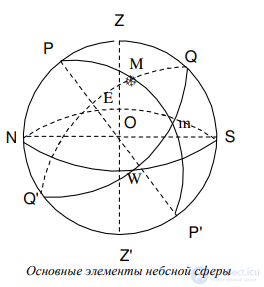
Main elements of the celestial sphere
The celestial meridian intersects the mathematical horizon at two points - the
north point and the south point.
The great circle of the celestial sphere ZMZ’, passing through the zenith, the luminary M, and the nadir, is called the vertical circle, or almucantar circle, of the luminary.
The small circle of the celestial sphere (bMb), whose plane is parallel to the plane of the
celestial equator, is called the celestial or diurnal parallel of the luminary.
The apparent diurnal motions of the luminaries take place along diurnal parallels.
The great circle of the celestial sphere PMP’, passing through the poles of the world and the luminary
M, is called the hour circle, or declination circle, of the luminary.
The position of the main elements of the celestial sphere relative to one another depends on the geographic latitude ϕ of the place of observation. At angle ϕ to the plane of the mathematical horizon lies the world axis PP’.
Celestial coordinate systems.
The position of a luminary in the sky is uniquely determined relative to the principal planes and their associated lines and points on the celestial sphere, and is expressed quantitatively by two quantities (central angles or arcs
of great circles), which are called celestial coordinates.
The horizontal system. The principal plane is the plane of the mathematical horizon NWSE, and the reckoning is made from the zenith and from one of the points of the mathematical horizon.
One coordinate is the zenith
distance z, or the altitude of the luminary above the
horizon h.
The altitude h of luminary M is called the arc
of the vertical circle mM from the mathematical horizon to the luminary, or the central
angle mOM between the plane of the mathematical horizon and the direction
toward luminary M.
Altitudes are reckoned within the range from
0 to 90
0 toward the zenith and from 0 to -90
0 toward the nadir.
The zenith distance of a luminary is called the arc of the vertical circle ZM from
the zenith to the luminary.
z + h = 90
0
The position of the vertical circle itself is determined by another coordinate -
the azimuth A.
The azimuth A of a luminary is called the arc of the mathematical horizon Sm from the point
of south S to the vertical circle passing through the luminary.
Azimuths are reckoned in the direction of the diurnal rotation of the celestial sphere, i.e. toward the
west from the south point, within the range from 0 to 360
0.
This coordinate system is used for direct determinations of the apparent
positions of luminaries using angle-measuring instruments.
The first equatorial coordinate system.
The origin of reckoning is the point of the celestial equator Q
One coordinate is the declination
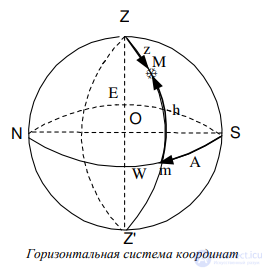
The horizontal coordinate system
The declination δ is called the arc mM of the hour circle PMmP’ from the celestial equator
to the luminary. It is reckoned from 0 to +90
0 toward the north pole and from 0 to -90
0 toward
the south.
p + δ = 90
0.
The position of the hour circle is determined by the
hour angle t.
The hour angle of luminary M is called
the arc of the celestial equator Qm from the upper
point Q of the celestial
equator to the hour circle PMmP’, passing through the luminary.
Hour angles are reckoned in the direction of the
diurnal rotation of the celestial sphere, toward the
west from Q, within the range from 0 to 360
0 or
from 0 to 24 hours.
This coordinate system is used in practical astronomy for determining
exact time.
The second equatorial coordinate system. One coordinate is the
declination δ, the other is the right ascension α.
The right ascension α of luminary M is called the arc of the celestial equator m
from the point of the vernal equinox to
the hour circle passing through the luminary. It is reckoned in the direction opposite to the diurnal rotation, within
the range from 0 to 360
0 or from 0 to 24 hours.
This coordinate system is used for
determining stellar coordinates and compiling catalogs.
The altitude of the celestial pole above the horizon,
the altitude of a luminary on the meridian.
The altitude of the celestial pole above the horizon
always equals the astronomical latitude
of the place of observation.
1) If the declination of a luminary is less than the geographic latitude, it culminates to the south of the zenith at z = ϕ − δ.
or at altitude h = 90
0 - ϕ + δ.
2) If the declination of a luminary equals the geographic latitude, it culminates
at the zenith and z = 0, and h = + 90
0.
3) If the declination of a luminary is greater than the geographic latitude, it culminates to the north of the zenith at z = δ − ϕ. or at altitude h = 90
0 + ϕ − δ.
Conditions for the rising and setting of luminaries.
A luminary rises and sets at a given latitude if
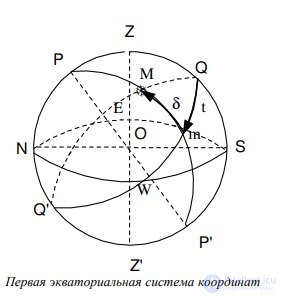
The first equatorial coordinate system
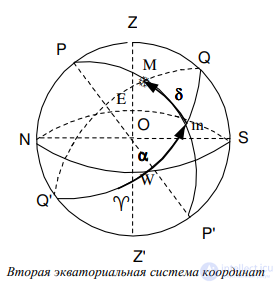
The second equatorial coordinate system
α
δ
δ < (90
0 - ϕ).
A luminary will be circumpolar or never-rising if
δ > (90
0 - ϕ).
For an observer at the Earth's equator all luminaries rise and set.
At the poles observers can only see hemispheres.
The phenomenon of a luminary crossing the celestial meridian is called the culmination of the luminary.
If a celestial body crosses the upper part of the meridian, upper culmination occurs; if the lower part, lower culmination occurs.
The conversion from the horizontal coordinates of a celestial body to equatorial coordinates and back, in
the general case, is carried out using formulas of spherical trigonometry. However, this task is simplified at the culmination of celestial bodies.
The North Star
Determining time
Observation instruments

Comments