
Lecture
The ancient sages placed the Earth at the center of creation. Some considered it
spherical, others - flat or lens-shaped, and the sky - a dome.
The Pythagoreans believed that the Earth and the planets move in circles, since
this is the most ideal path.
Eudoxus, in order to explain observational discrepancies from ideal motion, proposed a system of concentric spheres, at the center of which is
the Earth. On the outermost sphere the stars are fixed.
To describe the motion of the Moon and the Sun, three spheres moving relative
to one another were needed, and for the planets - four.
Aristotle adopted Eudoxus's ideas. He improved upon Eudoxus's system. In his
description of the world there were already 55 moving spheres needed for a satisfactory description of all the movements of celestial bodies.
Aristotle proved the sphericity of the Earth by pointing to the curvature of its shadow
on the surface of the Moon during lunar eclipses.
According to Aristotle's view, if the Earth moved, then a stone thrown
from a tower would have to land at a great distance from the tower, and stormy winds would arise.
The Pythagorean Philolaus in the 5th century BC supposed that the Earth revolves around
a central fire.
Heraclitus taught that Mercury and Venus move around the Sun, and the Sun around the Earth.
Ptolemy decided that since the center of the universe is the place toward which all bodies must move, then if the Earth were not at the center, it would fly toward the center faster than all the bodies present on its surface.
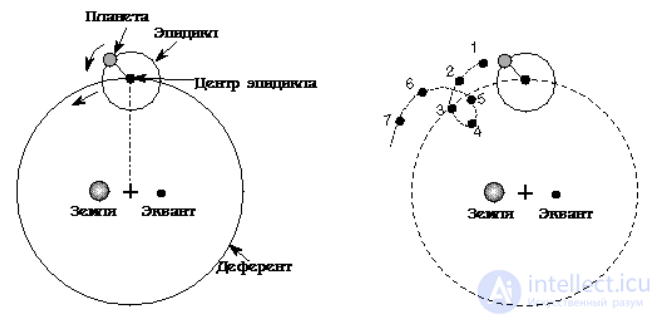
Epicycles and deferents. The equant - an element allowing a planet to perform
non-uniform motion along a circle, as long as from some point this motion appeared uniform.
By painstakingly selecting for each planet a combination of deferents, epicycles, and equants unique to it, Ptolemy achieved a system of the world
that predicted the positions of the planets with astonishing accuracy.
The idea of the Earth's rotation about its own axis was expressed by Nicole Oresme (1320
- 1382) and Nicholas of Cusa (1401 - 1464). The latter taught that the universe is infinite and has no distinguished fixed center.
Nicolaus Copernicus, having introduced the heliocentric system of the world, still believed that the planets move in circles and uniformly, so in order to
describe the complex motion of celestial bodies it was still necessary to use epicycles. His system numbered 34 circular motions. Some believed that the sys-
tem of Copernicus numbered 48 motions, while one of the variants of Ptolemy's system had only 40 motions.
Copernicus's book was published in 1543 and dedicated to Pope Paul
III. At first it was not condemned by the Catholic Church, but it provoked the fury
of the Protestants. Copernicus's work was placed on the "Index of Forbidden Books"
only 70 years later, thanks to the efforts of G. Bruno.
Tycho Brahe believed that the Earth is motionless and located at the center of the world, while the Sun
revolves around the Earth. The planets, however, revolve around the Sun.
T. Brahe discovered that comets move around the Sun and are not atmospheric phenomena.
Tycho Brahe's observations helped I. Kepler discover the three laws of motion of celestial bodies.
The discoveries of Galileo and Kepler showed that the world is more complex than
Aristotle's system of the world represented it, and destroyed the dogmatic perception of nature.
We observe the motion of the planets of the Solar System from the Earth, which is itself moving around the Sun, and this leads to a number of peculiarities in their apparent movements across the sky. The trajectories of the planets' motion are projected against the fixed
stars. The planets, like the Sun, move only through the zodiacal constellations,
constantly crossing the ecliptic, but never departing far from it.
The planets
move directly, in
the direction of the Sun's motion along the
ecliptic, then
slow their
motion, stop, and move
in the opposite direction.
After some
time the direction of motion
changes again.
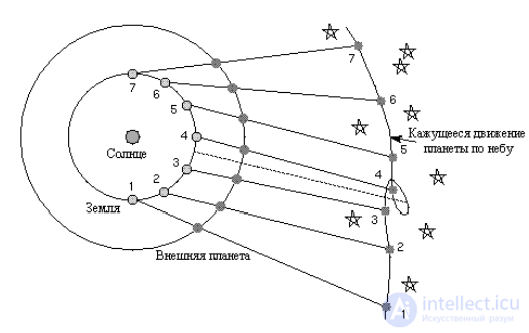
These motions
are called direct and retrograde. Ancient astronomers called the planets, because of their complex motion, "wandering luminaries."
Direct and retrograde motions of the planets are explained by the difference between the orbital linear velocities of the planet and the Earth. In doing so, the planets trace loop-shaped trajectories. The size of the loop depends on the ratio of the orbital radii of the planet
and the Earth. For Jupiter, the angular size of the loop is about 110, and for Pluto only 30.
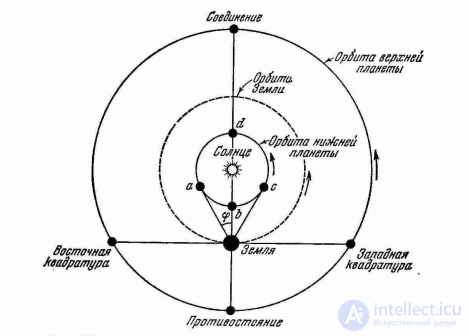
In their motion along their orbits, planets can occupy various positions relative to the Sun and the Earth. These positions are called configurations. Configurations differ for inferior and superior planets. Inferior
planets are those located closer to the Sun than the Earth, superior ones - those farther away.
For the inferior planets, the following configurations are distinguished: inferior and superior conjunction with the Sun, greatest western and eastern elongation. The word elongation means separation. The meaning of the two elongations is that if we
observe the inferior planets from Earth, they will be at the
greatest angular distance from the Sun. When a planet is at conjunction, it cannot be observed from Earth, since it comes closest to the Sun
and is lost in its rays.
The configurations for the superior planets are somewhat different. The superior planets
have conjunction, opposition, and western and eastern quadrature. The meaning of these configurations can be understood in a similar way to those of the inferior
planets. Conjunction means alignment with the Sun as observed from
Earth. This means that while the planet is in this configuration, it cannot be observed, since it is lost
in the sunlight.
At opposition,
on the contrary, the planet
is seen best
of all, since it is opposite the Sun, and
thus is observed
on the far side of
the sky. At this time
the planet is closest
to the Earth and
visible almost the entire
night. An inferior planet is closest to Earth at the moment of inferior conjunction, and farthest away at the moment of superior conjunction. A superior planet draws nearer at the moment of opposition and recedes at the
moment of conjunction.
Direct and retrograde motions of the planets are explained by the difference between the orbital linear velocities of the planet and the Earth.
The synodic period of revolution (S)
of a planet is the interval of time between its two successive identical configurations.
The sidereal, or stellar, period of revolution (T) is the interval of time during which a planet makes one complete revolution around the Sun along its orbit.
The sidereal period of revolution of the Earth is called the sidereal year (Ts).
The angular displacement along the orbit per day for a planet = 360/T, and for the Earth = 360/Ts
the difference between the daily angular displacements of the planet and the Earth is the apparent shift of the planet per day, i.e., 360/S.
For the inferior planets we obtain
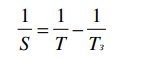
For the superior planets:
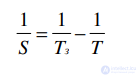
These are the equations of synodic motion.
Directly from observations, only the synodic
periods of revolution of the planets S and the sidereal period of revolution of the Earth can be determined. The sidereal periods of revolution of the planets are calculated using the equation of synodic motion.
The duration of the sidereal year is 365.256 mean solar days.
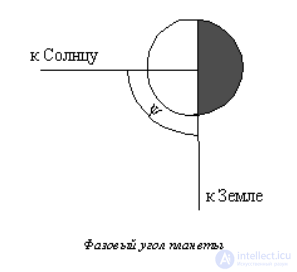
The phase of a planet is measured by the ratio of the area of the illuminated part of the visible
disk to the total area of the disk. The angle between the direction from the planet to the Sun and to
Earth is called the phase angle.
At phase angle ψ = 180°, the planet is between the Sun and the Earth, the phase
is equal to zero, the planet is not illuminated at all.
At phase angle ψ = 0, the Earth and the Sun
are on the same side of the planet,
the phase is equal to 1, the visible disk of the planet is fully illuminated.
The relation between phase and phase angle:
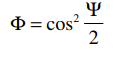
For the inferior planets the phase angle varies from 0 to 180. For Mars it is no more
than 48.3, for Jupiter it is 11, and for the rest it is less than 11.
For the superior planets the phase is close to 1.
The apparent shift of a luminary, caused by the movement of the observer, is called the parallactic shift, or parallax, of the luminary.
The parallactic shift of a luminary is greater, the closer the luminary is to the observer and the greater the observer's displacement.
The coordinates of luminaries determined from a point on the surface of the Earth are called
topocentric.
The topocentric coordinates of planets differ at different places on Earth.
Therefore the coordinates are referred to the center of the Earth and are called geocentric.
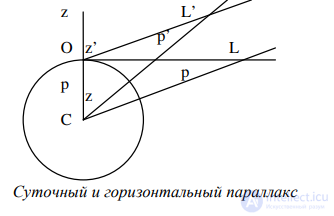
The angle between the directions in which the luminary M" would be seen from the center of
the Earth and from some point on its surface is called the diurnal parallax of the luminary.
The diurnal parallax is the angle p’, at
which the radius of the Earth at the place of observation would be seen from the luminary.
For a luminary at the zenith,
the diurnal parallax is equal to 0. For a luminary observed on the horizon, the diurnal parallax takes its maximum
z
O
C
p
z
z’
p
p’
L
L’
Diurnal and horizontal parallax
value and is called the horizontal parallax p.
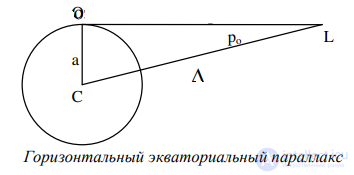
Knowing the horizontal parallax of a luminary makes it possible to find the distance from the center of the Earth to the luminary.
a — the equatorial radius of the Earth,
CL — the distance from the center of the Earth to the
luminary, equal to ∆, angle OLC — the horizontal parallax of the luminary p0.
We obtain the formulas:
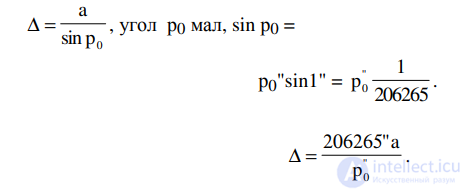
If we take the horizontal parallax of the Sun to be equal to 8".794, then the distance
from the Earth to the Sun will be equal to 149,597,870 km. This distance is called the astronomical unit (AU).
The distances to the planets and the Sun were also determined by radar methods in 1946 - 1963.

.
where c = 3. 105 km/s - the speed of propagation of radio waves. t - the time taken for the
radio signal to travel from Earth to the celestial body.
Due to the great distances to the stars, their horizontal parallaxes
are very small, and distances to stars are determined by means of annual parallaxes π.
The annual parallax of a star π is the angle at which the mean radius of the Earth's orbit would be seen from the star, provided that the direction toward the star
is perpendicular to the radius. The annual parallaxes of stars are very small quantities and are always less than 1". To measure them, very precise
astronomical instruments must be used, and the errors of the instrument must be well known, since they
may be larger than the parallactic angle.
The figure shows the method for determining parallax. A star closer to us
is displaced relative to the distant stars. This displacement can be measured
only for nearby stars, since the precision of instruments does not allow
too small parallactic angles to be measured.
In the figure, ST is the radius of the Earth's orbit, i.e., 1 AU, σS is the distance from the star to the
Sun, the angle SσT is the annual parallax
of the star π, then we obtain:
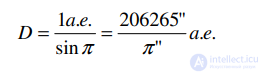
Horizontal equatorial parallax
..
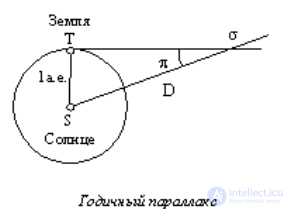
The distance corresponding to an annual parallax of 1" is called
a parsec (pc).
1 pc = 206,265 AU = 3.086 . 10^13 km.
If D is expressed in parsecs, then D = 1/π".
A distance of 1000 parsecs is called a kiloparsec, and a distance of 1,000,000 parsecs is called a megaparsec.
The distance that light travels in one year, propagating at a speed of about 300,000 km/s, is called a light-year.
1 light-year = 9.46 . 10^12 km = 63,198 AU = 0.3064 pc.
1 pc = 3.26 light-years.
The distances to the nearest stars are on the order of several light-
years. Thus the star closest to the Sun, α Centauri, is 4.34 light-years away, and Barnard's Star is 5.97 light-years away.
Astronomical technology first made it possible to measure parallaxes in the mid-19th century. This was done in Germany by Friedrich Bessel, at the Cape of Good
Hope by Thomas Henderson, and in Russia by V.Ya. Struve.
Bessel determined the parallax of the star 61 Cygni in 1838 - 1840. The angle obtained
was equal to 0″.3. This value corresponds to a distance of 11 light-years.
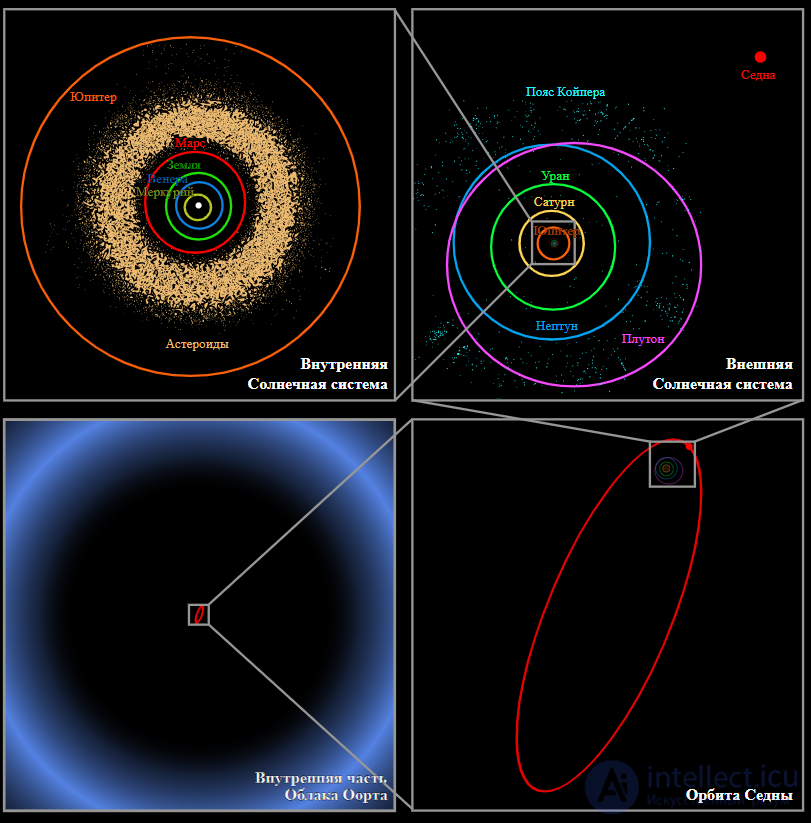
The Solar System — is a planetary system that includes the central star, the Sun, and all the natural cosmic objects on heliocentric orbits. It formed through the gravitational contraction of a gas-dust cloud approximately 4.57 billion years ago.
The total mass of the Solar System is approximately 1.0014 M☉. The greater part of it falls on the Sun; the remaining part is contained almost entirely in eight planets, distant from one another, having orbits close to circular and lying nearly in the same plane — the plane of the ecliptic. Because of this, a distribution of angular momentum between the Sun and the planets is observed that contradicts expectations (the so-called «angular momentum problem»): only 2% of the total angular momentum of the system falls to the Sun, whose mass is ~740 times greater than the total mass of the planets, while the remaining 98% falls to ~0.001 of the total mass of the Solar System.
The four planets closest to the Sun, called the terrestrial planets, — Mercury, Venus, Earth[19], and Mars — consist mainly of silicates and metals. The four planets more distant from the Sun, called the giant planets, — Jupiter, Saturn, Uranus, and Neptune — are far more massive than the terrestrial planets. The largest giant planets in the Solar System — Jupiter and Saturn — consist mainly of hydrogen and helium and are therefore classified as gas giants; the smaller giant planets — Uranus and Neptune — besides hydrogen and helium, contain mostly water, methane, and ammonia; such planets are placed in a separate class of «ice giants». Six of the eight planets and four dwarf planets have natural satellites. Jupiter, Saturn, Uranus, and Neptune are surrounded by rings of dust and other particles.
In the Solar System there are two regions filled with small bodies. The asteroid belt, located between Mars and Jupiter, is similar in composition to the terrestrial planets, since it consists of silicates and metals. The largest objects of the asteroid belt are the dwarf planet Ceres and the asteroids Pallas, Vesta, and Hygiea. Beyond the orbit of Neptune lie the trans-Neptunian objects, consisting of frozen water, ammonia, and methane, the largest of which are Pluto, Haumea, Makemake, Quaoar, Orcus, Eris, and Sedna. The Solar System also has other populations of small bodies, such as planetary quasi-satellites and Trojans, near-Earth asteroids, centaurs, damocloids, as well as comets, meteoroids, and cosmic dust moving through the system.
The solar wind (a flow of plasma from the Sun) creates a bubble in the interstellar medium, called the heliosphere, which extends to the edge of the scattered disk. The hypothetical Oort cloud, which serves as the source of long-period comets, may extend to a distance approximately a thousand times farther than the heliosphere.
The Solar System is part of the structure of the Milky Way galaxy.
The central object of the Solar System is the Sun — a main-sequence star of spectral class G2V, a yellow dwarf. The Sun contains the overwhelming majority of the entire system's mass (about 99.866%), and it holds by its gravity the planets and other bodies belonging to the Solar System . The four largest objects — the gas giants — make up 99% of the remaining mass (with most of it accounted for by Jupiter and Saturn — about 90%).
Most of the large objects orbiting the Sun move in practically the same plane, called the plane of the ecliptic. At the same time comets and Kuiper belt objects often have large angles of inclination to this plane ].
All the planets and most other objects orbit the Sun in the same direction as the Sun's rotation (counterclockwise, if viewed from above the Sun's north pole). There are exceptions, such as Halley's Comet. Mercury has the greatest angular velocity — it manages to complete a full orbit around the Sun in just 88 Earth days. For the most distant planet — Neptune — the orbital period is 165 Earth years.
Most of the planets rotate on their axis in the same direction as they orbit the Sun. The exceptions are Venus and Uranus, with Uranus rotating practically "lying on its side" (an axial tilt of about 90°). A special device called a tellurium is used to demonstrate rotation visually.
Many models of the Solar System conventionally show the planets' orbits at equal intervals, but in reality, with few exceptions, the farther a planet or belt is from the Sun, the greater the distance between its orbit and the orbit of the previous object. For example, Venus is approximately 0.33 AU farther from the Sun than Mercury, while Saturn is 4.3 AU farther than Jupiter, and Neptune is 10.5 AU farther than Uranus. There have been attempts to derive correlations between orbital distances (for example, the Titius–Bode rule)[24], but none of the theories has become generally accepted.
The orbits of objects around the Sun are described by Kepler's laws. According to them, each object orbits in an ellipse, at one of whose foci the Sun is located. Objects closer to the Sun (with a smaller semi-major axis) have a greater angular velocity of rotation, and therefore a shorter orbital period (year). In an elliptical orbit, an object's distance from the Sun changes over the course of its year. The point of an object's orbit closest to the Sun is called perihelion, and the farthest — aphelion. Each object moves fastest at its perihelion and slowest — at aphelion. The orbits of the planets are close to circular, but many comets, asteroids, and Kuiper belt objects have highly elongated elliptical orbits.
Most of the planets of the Solar System have their own subordinate systems. Many are surrounded by satellites, some of which exceed Mercury in size. Most large satellites are in synchronous rotation, with one of their sides constantly facing the planet. The four largest planets — the gas giants — also have rings, thin bands of tiny particles orbiting in very close orbits practically in unison.

Comments