
Lecture
The first telescope was used by G. Galileo. His instrument consisted of a convex
and a concave lens and magnified 3 times. The objective diameter was 4 cm. Later
Galileo built a telescope with a diameter of 4.5 cm and a magnification of 30 times. But even with
this telescope the scientist was able to make the most important discoveries, because before him
no one had looked at the sky through a telescope.
In 1611, J. Kepler proposed a different telescope design, consisting of
two biconvex lenses.
Observations are strongly hindered by aberrations (chromatic, spherical, coma, astigmatism, distortion). They can be reduced by introducing combined objectives.
It was noticed that as the focal length of the objective increases, the chromatic and spherical aberrations decrease. Therefore, in the 17th - 18th centuries
telescopes with very long focal lengths were built. The tubes were 30-40 meters in size. The
largest telescope was built by the French astronomer Auzout. It was 98 meters long. However, the quality of this instrument was poor.
Many discoveries were made using such aerial telescopes. Hevelius (star catalog, selenography), Cassini (satellites and the gap in Saturn's ring,
the polar caps of Mars and the bands of Jupiter), and Huygens (the bands of Jupiter) carried out many valuable studies.
The largest refractors were built by Alvan Clark. In 1888
a telescope with a diameter of 92 cm was installed at Lick Observatory. The money
for its construction was provided by the millionaire James Lick.
An even larger telescope was installed at Yerkes Observatory with money
from Charles Yerkes. It has a diameter of 102 cm. At this size refractors
reached their limit.
A further increase in the diameter of the telescope leads to deformation of the lens under
its own weight and is technically difficult to achieve.
Reflectors were described theoretically in 1616, 1638, and 1663, but
the first mirror telescope was built only by I. Newton in 1668. The mirror had a diameter of 2.8 cm. The focal length was 6.5 cm. Magnification - 40 times.
The main advantage of reflectors is the absence of chromatic aberration.
With a parabolic mirror, spherical aberration can also be eliminated.
Great success in observations with reflectors was achieved by W. Herschel. He built 47 cm and 122 cm mirrors. With his instruments he discovered many nebulae, double stars, and the planet Uranus.
A large telescope with a diameter of 2 m was made by Lord Rosse in 1842. With this telescope the spiral structure of galaxies was discovered.
The Mount Palomar reflector has a diameter of 5 m, a focal length of 16.5
m. The mass of the main mirror is 15 tons.
In the USSR a 6 m reflector was built in 1974. The mirror with the tube weighs 300
tons. The focal length of the main mirror is 24 m; the limiting magnitude is 24.
Main characteristics of telescopes.
Optical telescopes are designed to:
1. Collect as much light as possible from a distant object.
2. Create an image of a distant object near the observer and thereby allow
details to be distinguished that are inaccessible to the naked eye.
There are complex systems of optical telescopes, grouped into three
groups:
- lens telescopes - refractors;
- mirror telescopes - reflectors;
- mirror-lens telescopes.
In refractors, light is collected by an objective consisting of lenses.
In reflectors, the objective is a concave mirror, called the primary mirror.
In mirror-lens telescopes, a lens and a mirror are used simultaneously.
During visual observation, an eyepiece - a short-focus lens system - is placed
at the focal plane of the objective.
Instead of an eyepiece, a sensitive radiation receiver can be installed: a photographic plate, a photomultiplier tube (PMT), etc.
Focal length F.
Let the lens (Fig. 1) be the objective, on which rays from a star fall. The straight line,
drawn through the centers of curvature of both surfaces of the objective, will be its
main optical axis; the principal focus is located at point F'.
Fig. 1 shows rays coming from another star, located off to the side of the
main axis. The image of this star will be off to the side of the main axis at
point F, lying in the focal plane. From the diagram it is clear that if one looks
from the center of the objective, the angular distances between celestial bodies (or between two points of the same body) and their images are equal, since ∠FCF'= ∠SCS'.
Denoting these angles by the letter α, we can write
the equation:
FF'= F'C tg α.
Given the smallness of the angle α: tg α
= α. Then FF'=F'C.α, where α
is expressed in radians. From
this equation it follows that
the same angular
distance in the sky will
correspond to a larger
image FF', the greater the distance F'C, i.e., the focal length of the objective.
Penetrating power of the telescope.
The apparent magnitude
of the faintest star
accessible to a telescope determines its penetrating
power. For the pupil of the human eye when observing the night
sky diameter d = 6 mm, and for
a person with average vision
stars down to visual magnitude 6 m ,5 are available for observation. An objective
with diameter D mm collects
(D/d)2
times more light, and
therefore stars that many times fainter are visible through it. The apparent
magnitude of such stars is determined by Pogson's formula:
mt
= m + 5 (lgD - lgd), from which
mt
= 5 lgD(mm) + 2.1
Relative aperture A.

The most important quantity characterizing an objective is the ratio of the diameter of the objective's entrance aperture to its focal length, which
is called the relative aperture.
A=D/F.
The amount of light collected by the objective from a star (a point source) will depend only on the entrance aperture ( ~ D2
). The situation is different for objects with noticeable angular size, such as planets. In this
case the apparent brightness of the image will decrease, whereas for
observation of point objects it increases ~ D2
. Indeed, as the focal length F increases, the linear
dimensions of the image of such a body increase proportionally. At the same time, the amount of light collected
by the objective, with D unchanged, remains the same. The same amount of
light is therefore distributed over a larger image area, which grows ~ F2
. Thus, when F is doubled (or, equivalently, when
A is halved), the image area increases fourfold. The amount of light per unit area, which determines the brightness of the image,
decreases in the same ratio. Therefore the image will grow dimmer as
the relative aperture decreases.
Eyepiece magnification has exactly the same effect, reducing
the image brightness in the same ratio as a decrease in the objective's relative
aperture A.
Therefore, for observing the most extended objects (nebulae, comets),
low magnification is preferable, though of course not below the smallest useful one. It can be significantly increased when observing bright planets,
and especially the Moon.
Telescope magnification.
If the focal length of the objective is denoted by F and the focal length of the eyepiece by f, then the magnification M is given by the formula:
M = F/f.
The maximum permissible magnification under calm atmospheric conditions does not
exceed 2D, where D is the diameter of the entrance aperture.
Exit pupil diameter.
An observed object is seen clearly through the telescope only if
the eyepiece is set at a strictly defined distance from the focus of the objective.
This is the position at which the focal plane of the eyepiece coincides with
the focal plane of the objective. Bringing the eyepiece into this position is called focusing. When the telescope is focused, rays from each point of the object emerge from the eyepiece parallel (for a
normal eye). Light rays from star images, formed at the focal plane of the objective, are converted by the eyepiece into parallel beams.
The area where the light
beams of the stars intersect is called the exit
pupil. By pointing the telescope at a bright
sky we can easily see the exit pupil by holding a screen
of white paper up to the eyepiece. By moving
this screen closer and farther, we will find the
position at which the bright
circle has the smallest size
and at the same time is most distinct.
It is easy to understand that the exit pupil
is nothing other than the image
of the objective's entrance aperture, formed by the eyepiece. From Figure 2
it can be seen that
D
d
F
f
M d
D
M
= = ⇒ =
This last ratio allows one to determine the magnification given by a telescope even if neither the focal
length of the objective nor the focal
length of the eyepiece is known.
All the light collected by the objective is concentrated in the exit pupil. Therefore, by blocking part of the exit pupil, we effectively block part of the objective.
From this follows one of the most important rules: the exit pupil must not
be larger than the observer's eye pupil, otherwise part of the light collected by the objective will be lost.
From the definition of the exit pupil it follows that its size is smaller and it
is closer to the eyepiece the shorter the eyepiece's focal length (the "stronger"
the eyepiece), and vice versa.
Let us determine the magnification given by an eyepiece that forms an exit pupil
equal to the eye's pupil (the smallest useful, or equal-pupil, magnification
m):
m = D/δ,
where δ is the diameter of the eye's pupil, or
m
D
d
F
f
f
f
D
= =
=
⋅
;
.
δ
Field of view size.
The angle at which the eyepiece diaphragm is seen by the observer is called the angular
field of view of the eyepiece, as distinct from the angular field of view of the telescope, which represents the angular diameter of the circle visible in the telescope on the sky.
The size of the telescope's field of view is equal to the size of the eyepiece's field of view, divided
for magnification.
The resolving power of a telescope.
Because of the diffraction phenomenon at the edges of the objective, stars are seen through a telescope as
diffraction disks, surrounded by several rings of decreasing intensity. The angular diameter of the diffraction disk:
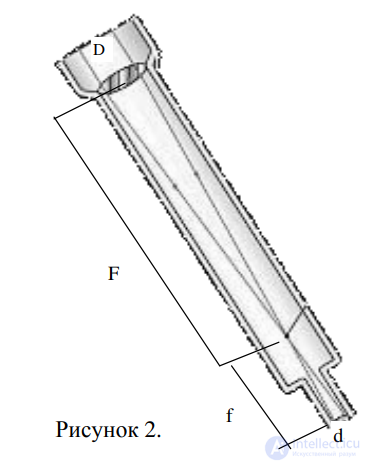
Figure 2.
Θ = λ/D,
where λ is the wavelength of light and D is the diameter of the objective. Two point objects
with an apparent angular separation Θ are at the limit of separate visibility, which determines the theoretical resolving power of the telescope.
Atmospheric shimmer reduces the resolving power of the telescope to:
Θ = 1.22 λ /D.
The resolving power determines the ability to distinguish two adjacent
objects in the sky. A telescope with greater resolving power allows
better viewing of two objects located close to each other, for example,
the components of a double star.
Details of any single object can also be seen better.
When the angular resolving power is low, objects appear as a single blurred spot. As the resolving power increases, two sources
of light become distinguishable as separate objects.
In 1931, Karl Jansky noticed that at a wavelength of 14.7 meters there was constant interference with radio transmissions with a periodicity equal to a sidereal day, i.e.
to the Earth's rotation on its axis. It was discovered that the interference came from the constellation
Sagittarius, where the direction to the center of the Galaxy lies.
World War II contributed to the development of radio engineering and radio astronomy.
Radio astronomy now uses the most sensitive receiving devices and the largest antenna systems.
The human eye receives waves whose length lies within the range from 400 to
760 nm.
Radio waves have a much greater length.
Every heated body emits radio waves. However, the Earth's atmosphere does not transmit all radio waves. There are absorption and reflection bands, so waves longer than 30 meters are reflected by the ionosphere.
Those waves that do pass through the atmosphere are studied using radio telescopes.
Radio telescopes are constructed like reflectors. The radiation is collected by a metal mirror, either solid or mesh. The shape of the mirror is parabolic.
A highly sensitive radio receiver receives the radiation. The waves, falling on the
feed horn, induce an electric current. The current is transmitted through waveguides to the
receiving device and is studied. A recording instrument is connected to the receiver, which registers the flux of radio waves of a given wavelength.
The mirrors of radio telescopes are significantly larger than those of optical telescopes. One of the largest
steerable telescopes has a size of 76 meters.
The fixed mirror at Arecibo has a diameter of 300 meters.
In the USSR, the largest radio telescope has a diameter of 600 meters and consists of
a ring made up of 895 movable aluminum reflectors. This telescope is designed to receive radio waves with a length from 8 mm to 30 cm.
In radio telescopes designed to receive waves several meters long, the mirrors
are made mesh-like. If the size of the mesh cells is small compared to the wavelength,
then the mirror works as if it were solid.
By changing the feed horn, the telescope can be tuned to different wavelengths.
Progress in the development of radio astronomy is largely related to advances in the theoretical explanation of the radio emission of cosmic objects. It was proven that
the cause of “non-thermal” radio emission is cosmic rays (high-energy electrons). These electrons, moving in weak magnetic fields, generate radio waves of various frequencies.
It was explained that the extended components of the radio emission of sources
associated with radio galaxies are magnetized clouds of rarefied gas,
filled with cosmic rays.
To a greater or lesser extent, all galaxies possess
some radio-emitting capability.
In active radio galaxies, the main cause of radio emission is
the powerful generation of relativistic particles in the nuclear regions of these galaxies.
Two sources of radio emission are distinguished - a point source in the galaxy's nucleus and an extended one.
The radio emission of the galaxy Cygnus A, located at a distance of 750 million light
years, is comparable to that of the Sun, given the Sun's distance from us of 8 light minutes.
The power of the source Cygnus A exceeds the Sun's radio emission by a factor of 1028.
A radio interferometer consists of two identical radio telescopes, separated by a distance (the baseline) and connected to each other by an electric cable, to
the middle of which a radio receiver is connected.
Radio waves continuously arrive at both radio telescopes from the source of radio emission. Falling on the different telescopes, they travel unequal
distances. This difference is called the path difference. If it contains
an even number of radio waves, then the waves reinforce each other.
In 1976 the radio telescopes of the Crimean and Haystack (USA) observatories
formed a single radio interferometer. Its baseline was equal to many thousands of kilometers. The resolving power reached 0.”0001. At such an angle one can see
from Earth the footprint of an astronaut's boot on the Moon.
As a result of studies of the nuclei of galaxies and quasars, highly active
explosive processes were detected.
Projects are being considered for placing radio telescopes on satellites, which would
give the baseline an even greater value.
The use of radio interferometers has made it possible to obtain high resolution
of many radio galaxies. It turned out that 75% of the sources studied are
binary systems. Thus the source Cygnus A turned out to consist of two components, symmetrically positioned on either side of the optical galaxy
with which it was identified. The linear dimensions of each of the components are 100,000 light years, and the distance between them is 300,000 light years.
In 1995, scientists from Harvard and the Haystack Observatory, led by D. Lebach, attempted to confirm Einstein's General Theory of Relativity using a radio interferometer. They observed the deflection of radio waves near the Sun as the solar disk passed near the extragalactic radio source 3C279. Two antennas were used, one in Massachusetts, the other in California. Within the margin of observational error, GR was confirmed.
11.5 Modern telescopes (new technologies and methods).
There are several projects for building large telescopes, with mirror
diameters of 10, 18, and 25 meters.
However, great difficulties arise in turning these instruments
while observing stars. The sky survey will be small. For a telescope with
an 18-meter diameter a fixed structure is envisioned; it will be aimed at a single point and its field of view will be small.
There are projects to build composite telescopes made of several mirrors. This
significantly reduces the mass. The mirror of a 6-m telescope weighs 42 tons, while
if such a mirror were made from composite segments, its weight would be 6.5 tons.
Construction of a 25-m telescope made of 8-meter-diameter mirror segments is planned. With
this instrument it will be possible to observe stars down to magnitude 32.
Right now the 10-meter “Keck” telescope is being completed. It is built on the Ritchey-Chretien system with a 36-segment primary mirror. With the help of the new telescope
it was possible to discover the most distant object in the Universe - the quasar PC 1247+3406 in
Canes Venatici.
Mexico and the USA are building a large radio antenna 50 m in diameter (made up of 126
individually adjustable segments) for millimeter astronomy.
The telescope will come into operation in 2000. It will study waves with wavelengths from 1
to 4 mm. In this range lies the radiation of many molecules present in
interstellar clouds, in which stars and planets are formed. With
the help of this telescope, the distant planets of the Solar System will be studied, along with comets, asteroids, vigorously evolving stars, and the nuclei of active
galaxies hidden behind a layer of dust.
In Chile, in the Andes, on the summit of Cerro Paranal, at an altitude of 2600 meters above
sea level, stands the most powerful observatory on the planet, the European Southern Observatory. Its first telescope has already come into operation. The mirror is 8.2 meters in diameter. The mirror was cast in the city of Mainz by the firm "Schott". The mirror's weight is – 24
tons. Its thickness is – 18 cm.
This mirror flexes easily and rests on 150 movable hydraulic supports,
which are under computer control. By means of precisely calculated pressure, a support rises or lowers, bending
the mirror in the needed direction. Such image corrections cannot be detected by the naked eye:
the largest deviation achievable through the movable supports can reach three hundredths of a millimeter.
By 2002 the construction of three more telescopes is planned, but their mirrors will be
smaller - three meters in diameter. All four instruments will be able to work together - as an ensemble. Light rays from a star or some other object,
captured by the four telescopes, will converge in a tunnel beneath the observatory.
The light oscillations of all four beams must be aligned to an accuracy of
one millionth of a millimeter. An interferometer will be created that will provide
a resolving power equal to that of a mirror 200 meters in diameter. The resolution will be such that it will be possible to make out the headlights of a car
sitting on the Moon.
The list of tasks facing the new observatory on Cerro Paranal is extensive.
Astronomers will need to determine with high precision the trajectories of several
hundred stars in order to find out whether or not a star has companions.
The observatory will need to register faintly glowing stars and "brown dwarfs". This will help determine the mass of "dark matter" in space. The telescope will need to study the center of the Milky Way and measure the speed of motion of the star clusters located there. This will point to the location of the central black hole.
The cost of the entire project is one billion German marks. Participating in the construction
are Belgium, Denmark, Germany, France, Italy, the Netherlands, Sweden and
Switzerland. The cost of the observatory is much less than just the repair in space of the Hubble Space Telescope. And the resolving power of the new astronomical instrument exceeds that of Hubble by a factor of ten.
Ground-based observatories cannot operate at full capacity because of atmospheric
interference. The constant movement of air masses blurs and spoils the image
of celestial bodies. Limited magnifications must be used (no more than
500x).
Because the atmosphere is opaque for many ranges of electromagnetic waves, the sky can only be studied through narrow windows.
In 1870, the Frenchman J. Janssen studied the Sun from a hot air balloon.
Later, aircraft were used for observations, especially of eclipses. The aircraft would fly along with the lunar shadow and extend the duration of the eclipse.
Since 1951, O. Dollfus made a series of high-altitude balloon flights.
In 1969, his stratospheric balloon reached an altitude of 13 km. Dollfus managed to photograph the spectrum of Venus, finding water vapor in its atmosphere.
In 1957, M. Schwarzschild began launching unmanned stratospheric balloons. One of
them rose to an altitude of 24 km and carried aloft a radio-controlled 36-
inch telescope.
At an altitude of 34 km, the influence of the atmosphere on observations is reduced to zero.
Good photographs of the Sun were obtained, granules and sunspots were examined in detail
. In the infrared parts of the spectrum of some cool stars,
water bands were detected.
With the help of stratospheric balloons, ultraviolet spectra of
hundreds of stars were obtained for the first time.
Since 1972, hundreds of balloons have been launched to altitudes of 30-35 km.
Astronomers also use rockets for research. As early as 1946, a group of
American astronomers installed a spectrograph on one of the captured "V-2"
rockets and sent the rocket to an altitude of 200 km.
Observatories placed on satellites orbiting the Earth are now widely used.
For observations, Orbiting Astronomical Observatories use
special stabilization systems.
The American OAO "Copernicus", launched in 1972, maintains the required direction for
an hour with an accuracy of 0.”1.
Currently in orbit is the Hubble Space Telescope, consisting of a reflector with a mirror diameter of 2.4 meters. The stabilization accuracy
is 0.”005. The telescope is in orbit 600 km from Earth. In 1995,
a correction of the telescope was carried out, after which it began to work much
better. Stars of magnitude 29 are visible through it. In December 1994, an 18-hour exposure was made, achieving magnitude 29.
Obstacles to observation nevertheless remain. Scattered light from interplanetary and interstellar dust interferes. The optics are damaged by bombardment from meteorites and
cosmic ray particles.
11.7 Infrared astronomy.
Between the radio range and the visible spectrum lies the region
of infrared rays.
It was first studied by William Herschel in 1800, observing the Sun through
variously colored dark glasses.
He dispersed sunlight into a spectrum and measured the temperature of each section.
The temperature increased toward the red part of the spectrum. Beyond the red part, where the eye
no longer saw any rays, the temperature remained high.
Thus infrared rays were discovered.
Important discoveries have been made through the analysis of infrared radiation from planets. Thus carbon dioxide
gas was found in the atmospheres of Mars, Venus, and Jupiter
.
Infrared radiation used to be measured with a thermocouple or bolometer, but now more modern methods are used - using a Golay
cell and semiconductor crystals.
The Earth's atmosphere greatly hinders infrared astronomy, since it not only
strongly absorbs infrared rays but is itself a source of them. Therefore, observations must be made using spacecraft and stratospheric probes.
In the late 1960s, Strong and Dollfus, using equipment mounted on a balloon, detected absorption bands of water vapor in the infrared spectrum of Venus. This means that above the cloud layer of Venus there is a layer of water vapor, 100 times less than above the surface of the Earth.
An infrared map of Venus was compiled and several hot
spots were found near the south pole. Such spots sometimes appear and disappear over
20-25 hours.
The study of Jupiter showed that the temperature of the Red Spot is two degrees
lower than the rest of the surface.
Jupiter's bands are not visible on the infrared map, meaning their temperature does not stand out in any way among the other regions.
When observing the Moon in the infrared range, it was found that on its
surface there are hot spots coinciding with young craters.
A star map compiled in the infrared range differs greatly from
the one visible to the naked eye. The brightest appear to be red cool stars,
and the core of the Galaxy is clearly visible. Near the center of the Galaxy a powerful
source of infrared radiation has been discovered, whose radiation flux exceeds the Sun's by 300,000 times. Quasars are strong sources of such radiation.
11.8 Ultraviolet, X-ray and gamma astronomy.
The short-wavelength region of the spectrum, separated from the long-wavelength region by the zone of visible light, consists of three types of radiation - ultraviolet,
X-ray and gamma radiation.
The branch of astronomy that uses these rays is called high-
energy astronomy.
Ultraviolet radiation is recorded using photographic plates with
a special emulsion sensitive to ultraviolet rays.
This radiation is very weak. Ultraviolet spots have been detected in the atmosphere of Venus, which have a different rotation period than that determined by radar methods. The appearance of the spots is possibly caused by atmospheric vortices or currents.
An intense source of ultraviolet radiation is the North America
nebula in the constellation Cygnus.
The most powerful source of ultraviolet radiation is the star
Zeta Puppis. Its brightness in the ultraviolet range is comparable to the brightness
of Venus. Next comes Zeta Orionis. A bright ultraviolet source
is the Orion Nebula.
For wavelengths shorter than 2000 A, ordinary refracting and reflecting systems
are unsuitable. Quanta become very energetic, penetrating all materials,
without changing their original direction of flight.
X-ray and gamma radiation are recorded using counters
used in the study of cosmic rays. The simplest instrument is the Geiger-Muller counter.
An X-ray telescope is built on the same principle. Its drawback is that it covers a large area of sky, several degrees wide, and cannot isolate a specific point source of radiation.
When studying the Sun, it is possible to create instruments giving a resolution close to 1 arc minute.
Study of the Sun's X-ray radiation during eclipses showed that its
source is the solar corona. The corona has a high temperature,
close to a million degrees, and produces X-ray radiation. When a
chromospheric flare occurs on the Sun, X-ray radiation increases hundreds of times.
In 1963 the American rocket “Aerobee” detected two
powerful sources of X-ray radiation in the starry sky. One is located in the constellation
Taurus and is associated with the Crab Nebula, the other is located in the constellation
Scorpius. Both of these sources are associated with supernova outbursts. Study of the occultation of the Crab Nebula by the Moon showed that the source of X-ray radiation is not the neutron star located at the
center of the nebula, but the nebula itself. The rays originate in it as fast electrons are decelerated in magnetic fields. The rays are emitted by the central
part of the nebula.
Hundreds of X-ray sources are now known. They are much
weaker than those discussed above. Almost all sources are located in the Milky
Way, in the constellations Sagittarius, Cygnus, Serpens and others.
According to I.S. Shklovsky's estimates, the distance to them is tens of thousands of light years.
Sources of X-ray radiation are often neutron stars
belonging to binary systems.
The possibility of the emergence of gamma astronomy was theoretically suggested in the 1950s.
In 1952 Hayakawa drew attention to the possibility of studying the nuclear component of cosmic rays by methods of gamma astronomy. In
inelastic interaction of “cosmic” nuclei with the nuclei of interstellar
gas atoms, neutral pi-mesons arise, which, upon decaying, give gamma quanta with an energy exceeding several tens of MeV.
The advantage of gamma astronomy compared with astronomy in other
spectral ranges should be the greater penetrating power
of gamma quanta. When a quantum passes along the entire galactic plane,
the probability of its absorption is less than 1%.
Cosmic gamma quanta with an energy greater than 50 MeV from the band of the
Milky Way were first registered in 1972. The intensity of gamma
radiation of the Milky Way increases toward the galactic center.
Gamma radiation was detected from the Crab Nebula.
In the 1970s satellites with gamma detectors were launched, studying radiation
in the plane of the Milky Way. A large increase in intensity was revealed
toward the galactic center. Bursts are observed in the region of the Crab Nebula, the constellations Vela, Norma, Orion.
Sources of gamma radiation may be:
a) interaction of the nuclear component of cosmic rays with the nuclei of interstellar atoms;
b) bremsstrahlung of relativistic electrons that are part of cosmic rays, upon colliding with atoms of the interstellar medium;
c) interaction of relativistic electrons with photons of stellar radiation,
filling interstellar space;
d) interaction with low-frequency quanta of the “relic” (cosmic microwave background) radiation, filling the entire Universe;
e) synchrotron radiation in the gamma range, caused by the motion
of ultrarelativistic electrons in cosmic magnetic fields.
Gamma quanta, entering the Earth's atmosphere, cause a cascade of multiplying secondary particles, above all very energetic electrons. They in turn
cause flashes of “Cherenkov” radiation. To study gamma radiation a Cherenkov counter is used. In modern ground-based gamma telescopes, radiation is registered from a patch of sky 30-350
across.
It is possible to localize the source of radiation by observing with artificial satellites, especially
if two or three satellites observe simultaneously. In the first case a band is identified in which the source is located, in the second - a rhombus.
The farther apart the satellites are from each other, the more precise the localization.
On March 5, 1979 it was possible to register a powerful gamma-ray pulse from nebula N 49, located in the Large Magellanic Cloud, at a distance of 55,000
pc from Earth. According to assumptions, the pulse came with a period of 8 s from a new
pulsar. Most local gamma-ray sources, presumably, are
old pulsars.
The satellite “COS-B” detected gamma radiation from quasar 3C 273, at a distance
of 500 Mpc.
The Compton Gamma-Ray Observatory and the Ulysses satellite registered
on 17.02.1994 a powerful gamma-ray burst. This burst lasted
very long - more than an hour, during which time the power of the gamma radiation
was 12 times greater than the maximum values recorded in the past.
The energy of the gamma quanta amounted to 25 billion eV. Some astronomers believe
that this occurred as a result of the collision of two stars. The phenomenon has
not been finally explained.
The neutrino was predicted in 1931 by Wolfgang Pauli. It was introduced to eliminate
an apparent violation of the law of conservation of energy in beta decay. The energy
of the escaping electrons is not always the same, but varies over a wide range. Pauli suggested that along with the electron a particle is emitted from the radioactive nucleus, carrying away the missing energy.
The properties of the neutrino were very unusual. Having no electric charge, it had to have a very small mass.
In 1957 the first neutrino was registered.
The neutrino is formed in all nuclear processes. This means it arises in the interior of all stars, as a byproduct of the nuclear reactions that sustain
their glow.
The neutrino radiation of the Sun amounts to 10% of its visible radiation in terms of energy.
The neutrino passes unimpeded through enormous thicknesses of matter. If
the Sun were surrounded by an iron shell millions of light-years
thick, this would not hinder the motion of neutrinos. This is due to their very small
mass. Their neutral charge means that they do not react to electromagnetic fields.
The neutrino reacts with the nucleus of chlorine. As a result of this reaction, a nucleus of the radioactive isotope argon is formed, which emits an electron. If one creates a large layer of carbon tetrachloride (perchloroethylene) and studies the argon formed by neutrinos, one can draw certain conclusions about the neutrino
radiation.
On this principle a neutrino observatory was built in 1955 in the USA
(South Dakota) at a depth of 1490 meters.
The radiation receiver was a horizontal cylindrical tank 14 meters
long, containing 400,000 liters of perchloroethylene. The results obtained in the course of the studies could not be reconciled with the theoretical conclusions.
The study of neutrinos may help in studying the interior of the Sun and other stars.
It is possible to predict supernova outbursts, since before flaring up in the
visible part of the spectrum, a star emits intense streams of neutrinos.

Comments