
Lecture
Это окончание невероятной информации про педагогические источники.
...
process queries — information retrieval systems (IRS). There are several models on which the operation of search engines is based, but historically two models have gained the greatest popularity — search directories and search indexes. Search directories are organized on the same principle as the subject catalogs of large libraries. They usually represent hierarchical hypertext menus with items and sub-items that determine the subject matter of the sites whose addresses are contained in the given directory, with a gradual, level-by-level, refinement of the topic. Search directories are created manually.
Teachers can use the internet to obtain information, for training, and for exchanging experience. Here is how the internet can be a useful source of pedagogical information:
Online courses and educational resources: There are many online courses and educational resources that provide pedagogical materials, lessons, and methodological recommendations. This can be useful for professional development, learning new methods, and developing curricula.
Professional communities and forums: Many websites and forums are intended for teachers, where they can discuss their experience, ask questions, and get advice from colleagues.
Scholarly journal websites and databases: Teachers can use the internet to access scholarly articles and research in the field of pedagogy and education.
Educational videos and webinars: Video materials provided on platforms such as YouTube can be useful for visualizing teaching materials and methods. There are also online webinars in which one can participate in real time.
Social networks: Teachers can join groups and communities on social networks where trends and innovations in education are discussed.
Blogs and websites of teachers: Many teachers and educators keep blogs and create websites where they share their experience, methods, and teaching materials.
Electronic libraries and resources: Many electronic libraries and resources can be found on the internet, storing teaching materials, textbooks, and articles.
Educational applications: There are many applications for smartphones and tablets designed for the training and development of children.
It is important to remember that the internet also contains a great deal of unreliable information, so teachers must be able to filter and evaluate sources. Always verify information and rely on authoritative sources, especially when preparing materials for lessons and classes.
Educational resources on the internet are extremely diverse, and sometimes interesting material needed by a teacher suddenly turns up on a site they previously knew nothing about. So what can be classified today as pedagogical internet resources? Let us list their main types.
1. Educational portals. As a rule, these are large resources that publish scholarly articles and methodological developments by teachers and other education specialists, organize various competitions for teachers and students, hold public discussions of pressing problems in education, and give teachers the opportunity for distance communication, keeping an author's blog, etc. Examples of educational portals: «Rossiyskoe Obrazovanie» (Russian Education) (www.edu.ru), «Pedsovet.org», «Pedsovet.su», «Zavuch.info», «Otkrytyi Urok» (Open Lesson), «Otkrytyi Klass» (Open Class), «Uchitelskiy Portal» (Teacher's Portal).
2. Electronic periodicals on pedagogical and educational topics. These include the electronic scholarly journals «Pisma v Emissiya. Offline» (Letters to Emissia. Offline) and «Sovremennye Problemy Nauki i Obrazovaniya» (Modern Problems of Science and Education), the scholarly-methodological journals «Sibirskiy Uchitel» (Siberian Teacher) and «Soobshchestvo Uchiteley Angliyskogo Yazyka» (Community of English Language Teachers), the journal of methodological developments «Pedagogicheskiy Mir» (Pedagogical World), the electronic publication «Pedagogicheskaya Gazeta» (Pedagogical Gazette), and others.
3. Internet resources of publishing houses, editorial offices, and other organizations specializing in holding scholarly events and issuing pedagogical publications. On such sites one can often find archives of electronic versions of print periodicals. Today all leading scholarly journals in Russia must be represented on the internet and provide access to archived issues. Many of them post their archives on their own websites. For example, here is a link for direct access to the archive of the «Gramota» publishing house: http://www.gramota.net/materials.html .
4. Internet communities and forums of teachers, students, graduates, and parents. These resources may exist either within educational portals or as entirely independent resources, such as the «Profobrazovanie» (Vocational Education) forum, or the «Planyorochka» forum for camp counselors. Their main merit is the opportunity to become acquainted and communicate, exchange information, and take part in discussions of various social problems faced by teachers, questions of study and leisure, earnings for students and schoolchildren, and so on.
5. Websites of educational institutions and their structural subdivisions. Such internet resources include not only the websites of higher education institutions, colleges, faculties, and departments. Since 2011, every educational institution has had its own website, be it any school or kindergarten.
6. Electronic dictionaries, reference books, encyclopedias. As in their printed versions, the brevity of the information in them is compensated for by a clear search structure and the breadth of information covered. And the capabilities of the internet make it possible to combine dictionary entries from many printed publications in a single reference resource.
7. Electronic libraries. In the world of information and communication technologies, the book still remains a source of knowledge – now it is the electronic book, which can be read online or downloaded to a computer or mobile device. Today, among electronic scientific libraries the leader is the NEB eLibrary.ru, which cooperates directly with publishers and authors, keeps a record of scientific publications in Russia, and automatically calculates the citation count for each scholar's work. Most electronic libraries have sections on pedagogy and related sciences, on questions of teaching and upbringing, and on self-education. There are relatively few specialized pedagogical libraries, but they do exist, for example: «Pedagogical Library», «Library on Pedagogy». A useful source of professional knowledge for a teacher is the electronic library «Kub», which specializes in publications on psychology.
8. Personal websites and blogs of teachers and instructors. The subject matter of these resources is determined not only by the pedagogical specialty and professional interests; often they also reveal the author-teacher's outlook on life and their interests outside the profession. The quality of these resources varies greatly: among them are many useful and unique projects, but there are also «one-day» sites created, for example, solely to earn extra points during certification. Examples of useful personal teacher websites include the site of G.O. Astvatsaturov «Didaktor», the blog of L.P. Kazantseva «Geografochka», as well as the sites of well-known pedagogical scholars A.V. Khutorskoy and B.M. Bim-Bad.
9. Highly specialized sites devoted to a particular method or methodology of teaching, upbringing, or personal development, based on some original scientific-pedagogical idea: «Zankov.Ru – The System of Developmental Education», «Igor Petrovich Ivanov and the Kommunar Methodology», and others.
10. Sites of various firms providing paid educational services, as well as consulting services on questions of personal development, interpersonal interaction, running a business, etc. In order to attract clients, such firms often do not limit themselves to creating a business-card-style site with a description of services and contact information, but try to fill it with interesting, informative content.
Searching for information on the Internet has its own particularities, and the effectiveness of this process depends on the skills and methods you use. Here are several particularities of searching for information on the Internet:
Abundance of information: The Internet contains an enormous amount of information on the most varied topics. This is an advantage, but also a challenge, since one needs to be able to filter out and select the most suitable and reliable sources.
Diversity of sources: Information can be found on websites, blogs, wikis, scientific journals, forums, social networks, and even in video and audio files. Different sources have different levels of reliability and trustworthiness.
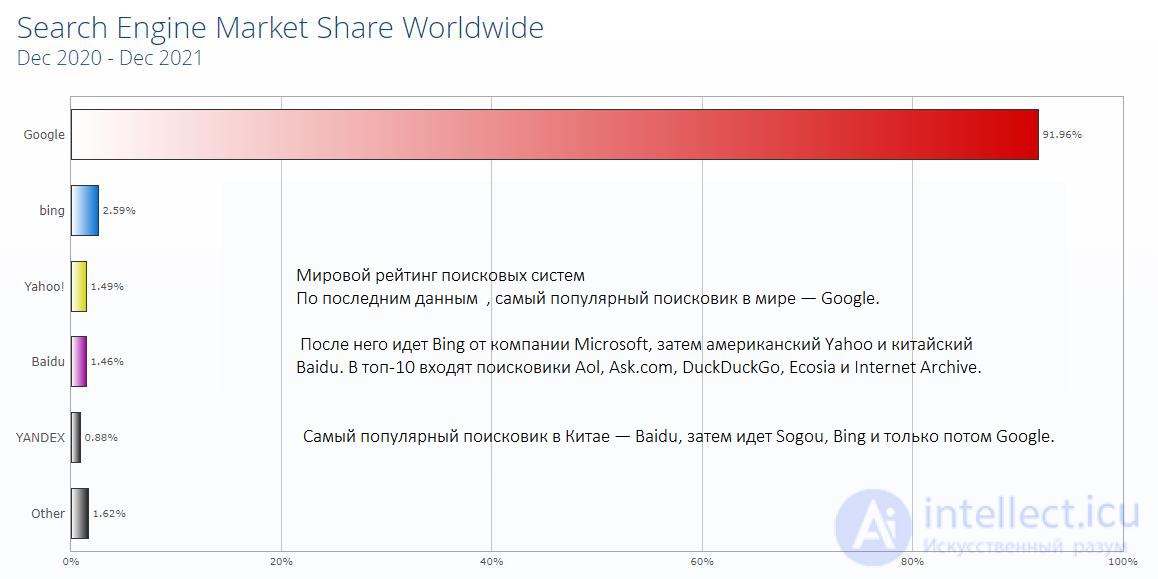
Search engines: Most people use search engines such as Google, Bing, or Yahoo to find information. It is important to know how to formulate queries correctly in order to obtain the most accurate results.
Filtering results: Since search engines can return a multitude of results, it is important to be able to filter them by various criteria, such as date, type of content, authority of the source, and others.
Critical thinking: The Internet also contains a great deal of erroneous and unreliable information. It is important to develop critical thinking and the ability to assess sources for reliability and authority.
Relevance: Information on the Internet can become outdated very quickly. Therefore, it is important to check the publication date of a source to make sure it is current.
Privacy and security: When searching for information, especially when registering on websites and entering personal data, it is important to observe privacy measures and ensure the security of your data.
Respecting copyright: When using found information, it is important to take copyright into account and use materials in accordance with copyright laws.
Saving information: For more effective use of found information, the ability to organize and save it is important. This may include creating bookmarks, downloading files, or using online tools for managing information.
Taking these particularities into account, searching for information on the Internet can be more productive and effective.
Publicism (socio-political journalism) arose in the ancient world. The first newspapers already existed in Ancient Egypt and Ancient Rome, and the first publicists known to us were ancient orators and philosophers (Socrates, Demosthenes, Cicero, and others).
In medieval Europe, information bureaus appeared: guilds of newsletter writers (Rome, Venice).
Publicism (from the Latin publicus — public), a genre of works devoted to topical questions and phenomena of the current life of society (Great Soviet Encyclopedia). Publicism plays an important political and ideological role as a means of expressing public opinion, including opinion forming around acute problems of life.
The particularities of pedagogical publicism in comparison with scientific and artistic literature are presented in Fig. 5.9.
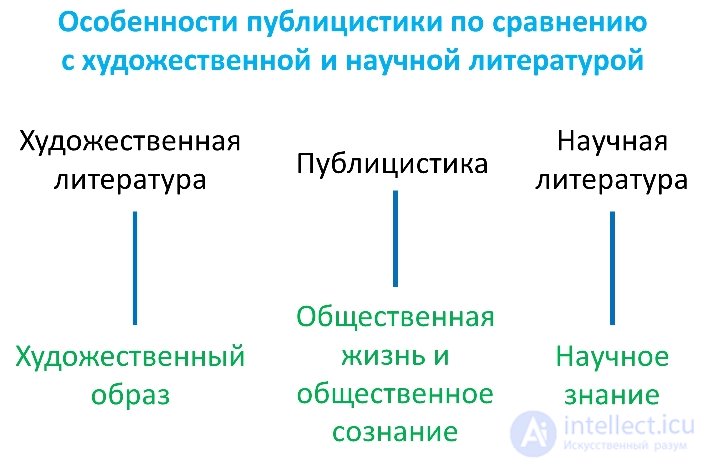
Fig. 5.9. Particularities of publicism in comparison with artistic and scientific literature
Main functions of publicism (E.P. Prokhorov):
1. Sociocognitive (informational-cognitive): to understand social phenomena using «all the cognitive tools accumulated by humanity – both scientific, logical-conceptual, and artistic, emotional-figurative».
2. Sociopsychological (social-pedagogical): to shape public consciousness, «constantly responding to the realities of public opinion, striving to «lead» it along with its own (preferably adequate) conception of the proper state of mass consciousness»).
Forms of publicism:
Pedagogical publicism as a mass phenomenon arises with the development of magazines and newspapers in the 19th century.
When comparing pedagogical publicism and scientific-pedagogical literature, a number of substantial differences emerge (see Fig. 5.10).
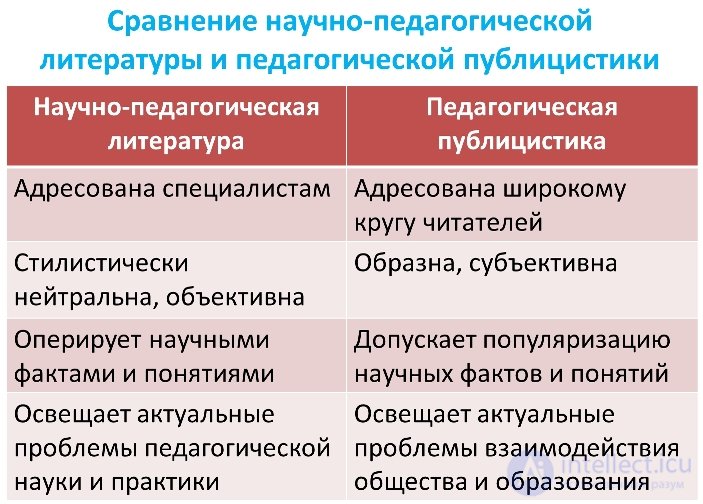
Fig. 5.10. Comparison of scientific-pedagogical literature and pedagogical publicism
N.I. Bondarenko distinguishes between the modern concepts of pedagogical press, pedagogical journalism, and pedagogical publicism.
Pedagogical press – the entire body of newspapers, magazines, and periodical and non-periodical collections that are wholly or partly devoted to problems of education and questions of pedagogical theory and practice.
Pedagogical journalism — a multifaceted phenomenon that includes:
Pedagogical publicism – a genre of pedagogical journalism, a type of work (publication) devoted to acute, pressing problems and phenomena of the education system, usually presented in a vivid, polemical form.
Pedagogical publicism performs a variety of functions. Let us list and explain some of them based on the work of T.A. Sutyrina.
Informational: pedagogical publicism reflects current, socially significant pedagogical problems, informs the public about them, and makes scientific-pedagogical knowledge accessible to a wide range of people.
The function of anticipation (from Latin anticipation — anticipation): anticipates and foresees the development of events, phenomena, ideas, results of actions, innovations, etc. Formative: purposefully shapes public opinion on the problems of the modern pedagogical process, introduces new pedagogical ideas into public consciousness.
Educational (character-forming): actively influences the consciousness and behavior of readers, shapes the target orientations of pedagogical consciousness through ideas, views, and convictions; forms an active life position.
Integrating: combines information from various fields of education, culture, and science, creating a new, ordered unity and integrity of knowledge.
Stimulating: allows knowledge to be used as a guideline or even a guide to action; encourages the independent resolution of theoretical and practical problems.
Actualizing: comprehension of pedagogical reality, its problems and goals, reflection on pedagogical experience, the art of upbringing, and the professional competence of educators, translating potential knowledge into actual knowledge.
The main types of publicism: informational, analytical, and literary-artistic.
Each type involves the use of certain genres. Let us consider some of the genres found in each type of pedagogical publicism.
Informational publicism states facts that have occurred, individual events.
Genres of informational publicism.
1. The note – a short account of a single fact, which may report on a positive experience or a shortcoming, express someone's opinion or feelings. The text of a note may be published in print, read on the radio, or accompany an image on TV.
2. The interview – a recorded conversation between a journalist and an interlocutor, intended for a mass medium (newspaper, radio, television). As a rule, this is an unequal dialogue, since the journalist asks questions and the interlocutor answers them. Example: an interview with the Honored Teacher of the Russian Federation, corresponding member of the Russian Academy of Education E.A. Yamburg, published in «Rossiyskaya Gazeta».
3. The event report is a sequential account of the events or actions, facts, and stages of a single major event. In a television or video report of this genre, the author's text may be reduced to a minimum or absent altogether. Example: «The Unified State Exam Live. A Report from the State Exam under the New Rules» (2014) – see the video.
Analytical publicism uncovers cause-and-effect relationships between phenomena and gives them a socio-political assessment.
Genres of analytical publicism.
1. The problem article as a genre of pedagogical publicism raises pressing questions of education and problems of the teaching profession. Such articles are characterized by the formulation and discussion of ways to solve the problem. A problem article may be discursive in character, presenting several points of view.
2. The problem report differs from the event report in that the facts presented in it characterize the essence of a particular problem and ways of solving it. Example: «The Unified State Exam: Consequences». At the center of this report is the problem of mass violations during the Unified State Exam.
3. The conversation – is a television genre of publicism representing a dialogic form of communication. Competent people who are well-versed in the given topic and can answer questions of concern to many are usually invited as participants in the conversation (guests of the television program). Example: a conversation with the Minister of Education.
4. The commentary supplements information about a known, previously covered event or phenomenon, explains the main content of the material, helping to understand its essence, emphasizing its importance, or expressing a competent opinion about the main material. The purpose of a commentary is to explain a fact when the audience lacks information. Types of commentary:
- detailed (an explanation down to the smallest details); this type of commentary often stands as an independent journalistic work, in which the fact itself is briefly reported at the beginning and then commented on at length.
5. The review (revue) presents to the reader (viewer, listener) a group of similar events or several thematically related groups of events. In a review, scattered facts are arranged in a certain sequence; the author identifies what is essential in them, gives an assessment, and draws a general conclusion. For example, the genre of pedagogical review may include analytical reviews of textbooks and educational programs, forms of extracurricular work, higher education institutions and departments, and changes in the regulatory framework of education. The main advantage of a review for the reader is the opportunity to obtain, within a relatively small volume of material, information about many subjects and phenomena of the same kind in comparison with one another.
Literary-artistic publicism reveals the typical, the general, through the individual, the particular.
Genres of literary-artistic publicism.
1. The sketch - is an artistic description of nature, a person, a setting, or thoughts. It does not so much recount a fact as create an image of that fact, the author's individual vision of it. Example: a sketch about school life, «I Do Not Like Injustice» by Natalia Yepifanova.
2. The essay-sketch (ocherk) in pedagogical publicism is understood as a genre that describes predominantly singular phenomena and objects of reality directly familiar to the author. An ocherk is small in volume and contains no sharp, quickly resolved conflict. Example: an ocherk about a school: «The Staircase» by Yuri Mednykh.
3. The essay (French: essey – experience, sketch) in journalism – a genre in which the author expresses their impressions and reflections on a specific question. In the essay, the individual position of the author is emphasized; the author sets it forth freely, without claiming to give an exhaustive treatment of the question or an absolutely correct interpretation of the subject. The freedom and informality of this genre make it interesting to the reader. Today, writing an essay is also a popular assignment in various creative competitions held among teachers, students, and schoolchildren. An example of an essay written for a teachers' competition.
4. Feuilleton and other satirical genres. The feuilleton is characterized by topicality, currency, a pronounced evaluative stance, artistic expressiveness, and satirical meaning. An example of this genre in pedagogical journalism is the work by I. Ilf and E. Petrov, «Conversations at the Tea Table», first published in 1934 in the newspaper «Pravda» (the authors mock errors in school instruction typical of that time).
Folk pedagogy (ethnopedagogy) is the body of pedagogical knowledge and upbringing experience preserved in folk cultural traditions, in folk artistic creativity, and in the particular stable forms of interaction between different generations characteristic of each people.
Folk pedagogy preserves the general features of national culture and is the most important means of ensuring the continuity of generations and the integrity of an ethnic group.
Means of folk pedagogy:
- folklore – works of folk poetic creativity (folk songs, fairy tales, proverbs, sayings, tongue-twisters, etc.);
- folk toys (dolls, toy horses, various figures of people and animals have long been used by various peoples to tell children about the world around them, about human interaction with other people and with nature);
- labor – a means that allows not only preparing a child for independent labor in adult life, but also strengthening the bond between generations by passing on practical experience from elders to the young;
- folk games, distinguished by great variety: active games (tag, hide-and-seek, "burners", blind man's buff, cat-and-mouse), attention games, finger games for developing fine motor skills, role-playing games (for example: "daughters and mothers", "cossacks and robbers" – games in which children act out various situations from adult life), and others;
- religion served as one of the most important sources of moral and aesthetic upbringing; by constantly turning to God, children formed a clearer picture of the ideal of a moral life, and by attending church, they admired the beauty of its decoration and strove for beauty in life;
- folk holidays, which were tied to important events in the family and the community (for example: name days, weddings) or to religious traditions (Trinity Sunday, Easter, Christmas, etc.); thus, by taking part in holidays, children absorbed the customs of their people and religious-moral values, and learned to communicate with people of different ages and status;
- caring for the younger and elderly members of the family fostered responsibility and compassion;
- mutual aid in the peasant community (helping fire victims, orphans who had lost their breadwinner, those affected by illness, natural disaster, or crop failure) developed a sense of solidarity and formed mutual support;
- social control – a special means whereby every member of a social group or community bears responsibility not only for their own children but also for other people's children (without hesitation, one would help a crying toddler, praise a child for a good deed, reprimand a mischief-maker, tell his parents about his bad behavior, etc.);
- everyday life as a means of upbringing makes it possible to see pedagogical meaning in any, even the most ordinary, everyday situation (reminding a child of his household duties, that he should be the first to greet his elders, etc.).
These and other means of folk pedagogy are successfully used today in professional pedagogical activity.
In studying folk pedagogy, scholars have concluded that its elements are not disparate but together form a unified system of upbringing. Of course, this system did not arise on a scientific-theoretical basis, but it was formed and perfected over many centuries, and therefore possesses high effectiveness and reflects a certain level of pedagogical knowledge.
Since ancient times, traditions have been preserved for the care of young children, the upbringing of adolescents and young men, preparation for family life, for labor, for the defense of the homeland, and the formation in the new generation of respect for laws and the norms of public morality. The ideas and experience of folk pedagogy are especially relevant in social, family, and preschool upbringing. In it, an understanding of good and evil is clearly expressed, along with the values, character traits, and personal qualities that are encouraged and condemned among the people (industriousness – laziness, courage – cowardice, loyalty – betrayal, etc.).
Folk pedagogy took into account the individual and age-related characteristics of children, and the methods used were distinguished by great variety: explanation, advice, persuasion, demonstration, personal example, habituation, coercion, censure, prohibition, reproach, encouragement, punishment (moral and physical), and competition. (In contemporary pedagogical practice, coercion and habituation are considered undesirable, and physical punishment is prohibited altogether; however, let us not forget that the times when folk pedagogy was being formed were far harsher.)
It is no surprise that the rich pedagogical heritage of the world's various peoples serves as a source of ideas for scholarly pedagogy.
The founder of scientific pedagogy, J.A. Comenius, devoted one of his most famous works – the book «The School of Infancy» (1633) – to family upbringing, and believed that the "mother's school" he had substantiated should become part of the national education system.
The famous Swiss pedagogue J.H. Pestalozzi was convinced that the common people were the bearers of the most correct pedagogical ideas. In his novel «How Gertrude Teaches Her Children» (1801), the main heroine is a simple peasant woman, but it is precisely from her that the reader learns about a new didactics of elementary education.
The great Russian pedagogue K.D. Ushinsky highly valued the potential of folk pedagogy, devoting to this question his work «On Nationality in Public Upbringing» (1857). He was convinced that «upbringing created by the people themselves <…> possesses that educative force which is absent from the best systems founded on abstract ideas».
The ideas of folk pedagogy retained their relevance in the twentieth century; they were drawn upon by outstanding Soviet pedagogues N.K. Krupskaya, A.S. Makarenko, V.A. Sukhomlinsky, and others.
Today, folk pedagogy remains an inexhaustible source of pedagogical ideas.
Часть 1 Information and Methodological Support of an Academic Discipline: Sources of Pedagogical Ideas and Searching for
Часть 2 Pedagogical Publicism - Information and Methodological Support of an Academic

Comments