Tests with answers: Methods of correctional-developmental work of a psychologist.
answers at the end of the article
Version 1.
1. Introduction to psychological-pedagogical correction.
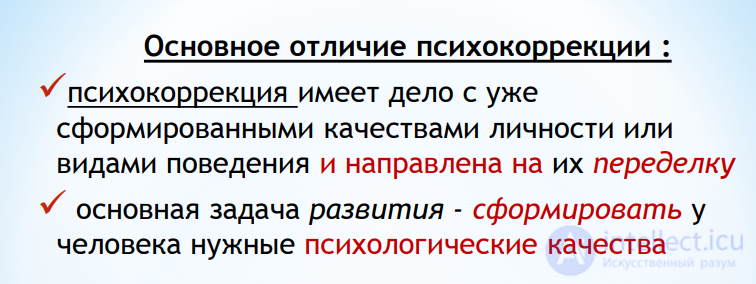
1. Psychocorrection, unlike psychotherapy, is characterized as:
- 1) a substantiated influence of the psychologist on discrete characteristics of a person's inner world *
- 2) a directed psychological influence on various psychological structures with the aim of ensuring the full development and functioning of the personality as a whole
- 3) the creation of conditions aimed at correcting deficiencies and deviations in a person's development
- 4) the creation of conditions aimed at correcting a person's behavior

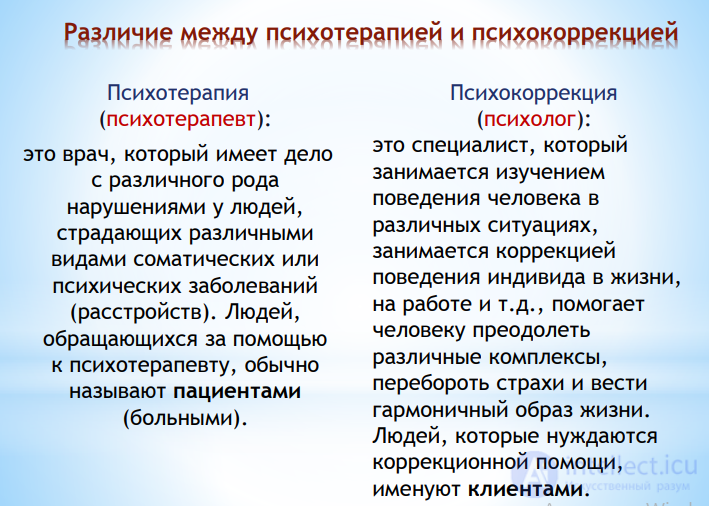
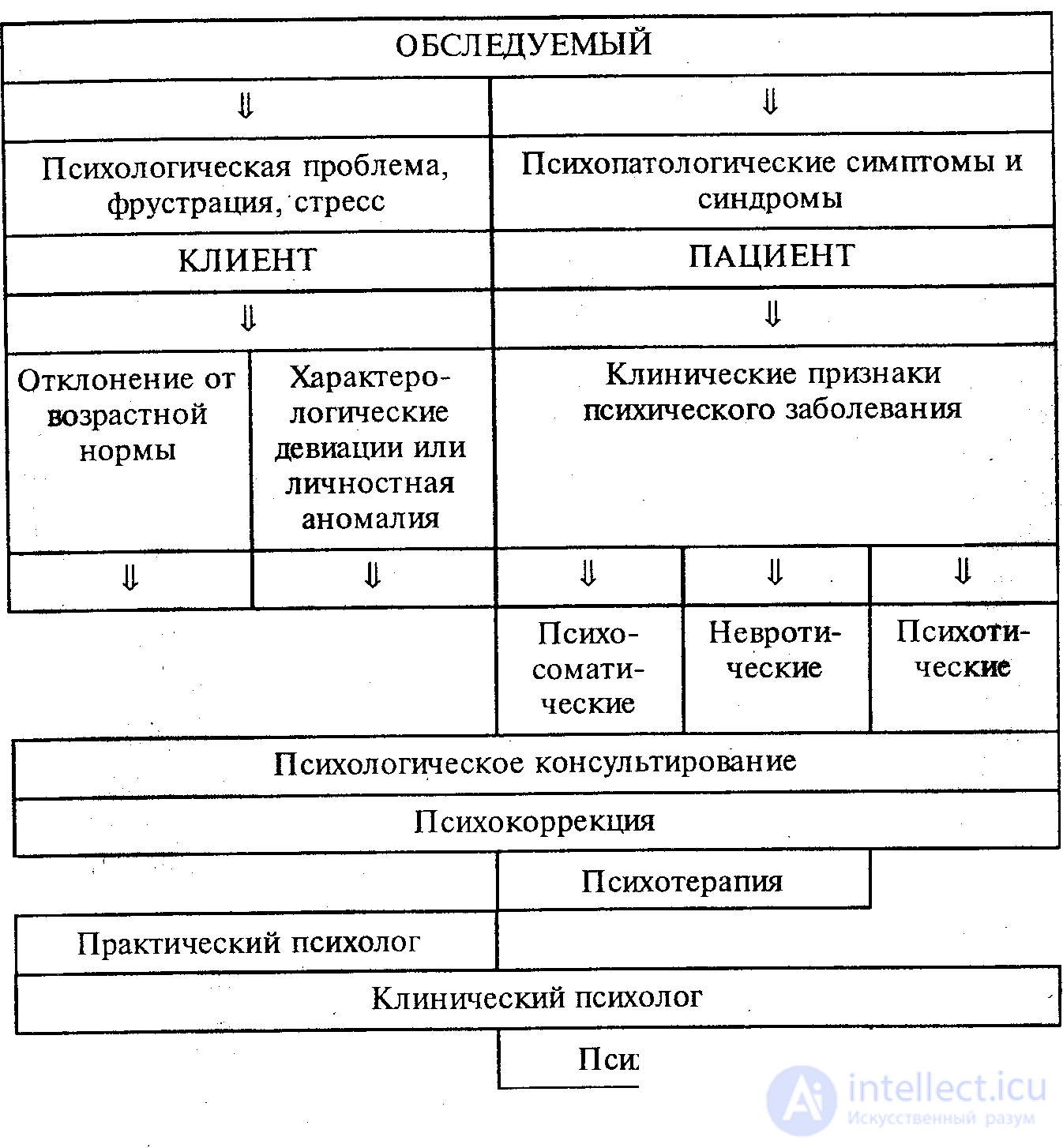
2. A normal, physically and mentally healthy person who has developed problems of a psychological or behavioral nature in life – this is:
- 1) a patient
- 2) a pupil
- 3) a client *
- 4) a sick person
- 5) a source of money
3. The expansion of the use of psychocorrection in work with healthy children is not caused by:
- 1) the active introduction of new educational programs into the instructional system
- 2) the humanization of the educational process
- 3) an increase in the number of children with borderline conditions*
- 4) the variability of educational programs
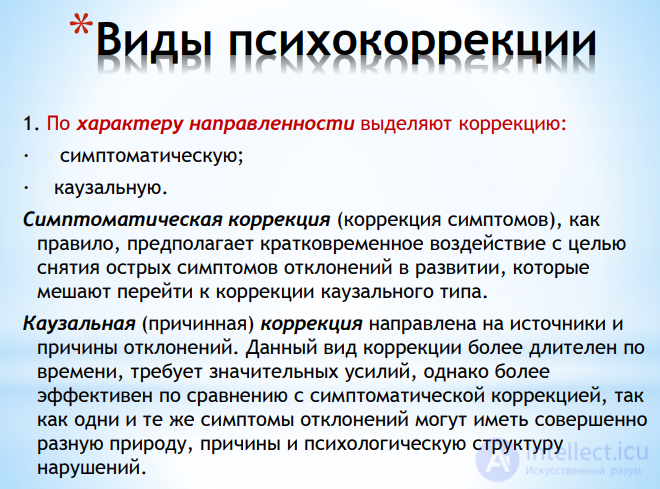
4. Which of the following is not a criterion for the classification of types of psychocorrection:
- 1) duration
- 2) orientation
- 3) technological character *
- 4) form
5. Psychocorrection, unlike development, is aimed at:
- 1) reshaping already formed personality traits or types of behavior*
- 2) forming in a person the necessary psychological qualities in their absence or insufficient development
- 3) eliminating undesirable behavioral manifestations caused by psychogenic and organic factors
- 4) eliminating personal deficiencies caused by organic damage
6. Symptomatic correction relies on the psychological approach:
- 1) the psychodynamic approach
- 2) the behavioral approach*
- 3) the humanistic approach
- 4) the cognitive approach
7. The sources of psychocorrection as a science are usually considered to be research:
- 1) in the field of group psychotherapy (J. Braid, H. Bernheim)
- 2) into psychological mechanisms and the specific features of group functioning (E. Durkheim, G. Simmel)
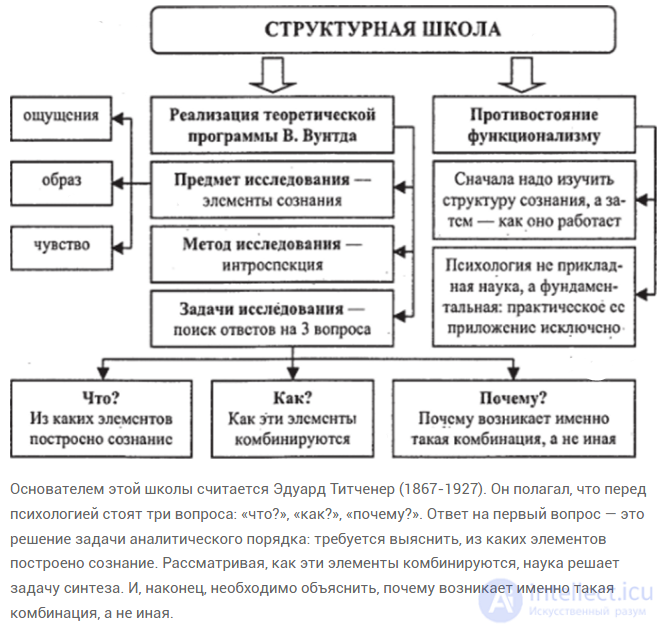
- 3) in the field of structuralism (E.B. Titchener) *
- 4) in the psychodynamic traditions (S.H. Foulkes, W. Bion, T. Main)
8. A general continual approach in the theoretical training of a psychologist implies
- 1) deep immersion in the theory and practice of a single approach
- 2) a professional going beyond the limits of the basic theory *
- 3) selective knowledge from individual theories and practices
- 4) command of all techniques and methods of psychotherapy
2. Organization of the psychocorrectional process
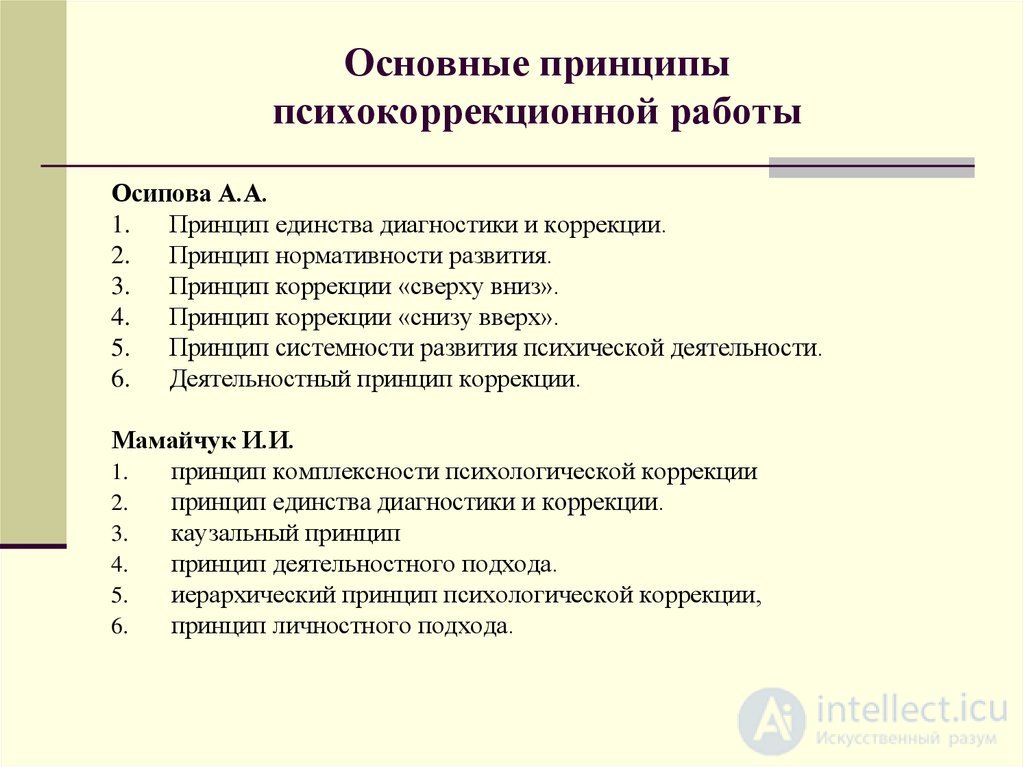
1. Which of the following is not among the domestic principles of psychocorrection:
- 1) the principle of the unity of diagnosis and correction
- 2) the principle of the normativity of development
- 3) the principle of systematicity
- 4) the principle of spirituality*
2. The orientation block solves all of the listed tasks except:
- 1) adaptation to the conditions of group work
- 2) clarification of the request
- 3) forming a willingness to cooperate
- 4) mastering certain modes of activity *
3. Free correctional programs differ from standardized ones in:
- 1) an orientation toward the present moment*
- 2) a clear schedule of work stages
- 3) the optimal distribution of the workload in each session
- 4) an orientation toward mastering certain components of actions
4. The evaluation of the effectiveness of correctional work does not include:
- 1) observation by the psychologist
- 2) the client's self-assessment
- 3) an assessment by people significant to the client
- 4) normative standards of behavioral reactions*
5. The causal principle of psychocorrection presupposes:
- 1) the elimination or compensation of symptoms
- 2) the elimination of the sources and causes of deviations in the client's behavior and emotional response*
- 3) an influence on the personality as a whole
- 4) the regulation of the client's behavior
6. The duration and intensity of correctional sessions is not determined by:
- 1) the richness of the content
- 2) the variety of methods used
- 3) the degree of the client's active participation
- 4) normative directives*
7. The least directive tactic is applied at the stage:
- 1) evaluative
- 2) orientation*
- 3) reconstructive
- 4) reinforcing
8. The orientation block of psychocorrection consists mainly of methods:
- 1) aimed at developing social perception
- 2) game methods*
- 3) meditative methods
- 4) evaluative techniques
3. Individual and group correction
1. Which of the following is not an indication for individual psychocorrection:
- 1) the client's categorical refusal to work in a group
- 2) a high level of anxiety
- 3) an insufficient level of the client's moral and intellectual development
- 4) severe inhibition caused by organic reasons*
2. Psychological training in psychocorrection is distinguished by:
- 1) acceptance of the norm of mental development
- 2) a reduced role of the cognitive component
- 3) an influence on the personality as a whole
- 4) a complex correctional influence*
3. The term “group dynamics” is usually used for:
- 1) characterizing the processes occurring in a group as it develops and changes
- 2) designating the set of techniques used by the psychologist when working with a group
- 3) describing changes in relationships within the group*
- 4) clarifying the rate of a group's development
4. The concept of the norms of group work is best described by the statement:
- 1) behavioral norms existing in society that are projected onto the work of the group and thereby promote the social adaptation of its members
- 2) a system of rules of conduct in the group and sanctions for their violation, introduced by the psychologist
- 3) specific rules of conduct worked out by the group, aimed above all at ensuring psychological safety in the group*
- 4) a system of behavioral restrictions ensuring the therapist's leadership and the effectiveness of the methods he or she applies
5. When experiencing a threat from the group, participants will most likely react by:
- 1) Fighting for power
- 2) Giving useful feedback
- 3) Reacting in a defensive manner*
- 4) Using intellectualization
6. Which of the following statements is most correctly classified as feedback:
- 1) If I were you...
- 2) You should... *
- 3) When you talk about this, I feel...
- 4) I think that you are doing...
7. A worsening of the client's condition, or partial failures in the course of correctional work, must be regarded as:
- 1) an indicator of the psychologist's professional incompetence
- 2) a possible intermediate result of the work*
- 3) a manifestation of the client's difficult character
- 4) an indication to discontinue further work with the client
8. Group forms of child psychocorrection are used in work with children starting from the age of:
- 1) 2-4 years
- 2) 4-7 years*
- 3) 7-8 years
- 4) 8-11 years
4. Basic correctional approaches and methods of psychocorrection
Correctional approaches and methods of psychocorrection are diverse and are chosen depending on the nature of the disorder, the age of the patient and other factors. Listed below are some of the basic correctional approaches and methods of psychocorrection:
-
Cognitive behavioral therapy (CBT): This approach focuses on changing negative thoughts and behavioral patterns. Through analyzing and changing thinking and reactions, patients can develop more adaptive strategies for interacting with the surrounding world.
-
Family therapy: Especially important when working with children and adolescents. It involves working with the family in order to resolve conflicts, improve communication and create a supportive atmosphere for the patient.
-
Play therapy: Play can be a powerful tool for expressing emotions, developing social skills and correcting behavioral problems, especially in children.
-
Art therapy: Involves the use of artistic and creative methods, such as drawing, music and dance, for expressing emotions and self-knowledge.
-
Social skills and training: Teaching adaptive social skills, such as emotional recognition, conflict resolution and stress management.
-
Relaxation and meditative methods: These methods are aimed at reducing anxiety, tension and stress, promoting psychophysical relaxation.
-
Biofeedback: Technology that helps people control physiological functions, such as pulse, breathing and muscle tension, in order to improve self-regulation and adaptation.
-
Rational emotive therapy (RET): Involves analyzing and changing irrational ways of thinking that can cause emotional distress.
-
Psychoeducation: Teaching patients to understand their condition, their disorders and methods for managing them.
-
Group therapy: Involves working with a group of people with similar problems, which promotes the exchange of experience and mutual support.
-
Pharmacotherapy: In the case of serious psychological and psychiatric disorders, drug treatment may be required.
The choice of specific methods depends on the individual characteristics of each patient and the goals of correction. It is important to work with experienced specialists who will help determine the most suitable methods for the specific situation.
tests-
1. The method of “paradoxical intention” was developed by:
- 1) I.P. Pavlov
- 2) V. Frankl *
- 3) J. Wolpe
- 4) B.F. Skinner
2. The core of K. Rogers's teaching is:
- 1) psychoanalysis
- 2) client-centered therapy *
- 3) gestalt therapy
- 4) individual therapy
3. According to S. Kratochvil's classification, projective drawing does not use the techniques of:
- 1) free drawing
- 2) communicative drawing
- 3) joint drawing
- 4) abstract drawing *
4. Which of the following is not a type of self-suggestion:
- 1) voluntary self-suggestion
- 2) active self-suggestion *
- 3) involuntary self-suggestion
5. From a modern standpoint, meditation is one of the forms of:
- 1) twilight consciousness
- 2) auto-hypnotization *
- 3) a somnambulistic state
- 4) deep sleep
6. The token method (point method) presupposes:
- 1) a systematic, sequential reduction of a person's sensitivity to objects that cause an unfavorable mental state
- 2) an intensification of the symptom to the point of absurd manifestations
- 3) immediate positive reinforcement of desired forms of behavior with a substitute for a significant reinforcer *
- 4) punishment for undesired forms of behavior
7. According to Berne, the Child is:
- 1) the immature part of the personality
- 2) the part of the personality structure that is contrasted with the Parent
- 3) the most impulsive and sincere part of the personality *
- 4) an infantile personality
8. Gestalt is:
- 1) the most important and significant events that occupy a central place in a person's consciousness
- 2) less important information that has receded into the background
- 3) a need that has been discharged or not discharged *
- 4) a method of psychocorrection
5. Basic symptom complexes and general pathways of correction
Basic symptom complexes are characteristic groups of symptoms that characterize particular disorders in a person's development. Correction, in turn, is aimed at changing or eliminating these symptoms with the goal of achieving the best possible adaptation and quality of life. Below are presented some of the basic symptom complexes and general pathways of correction:
-
Autism symptom complex: This complex includes impairments in social interaction and communication, repetitive behavior and restricted interests. Correction involves increasing social communication skills, training emotional perception, teaching adaptive skills and providing support in learning.
-
Attention-deficit hyperactivity disorder (ADHD) symptom complex: Children with this complex display a lack of attention, hyperactivity and impulsive behavior. Correction may include psychostimulants, psychotherapy and teaching strategies for managing attention and emotions.
-
Autism spectrum disorder (ASD) symptom complex: This complex combines various disorders, from autism to Asperger syndrome. Correction is aimed at developing social skills, teaching communication, reducing stereotyped behaviors and training behavioral aspects.
-
Psychomotor developmental delay symptom complex: Includes a delay in physical and cognitive development. Correction may include physiotherapy, speech therapy, intensive exercises and stimulation to support normal development.
-
Behavioral and emotional problems symptom complex: Includes aggression, depression, anxiety and other problems in behavior and the emotional sphere. Correction may include therapy, psychoeducation, teaching emotion management and developing adaptive problem-solving strategies.
-
Speech and language disorders symptom complex: Includes problems with articulation, grammar, vocabulary and other aspects of speech. Correction may include speech therapy sessions, articulation training and work on lexical skills.
General pathways of correction may include:
-
An individual approach: Correctional programs should be individually adapted to the characteristics of each person.
-
A multimodal approach: A combination of various methods, such as pedagogy, psychotherapy, medical assistance, etc.
-
Early intervention: The earlier correction begins, the more effective it can be.
-
Cooperation with the family: Involving parents and close relatives in the correctional process to provide support and further work.
-
Positive reinforcement: Using rewards and praise to strengthen desirable behavioral patterns.
-
A systemic approach: Considering the person in the context of his or her environment in order to determine the influence of social, family and educational factors.
It is important to remember that correctional work is individual and requires patience, a creative approach and constant evaluation of results.
Tests
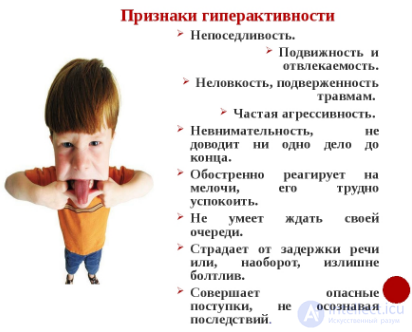
1. A hyperactive child is not characterized by the following manifestations:
- 1) impulsiveness
- 2) inattentiveness
- 3) unsociability *
- 4) motor disinhibition
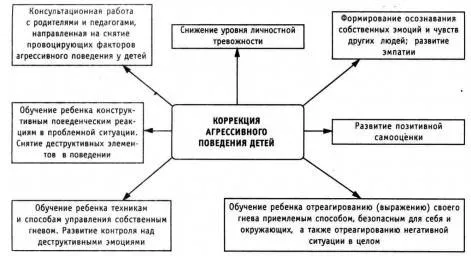
2. The formation of aggressive behavior is not influenced by the factor of:
- 1) the style of upbringing in the family
- 2) somatic diseases or diseases of the brain
- 3) national predispositions *
- 4) social learning
3. Work with anxious children is carried out in all directions except:
- 1) Raising self-esteem
- 2) Relieving muscle tension
- 3) Raising the level of aggressiveness *
- 4) Teaching the ability to manage oneself in stressful situations
4. Specific manifestations of insecurity do not include:
- 1) low motivation for activity
- 2) poor adaptation
- 3) shyness
- 4) impulsiveness *
5. False hyperactivity arises as a result of:
- 1) restrictions on motor activity *
- 2) overstated demands
- 3) failure to observe norms and rules of behavior
- 4) understated demands
6. The problem of correcting disorganization is solved with the help of:
- 1) forming voluntary regulation of behavior *
- 2) the “carrot and stick” method
- 3) the method of paradoxical intention
- 4) forming normative knowledge and skills
7. The most difficult problem for a psychologist in correcting aggressiveness is:
- 1) excluding the response reaction
- 2) displacing aggression onto another object
- 3) distracting attention
- 4) properly uniting for joint activity *
8. Which of the following is not a characteristic manifestation of anxiety:
- 1) restlessness
- 2) passivity
- 3) irritability
- 4) persistence *
Version 2.
1. Introduction to psychological-pedagogical correction.
1. Psychocorrection is defined as:
- 1) a system of measures aimed at correcting deficiencies in a person's psychology or behavior with the help of special means of psychological influence *
- 2) a system of measures aimed at solving clients' problems caused by psychogenic and organic factors
- 3) a system of general pedagogical measures aimed at optimizing the developmental environment
- 4) a system of measures aimed at removing the symptoms of a person's psychology and behavior
2. Which of the following is not among the specific features of psychocorrection:
- 1) an orientation toward clinically healthy people
- 2) an orientation toward the healthy sides of the personality
- 3) drug support *
- 4) a focus on changing behavior and developing the personality
3. Symptomatic psychocorrection is defined as:
- 1) psychological work aimed at preventing a relapse
- 2) rehabilitation of lost bodily functions with the help of drug treatment
- 3) work aimed at eliminating or reducing the manifestation of a symptom *
- 4) work aimed at eliminating the causes of the client's problems
4. The author of the theory of “animal magnetism” is:
- 1) L. Chertok
- 2) F.A. Mesmer *
- 3) R. de Saussure
- 4) S. Freud

5. The goals of correctional work in domestic practice are:
- 1) optimizing the social situation of development, developing the child's types of activity, and forming age-psychological new formations *
- 2) restoring the integrity of the personality and the balance of psychodynamic forces
- 3) modifying the child's behavior through enrichment and change of the environment and teaching him or her new forms of behavior
- 4) diagnosing the client's problems
6. An eclectic approach in the theoretical training of a psychologist implies
- 1) deep immersion in the theory and practice of a single approach
- 2) a professional going beyond the limits of the basic theory
- 3) selective knowledge from individual theories and practices *
- 4) command of all methods and techniques of psychocorrectional work
7. Causal psychocorrection is defined as:
- 1) psychological work aimed at preventing a relapse
- 2) rehabilitation of lost bodily functions with the help of drug treatment
- 3) work aimed at eliminating or reducing the manifestation of a symptom
- 4) work aimed at eliminating the sources and causes of the client's problems and difficulties *
8. Which of the following is not among the types of symptomatic psychocorrection (according to S.S. Libikh):
- 1) sedative correction
- 2) distracting correction
- 3) cognitive correction *
- 4) activating correction
2. Organization of the psychocorrectional process
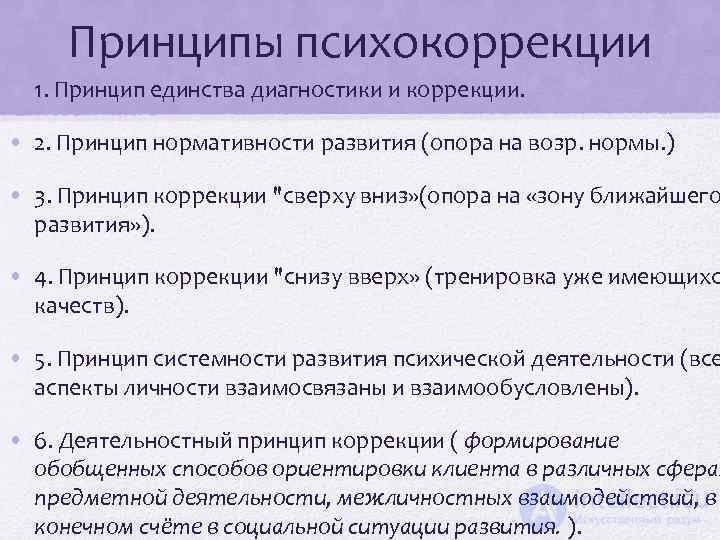
1. The correction principle of “bottom-up” is defined as:
- 1) reinforcement of behavior patterns that already exist *
- 2) creating a “zone of proximal development”
- 3) taking into account the various aspects of the personality and the heterochronicity of their development
- 4) organizing the client's active activity
2. The orientation phase within the correctional block itself solves the tasks of:
- 1) structuring the group
- 2) consolidating adequate emotional responding and adaptive behavior
- 3) forming the group as a whole *
- 4) correcting inadequate emotional reactions and maladaptive forms of behavior.
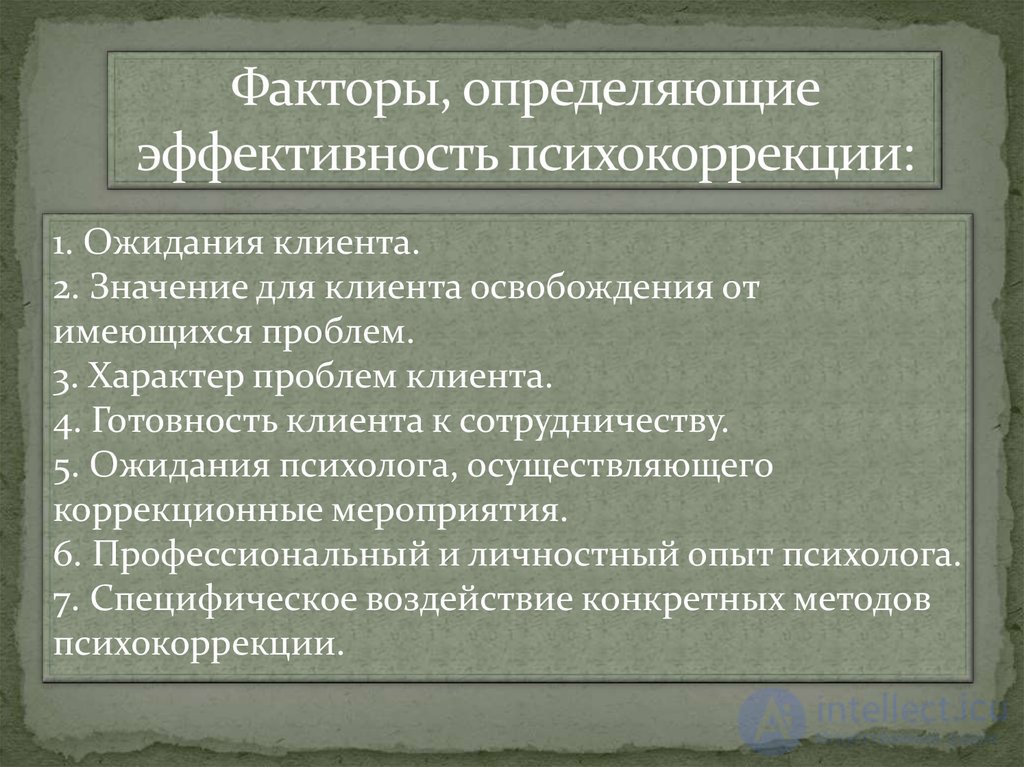
3. The effectiveness of psychocorrectional work does not depend on:
- 1) the psychological characteristics of the leader
- 2) the adequacy of the correctional tasks set
- 3) the support of significant people
- 4) the composition of the group by sex *
4. Standardized correctional programs differ from free ones in:
- 1) an orientation toward the present moment
- 2) a clear schedule of work stages *
- 3) the optimal distribution of the workload in each session
- 4) an orientation toward mastering certain components of actions
5. A correctional program includes all of the following blocks except:
- 1) diagnostic
- 2) reconstructive
- 3) systemic *
- 4) evaluative
6. Non-game techniques belong to the following subgroups, except:
- 1) those aimed at developing communication skills
- 2) those forming the emotional-personal sphere
- 3) those identifying the leading problems *
- 4) those expanding the sphere of awareness of one's problems
7. The structure of a correctional session in the reconstructive block depends on:
- 1) the specific tasks of the problem being solved
- 2) the characteristics of the participants' emotional discharge
- 3) the dynamics of psychological changes
- 4) the initial goals of the correctional work *
8. Diagnosis of the effectiveness of correctional work is carried out:
- 1) after the correctional program has been implemented
- 2) at the end of each session
- 3) periodically, as necessary
- 4) all of the above are correct *
3. Individual and group correction
Individual and group correction are two basic approaches to conducting correctional work with people experiencing various problems in behavior, development or adaptation. Each of these approaches has its own advantages and areas of application. Let us examine them in more detail:
Individual correction:
-
Suitable for personalized work: Individual correction allows the specialist to analyze the individual problems and needs of the patient more deeply.
-
Adapted to the individual's characteristics: Correction methods and strategies can be precisely adapted to the individual needs, capabilities and pace of development of the particular person.
-
Increased attention: The specialist can devote more attention to each patient, monitor his or her progress and respond to changes.
-
Positive working relationships: Individual work can help establish trusting relationships between the specialist and the patient.
Group correction:
-
Social dynamics: Group correction allows patients to interact with one another, share experience and learn from the example of others.
-
Exchange of experience: People can share their success stories, which can inspire others to change.
-
Learning effect: Group work can teach social skills and improve the ability to cooperate and resolve conflicts.
-
Cost-effectiveness: Group correction can be more cost-effective, since one specialist can work with several people at the same time.
-
Reduced isolation: Group work helps reduce the feeling of loneliness and isolation that some people may experience.
The choice between individual and group correction depends on a number of factors, such as the nature of the disorders, the patient's preferences, the availability of a supportive group, etc. In some cases, a combination of both approaches may be useful for achieving the best results.
1. Changes in individual correction, unlike group correction, mainly occur:
- 1) in the cognitive sphere *
- 2 in the emotional sphere
- 3) in the behavioral sphere
- 4) in the affective-volitional sphere
2. Which of the following is not among the specific features of training:
- 1) the principles of group work
- 2) a specific spatial organization
- 3) drug support*
- 4) the use of active methods of group work
3. As a rule, phases are distinguished within group dynamics that do NOT include:
- 1) orientation and dependency
- 2) tension and aggression
- 3) partial disintegration*
- 4) forming a working group
4. Which of the following is NOT an actively operating factor in group psychocorrection:
- 1) group dynamics
- 2) the character structure of each member of the group *
- 3) group norms
- 4) social roles
5. Confrontation in group psychocorrection is understood as:
- 1) a conflict of positions and opinions among group members
- 2) an opposition of the positions and opinions of the psychotherapist and the group
- 3) an open encounter of group members with themselves *
- 4) a means of struggling for power
6. The “Johari window” (the scheme of J. Luft and H. Ingham) includes all of the following except:
- 1) the arena
- 2) the blind spot
- 3) the visible*
- 4) the common opinion
[[b8383]]
7. The position of the psychologist most optimal for interacting with the client:
- 1) “above” the client, implying that the client is led
- 2) flexible, proceeding from the interests of the client and the requirements of the methods used *
- 3) “as equals”, relying on subject-subject relations
- 4) “behind the client”, allowing appeal to the client's significance.
8. All of the following belong to general training methods except:
- 1) group discussion
- 2) game methods
- 3) methods aimed at developing social perception
- 4) art therapy methods *
4. Basic correctional approaches and methods of psychocorrection
1. Which method of psychotherapy and correction is based on the concepts of “function and defenses”, “awareness of feelings and concentration on the present”, “taking responsibility for oneself”, “the relationship of figure and ground”:
- 1) psychoanalysis
- 2) Jung's analytical psychotherapy
- 3) Adler's individual therapy
- 4) gestalt therapy *
2. The term autogenic training was introduced by:
- 1) Coue
- 2) Mesmer
- 3) Schultz*
- 4) Schwartz
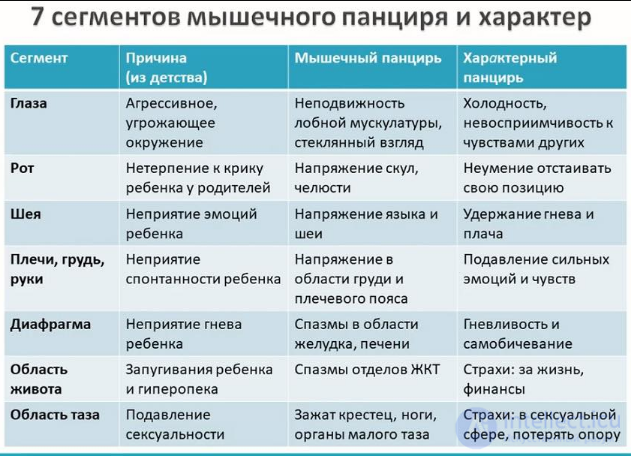
3. The “muscular armor” is the result of:
- 1) the uncontrolled flow of orgone energy
- 2) the chronic fixation of energy blocks on a particular group of muscles *
- 3) a neurotic character
- 4) dissatisfaction with communication
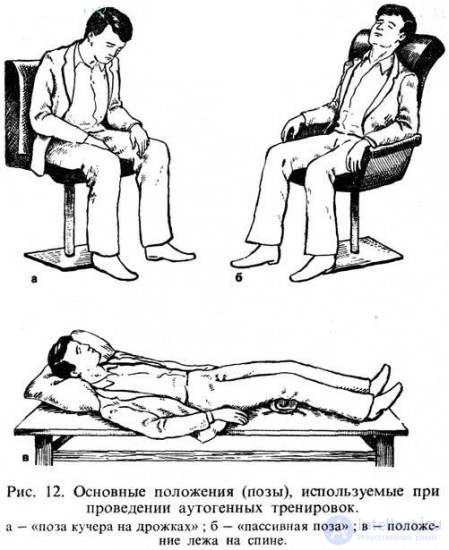
4. Meditation in psychocorrectional practice is defined as:
- 1) an artificially created situation in which the client is able to voluntarily concentrate on something and not think about what is interfering at the given moment *
- 2) an obsessive idea, motive or image
- 3) concentration of thought, focusing of attention
- 4) awareness of one's inner «I» through one's own body
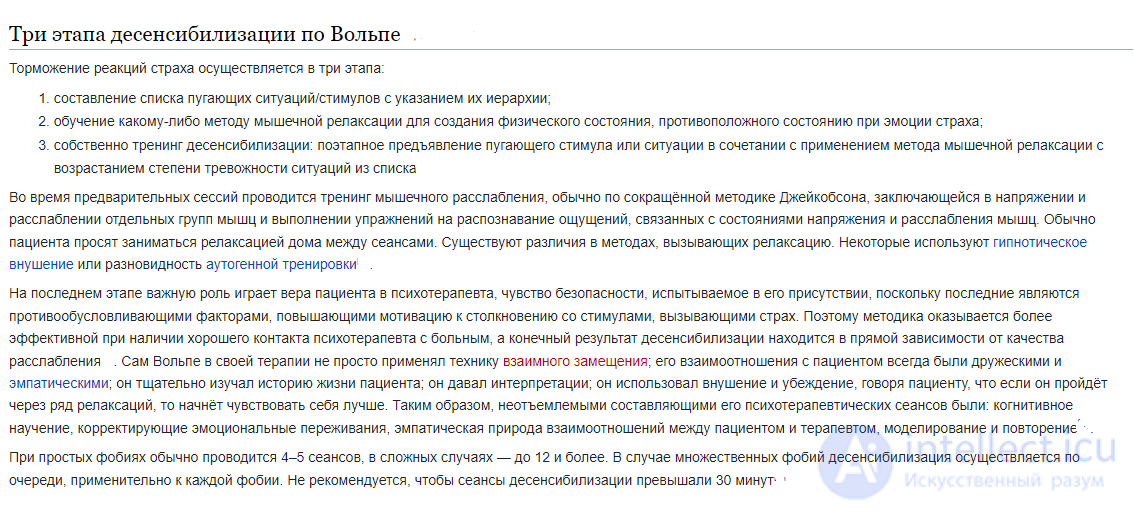
5. Wolpe's method of systematic desensitization is a method of:
- 1) neurolinguistic programming
- 2) hypnosuggestion
- 3) behavioral correction *
- 4) positive psychotherapy
6. Negative reinforcement is:
- 1) a pleasant stimulus following a desirable form of behavior
- 2) the cessation of an unpleasant stimulus following a desired form of behavior *
- 3) the effect of an unpleasant stimulus
- 4) the cessation of a pleasant stimulus following an undesirable form of behavior
7. A transaction is:
- 1) a stimulus
- 2) a reaction
- 3) a unit of communication *
- 4) a situation
8. According to the psychologist's functions in play therapy, a distinction is made between:
- 1) directive and non-directive play therapy*
- 2) long-term and short-term play therapy
- 3) abreactive play therapy and primitive play therapy
- 4) conscious and unconscious play therapy
5. Basic symptom complexes and general pathways of correction
1. The “hyperactivity” syndrome complex includes all of the following manifestations except:
- 1) lack of discipline
- 2) impulsiveness
- 3) unmanageability
- 4) voluntary self-regulation *
2. Among the recommendations for solving the problem of disorganization, one does not use:
- 1) analysis of the behavior of those around the client
- 2) motivating any activity
- 3) inclusion in joint activity
- 4) strictness of demands *
3. The “aggressiveness” syndrome complex does not include:
- 1) unfriendliness
- 2) hostility
- 3) withdrawal*
- 4) conflict-proneness
4. The prevention of insecurity has three strategic lines, except:
- 1) increasing the client's real achievements
- 2) changing the attitude to the problem *
- 3) changing the attitude of significant others
- 4) changing the client's attitude toward himself or herself

5. A hyperactive child is not characterized by the following manifestations:
- 1) impulsiveness
- 2) inattentiveness
- 3) unsociability *
- 4) motor disinhibition
6. Among the recommendations for solving the problem of disorganization, one does not use:
- 1) analysis of the behavior of those around the client
- 2) motivating any activity
- 3) inclusion in joint activity
- 4) strictness of demands *
7. The most difficult problem for a psychologist in correcting aggressiveness is:
- 1) excluding the response reaction
- 2) displacing aggression onto another object
- 3) distracting attention
- 4) properly uniting for joint activity *
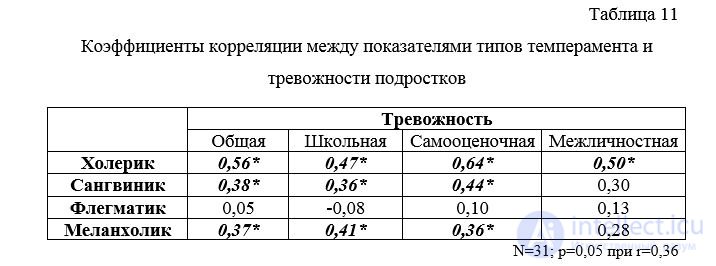
8. Anxiety is most often a characteristic trait of:
- 1) sanguine types
- 2) melancholic types *
- 3) choleric types
- 4) phlegmatic types
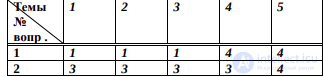
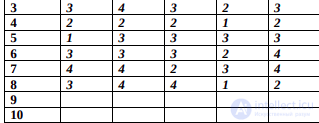
Answer key for the test tasks of version No. 1
Answer key for the tasks of version No. 2
See also
See also


Comments