
Lecture
"Primary developmental defect" and "secondary developmental defect" are terms used in medicine and psychology to describe various aspects of deviations in children's development.
Defectology (from the Latin defektus - deficiency) deals with the psychophysiological developmental characteristics of children with special needs. Children with developmental problems have physical and/or mental deficiencies (defects) that lead to deviations in overall development. Depending on the nature of the defect and the time of its onset, some deficiencies can be overcome completely, others can only be corrected, and some can be compensated for. Early psychological-pedagogical intervention makes it possible to substantially neutralize the negative influence of the primary defect.
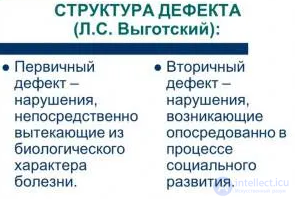
The concept of primary and secondary defects was introduced by L. S. Vygotsky. Primary defects arise as a result of organic damage to or underdevelopment of some biological system. A secondary defect has the character of mental underdevelopment and disorders of social behavior that do not directly follow from the primary defect but are conditioned by it.
Psychological-pedagogical correction and rehabilitation of children with developmental problems is possible if the nature of the disorder in the child's normal development has been determined.
Primary disorders – are impairments (defects) of organs or systems that are biological in nature (for example, a disorder of the auditory analyzer, the visual analyzer, or local or massive disorders of various parts of the central nervous system.) They can be congenital or acquired. Hereditary factors, harmful effects on the fetus during pregnancy (infections, intoxications, injuries), as well as birth injuries, play an important role in the occurrence of congenital disorders. Acquired disorders are the consequences of infectious diseases, injuries, and the like that the child has suffered. The degree and quality of the primary defect have a substantial influence on children with developmental deviations. Secondary deviations, depending on the degree of the disorder, are in some cases sharply pronounced, in others – weakly pronounced, and in still others – almost imperceptible. The degree to which the disorder is pronounced determines the distinctive character of the abnormal development. Thus, a slight hearing loss leads to minor disorders in speech development, while a profound impairment of hearing, without special help, can leave a child mute. That is, there is a direct dependence of the quantitative and qualitative distinctiveness of secondary developmental disorders in children with developmental deviations on the degree and quality of the primary defect.
Correction of primary disorders is carried out by medical means. An important role in this is played by advances in the development of medical technology (for example, hearing-aid fitting and implantation in the correction of hearing disorders, and the correction of vision disorders with glasses and lenses.) Great hopes for overcoming the occurrence of primary developmental disorders in children are associated with the development of immunology and genetic engineering.
Secondary deviations differ in nature from primary ones, although they are derived from them. Their connection is not of an unambiguously organic nature and is not as unconditional as it once seemed to researchers of childhood defectiveness. Secondary defects have the character of mental underdevelopment and disorders of social behavior that do not directly follow from the primary defect but are conditioned by it. The primary defect may have the character of underdevelopment. The secondary defect is the main object in the psychological study and pedagogical correction of abnormal development. Those functions that are directly connected with the damaged zone become secondarily underdeveloped (for example, underdevelopment of speech comprehension in children with hearing impairment).
Secondary disorders arise only when primary ones lead to the child's «falling out» of the system that is obligatory for any society. Calling such instances of falling out «social dislocations» L.S.Vygotsky emphasized that they can be prevented if «bypass routes» are found that provide children with special needs access to culture as a source and means for the development of higher mental functions. In these cases, secondary disorders do not become an inevitable consequence of primary ones.
Since secondary (tertiary, etc.) disorders do not have a direct organic nature, they do not require correction by medical means. The prevention and correction of such disorders, which are social in nature, fall within the competence of special psychologists and educators.
Lev Semyonovich Vygotsky examined closely the content of the primary and secondary defect, analyzing the biological and social factors behind its occurrence. The combination of theory with practice allowed the scholar to pursue a research quest for the methodological grounding of the relations between the primary deficiency and the secondary (tertiary, etc.) layers built upon it, the defect, and the problems of its compensation. He studied with particular thoroughness the possibilities of compensation in children with special needs.
Pedagogical influence must be widely applied to secondary deviations in the development of a child with developmental deficiencies, since these are largely amenable to correction. Overcoming the primary defect requires medical intervention, which, however, often proves to be of little effectiveness.
Ignoring environmental factors at early stages of development and underestimating the importance of special education aggravate secondary deviations in a child's development.
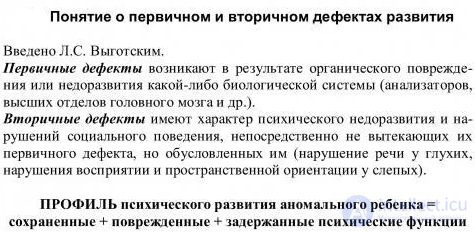
Fig. profile of the mental development of an abnormal child
Special approaches have been developed in Russian defectology, and experience has been accumulated in the successful practical correction and prevention of the occurrence of secondary disorders. Thus, under conditions of specially organized early instruction, a deaf child (even in the case of congenital deafness) can develop fully formed verbal speech, both in oral and in written form; blind children can learn to read and write freely, without outside help.
It is important to understand that primary and secondary developmental defects can have different causes, developmental mechanisms, and consequences. Diagnosis and approaches to helping such children can vary depending on the nature of the defect and its origin.

Comments