
Lecture
The connection between speech disorders and other aspects of mental development is also manifested in specific features of thinking. Although possessing full prerequisites for mastering the mental operations available at their age, children lag behind in the development of verbal-logical thinking and have difficulty mastering mental operations
(analysis and synthesis, comparison and generalization, classification). They
show an insufficient store of information about the surrounding world and about the properties and functions of real objects, and difficulties arise in
establishing cause-and-effect relationships between phenomena, in forming mathematical concepts, and in developing logical thinking.
Imagination (the psychological basis of
creativity) develops somewhat differently in children with severe speech disorders. Timely speech formation promotes the development of a child's imagination, whereas a delay
in speech development leads to lags in the development of thinking and imagination. This category of children finds it impossible to perform
creative tasks. They poorly understand the figurative meanings of words and metaphors and have difficulty composing creative stories. This
is explained by the poverty of their vocabulary, the simplified nature of their phrases, disorders of the grammatical structure of speech, and a low level of spatial
manipulation of images.
Most children show disorders in the development of the motor sphere, i.e., gross and fine motor skills (poor coordination of movements,
reduced speed and dexterity in performing them). The greatest difficulties are found in performing exercises for the fingers and hands
that are accompanied by verbal instructions.
Also notable is the low level of development of play activity in preschoolers with general speech underdevelopment: low speech activity during play,
an inability to organize role-play, and refusal to take part in games
of a verbal nature.
Children with severe speech disorders show deviations in the emotional-personal sphere. They are characterized by passivity, instability of interests, self-doubt, heightened irritability,
aggressiveness, withdrawal, sensitive dependence on those around them,
and a tendency toward spontaneous behavior.
Children with systemic speech underdevelopment are characterized by a differentiated understanding of their own emotional states (this
position has been confirmed by a special psychological study). However, it is especially difficult for children with speech disorders to convey emotions of anger, fear, and surprise through facial expression.
Any defect of mental development, in particular speech pathology, significantly affects the development of a person's self-esteem.
V.I. Seliverstov identifies the following indicators of the degrees to which children are fixated on their defect:
- zero degree of fixation on the defect. Children experience no sense of being slighted by an awareness of the inadequacy of their speech, or do not even
notice its shortcomings at all. They readily make contact with peers
and adults, both familiar and unfamiliar people. They have no elements of shyness or touchiness;
- moderate degree of fixation on the defect. Children experience unpleasant feelings in connection with the defect and conceal it,
compensating for their manner of verbal communication with various tricks. Nevertheless,
children's awareness of their shortcoming does not develop into a constant, oppressive feeling of their own inferiority;
- pronounced degree of fixation on the defect. Children are constantly fixated on their speech shortcoming and deeply
distressed by it, making all their activity dependent on their speech failures.
They are characterized by withdrawal into illness, self-deprecation, morbid suspiciousness, obsessive thoughts, and a pronounced fear of speaking.
In the process of forming communicative skills, children with systemic speech underdevelopment show certain problems
that manifest themselves in the immaturity of the motivational-need sphere
and lead to persistent disorders of communication. This makes the process of interpersonal interaction difficult: children find it hard to make contact
with peers and adults. The interdependence of speech and communicative skills means that a poor vocabulary and the peculiar nature of connected utterances hinder the achievement
of full-fledged communication; the consequences of these difficulties are a decrease
in the need for communication, non-formation of communication forms (dialogic and monologic speech), behavioral peculiarities; lack of interest in contact, an inability to orient oneself in a communicative situation,
and negativism.
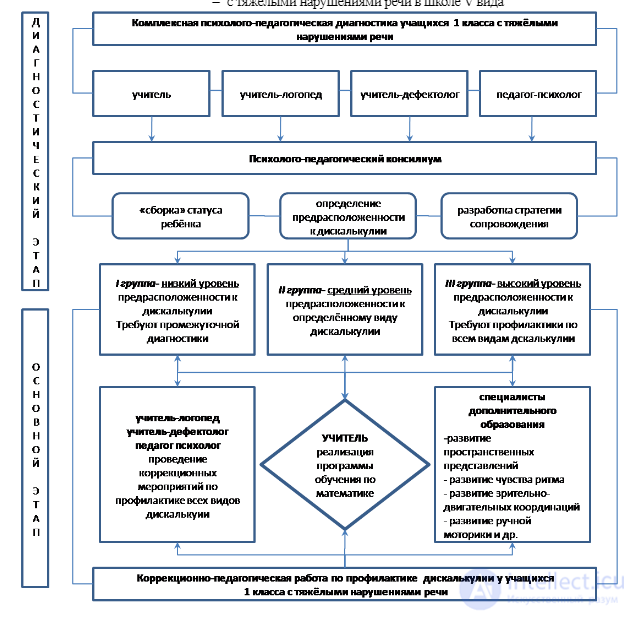
Diagram 1. Model of the comprehensive interaction of participants in the educational process for the prevention of dyscalculia in younger schoolchildren with severe speech disorders in a Type V school
The process of communication between children with speech pathology and adults differs significantly from the norm both in the level of development and in the main
qualitative indicators. Most children have not developed the skills of a culture of communication, and lack any sense of a respectful distance between the child and the adult in the process of communication.
Thus, the presence of severe speech disorders, manifested in general speech underdevelopment, leads to persistent disorders of communication.
The Code "On Education" states that special education is aimed at preparing per

Comments