Instructions for taking the test for the course "Correctional Pedagogy with the Fundamentals of Special Psychology":
-
Prepare for the test:
- Make sure you have enough time to take the test without rushing.
- Make sure you have internet access if the test will be taken online.
-
Familiarize yourself with the rules:
- If you are given rules and instructions for the test, read them carefully.
-
Gather the necessary materials:
- Prepare a pen, pencil and paper for notes, if needed.
-
Be ready to concentrate:
- Find a quiet place where you will not be disturbed while taking the test.
- Avoid multiple distractions, such as phones, social media and noise.
-
Read the questions carefully:
- Read each question carefully and think about what is being asked of you.
-
Analyze the answer options:
- Review all the answer options before choosing the most suitable one.
-
Choose the best answer:
- Select the answer option that, in your opinion, most accurately reflects your understanding of the topic.
-
Do not dwell on a single question:
- If a question causes difficulty, do not spend too much time on it. Move on to the next one and return to the one that caused difficulty later, if there is time.
-
Do not try to overinterpret the questions:
- Answer the questions as you understood them the first time, avoiding unnecessary complexity in interpretation.
-
Check your answers:
- If there is time, go through all the questions and make sure you have answered all of them.
-
Confirm your choice of answers:
- If the test is conducted online, make sure you have confirmed your choice before finishing the test.
-
Rest before submitting:
- After finishing the test, rest a little before submitting your answers.
-
Save the results, if necessary:
- If the test is conducted online, make sure you have saved confirmation of its completion.
Remember that this test is designed to assess your knowledge, and your honesty in answering is very important. Good luck with the test!
Tests
Choose one of the options:
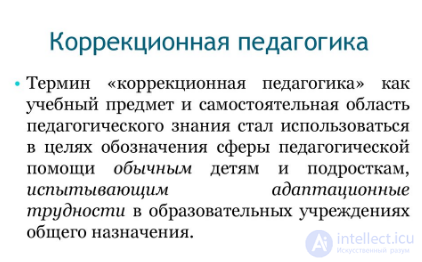
1. Correctional pedagogy is …
- A) the science of the upbringing, education and instruction of people;
- B) an area of special psychological-pedagogical knowledge about the nature of the education and upbringing of children and adolescents who have mildly expressed deficiencies in the development of the psyche and behavioral disorders; *
- C) the theory and practice of special (particular) education for persons with disorders in physical and mental development.
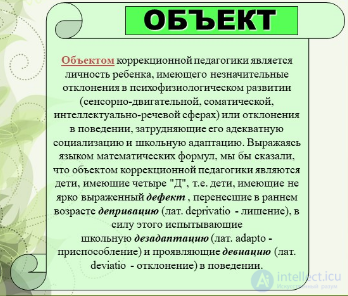
2. The object of correctional pedagogy is:
- A) special education for persons with special educational needs.
- B) upbringing as a consciously and purposefully implemented process;
- C) the personality of a child who has minor developmental and behavioral disorders. *
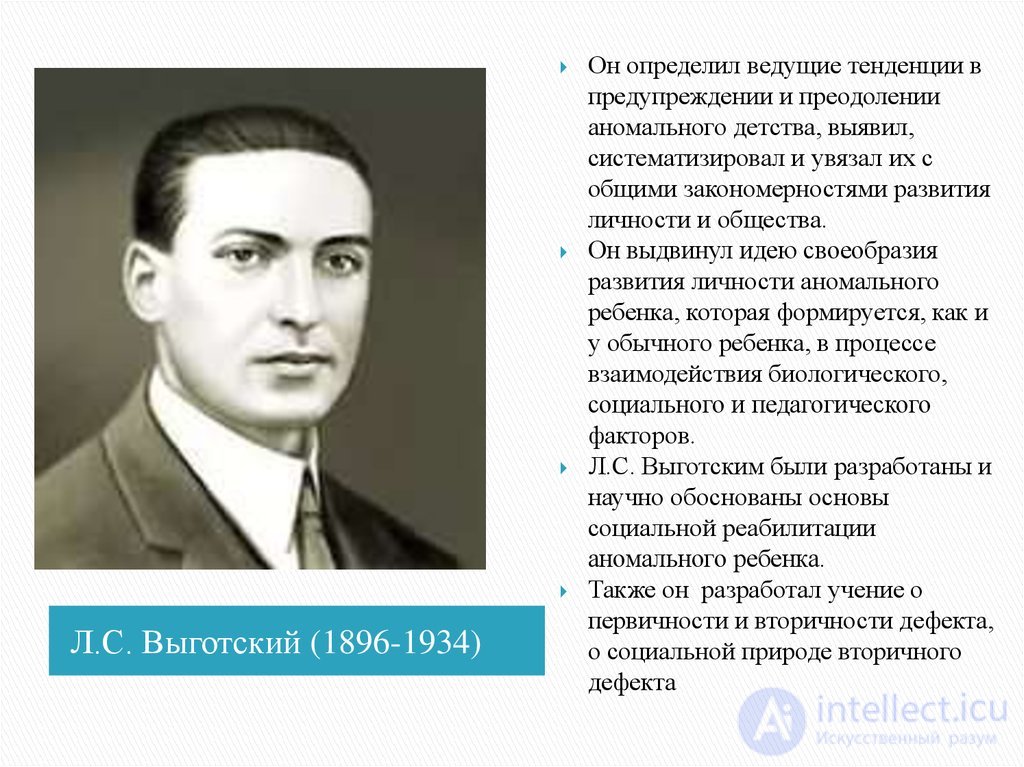
3. The leading trends in preventing and overcoming abnormal childhood were identified by:
- A) L.I. Bozhovich;
- B) L.S. Vygotsky; *
- C) P.Ya. Galperin.
4. One of the principles of special correctional-pedagogical activity is…
- A) the principle of consistency of correctional, preventive and developmental tasks; *
- B) the principle of the humanistic orientation of the pedagogical process;
- C) consciousness and activity of the personality in the holistic pedagogical process.
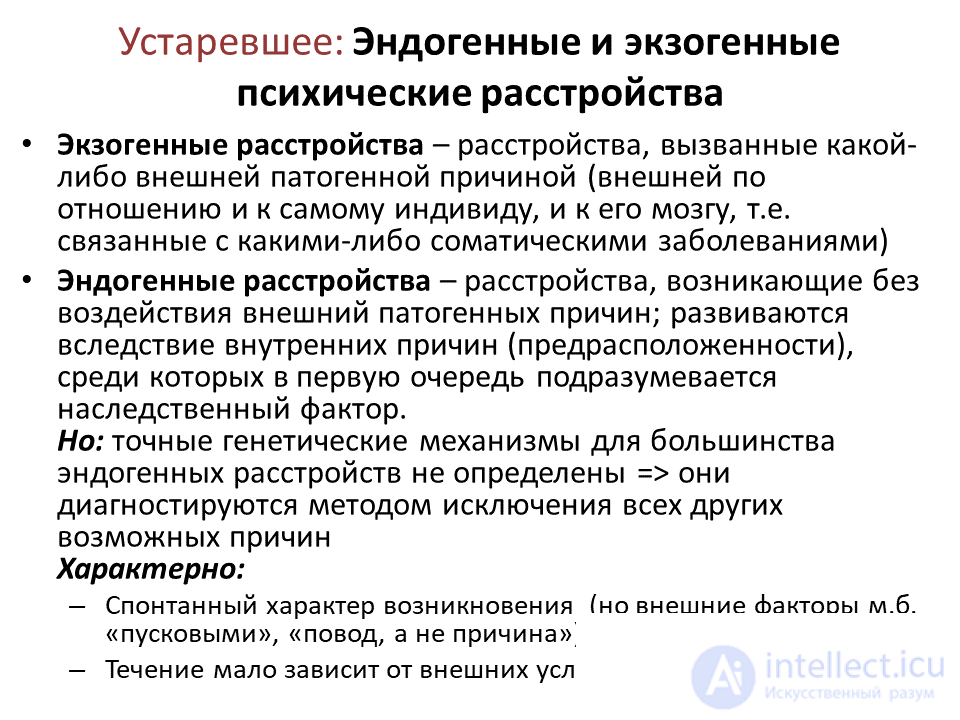
5. Exogenous factors leading to disorders of psychophysical development include:
- A) hereditary diseases;
- B) infectious diseases; *
- C) genetic abnormalities.
6. The most widely used classification of developmental and behavioral disorders in children is that of…
- A) V.V. Lebedinsky;
- B) O.N. Usanova;
- C) V.A. Lapshin and B.P. Puzanov. *
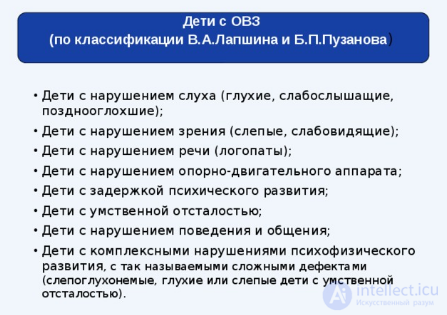
7.A system of special and general pedagogical measures aimed at weakening or overcoming deficiencies in psychophysical development is defined as…
- A) compensation;
- B) correction;*
- C) adaptation.
8. What type of rehabilitation does a child need to restore lost learning skills and cognitive abilities:
- A) medical;
- B) psychological;
- C) pedagogical.*
9. The main forms of correctional-developmental instruction are:
- A) individual sessions; *
- B) group sessions;*
- C) frontal (whole-class) sessions.
10. For children with delayed mental development, the following special (correctional) educational institution is established:
- A) Type V;
- B) Type VII; *
- C) Type VIII.
11. The main tasks of the psychological-medical-pedagogical commission (PMPC) include:
- A) treatment of the child's illnesses;
- B) rehabilitation of children with behavioral disorders;
- C) diagnostic-consultative activity. *
12. Deviations in the behavior of minors do not include:
- A) difficulty in upbringing;
- B) social-pedagogical neglect; *
- C) delays in mental development.
See also
See also


Comments