
Lecture
The Code «On Education» states that special education is aimed at preparing persons with special features of psychophysical development
for work activity and family life, and at their socialization and integration into society.
The system of special education includes: participants in the educational process in the implementation of special-education curricula, special-education curricula themselves, special education institutions, other education institutions implementing special-education curricula, other organizations which, in accordance with legislation,
have been granted the right to carry out educational activity and that implement special-education curricula, individual entrepreneurs who, in accordance with legislation, have been granted the right to carry out educational activity,
implementing special-education curricula,
state educational organizations ensuring the functioning of the system of special education, republican bodies
of state administration, other state organizations subordinate to the Government of the Republic of Belarus, local executive and
administrative bodies, and other organizations and individuals within their powers in the sphere of special education.
In 2015 the system of special education was represented by
141 CCRDR centers, 46 special preschool institutions, 28 auxiliary schools (auxiliary boarding schools), and 25 special general-education schools (special general-education boarding schools).
Under conditions of integrated instruction and upbringing, in the 2015/2016
academic year 30,606 children with special psychophysical developmental needs (SPPDN) were receiving an education (68.3% of the total number of children in need of special education). In the 2015/2016 academic year, in the system of special education
24,181 pedagogical staff members were employed, of whom 10,420 (43.1%)
had a special education. An optimization of
the network of special education institutions continues: on the one hand, it is marked by
the closure of special schools and boarding schools, and, on the other hand, by the emergence and expansion of the network of centers for correctional-developmental education and
rehabilitation (CCRDR).
A characteristic feature of the system of special education of the Republic of Belarus is that the majority of children with SPPDN receive their education in
mainstream education institutions, and the creation of special conditions for
learners with special psychophysical developmental needs in institutions
of mainstream education. Integrated instruction and upbringing are becoming ever more widespread. Integration processes may take place within the system of special education itself - an internal form
of integration (the joint instruction of children with hearing impairment and children with intellectual disability, children with visual impairments and children with
learning difficulties, children with delayed mental development, and children
with severe speech disorders, and others), or it may involve interaction between special and mainstream education - an external form.
Depending on the temporal duration of joint instruction of children with special psychophysical developmental needs and their normally
developing peers, the following variants (models) of integrated instruction and upbringing are distinguished: combined (children whose level
of psychophysical and speech development corresponds to, or is close to,
the age norm are placed in mainstream groups or classes, receiving
constant correctional assistance from a special-education teacher), partial
(children with developmental problems who are not yet able to master education on an equal footing with their healthy peers are integrated into mainstream groups
(classes) for part of the day), temporary (all pupils of special groups,
regardless of their level of psychophysical and speech development, join healthy children not less than 1-2 times a month to carry out
various upbringing events), and full (a child with
developmental special needs is educated permanently among healthy peers; correctional assistance is provided to them by their parents under the supervision
of specialists).
The choice of a particular model of integration is determined by the type of educational
institution (special or mainstream), since they possess different potential for organizing integrated instruction and upbringing.
The most important feature of the modern education system for persons with special psychophysical developmental needs is the movement toward inclusive education (the inclusion, in a single educational environment,
of all children, regardless of the disorders they have, of their sex,
nationality, ethnic affiliation, religion, etc.).
In our country, progressive work is under way toward a transition to inclusive education. Thus, the modern education system is aimed at the fullest possible inclusion of children in a single developmental environment that is «comfortable» for everyone (psychologically, physically, and pedagogically)
educational space.
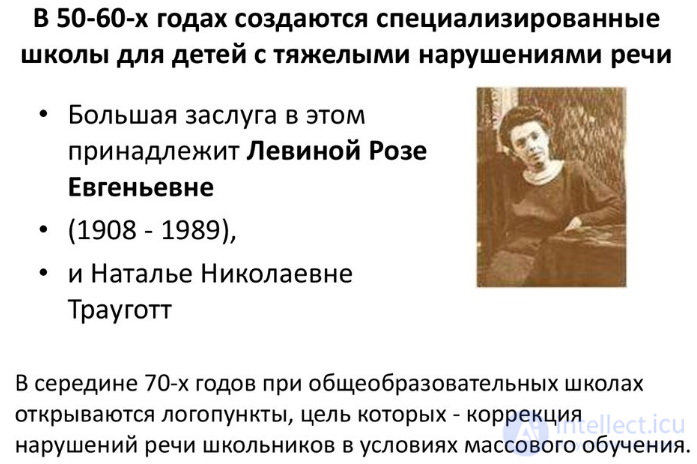
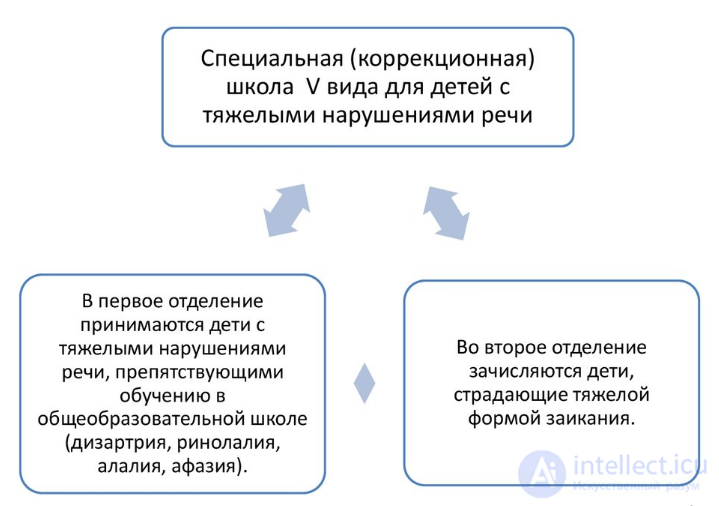
The system of institutions of special education for children with speech disorders includes special nursery-kindergartens, special
kindergartens for children with SSD, special schools and boarding schools,
special classes, and classes of integrated instruction in general-education schools. Children with SSD can receive special assistance
at correctional-pedagogical assistance centers (CPAC) in preschool
institutions and general-education schools.

Comments