
Lecture
The content and main directions of correctional and pedagogical activity cover a wide range of methods, strategies, and approaches aimed at ensuring quality instruction, development, and social adaptation of children with special educational needs. The main directions of correctional and pedagogical activity include:
Instruction and development: Correctional educators develop individual and group educational programs that take into account the specific needs and level of development of each child. It is important to develop diverse skills, including cognitive, communicative, social, and practical ones.
Social adaptation: One of the main tasks of correctional and pedagogical activity is preparing children with special educational needs for successful integration into society. This includes developing social skills and the ability to communicate, cooperate, and participate in group activities.
Inclusive education: Correctional educators work in educational institutions, promoting inclusive practices. They cooperate with mainstream teachers by developing adapted materials, providing consultations, and supporting the inclusion process.
Individualized approaches: Instruction based on the principle of individualization involves adapting learning materials and methods to the needs of each child. This may include developing individual educational plans and methods.
Psychological support: Correctional educators help children cope with emotional and psychological difficulties that may arise in connection with their special needs. They conduct psychological trainings and consultations and support a positive sense of self.
Working with parents: Cooperation with parents is an important part of correctional and pedagogical activity. Correctional educators provide parents with psychological and pedagogical support and advise them on methods for teaching and raising children with special needs.
Developmental programs and games: Correctional educators use specially designed developmental programs and games that stimulate children's all-round growth and help develop skills through play.
Technology in education: Modern technologies, such as computer programs, applications, and learning platforms, can be effective tools for correctional and pedagogical activity.
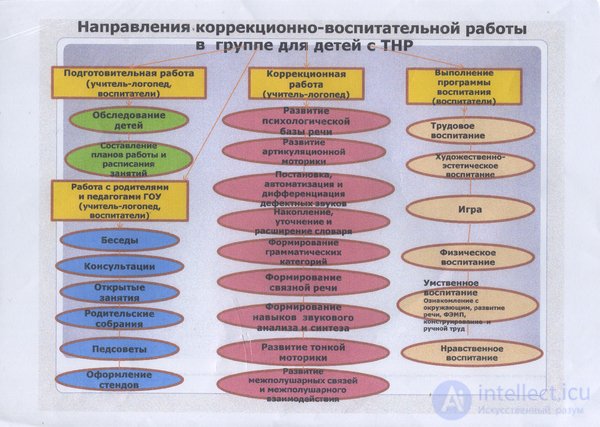
The content of correctional and pedagogical activity includes a wide range of methods and approaches aimed at ensuring the full-fledged instruction and development of children with special educational needs. This activity covers various aspects of psychology, pedagogy, and social work in order to provide the best conditions for the individual development of each child.
Since correctional and pedagogical activity is a component part of a unified pedagogical process, it must have a certain «working field», be delimited by a «circle of influence», a sphere of its own action, and have a definite structure and directions of influence.
First, within the framework of the concept of correctional-developmental education and upbringing of children and adolescents, correctional and pedagogical activity occupies a central place in the unified pedagogical process. Second, correctional activity, while being one of the constituent parts of general education, at the same time has its own specific orientation in the implementation of the educational process. Third, in terms of scope and significance, the correctional-pedagogical process occupies a rather prominent place in the system of general education, at the intersection of the components of the educational process (instruction, upbringing, development). Fourth, correction, as an independent unit of the pedagogical process, must have an independent outlet and interact with the social environment, since for the correctional-pedagogical process the environment is not a component element but a surrounding sphere – that very boundary of the field of interaction and mutual influence of the components of the unified pedagogical process. The system of correctional-pedagogical work is aimed at rehabilitating and socially adapting a student with deviations in
development and behavior to the realities of the surrounding world, and at making him or her a fully-fledged and active member of society.
The main directions of correctional work can be designated
as strategic directions:
1.corrective influence on the child through environmental factors (natural, social) – i.e., «milieu therapy»;
2.specific organization of the educational process (its correctional orientation);
3. the purposeful selection of cultural and recreational, and health-improvement activities;
4.psycho-hygiene of communication and family upbringing.
In correctional and pedagogical work with children and adolescents who have developmental and behavioral deviations, the following directions of correctional activity are identified:
1.normalizing and enriching the child's relations with the surrounding world, above all with teachers and the children's collective;
2.compensating for gaps and shortcomings in his or her overall development, and intensifying
activity in the area that he or she loves, in which he or she can achieve
good results (compensation in an area of interesting pursuit, an enthusiasm for sports, technology, music, etc.);
3.restoring in the child positive personality traits that have undergone minor deformation (deviation);
4.the constant stimulation of positive qualities that have not lost their social significance;
5.intensifying the positive development of the personality, and forming
leading positive qualities;
6.the assimilation and accumulation of socially valuable life experience, and the enrichment of practical activity in various spheres of life;
7.the accumulation of skills of moral behavior, healthy habits, and
needs, based on organizing students' activity to satisfy their interests;
8.correction as the overcoming of the negative, i.e., the elimination of gaps in the formation of positive qualities, and the eradication of negative qualities and harmful habits. Correctional and pedagogical activity has a certain set of instruments at its disposal: methods, techniques, and means for achieving the set goal and implementing specific tasks, and for carrying out the corresponding measures in various directions of activity. In correctional and pedagogical activity, a group of methods is distinguished: re-persuasion, coercion, habituation, «reconstruction» of character, «explosion», redirection, reward, and punishment (A.I. Kochetov).
At the same time, teachers and psychologists also identify specific methods for correcting deviations in the behavior and development of children and adolescents:
1. suggestive (suggestion – hinting, implanting an idea) and heterosuggestive psychocorrection techniques, based on self-suggestion and pedagogical suggestion;
2. didactic correction techniques, including explanation, persuasion, and other techniques of rationally reasoned influence;
3. the method of «Socratic dialogue»;
4. techniques for teaching sanogenic thinking, aimed at self-management, strengthening one's neuropsychic health, and self-reflection;
5. group correction techniques, the acting out of role-play situations;
6. methods of congruent communication; the method of conflict resolution;
the method of art therapy; the method of social therapy; the method of behavioral training, etc.
All these methods and techniques for correcting a child's development and behavior are an important instrument in overcoming the child's existing shortcomings, in rehabilitating his or her personality, and in achieving the child's successful adaptation and integration into society. The substantive part of correctional and pedagogical activity should be aimed not only at eliminating gaps in cognitive activity, but also at forming a worldview and socially significant knowledge, abilities, and skills; all correctional and pedagogical activity should be practice-oriented and aimed at a high level of effectiveness. It should be permeated with the idea of cooperation and interaction between the object and the subjects of the correctional-pedagogical process, and between the student body and the teaching staff. Correctional and pedagogical activity should rest on a solid foundation of coordinated efforts by the school, the family, and society in solving the tasks of preventing and overcoming shortcomings in the development and behavior of children and adolescents, and of forming socially significant personality traits in them. Only in this way – while maintaining a strict sequence of all the elements and stages of the activity (from setting the goal to achieving the final result, comparing the intended milestones with the result achieved, down to self-assessment and self-analysis of the entire correctional process) – can one speak of the effectiveness of correctional and pedagogical activity and of its psychological and pedagogical significance in the unified pedagogical process of a general-education school.

Comments