
Lecture
A turning point in state policy and public consciousness was
prepared by the ideas of the great thinkers of the Renaissance and the Enlightenment.
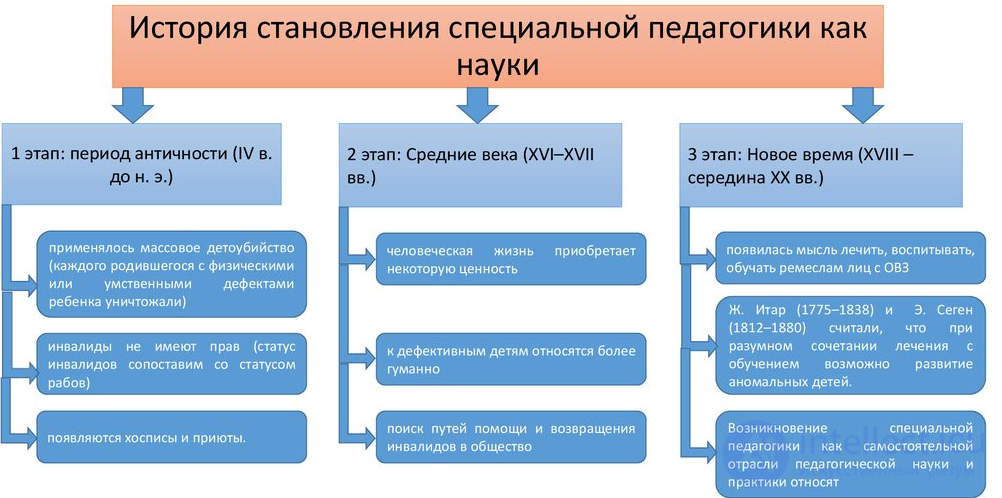
A key role was played by the French Declaration of the Rights of Man and of the Citizen (1789). Beginning in the early 19th century, a number of countries adopted legal
acts introducing special education (1817, Denmark - the Act on Compulsory Education of the Deaf; 1842, Sweden - the Law on Elementary Education; 1873, Saxony - the Law on Compulsory Education of the Blind, the Deaf,
and the Mentally Retarded; 1881, Norway - the Law on Compulsory Education;
Sweden - the Law on Compulsory Eight-Year Education of the Deaf; 1892,
Prussia - a Circular confirming the need to expand the network
of auxiliary classes; 1893, England - the Law on Elementary Education
of the Deaf and the Blind; 1896, the Law on the Compulsory Education of the Blind, etc.)
The formation of systems of special education took place during the indicated
period in Austria, England, Germany, Denmark, Italy, and France - or more precisely,
in the centers of the cultural, scientific and political life of the countries
listed - their capitals (Vienna, London, Berlin, Copenhagen, Rome, Paris).
This short list could be extended by three or four more European cities - major university centers.
The intensive development of auxiliary classes and schools for mentally retarded children is directly linked to the introduction of the law on universal elementary education. Having begun to teach all children without exception, the state
was compelled to create a parallel educational system for
children who were unable to master the educational standard within the established period. It was precisely in this way that the mentally retarded came to be singled out as a special
category of children requiring special education. The beginning of the 20th century
was the time of the final formation of national systems of special education, providing for the instruction of three categories of children:
those with hearing impairments, visual impairments, and intellectual impairments. The remaining children with pronounced
developmental deviations remained under the guardianship of
church and secular charity.
Each European country followed its own path in building a system
of special education; however, despite certain differences, common to all of them were:
the adoption of a Law on Compulsory Universal Elementary
Education; recognition of the right of children with disabilities to education, and the extension of the Law on Compulsory Universal Elementary Education to children with hearing and visual impairments, and later also to children with mental retardation; the creation of a minimal regulatory and legal framework,
governing the functioning of the special education system
(a state basic curriculum, a regional curriculum,
principles for the staffing of special educational institutions
of three types, etc.); the determination of the principles and sources of financing
for special schools (at the state, regional, and local levels)
and their legislative consolidation; the parallel functioning of non-governmental organizations (associations, charitable foundations),
stimulating and monitoring state decisions and initiating the development of a network of special institutions; and the coverage of special education for children in all regions of the country.
In Russia, this time is marked by the opening of the first schools for the deaf-mute (1806) and for the blind (1807). In Russia, as in Europe, three
main lines of assistance developed for children with developmental disorders: the charitable-religious line (organizational forms - shelters, almshouses,
poorhouses), the medical-pedagogical line (a special ward in a hospital, a sanatorium-school), and the pedagogical line (school, kindergarten, colony).
The mass opening of institutions for the deaf-mute on ethnically Russian territories occurred in the second half of the 19th century, which was natural and was due above all to: the abolition of serfdom (1861); the establishment
of the zemstvo, which was charged with the administration of local healthcare and public education, as well as the adoption of a new charter for elementary schools,
which permitted the opening of schools on the initiative of local authorities and communities
(1864); the reform of urban self-government, which allowed city councils to independently open medical and educational institutions
(1870); the economic upturn and the development of charity, including
the creation of the Department of Institutions of Empress Maria Feodorovna.
Under the influence of the same factors, educational institutions for the blind also began to appear in Russia.
Institutions for the blind, just like establishments for the deaf, were not financed from the state budget and existed exclusively
on charitable funds. Since the proclamation in Russia of a course toward universal elementary education (1908), specialists and trustees
demanded from the government, as did their colleagues in Western Europe, the introduction
of compulsory education for the blind, but unlike their European counterparts, they did not meet
with understanding. Only the introduction of legislative acts on universal compulsory elementary education and universal military conscription led to an inevitable reflection by the state and society on the presence within it
mentally retarded children and adults. As in Western Europe, so too in Russia, it was precisely these legislative acts that led to the organization
of a network of institutions for mentally retarded children. By the beginning of the 20th century, in Russia,
as in Western Europe, a significant number of special educational institutions arose for three categories of children: the deaf, the blind, and the mentally retarded. There are, however, no grounds for believing that in pre-revolutionary
Russia a national system of special education had been created and
formally established.
From the very moment speech therapy emerged as a science, its differentiation into two areas - medical and pedagogical - was observed, which accounts for the constant joint involvement of both physicians and educators in the study
of the etiology, symptomatology, and therapy of speech disorders.
At the early stage in the development of speech therapy (the turn of the 18th-19th centuries), a purely empirical approach was used. For the most part only external, mostly isolated and disparate, phenomena were described. Speech disorders
were considered mainly within medicine, and concerned, for the most
part, individual clinical cases. Most specialists
believed that methods for overcoming speech disorders should be symptomatic in nature, medical methods being predominant
at that. However, alongside them, didactic «training» methods were also used.
Throughout the entire history of the development of speech therapy, researchers strove to create a comprehensive classification of speech disorders.
Speech-therapy scholars were among the first to recognize the classification of A. Kussmaul (1877), who subjected the previously established
notions of the types of speech disorders to critical analysis and systematized them.
The emergence of the doctrine of speech pathology as an independent field of knowledge, and the appearance of classifications of speech disorders, were greatly facilitated by the publication of a considerable number of works dealing with both general-methodological and particular questions of speech pathology.
This was aided by the development of research into normal speech by both linguists and physiologists.
In a monograph published in 1827, a professor at Vilnius
University, I. Frank, was one of the first in Europe to apply the term «dyslalia» in a generalized sense as a designation for all types of articulation disorders of various etiologies. In the 1830s, a Swiss
physician, R. Schultess, also introduced this term into his works. In the 1860s
A. Trousseau proposed the term «aphasia», which came to be applied in cases of loss of speech. Especially favorable conditions for the development of speech therapy
(in its modern sense) took shape in the second half of the 19th century. As
the enrichment of the natural sciences increasingly influenced production and technological processes and the development of industry, requirements
for the training of qualified specialists rose ever higher.
The concentration of industry and the growth of large cities contributed
to the constant increase in the professional groups of teachers, civil
servants and businesspeople, as well as clergy, for
whom the command of correct speech was becoming a necessity. Questions concerning the influence of speech disorders on fitness for military
service were studied. Thus, the correction of speech defects emerged as a social need.
Especially favorable conditions for the development of speech therapy (in its modern sense) took shape in the second half of the 19th century. As
the enrichment of the natural sciences influenced production and technological processes and the development of industry, requirements for the training
of qualified specialists rose ever higher. The concentration of industry and the growth of large cities contributed to the constant increase in the professional groups of teachers, civil servants,
and businesspeople, as well as clergy, for whom
the command of correct speech was becoming a necessity. Questions concerning the influence of speech disorders on fitness for military service were studied. Thus, the correction of speech defects emerged as a social
need.
The scientific establishment of speech therapy was aided by the research
of H. Helmholtz in the field of the physiology of hearing and sound analysis, the discovery by the Dax family (father and son) of the connection between speech disorders and lesions of the cerebral cortex (1836), and the publication of Kussmaul's fundamental works. By the beginning of the 20th century, specialists' opinion on stuttering as a complex psychophysical disorder had changed, or rather, been refined (Gutzmann A., 1879;
Kussmaul A., 1878; Coen A., 1878, and others). Attempts were made to explain this disorder by various types of neuroses - of expectation, of fear,
of inferiority, obsessive neurosis, and others. Of decisive importance for the treatment of this type of speech disorder was A. Gutzmann's work «Stuttering
and Its Reliable Elimination by a Methodically Developed and Tested
Practical Method» (1879), as well as his practical work as a
teacher of the deaf and speech therapist.
The above factors served as the basis for the inclusion of speech therapy as a
special subject into the curriculum of the University of Berlin.
In Russia, in the 1860s-1880s, numerous translations of foreign works on speech pathology began to appear, and at the same time domestic researchers
A.Ya. Kozhevnikov (1874) and
V.M. Tarnovsky (1867, 1868) came onto the scientific scene, who were among the first to study the problems
of aphasia. There was a tendency toward the theoretical comprehension of empirical material on speech pathology.
Gradually an independent field of knowledge was taking shape - «logopathology» (a term coined by A. Kussmaul); speech therapy as a pedagogical science was still
absent, and pedagogical approaches to the correction of speech disorders
were encountered only in translations of foreign publications.
Since the 1980s, interest in the problems of speech pathology increased noticeably: they became the subject of research for a number of domestic authors
(M.M. Manasseina, 1882; I.A. Sikorsky, 1889; I.K. Khmelevsky, 1897;
V.F. Oltushevsky, 1898; A.F. Ostrofadsky, 1899, and others), and they encompassed
virtually all forms of speech disorders by then.
Two main approaches to the study of speech disorders became apparent - the mechanistic and the functional, with the latter acquiring ever greater significance. V.F. Oltushevsky formulated
the subject and object of logopathology and developed its systematics. Gradually,
speech therapy was born within the depths of logopathology. For Russia, this period
is unique in that it was interrupted by two revolutions that led to a radical restructuring of the state and society. The prerequisites for the formation of a national system of special education began to take shape under one type of state - monarchical Russia - yet the system itself took final form
in a state of a different type - a socialist one. From this moment on, the domestic system of special education differs fundamentally from Western European ones, since it is built on the logic of the socialist
state, on fundamentally different ideological and philosophical postulates, value orientations, and a different understanding of human rights and freedoms.
After the revolution of 1917, the system of special education, being built «in struggle against the philanthropic principles of raising and educating anomalous children», for the first time became part of the state
educational system. In the context of communist ideology, civil rights and the goals and tasks of education were reconsidered. In pursuance of the Declaration of the Rights of the Working and Exploited People (1918)
the church was separated from the state and the school, philanthropic-charitable activity was prohibited, and all charitable societies, brotherhoods, and departments were abolished. The children's institutions subordinate to them
were transferred to the People's Commissariat of Health or the People's Commissariat of Education. The latter was assigned responsibility for raising children with developmental disorders,
«mentally retarded children are raised in the auxiliary schools
of the People's Commissariat of Education; physically defective children (the deaf-mute, the blind, cripples) are raised in special institutions of the People's Commissariat of Education».
State policy toward children with pronounced deviations in mental and physical development became part of state policy toward socially disadvantaged categories of children. The system of special education being formed in Soviet Russia envisaged the creation of a network of special educational institutions,
where defective children, while studying, were isolated from society.
At this stage in the formation of the Soviet special school, the following worked:
enthusiast-educators and defectologist-pedologists: D.I. Azbukin, P.G. Belsky, P.P. Blonsky, A.V. Vladimirsky, L.S. Vygotsky, V.A. Gander,
A.N. Graborov, E.K. Gracheva, A.S. Griboyedov, A.M. Elizarova-Ulyanova,
V.P. Kashchenko, B.I. Kovalenko, A.A. Krogius, N.K. Krupskaya, N.F. Kuzmina-Syromyatnikova, N.M. Lagovsky, M.P. Postovskaya, P.P. Pochapin,
S.S. Preobrazhensky, E.F. Rau, N.A. Rau, F.A. Rau, V.A. Selikhova, I.A. Sokolyansky, D.V. Feldberg, and many others.
The formal establishment of the domestic system of special education took place at the end of the 1920s.

Comments