
Lecture
The role of biological and social factors in the mental development of the child. The manifestation of general laws of mental development in mental, sensory, intellectual and physical disorders. General and specific laws of abnormal development. The concept of a developmental factor. Factors of deviant development. Modern terminology used to designate children in need of special psychological assistance: "children at risk," "children with special needs," "children with limited health capabilities" and others. The concept of retardation, dysfunction, and asynchrony of development. Dysontogenesis and its parameters: functional localization, time of the lesion, structure of the defect, disruption of interfunctional interactions. Classification of types of mental dysontogenesis (V.V. Lebedinsky). Age-related susceptibility to various pathogenic influences.
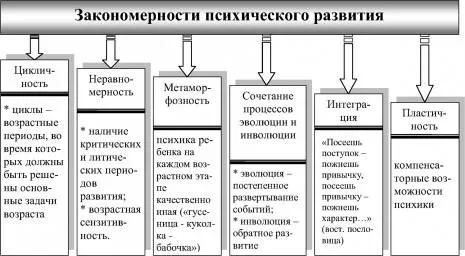
The laws of a child's psychological development represent certain general tendencies and regularities that characterize changes in the child's mental processes and behavior at different stages of his or her life. These laws help to understand and explain typical patterns of development, and they also influence pedagogical approaches and teaching methods. Below are some of the main laws of a child's psychological development:
Processuality: The development of the child is a continuous process, characterized by a sequence and gradualness of changes in various aspects of the psyche. New abilities and skills are built on the basis of those already acquired, forming a kind of "ladder" of development.
Individuality: Each child has his or her own developmental trajectory, and the pace of this development can differ. Genetic predispositions, the social environment, stimulation and other factors influence how the child develops.
Integrativity: Different aspects of psychological development are interrelated. Physical, psychological, social and cognitive development interact and influence one another. For example, physical maturity can influence the child's abilities for learning and social adaptation.
Hierarchy: Certain abilities and skills develop later than others and are built on their basis. For example, the capacity for abstract thinking develops later than the capacity for concrete thinking.
Synchrony: Different aspects of development (for example, cognitive, social and emotional) can develop in parallel and interconnectedly. This means that changes in one area can influence changes in other areas.
Qualitative changes: At different stages of development, not only quantitative but also qualitative changes are observed in mental processes. For example, a shift in the type of thinking (from concrete to abstract) or the emergence of new abilities (for example, symbolic play) constitute qualitative changes.
Zone of proximal development: A concept proposed by Lev Vygotsky, implying that there is a zone in which the child can achieve success with the support and help of more experienced people (parents, teachers). This helps the child move from the current level of development to a higher one.
Plasticity: The child possesses a high degree of plasticity, meaning his or her ability to adapt to new conditions and to learn. This is especially characteristic of early childhood, but plasticity is preserved throughout the whole of development, although it declines.
These laws denote the main tendencies characterizing the psychological development of the child. They help us understand that development is a complex process, dependent on a multitude of factors, and they influence approaches to the upbringing, education and support of children at different stages of their lives.
Dysontogenesis of the general persistent-underdevelopment type. The concepts of "mental retardation" and "feeble-mindedness." The main forms of mental retardation. Oligophrenia as the main form of mental retardation in childhood. Classification of oligophrenias by etiological criterion. G.E. Sukhareva on the main characteristics of oligophrenia as a specific form of dysontogeny.
Delayed development. The history of its identification within the child population, its representation in the population, and sex-related differences. Harmonious psychophysical infantilism. The concept of minimal brain dysfunction. Variants of delayed development: constitutional, somatogenic, psychogenic, cerebral-organic (K.S. Lebedinskaya). Mental and social development of children with various forms of DMD. Principles of the differential diagnosis of DMD from similar conditions. Damaged development. Organic dementia as a variant of damaged development. Psycho-organic syndrome in children and adolescents, its age-related characteristics and manifestation. Features of the mental development of people with ongoing neuropsychiatric illnesses.
Disorders of mental development can manifest in various types and forms, including autism spectrum disorders, attention deficit and hyperactivity disorders, delays in intellectual development, and others. Below are the psychological characteristics of some of the main types of disorders of mental development:
Autism spectrum: People with autism spectrum disorders may display social and communication difficulties. They may experience difficulties in establishing contact with others, understanding non-verbal signals, developing interaction with the surrounding world, and expressing emotions. They may have a limited range of interests and repetitive behavioral patterns.
Attention deficit and hyperactivity disorder (ADHD): Children with ADHD may display attention disorders, impulsive behavior and hyperactivity. They may have difficulties concentrating on tasks, organizing actions, managing time and restraining impulses. These children may be prone to frequent shifts of attention and insufficient self-control.
Delays in intellectual development: Children with delays in intellectual development may have a lower level of intellectual abilities compared with typical indicators. They may experience difficulties in mastering new information, making decisions, solving problems and social adaptation. However, it is important to remember that every child with a delay in intellectual development may have his or her own strengths.
Autism spectrum disorders: Children with autism spectrum disorders may experience problems with social communication and interaction, limited interests and stereotyped behavior. They may have difficulties understanding social norms, showing empathy and forming relationships with those around them.
Speech and communication disorders: Children with speech and communication disorders may have difficulties in developing speech and language skills. This may manifest as a limited vocabulary base, difficulties expressing thoughts, and difficulties understanding the speech of others.
Dyslexia and dyscalculia: Children with dyslexia (a reading disorder) and dyscalculia (a disorder of mathematical skills) may have difficulties mastering reading, writing and mathematics skills. They may experience difficulties recognizing letters, reading aloud, understanding text, performing mathematical operations, and so on.
Besides these types of disorders, there are others, each of which has its own unique characteristics and features. It is important to understand that every child is unique, and the approach to pedagogical and psychological support must be individualized, taking into account the characteristics of each case.
Deficit-based development. The distinctiveness in the development of cognitive processes, the emotional sphere and the personality of people with impairments of vision, hearing, speech and the musculoskeletal system. The main directions of compensatory processes in deficit-based development. Problems of differential diagnosis of children with primary speech disorders from other dysontogenies accompanied by speech disorders (mental retardation, DMD, early childhood autism). Psychological aspects of personal and vocational rehabilitation. Distorted development. Early infantile autism syndrome (Kanner syndrome) as a specific developmental disorder. Time of its identification, representation in the population, sex-related differences. Features of mental development in early infantile autism: specific disorders of perception, speech and thinking, fears, stereotyped (ritualistic) behavior, pathological forms of self-stimulation. Problems of the differential diagnosis of early infantile autism from mental retardation, deafness, speech underdevelopment, schizophrenia.
Disharmonious development. Behavioral disorders in childhood and adolescence. The concept of character accentuation. A comparative analysis of the classifications of character accentuation by K. Leonhard and by A.E. Lichko. Psychopathy as a variant of disharmonious development.
Children with complex disorders. Complex defect in the context of deviant development. Causes of the emergence of children with combined developmental disorders. Approaches to classifying children with a complex defect according to the principle of combining a sensory and an intellectual defect, or several sensory defects, or a combination of sensory disorders with disorders of the musculoskeletal system. The qualitative distinctiveness of the development of a child with a complex defect.
Principles of psychological support for a child with a combined developmental disorder.

Comments