
Lecture
Correctional (special) pedagogy — a field of pedagogical knowledge whose subject is the development and implementation, in educational practice, of a system of conditions providing for the timely diagnosis, prevention and pedagogical correction of disorders of individuals' social and psychological adaptation, and of their difficulties in learning and in mastering the social roles appropriate to their age stage of development. "Correctional pedagogy" is a much narrower concept than "special pedagogy". The term is used in Soviet and Russian pedagogical literature; because it quite clearly points to active intervention on the part of those carrying out corrective measures (which are not always required and, more importantly, to which the students and their parents or guardians do not always give their consent), it is almost never found in the world literature.
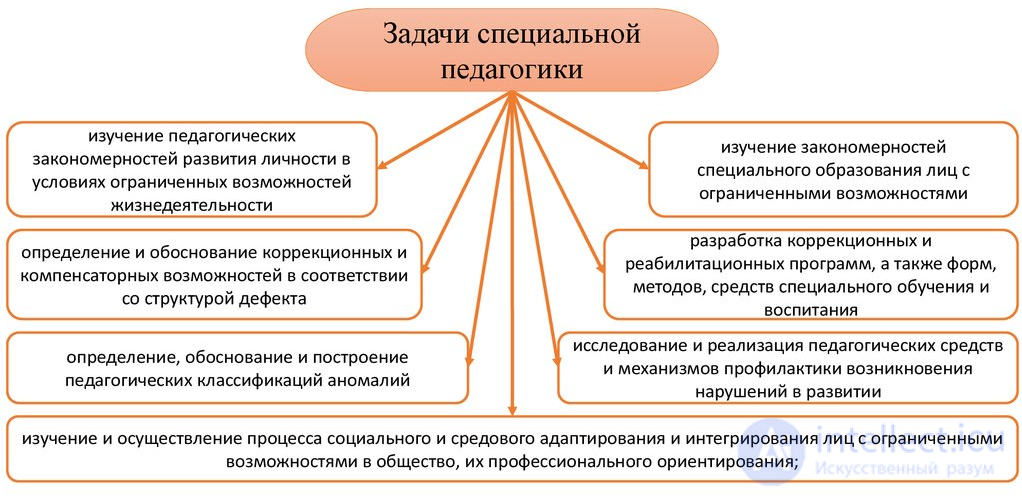
Special pedagogy is a science that studies the essence, regularities and trends in managing the process of development of the individuality and personality of a child with limited health capabilities who needs specialized individual methods of upbringing and instruction. It is divided into preschool, school and special pedagogy for adults. Teaching makes use of correctional-educational work (a system of special pedagogical measures aimed at weakening or overcoming developmental defects). Among the tasks addressed by special pedagogy are the inclusion of people with developmental problems into the social environment, as well as the prevention and treatment of pathological conditions in young children who have not yet adapted to the social environment.
Correctional (special) pedagogy — a field of pedagogical knowledge whose subject is the development and implementation, in educational practice, of a system of conditions providing for the timely diagnosis, prevention and pedagogical correction of disorders of individuals' social and psychological adaptation, and of their difficulties in learning and in mastering the social roles appropriate to their age stage of development. "Correctional pedagogy" is a much narrower concept than "special pedagogy". The term is used in Soviet and Russian pedagogical literature; because it quite clearly points to active intervention on the part of those carrying out corrective measures (which are not always required and, more importantly, to which the students and their parents or guardians do not always give their consent), it is almost never found in the world literature.
Several different approaches to teaching students with special needs can be distinguished. Four categories can be identified, differing in the extent of contact between the students being taught and «regular» students:
Correctional educational institutions in Russia are divided into 8 types, depending on the problem being addressed:
Besides special correctional educational institutions, the education of children with special needs is also organized in correctional classes of general-education schools.
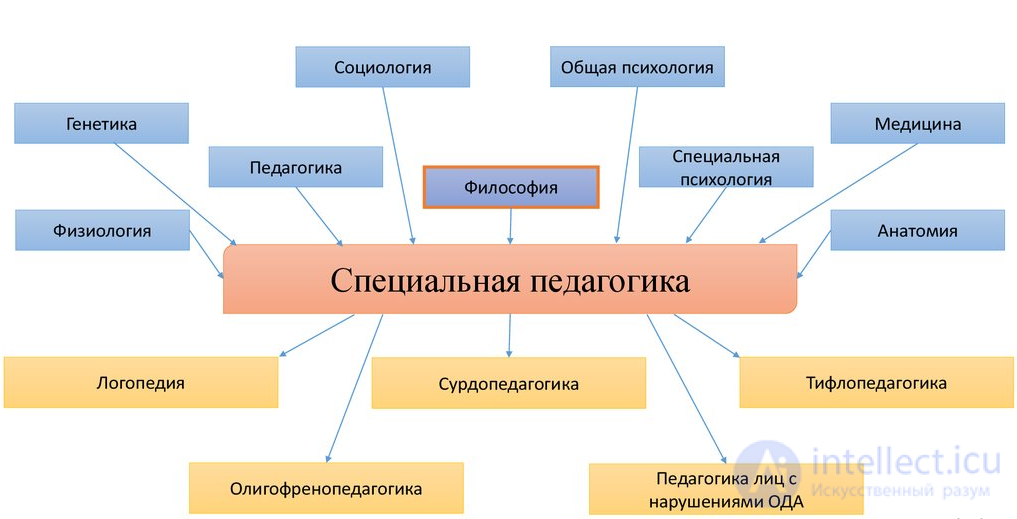
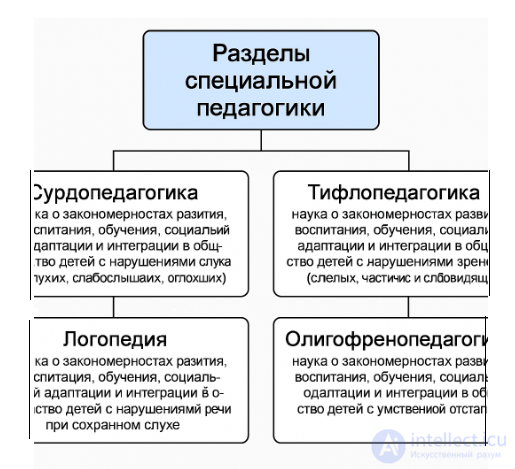
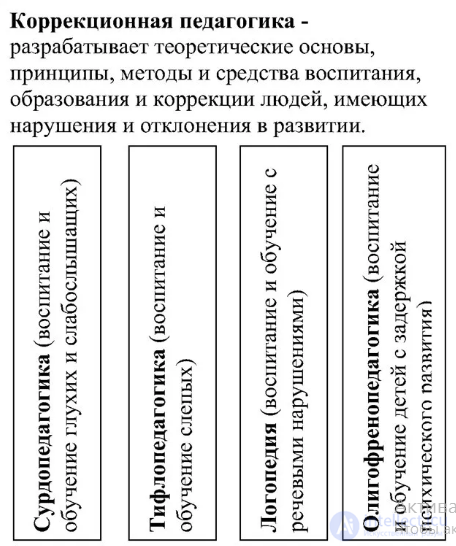
Correctional pedagogy (from Lat. correctio – correction) is a multidisciplinary science that studies children with special features of psychophysical development and is engaged in developing the problems of their upbringing, instruction and correction of ontogenetic deficiencies. It provides the scientific basis for the work of special educational schools and preschool institutions, and of correctional-pedagogical assistance centers. The object of correctional pedagogy is the personality of a child who has deviations in the sensory-motor, somatic, intellectual and speech spheres, deviations in behavior that hinder school adaptation and adequate socialization. According to A.D. Goneyev (1999), the object of correctional pedagogy is children who have four «D»s, i.e., children who have a not clearly expressed defect, who suffered deprivation in early childhood, who as a result experience school disadaptation (a disturbance of adjustment) and who display deviation (deviant behaviour).
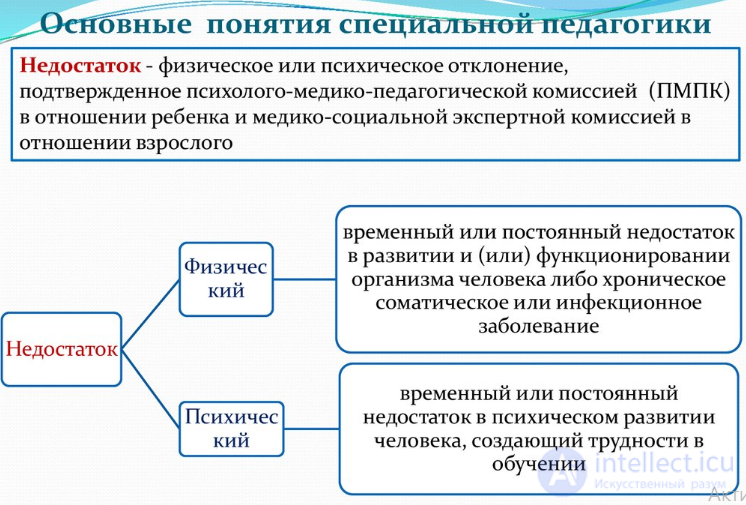
The subject of correctional pedagogy is the theory and practice of special education, including the study of the features of the development and education of a child with special psychophysical developmental needs, of the features of the formation of his or her personality, and the use of this knowledge to find the best means, conditions and ways that will ensure correction of physical or mental deficiencies and behavioral deviations in the education of such a child, for the purposes of his or her social adaptation and integration into society. Among the goals of correctional pedagogy are: correction of a deficiency and its compensation by pedagogical means; social and personal adaptation and rehabilitation. These goals can be achieved only once the specific goals of instruction and upbringing, and of education as a whole, have been achieved, i.e., once there are positive results of the correction and compensation of the deficiency.
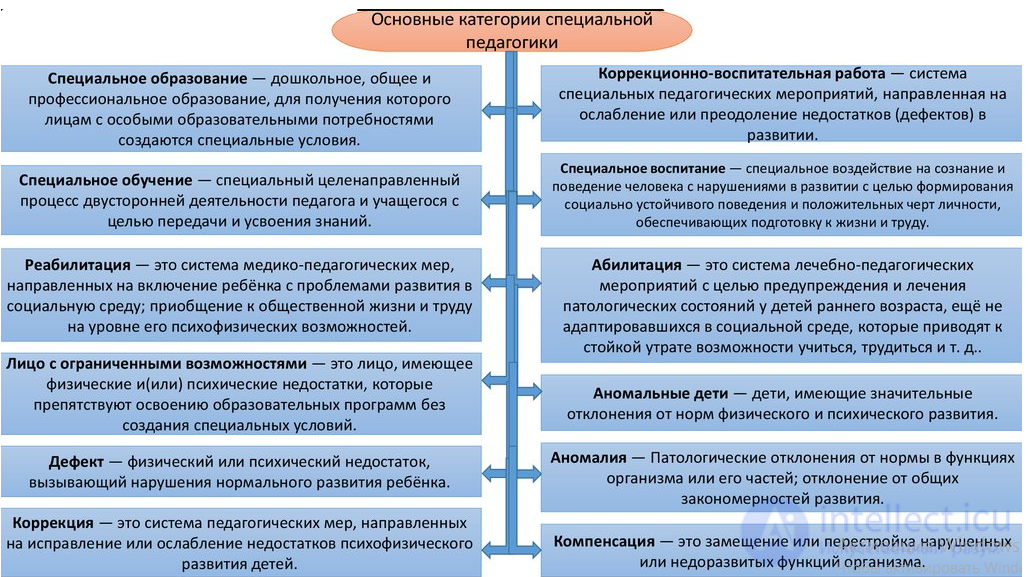
To achieve the stated goals, correctional pedagogy addresses the following tasks: it determines the nature and essence of physical and mental deficiencies and deviations, and identifies the causes and conditions of their occurrence; it studies the pedagogical regularities of personality development under conditions of limited life activity; it identifies the leading trends in the prevention and overcoming of developmental deviations, and the etiology of psychophysical development and of the socio-pedagogical conditions of life activity of persons with disabilities; in accordance with the structure of the disorder, it determines the correctional and compensatory possibilities of a specific person with disabilities; it develops methods, techniques, means and technologies of correctional-pedagogical influence on the personality; it determines and substantiates the construction of pedagogical classifications of persons with disabilities; it determines the goals, tasks and directions of activity of special correctional-developmental institutions; it creates the necessary educational-methodological base for training teachers for correctional-pedagogical work with persons with disabilities.
Correctional pedagogy unites a number of independent branches: surdopedagogy (from Greek surdus – deaf), which studies questions of the upbringing and instruction of children with hearing deficiencies; tiflopedagogy (from Greek tiphlos – blind) – questions of the upbringing and instruction of children with visual defects; oligophrenopedagogy (from Greek olygos – small, phren – mind) – questions of the upbringing and instruction of children with intellectual disability (intellectual insufficiency); speech therapy/logopedics (from Greek logos – word, paideia – upbringing, instruction) – questions of studying and correcting speech deficiencies.
Within correctional pedagogy, questions of special didactics (from Lat. didaktikos – instructive) are developed. Special didactics studies the problems of the theoretical and applied foundations of correctional instruction, identifies the regularities to which it is subject, determines the pedagogical foundations of the content of education, and investigates the essence of the principles of instruction and the ways of activating the educational-cognitive process. In other words, the main task of special didactics is such processing of the material presented to learners that, as a result, it becomes accessible, comprehensible and easy to assimilate, without thereby losing the logic of the subject.
Upbringing and instruction in correctional pedagogy must be developmental in character, taking into account the zone of proximal development (ZPD), i.e., that reserve of potential capabilities, of the child's forming functions, which he or she cannot yet realize independently but already realizes with the help of an adult. According to L.S. Vygotsky, the ZPD determines not only the existing capabilities but also the prospects for the mental development of a child with problems. Any instruction must stimulate the transition of the ZPD into actual development (the zone of actual development), i.e., over time the adult's guidance becomes unnecessary, and the child's solving of tasks becomes independent. This constitutes the interrelationship between instruction and development, in which properly organized instruction leads development forward, relying on the forming mental functions.
Correction (from Lat. correctio – correction) is a system of psychological-pedagogical measures aimed at correcting, weakening or smoothing over deficiencies in the psychophysical development of children with disabilities. This may be either the correction of individual defects (correction of pronunciation or vision) or a holistic influence on the child's personality in order to achieve a positive result in the process of correctional educational-upbringing work. Compensation (from Lat. compensatio – recompense, equilibration) is the substitution, restructuring of impaired or underdeveloped functions of the organism, a kind of adaptation of it to changed negative conditions of existence, and an attempt to replace affected, disabled or unproductively functioning structures with relatively intact, compensatory mechanisms.
The successful course of compensatory processes in such children depends on a number of conditions: a properly organized education system providing for the differentiated construction of a network of special educational institutions, the construction of the educational-upbringing process on the basis of applying special techniques and methods of correctional-rehabilitation work, and their reasonable alternation; the use of the principles of taking into account the individual and typological features of children, of an individual and differentiated approach, of combining theory and practice; the formation and maintenance of correct interpersonal relations within the children's collective, as well as between teachers and children; the correct organization of the schedule of study work and rest for children, preventing the possibility of overload with academic activities; the use of a broad arsenal of visual and technical aids for the optimal realization of children's capabilities and abilities.
Integration (from Lat. integratio – restoration, joining) – in the context of correctional pedagogy, this is the inclusion of children with problems into the surrounding environment, into ordinary interpersonal relations, for the purpose of maximally normalizing their socio-cultural status. One of the optimal means of integration is integrated instruction – the process of the joint education of children with normal psychophysical development and children with special features of psychophysical development. Habilitation (from Lat. abilitas – to equip with a skill, ability) – a complex of services and measures aimed at forming new and strengthening existing resources of a child's social and psychophysical development.
Social rehabilitation (from Lat. re – again, habilitas – restoration of fitness for something, ability, and socium – society) is the restoration of physical, social and educational abilities that existed in the past and were lost due to illness or a change in living conditions. According to V.N. Yarskaya, rehabilitation refers both to recovery after a severe illness and to comprehensive assistance to children with problems. Social adaptation (from Lat. adapto – I adapt) is active adaptation to the conditions of the social environment through the assimilation and acceptance of the goals, values, norms and behavioral styles accepted in society.
PRINCIPLES OF CORRECTIONAL PEDAGOGY
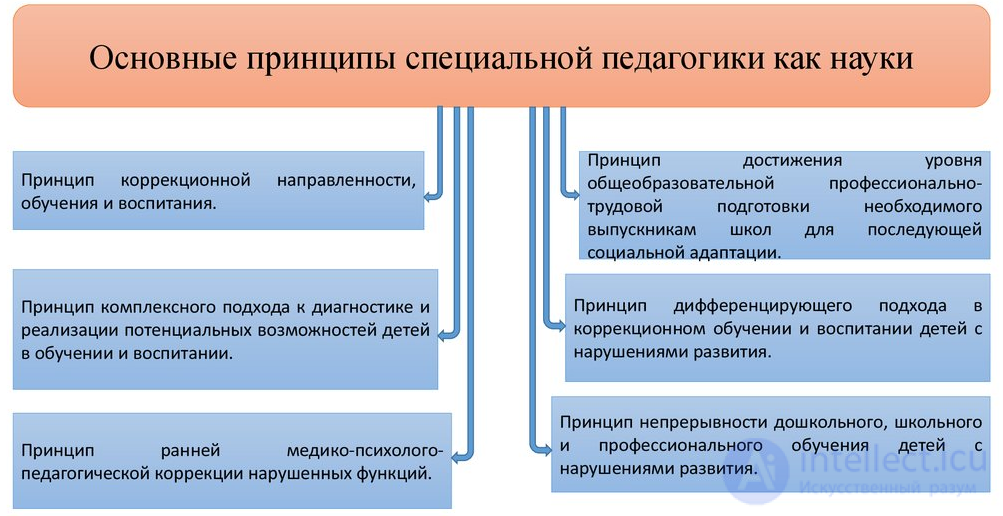
The first principle is the principle of comprehensive borrowing of forms, methods, means and tools from related sciences. The second principle – the principle of comprehensive study of children with disabilities, that is, the comparison of data obtained by teachers, educators, psychologists, physicians, etc. The main task of all scientific research in correctional pedagogy is the development of effective ways (methods) of preventing and overcoming developmental deviations.
Integration is based on the concept of «normalization», which rests on the idea that the life and everyday existence of people with disabilities should be as close as possible to the conditions and lifestyle of the society in which they live. The principles of «normalization» are enshrined in a number of international legal instruments: the Declaration of the Rights of the Child (1989), the Declaration on the Rights of Mentally Retarded Persons (1971), and the Declaration on the Rights of Disabled Persons (1975). In accordance with these documents, a person with disabilities is granted the same rights and privileges as all other members of society: the right to live, study and work in their own locality, to have their own home, to choose friends and be friends with them, the right to be a welcome member of society, the right to be like everyone else.
As applied to children, this means the following: a child with special educational needs also has needs common to all, the main one of which is the need for love and a stimulating developmental environment; the child should lead a way of life that is as close as possible to normal; the best place for a child is his or her own home, and it is the duty of local authorities to help ensure that children with special educational needs are raised in their own families; all children can learn, and therefore all of them, however severe their developmental disorders may be, must be given the opportunity to receive an education.
The main principle of integrative pedagogy is as little external and as much internal differentiation as possible. The main types of integration are: social and educational. Some scholars also distinguish physical integration (being in the same room), functional integration (activity-based: subject-spatial unification) and societal integration (inclusive: complete removal of social distance, equal partnership in activity).
EARLY CORRECTION IN CHILD DEVELOPMENT
Competently organized early correction helps to prevent the emergence of secondary developmental deviations, to ensure the maximum realization of rehabilitation potential, and, for a significant proportion of children, to ensure the possibility of inclusion in the general educational mainstream at an earlier stage of age-related development, eliminating the need for costly special equipment. Early correction includes the following elements: the earliest possible detection and diagnosis of a developmental disorder; the maximum reduction of the gap between the moment developmental deviations in a child are detected and the start of targeted correctional assistance; lowering the time threshold for the start of special education (to the first months of the child's life); the mandatory involvement of parents in the correctional process based on identifying the positive aspects of the family and activating its rehabilitation potential; the intensity of early correction: the more actively correction is carried out, the more significant the results of the child's development; coverage by correction of various spheres of the child's development; the creation of all the necessary conditions for the child's development.
19 Children with disabilities are children who have various mental or physical deviations that cause disorders of general development, preventing the children from leading a full life. A number of alternative concepts can serve as synonyms for this term: «children with special educational needs», «children with developmental deviations», «children with special needs», «atypical children», «children with learning difficulties», «children with dysontogenesis» (a disturbance of the individual course of development), «exceptional children», «children with deficiencies in mental and physical development», «children with an affliction» and others.
correctional upbringing is the fostering of typological properties and qualities of the personality, invariant to the subject-specific nature of the activity (cognitive, labor, aesthetic, etc.), enabling adaptation to the social environment; In preschool age, a child with intellectual insufficiency, without special correctional work, misses two important stages in mental development: the development of object-related actions and communication with other people. This child has little contact with adults and peers, does not enter into role-play or any joint activity with others. All this is reflected in the accumulation of children's social experience and in the development of higher mental functions – thinking, voluntary memory, speech, imagination, self-awareness, will.
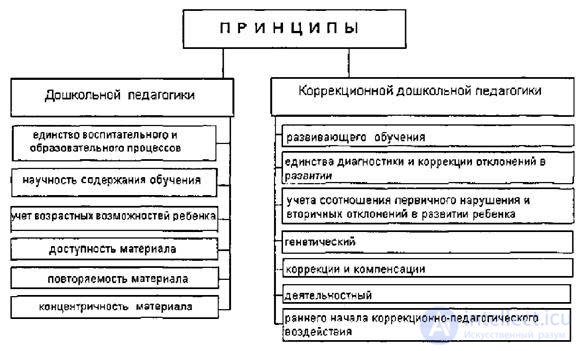
The principles of teaching children with intellectual insufficiency are determined by special didactics. The principle of visualization in instruction. The principle of correctional-educational instruction. The principle of accessibility. The principle of scientific character. The principle of conscious instruction. The principle of systematicity and consistency. The principle of durability. The principle of connecting instruction with life. The principle of the collective character of instruction combined with taking into account the individual characteristics of learners.
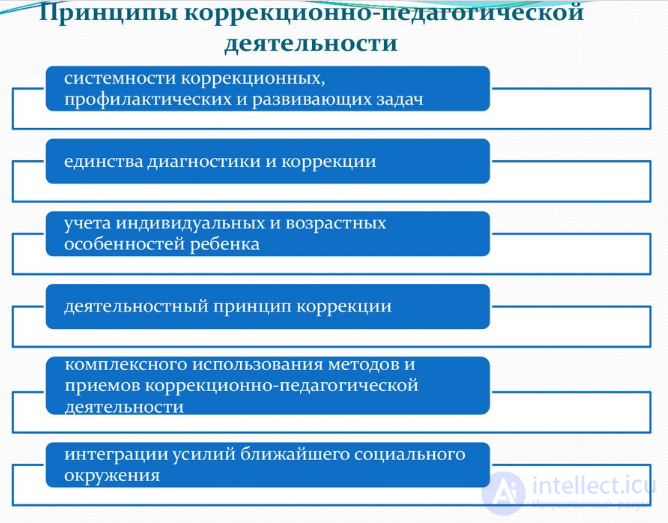
The term was introduced into modern pedagogical science in 1988 (G.F. Kumarina, 1988), however the first attempt to reveal its content was made by P.V. Kashchenko and V.V. Murashev, who in 1929 prepared a work titled «Therapeutic (correctional) pedagogy», which even then marked a new direction in the development of scientific knowledge.
The object domain of correctional pedagogy in its modern interpretation is situations and states of risk in the development of the growing person, adaptation disorders that manifest themselves in the interaction of the individual with the environment and are not caused by factors related to organic etiology, phenomena of socio-psychological and school disadaptation. Surdopedagogy, tiflopedagogy, oligophrenopedagogy and speech therapy can serve as examples.
The system of special instruction and upbringing of children with severe speech disorders (logopedagogy), as a branch of general, developmental and correctional pedagogy (oligophrenopedagogy, surdopedagogy, tiflopedagogy, and the pedagogy of children with musculoskeletal disorders), is built above all on the basis of the general theory of instruction (didactics), whose object of study is the regularities and principles,
methods, organizational forms and means of instruction.
V.I. Seliverstov believes that the totality of fundamental linguistic, clinical and psychological knowledge about an individual with impaired speech (a person with a speech disorder) is transformed into a correctional-pedagogical (logopedagogical) process ensuring the formation in
a person with a speech disorder of skills of correct speech together with the harmonious development of his
personality and adequate social behavior.
Logopedagogy is based on the following propositions:
- mastery of linguistic forms, speech and learning skills occurs in activity, in the course of which the need for communication arises and develops; the social environment and communication are factors determining
the intensity of speech development; the need to teach children special techniques for organizing speech communication in order to implement a communicative approach to speech development; the development and correction of speech are
means of mental (intellectual) upbringing.
Didactic regularities find their concrete expression in
the basic propositions, or principles, of instruction (didactic principles). In logopedagogical work these principles acquire a certain
distinctiveness owing to the specific nature of the population of children and the tasks of their correctional instruction and upbringing.
— The principle of scientific character presupposes the existence of reliable and valid psychological-pedagogical methods and techniques for studying the child for the purposes of differential diagnosis of disorders in his development
and of determining the basic orientation and necessary conditions of correctional-pedagogical work; and of scientifically substantiated methods, content, organizational forms and means of logopedagogical work
with the child.
— The principle of an individual approach under conditions of collective
work implies the dynamic study of the child with a speech disorder; the collection
of anamnestic information about the child, and techniques for his speech-therapy
examination; individual and group sessions; the principles of forming speech-therapy groups of children with homogeneous speech
disorders; the creation of conditions of group work for all children and
for each individual child with a speech disorder; the selection of manageable tasks for each child in the session; measures of encouragement and stimulation, etc.
— The principle of accessibility, consistency and systematicity presupposes a gradual increase in the complexity of speech exercises in the course of forming the child's skills of correct speech and behavior, from simple to more complex, relying on his intact skills of correct speech,
and a gradual build-up of new qualities and skills.
— The roundabout correctional-pedagogical path (according to L.S. Vygotsky) – from the correction of distant, secondary signs of the defect to the correction of its primary, core manifestations.
A phased implementation of the content of speech-therapy sessions is advisable, together with the selection of the organizational forms, techniques
and means necessary for this; the regularity and continuity of correctional-speech sessions,
ensuring the success and durability of the formation of new, correct speech and behavior skills.
— The principle of consciousness and activity – concerning the joint activity of the speech therapist and the child, the need for and forms of the child's personal active participation in speech-therapy sessions and outside them, in his cognitive and
sensory-practical activity.
— In accordance with the principle of visualization, sessions make use of
specific and auxiliary audiovisual and technical teaching aids aimed at correcting faulty speech: speech-therapy probes, a tape recorder, a corrector device, an echo apparatus, a metronome, a tonometer, individual-use linguo-devices for sound amplification and
sound attenuation, massagers, computer games and programs, «Visible Speech» and others.
— The principle of the durability of learning outcomes determines the durability
of the knowledge, abilities and skills acquired in speech-therapy sessions,
while the effectiveness of speech-therapy work and the durability of its results
depend overall on the professional skill of the speech therapist, on the complexity
of the structure of the speech disorder, on the individual-personal characteristics of the child, and on the various conditions of speech-therapy work.
The specific nature of correctional-speech instruction for persons with speech disorders (according to
V.I. Seliverstov) has given rise to the formation of concepts of special methodological (or logodidactic) principles of speech-therapy sessions: the principle of conformity with nature, reflecting the need, in the process of correctional-speech instruction, for orientation toward and reliance on the regularities of the natural
development of children's speech; the principle of the mental readiness of the person with a speech disorder for correctional instruction; the principle of the psychophysical readiness of the person with a speech disorder for
correctional instruction; the principle of imitativeness in correctional instruction, reflecting the influence of the speech environment on the formation of speech and speech behavior; the principle of the comprehensive and integral-personal character of speech-therapy sessions, providing for correctional-pedagogical
influence on the impaired aspect of the speech of the person with a speech disorder and, as a whole, on all aspects of his speech (the sound aspect, the lexico-grammatical, the tempo-rhythmic,
the melodic-intonational aspects, writing and reading), on all types of his mental
activity and social behavior; the principle of a comprehensive therapeutic-pedagogical approach to overcoming speech disorders.
The process of correctional-speech instruction is assistance to the person with a speech disorder in
developing his existing aptitudes for correct speech and speech behavior; reflecting his ability to understand speech addressed to him and
to carry out the necessary speech-therapy tasks.
Didactic regularities and principles are the general theoretical basis for structuring the entire correctional-pedagogical process with children who have speech disorders, and the basis for the selection and construction of particular, practical methods encompassing the tasks, content, methods,
means and organizational forms of speech-therapy work.
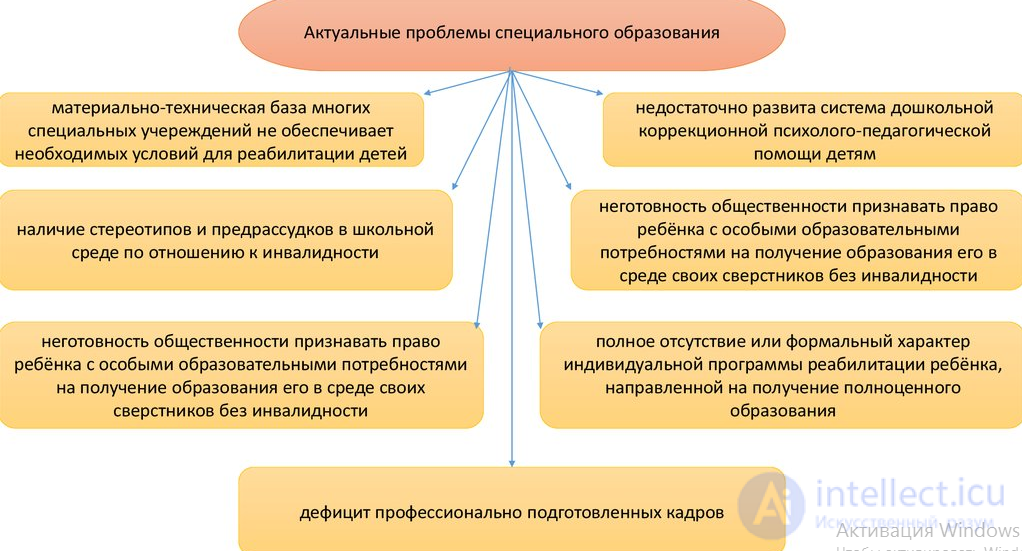
problems of special education

Comments