
Lecture
The formation of correct sound production is the most important component of a child's speech development. Disorders of this aspect of speech not only hinder the process of communication but also have a negative effect on the development of phonemic hearing, the lexical-grammatical structure of speech, and written language. One of the most common forms of speech deviation in children is phonetic-phonemic disorder, manifested in the distortion, substitution, or omission of sounds.
Phonetic-phonemic distortions affect both the articulatory-acoustic side of speech (the phonetic level) and the perceptual-differentiating side (the phonemic level), which causes difficulties in their diagnosis and correction. The relevance of studying this problem is due to the high prevalence of such disorders among preschoolers and younger schoolchildren, as well as the need for a systematic approach to their correction in speech-therapy practice.
The purpose of the present study is to analyze the mechanisms and manifestations of phonetic-phonemic distortions in sound production, their place in the structure of speech disorders, and to examine effective approaches to their diagnosis and correction.
Phonetic-phonemic underdevelopment of speech in children (also known as PPUS) – is a disorder of the processes of speech formation combined with various speech disorders.
A phoneme (Ancient Greek φώνημα — «sound») — is the minimal meaning-distinguishing unit of language. A phoneme has no independent lexical or grammatical meaning of its own, but serves to distinguish and identify meaningful units of language (morphemes and words).
Phonemic hearing - the ability to distinguish phonemes, the sounds of speech.
Phonetic-phonemic underdevelopment of speech - a disorder of the processes forming the pronunciation system of the native language in children with various speech disorders, resulting from defects in the perception and production of phonemes.
This category includes children with normal hearing and intelligence.
PPUS — is a type of speech disorder in which the formation of the pronunciation side of speech is impaired both at the level of articulation and at the level of auditory (phonemic) perception. The child suffers impairment both in the production of sounds and in distinguishing them by ear, which hinders mastery of the native language system.
Such a disorder is often not an independent diagnosis but accompanies other speech-therapy conditions, including:
Alalia (delay or absence of speech development due to damage to the speech zones of the brain);
Dysarthria (impairment of speech motor function due to organic damage to the central nervous system);
Dyslalia (distorted pronunciation with preserved hearing and innervation);
Rhinolalia (nasality and impaired sound production due to pathologies of the nasopharynx and palate).
PPUS manifests itself in substitutions, distortions, and omissions of sounds, as well as in difficulties with phonemic analysis and synthesis, which can hinder not only oral speech but also the mastery of reading and writing.
Normal functioning of the phonemic system presupposes the possibility of error-free auditory differentiation of all speech sounds (including acoustically close ones) and correctness of their pronunciation.
Studies by a number of authors (R. E. Levina, R. M. Boskis, N. Kh. Shvachkin, L. F. Chistovich, A. R. Luria, and others) have made it possible to conclude that in cases of disturbed articulatory interpretation of a heard sound, its perception may also deteriorate to varying degrees.
R. E. Levina, on the basis of a psychological study of children's speech, arrived at the conclusion that phonemic perception is of paramount importance for the complete mastery of the sound aspect of speech. It was established that children with a combination of impaired pronunciation and perception of phonemes show an incompleteness in the processes of forming the articulation and perception of sounds that differ in subtle acoustic-articulatory features.
The state of children's phonemic development affects the mastery of sound analysis (L. F. Spirova, 1982).
The level of formation of the action of identifying the sequence of sounds in a word, and the ability to consciously orient oneself among the sound elements of a word, depend on the degree of underdevelopment of phonemic perception and on whether this underdevelopment is primary or secondary.
Secondary underdevelopment of phonemic perception is observed in disorders of speech kinesthesia occurring with anatomical and motor defects of the speech organs.
In these cases, the normal auditory-articulatory interaction, which is one of the most important mechanisms in the development of pronunciation, is disrupted.
The child's low cognitive activity during the period of speech formation, and weakened voluntary attention, are also of significance.
Malformed pronunciation may be expressed:
Several states can be identified in the phonetic-phonemic development of children:
A low level of phonemic perception is expressed in the following:
a) indistinct auditory differentiation of phonemes in one's own and others' speech (primarily voiceless — voiced, whistling — hissing, hard — soft, hissing — whistling — affricates, etc.);
b) unpreparedness for elementary forms of sound analysis and synthesis;
c) difficulty in analyzing the sound composition of speech.
In children with PPU there is often a definite relationship between the level of phonemic perception and the number of defective sounds, i.e., the greater the number of unformed sounds, the lower the phonemic perception.
After examining children with phonetic-phonemic underdevelopment, it is necessary to:
When analyzing the results of an examination of phonemic perception, the speech therapist pays attention to the following:
1. Does indistinct perception of sounds correspond to their incorrect articulation?
2. Is a large number of indistinctly perceived sounds found alongside an insignificant number of incorrectly pronounced ones?
3. Under what conditions does phonemic underdevelopment manifest itself (regularly; in complex positions, when perceiving paronym words)?
4. What is the nature of the specific errors in writing (in schoolchildren)? How do they relate to the state of phonemic perception? Based on material from speech utterances, an assessment is made of the formation of the syllabic structure of speech and the children's lexical-grammatical development.
Nasality and a burred [r] are examples of speech disorders associated with the articulation of sounds. Below is a list of other common speech features and disorders of a similar nature:
Speech "through the nose", which can be:
Open nasality — due to anatomical features (for example, with a cleft palate), when air escapes through the nose during speech.
Closed nasality — with a runny nose, polyps, or adenoids, when nasal breathing is impaired.
Distortion of the sound [r] — pronounced as [l], [g], [y], or omitted altogether. It can be:
Physiological — in children under 5 years of age.
Functional — due to incorrect articulation.
Organic — due to disorders in the structure of the tongue or palate.
Phonetic-phonemic defects of the sounds r, r' – substitution of sounds, and purely phonemic (phonological) defects – confusion of the sounds r, r' – are called pararhotacism.
Causes: impairment of phonemic hearing, underdevelopment of phonemic perception, weakness of articulatory kinesthetic sensations.
Types of pararhotacism:
intra-group substitution, confusion – [r – r`]. For example: raketa (rocket) – ryaketa, ryba (fish) – riba;
substitution, confusion – [r, r` – y]. For example: gorka (hill) – goyka, gora (mountain) – goya, remen (belt) – yemen, Borka (name) – Boyka.
Impairment in the pronunciation of the sound [l] (it is substituted, disappears, or sounds distorted).
Phonetic-phonemic defects of the sounds l, l` – substitution – confusion of the sounds l, l` are called paralambdacism.
Disorders of whistling and hissing sounds:
Interdental — the tongue between the teeth.
Lateral — air escapes along the sides of the tongue.
Hissing sigmatism — distortion of [sh], [zh], [ch], [shch].
Parasigmatism — is the substitution of whistling and hissing sounds ([s], [z], [ts], [sh], [zh], [ch], [shch]) with other sounds, most often based on phonetic or articulatory similarity.
| Type of parasigmatism | Example of error | Description |
|---|---|---|
| Tetism | [s], [ts] → [t] | «sok» (juice) → «tok», «tsirk» (circus) → «tirk» |
| Detism | [z] → [d] | «zub» (tooth) → «dub» |
| Shchetism / Chetism | [sh], [shch] → [t’], [ch] | «shar» (ball) → «char» |
| Zhetism | [zh] → [d’] or [g] | «zhuk» (beetle) → «duk» or «guk» |
| Sigmatic yotacism | [s], [sh] → [y] | «sok» (juice) → «yok», «shapka» (hat) → «yapka» |
| Disorder | Example | Type of distortion |
|---|---|---|
| Sigmatism | [s] is pronounced distortedly (with a lisp, interdentally, etc.) | Phonetic |
| Parasigmatism | [s] is replaced with [t], [y], etc. | Phonemic |
Impairment of the sound [k], for example, pronounced as [t] or [kh].
Impairment of the pronunciation of the sound [g].
Impairment of the sound [y].
A general impairment of sound production with normal hearing and structure of the speech apparatus.
Impairment of the pronunciation of the sound [r] is called rhotacism.
Here is detailed information:
Complete omission of the sound [r]
Example: instead of «reka» (river) — «eka».
Cause: weakness of the tip of the tongue, insufficient vibration.
Substitution of the sound [r] with another sound
Example: «reka» → «leka» (substitution with [l]) — l-rhotacism.
Example: «reka» → «yeka» — y-rhotacism.
Example: «reka» → «kheka» — a rare variant with substitution by [kh].
Distorted pronunciation of [r]
Uvular [r] — produced not with the tongue but with the uvula in the throat (found among French speakers).
Guttural [r] — a hoarse, throaty sound.
Incorrect tongue position (the tip of the tongue does not rise to the alveolar ridge).
Weakness or limited mobility of the tongue.
Malocclusion or a short lingual frenulum.
Imitation of adults with defective speech.
Psychological features (stiffness, shyness).
Neurological or anatomical problems.
Work with a speech therapist — special articulatory exercises.
Exercises to develop the mobility and strength of the tip of the tongue (for example, «drummer», «little horse»).
Gradual elicitation and automatization of the sound [r] in syllables, words, and phrases.
In individual cases — speech-therapy massage, clipping of the tongue frenulum (if it is short).
Impairments of vowel-sound pronunciation occur less often than those of consonants, but they too exist and can significantly distort speech. Such disorders most often belong to general speech disorders.
This is the general name for defects in which the sound of vowels is distorted: [a], [o], [u], [y], [e], [i].
The sound is pronounced incorrectly, unclearly, «smeared».
Example: instead of «mama» it sounds like «mumo» or «mema».
Possible causes:
weak articulation of the lips, tongue;
lack of auditory control;
low speech tone.
One vowel is replaced by another.
Example: «papa» → «pipa» or «popa».
More common in children with alalia or dysarthria.
Vowels sound indistinct, as though the person is «swallowing» them.
Example: instead of «voda» (water) it sounds like «vdaá» or «vde».
Often occurs in adults with impaired speech tempo or in children with general speech underdevelopment.
Example: «kotik» (kitty) → «ktk», «zayats» (hare) → «zyts».
Usually found in general speech underdevelopment.
Underdevelopment of phonemic hearing (the child does not distinguish similar sounds).
Delayed speech development (DSD).
Impairments in the functioning of the articulatory organs (lips, tongue, soft palate).
Dysarthria, alalia, aphasia.
Hearing impairment.
Development of phonemic hearing (exercises for distinguishing sounds).
Articulatory gymnastics.
Visual and auditory support (showing a picture + sound).
Elicitation of the correct vowel sound through imitation.
Repetition of syllables, words, and sentences with the target sound.
Impaired articulation due to damage to the central nervous system (often in cerebral palsy).
Loss of speech following brain damage (stroke, injury, etc.).
Absence of speech or severe delay due to organic brain damage in early childhood.
Impairment of the tempo and rhythm of speech with spasms of the speech apparatus.
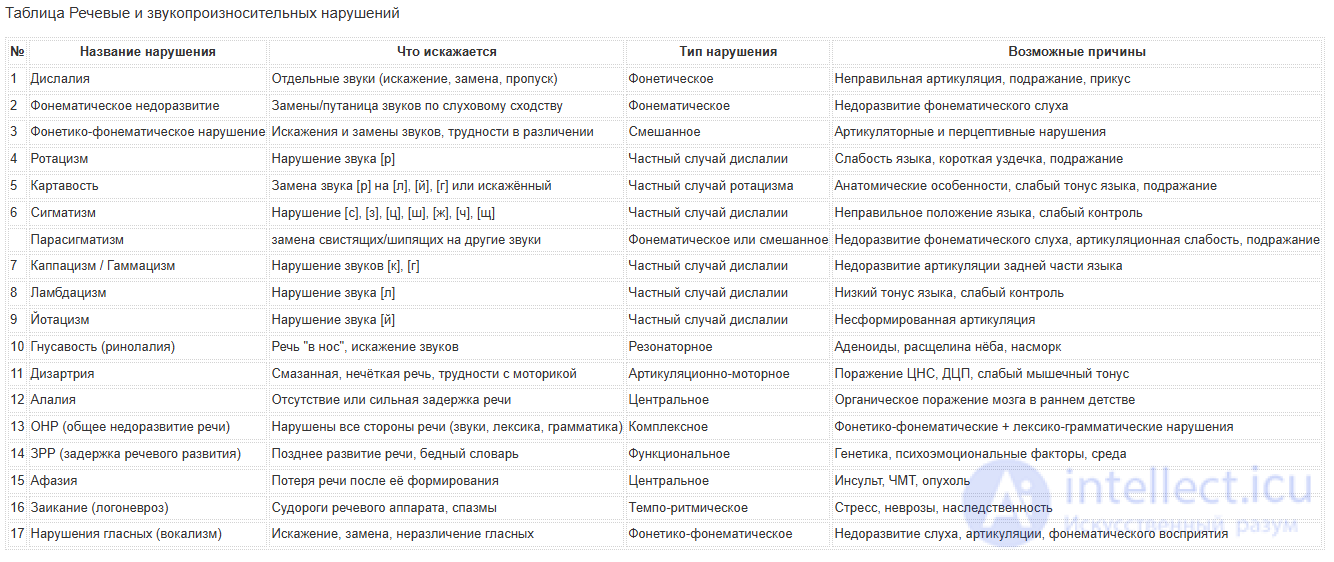
| No. | Name of disorder | What is distorted | Type of disorder | Possible causes |
|---|---|---|---|---|
| 1 | Dyslalia | Individual sounds (distortion, substitution, omission) | Phonetic | Incorrect articulation, imitation, malocclusion |
| 2 | Phonemic underdevelopment | Substitution/confusion of sounds based on auditory similarity | Phonemic | Underdevelopment of phonemic hearing |
| 3 | Phonetic-phonemic disorder | Distortions and substitutions of sounds, difficulties in differentiation | Mixed | Articulatory and perceptual impairments |
| 4 | Rhotacism | Impairment of the sound [r] | A specific case of dyslalia | Weakness of the tongue, short frenulum, imitation |
| 5 | Burred r-sound | Substitution of the sound [r] with [l], [y], [g], or a distorted variant | A specific case of rhotacism | Anatomical features, weak tongue tone, imitation |
| 6 | Sigmatism | Impairment of [s], [z], [ts], [sh], [zh], [ch], [shch] | A specific case of dyslalia | Incorrect tongue position, weak control |
| Parasigmatism | substitution of whistling/hissing sounds with other sounds | Phonemic or mixed | Underdevelopment of phonemic hearing, articulatory weakness, imitation | |
| 7 | Kappacism / Gammacism | Impairment of the sounds [k], [g] | A specific case of dyslalia | Underdevelopment of articulation of the back of the tongue |
| 8 | Lambdacism | Impairment of the sound [l] | A specific case of dyslalia | Low tongue tone, weak control |
| 9 | Yotacism | Impairment of the sound [y] | A specific case of dyslalia | Unformed articulation |
| 10 | Nasality (rhinolalia) | Speech "through the nose", distortion of sounds | Resonatory | Adenoids, cleft palate, runny nose |
| 11 | Dysarthria | Slurred, indistinct speech, motor difficulties | Articulatory-motor | CNS damage, cerebral palsy, weak muscle tone |
| 12 | Alalia | Absence or severe delay of speech | Central | Organic brain damage in early childhood |
| 13 | GSD (general speech underdevelopment) | All aspects of speech are impaired (sounds, vocabulary, grammar) | Complex | Phonetic-phonemic + lexical-grammatical disorders |
| 14 | DSD (delayed speech development) | Late speech development, poor vocabulary | Functional | Genetics, psycho-emotional factors, environment |
| 15 | Aphasia | Loss of speech after it has already formed | Central | Stroke, TBI, tumor |
| 16 | Stuttering (logoneurosis) | Spasms of the speech apparatus, cramping | Tempo-rhythmic | Stress, neuroses, heredity |
| 17 | Vowel disorders (vocalism) | Distortion, substitution, non-differentiation of vowels | Phonetic-phonemic | Underdevelopment of hearing, articulation, phonemic perception |
Overcoming phonetic-phonemic underdevelopment is achieved through purposeful speech-therapy work aimed at correcting the sound aspect of speech and phonemic underdevelopment.
Speech-therapy work includes:
Alongside the formation of correct sound pronunciation, the following is carried out:
1) developing attention to the morphological composition of words and the changes of words and their combinations in a sentence;
2) forming in children the ability to correctly construct simple extended and complex sentences, and to use various sentence constructions in connected speech;
3) developing connected speech, working on narration and retelling with the formulation of some correctional task;
4) developing children's vocabulary by drawing their attention to methods of word formation and to the emotional-evaluative meaning of words;
5) developing voluntary attention and memory. In carrying out correctional instruction for children with phonetic-phonemic underdevelopment, the speech therapist takes into account the regularities of the process of mastering the sound aspect of speech under normal conditions, which are formed through a gradually developing differentiation in the sphere of distinguishing the characteristic features of speech sounds.
Below is a systematized overview of groups of methods, principles, and approaches to correcting speech and sound-production disorders — both in dyslalia and phonetic-phonemic disorders, and in more severe speech disorders (GSD, dysarthria, alalia, etc.).
| Group of methods | Examples / explanation |
|---|---|
| 1. Articulatory methods | Articulatory gymnastics, sound elicitation, development of tongue and lip movements |
| 2. Acoustic-phonemic methods | Development of phonemic hearing, distinguishing sounds by ear and by articulation |
| 3. Speech-therapy massage | In dysarthria — massage of the tongue, lips, and cheeks to reduce spasticity and improve tone |
| 4. Breathing exercises | Formation of phonatory breathing (inhalation-exhalation, duration of exhalation) |
| 5. Finger exercises | Development of fine motor skills as a support for speech |
| 6. Rhythmic-intonational methods | Use of rhythm, singing, metrical repetitions, logorhythmics |
| 7. Visual support / visual images | Mirrors, cards, video, diagrams, articulatory images |
| 8. Play-based methods | Speech-therapy games, role-play exercises, play exercises with dolls |
| 9. Technical aids | Use of speech-therapy trainers, speech-therapy programs, tablets |
| 10. Neuropsychological methods | Development of interhemispheric interaction and the functions of attention, memory, and motor skills |
| 11. Lexical-grammatical work | Vocabulary enrichment, work with phrases and connected speech |
| 12. Automatization and differentiation of sounds | Practicing the sound from isolation to speech in sentences |
| Principle | Explanation |
|---|---|
| 1. Principle of systematicity | All aspects of speech are interrelated; work is carried out comprehensively |
| 2. Principle of gradualness | Elicitation — automatization — differentiation — inclusion in speech |
| 3. Principle of an individual approach | Taking into account the diagnosis, age, rate of mastery, and characteristics of the child |
| 4. Principle of visualization | Mirrors, pictures, diagrams, video — as support for articulation |
| 5. Principle of accessibility | Exercises correspond to the child's age and speech level |
| 6. Principle of motivation and activity | The child is engaged in the process; tasks are interesting and playful |
| 7. Principle of repetition and regularity | Sessions are systematic, with consolidation and a return to difficult sounds |
| 8. Principle of accounting for the zone of proximal development | Gradual complication of tasks, building on what the child already knows how to do |
| Approach | Characteristic |
|---|---|
| 1. Classical (articulatory-phonetic) | The main approach — elicitation and practice of sounds |
| 2. Phonemic | Emphasis on developing auditory perception and phonemic analysis |
| 3. Psychological-pedagogical | Comprehensive work on all aspects of speech and mental development |
| 4. Neuropsychological | Work with higher mental functions (attention, memory, motor skills, interhemispheric connections) |
| 5. Sensorimotor | Incorporation of body-oriented methods, breathing, and movement |
| 6. Integrative | Combining several approaches — speech-therapy, psychological, and neurological |
| 7. Play-based | Working through storyline, play, and motivation — especially effective with preschoolers |
| 8. Technology-based / digital | Use of ICT, speech-therapy applications, interactive exercises |
Phonetic-phonemic distortions are a complex speech disorder affecting both the productive and perceptual sides of speech, which requires a clear distinction from isolated dyslalia and phonemic underdevelopment.
Distortions and substitutions of sounds are most often observed in the structure of such disorders, caused by unformed articulatory patterns, weakness of phonemic perception, and impairment of auditory differentiation.
Phonetic-phonemic disorders occur in various forms of GSD, dysarthria, and DSD, as well as within more complex speech diagnoses (alalia, ASD, etc.), which requires a comprehensive and individualized speech-therapy approach.
Effective correctional work requires a combination of methods for forming articulatory skills, developing phonemic hearing, and automatizing sounds in connected speech, with early diagnosis and interdisciplinary cooperation among specialists being especially important.
A promising direction is the use of modern technologies (speech-therapy trainers, digital platforms, neurocorrectional methods) to increase the effectiveness of correcting phonetic-phonemic disorders.

Comments