
Lecture
The practice of teaching the deaf oral speech felt an acute need for knowledge in the field of phonetics: the description of the articulation of speech sounds
gave experimenters the initial groundwork for developing methods of artificially inducing sounds in the hearing-impaired, and later,
in logopathology, opened up possibilities for comparing articulation in
normal speech and in disorders of the pronunciation side of oral speech. During this
same period, treatises on phonetics also became widespread, in which
the first incomplete and often erroneous classifications of sounds were already
presented, and a considerable amount of phonetic information was given -
for example, in Wallis, Holder, and Wilkins (England). At the same time,
descriptions were still characteristically limited to the articulation of only those sounds that could be directly observed.
The accumulation and deepening of pedagogical, medical and linguistic knowledge, and of ideas about the peculiarities of the psychophysical development of deaf-mute, blind, and mentally retarded children, together with the interested
attitude of parents and relatives toward their upbringing, led to the
emergence, in the countries of Western Europe, of the practice of their individual instruction and vocational training.
The general rise in all spheres of public life, and the development of science,
characteristic of the Renaissance, were, as indicated above, the decisive factor in the emergence, in the countries of Western Europe, of the practice
of individual instruction for deaf-mute and blind children and the development of corresponding methodological systems.
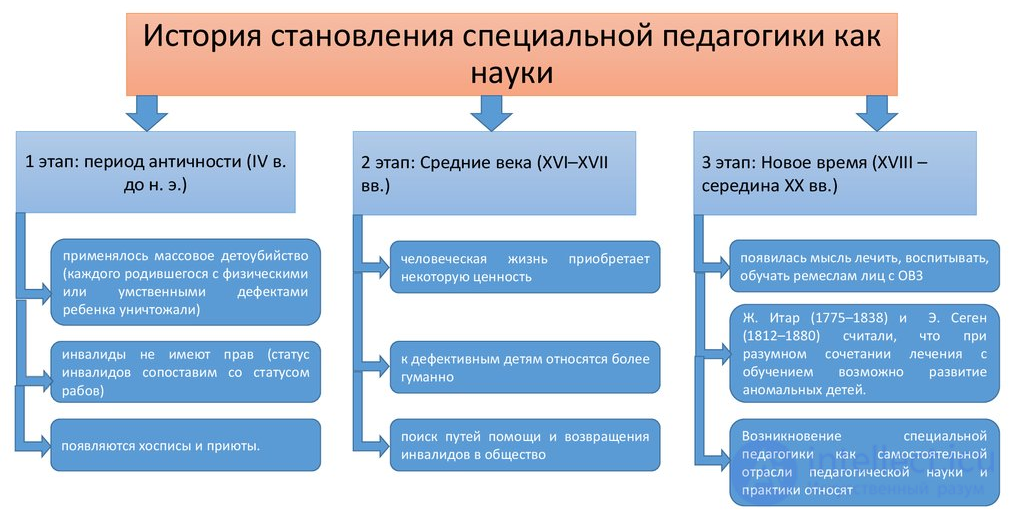
One of the first teachers of the deaf-mute was a monk of the Benedictine
Catholic monastery of San Salvador, not far from Burgos (Spain) - Pedro Ponce de Leon (1508-1584), who taught (from 1570) deaf children from noble families speech, reading, and literature, and some of them - Latin, Greek and Italian. In the 17th-18th centuries
the industrial exploitation of nature began, and a technogenic
civilization was being born. During the period under consideration, the natural sciences developed as a priority, and their significance for the formation of special pedagogy was fundamental.
A number of physicians (F.M. van Helmont, John Bulwer, Johann Conrad Amman
and others), having failed to achieve success in treating deafness, made attempts
at teaching deaf children oral speech. One of the first representatives of general pedagogy of that time to voice the idea of the possibility of teaching and raising children with developmental disorders was Jan Amos
Comenius (1592-1670) - an outstanding Czech scholar of the 17th century, the founder of Christian pedagogy and of pedagogy as a science. His pedagogical works contain direct indications of the need to teach children
with various developmental deviations. It seems surprising, but in
J.A. Comenius one can also find ideas of early childhood assistance and integration that are relevant today: «Finally, these defects and deviations in abilities are best helped while they are still new <...> there must
be such an order that the slow are mixed with the quick,
the dull with the more perceptive, the stubborn with the obedient, so that all are guided by the same instructions and examples for as long as they need
a guide... By this mixing I mean not only in respect of place, but even more so in respect of help...». For the science and education of that
time, the main problem with regard to the deaf was the search for means
for their communication with other people, and above all with representatives of the church - means proving their belonging to the human
community.
In the education of the blind, the problem of the search lay elsewhere - in finding
methods of teaching written communication, which at that time few people possessed. France of the 18th century became the focal point of the ideas of the Enlightenment. It was precisely
French philosophical and scientific thought that gave the world the huge, foundational work - the «Encyclopédie», which carried pedagogical and spiritual-moral significance. The Enlightenment encyclopedists, educators and political figures J.J. Rousseau, D. Diderot, A.L. Lavoisier, L.M. Lepeletier and
many others believed in the healthy natural forces of man and strove for their
awakening. They proposed combining broad general education with
productive labor, with preparation for working life.
Denis Diderot (1713-1784), in particular, defended the principle of the accessibility of general education, believing that fine natural gifts were characteristic
of representatives of all social classes; he acknowledged the «natural differences of children» and
recommended that teachers take into account the individual characteristics of their pupils in their pedagogical work. In 1749 he published
the well-known «Letter on the Blind, for the Use of Those Who See», and in 1751 the «Letter on the Deaf and Dumb». The author of these works turned to the fates of people with disabilities,
deprived of sight or hearing for various reasons. Among the representatives
of the French Enlightenment, an important place belongs to the thinker, educator and philosopher Jean-Jacques Rousseau (1712-1778). For pedagogy, it was precisely
Rousseau who became the founder of the theory of natural, free upbringing, in accordance with the laws of physical, mental and moral
of the child's development. In the system of harmonious upbringing he described,
the central place for children is given to sensory experience as the sole reliable source of knowledge, in connection with which he attached great importance
to sensory education. An obligatory component part of this
system was the development of children's speech, and special attention was paid
to the initial period of mastering spoken speech, to the formation of clarity of pronunciation, the expansion of meaningful vocabulary, the peculiarities of children's literacy, and also to particular causes of delay
in speech development and defects in children's speech.
In considering the significance of the activity of Enlightenment thinkers for the development of pedagogical science, one must turn to the work of one of the «great and noble champions of the cause of educating
the humiliated and the insulted» - Johann Heinrich Pestalozzi (1746-1827).
For Pestalozzi, the main idea became that of the many-sided development of the child,
and his preparation for future working life. The theory of elementary education, developed by the scholar as early as the turn of the 18th-19th centuries,
envisaged developmental instruction and included, alongside mental and physical education, obligatory labor education. Unlike Rousseau,
J.H. Pestalozzi expressed conviction in the necessity of raising
and teaching the «feeble-minded». For them he recommended opening special
educational homes. A special place in the writings of J.H. Pestalozzi - «How
Gertrude Teaches Her Children», «The Book of Mothers, or a Guide for Mothers on How to Teach Their Children to Observe and Speak» - was devoted to a broad
range of questions concerning the development of a child's speech. Correctly assessing
the role of speech in a person's overall development and in the improvement of their cognitive abilities, J.H. Pestalozzi expressed original thoughts about
the sequence of speech development in a young child, the role of auditory perception and «sound recognition» (phonemic hearing) in the formation of spoken speech, and the means of developing auditory perception;
he revealed the patterns in a child's mastery of speech, and showed the importance
of sensory education and the role of the surrounding speech environment in the formation
of children's speech. Thus, the pedagogical ideas of the Western European encyclopedist-enlighteners prepared a solid foundation for the further
study of the peculiarities of speech development under normal conditions and in disorders of sensory and intellectual development, and created the prerequisites for the accumulation
and systematization of pedagogical knowledge about speech disorders and methods of overcoming them.
The pedagogy of this period established a certain distance in relation
to children with developmental disorders, and, paradoxically,
created the prerequisites for the development of its own independent branch - special pedagogy.
In Russia, at this stage, which corresponded chronologically to the Renaissance in the countries of Western Europe, the situation of people with developmental
disorders did not undergo substantial change. As before, monasteries remained the main centers where children and
adults with physical and mental defects found shelter. This was explained
mainly by the fact that during the period under consideration the Muscovite state had not yet fully taken shape as a unified and centralized one, and the principles of organizing public charity that had existed in Kievan Rus continued to operate.
Important changes connected with the instruction and upbringing of children
(including those with developmental disorders) were characteristic of Russian
reality in the 18th century. During this period, profound economic, political and cultural transformations began to
take place in Russia.
The energetic activity of Peter I contributed to the significant development of education, science and technology.
Pedagogy and medicine were renewed at a rapid pace. The improvement of the system of public education and the creation of an advanced
"real school" for that time were meant to meet the practical tasks of expanding industry and trade and strengthening the army and state institutions. The main centers of Russian science became
the Academy of Sciences, founded by Peter I in 1724, and, subsequently, opened
(in 1755) on the initiative of M.V. Lomonosov, Moscow University.
The charitable care of the feeble-minded was still provided by monasteries, which played a certain role in shaping humanistic attitudes in society, but did not change the actual situation of these children.
Only in the reign of Catherine II, who issued in 1775 the «Decree on the Establishment of Boards of Public Charity», did institutions for the mentally ill and other persons in need of special
care appear in Russia.

Comments