
Lecture
The goals and objectives of the pedagogical process must be based on the fundamental rules, guiding ideas, and basic requirements for activity and behavior that follow from the laws governing the pedagogical process, i.e., on pedagogical principles.
The organization of correctional and pedagogical activity is based on a number of principles that guide the work of specialists and ensure effective instruction and support for children with special educational needs. Below are some of the main principles for organizing correctional and pedagogical activity:
Individual approach: Every child is unique, and the approach to his or her instruction and support must be individualized. The principle of individuality presupposes taking into account the characteristics of each child, his or her needs, abilities, and pace of development.
Comprehensive approach: Correctional and pedagogical activity includes various aspects of instruction and development. Specialists take into account psychological, cognitive, emotional, and physical aspects, and also work with children's families and other specialists.
Inclusion: The principle of inclusion means that children with special educational needs should be included in the educational process together with typically developing children. An inclusive environment promotes social adaptation, mutual understanding, and cooperation.
Differentiated approach: The principle of differentiation presupposes adapting the educational process and materials to the individual needs and abilities of each child. Curricula, methods, and assignments can be adapted for optimal instruction.
Cooperation with the family: Interaction with the child's family plays an important role in correctional pedagogy. The principle of cooperation presupposes the active involvement of parents in the educational process and the exchange of experience and information.
Taking needs and interests into account: The principle of taking children's needs and interests into account presupposes orientation toward their individual interests, motivation, and preferences. This contributes to more effective instruction and active engagement.
Systematicity and consistency: The principle of systematicity presupposes the development of holistic educational programs and plans that account for the consistent development of children's skills and knowledge. This helps achieve stable results.
Developmental environment: The surrounding environment should promote children's development. The principle of a developmental environment presupposes creating a stimulating, safe, and supportive setting for learning and play.
Systematic monitoring and adaptation: The principle of systematic monitoring implies constant observation of children's progress and achievements, as well as flexibility in adjusting plans and approaches according to current needs.
The principles for organizing correctional and pedagogical activity ensure a systematic, humanistic, and individually oriented approach to the instruction and support of children and adolescents with special educational needs.
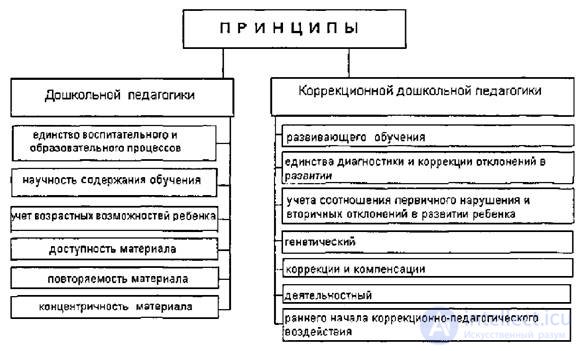
In pedagogical science, principles are the foundation, the starting point; they reflect the requirements for organizing pedagogical activity (including correctional and pedagogical activity), and determine its directions, ultimate goal, and outcome. Principles promote the integration of various means, forms, methods, and techniques into a coherent system, and determine the strategic direction of a holistic approach to solving the tasks of the correctional-pedagogical process. In the psychological and pedagogical literature, there are various approaches to classifying the principles of correctional activity. As a basis for classification, a number of researchers identify the diagnostic or preventive orientation of the correctional process, while others focus on the specifics of the child's mental development and the distinctive nature of interpersonal relations among children with developmental and behavioral disorders.
When organizing and carrying out correctional and pedagogical activity, one must to a large extent rely on general pedagogical
principles. First we will consider the general pedagogical principles, and then we will define the group of correctional-pedagogical principles that form the basis for the pedagogical correction of deviant behavior and development in children and adolescents.
General pedagogical principles
Specific principles of correctional and pedagogical activity
1.The leading principle in the system of purposeful correctional and pedagogical activity is the principle of the unity of correctional, preventive, and developmental tasks, in which the systematicity and interdependence of tasks reflects the interconnection of the development of various aspects of the child's personality and their heterochrony, i.e., the unevenness of development. Every person is at different levels of development in different respects within one and the same age period. Therefore, when defining the goals and objectives of correctional and pedagogical activity, one must proceed from the nearest prognosis of the child's development rather than from the momentary situation of his or her deviant behavior. Timely preventive measures make it possible to avoid unnecessary complications in the child's development and behavior and, consequently, the need to subsequently deploy full-scale special correctional measures. At the same time, any program for correcting a pupil's development should be aimed not so much at correcting deviations in development and behavior, and at preventing them, as at creating favorable conditions for the fullest possible realization of the child's potential for harmonious personal development.
2.The implementation of the principle of the unity of diagnosis and correction ensures
the integrity of the pedagogical process. It is impossible to carry out effective and full-fledged correctional work without knowing the initial data about the subject.
3.The principle of taking into account the child's individual and age-related characteristics is more appropriately viewed, in the correctional-pedagogical process, as the principle of «normativity» of personality development, as a sequence of successive ages.
4.The activity principle of correction determines the tactics of conducting correctional work and the ways of implementing the set goals, emphasizing that the starting point in achieving them is the organization of the child's active activity, the creation of the necessary conditions for his or her orientation in complex conflict situations, and the development of an algorithm of socially acceptable behavior. When planning and organizing correctional and pedagogical activity, one should choose the model of activity most adequate to the goals and objectives of correction, so that its content, forms, and methods of implementation contain manageably complex situations that the child would be able to resolve, and whose resolution would direct him or her toward a positive course of development. The principle of the activity approach is a methodological principle for constructing the correction process.
5.The principle of the comprehensive use of methods and techniques of correctional and pedagogical activity. Neither in psychology nor in pedagogy are there universal techniques of influence that promote the reorientation and change of a personality's direction, or an abrupt change in the behavior of children and adolescents. Therefore, correctional pedagogy requires a certain combination of ways and means, methods and techniques that take into account the individual psychological characteristics of the personality, the state of the social situation, the level of material, technical, and instructional-methodological support for the pedagogical process, and the readiness of teachers to carry it out. At the same time, there must be a certain logic and sequence in the application of pedagogical methods and correctional techniques, a graduated influence on the child's consciousness and his or her emotional-sensory sphere, and involvement in active individual or group activity with peers or adults.
6.The principle of integrating the efforts of the immediate social environment. A child cannot develop outside of a social environment; it is an active
component of it, a constituent part of the system of his or her integral social relations. A child's deviation in development and behavior is the result not only of his or her psychophysiological state, but also of the active influence upon it of parents, close friends and peers, and the school's teaching staff and student body. Difficulties in behavior are a consequence of the child's relations with the immediate environment, the forms and methods of their joint activity and communication, and the nature of interpersonal contacts with society. Consequently, the success of correctional work with children and adolescents, without cooperation with parents or other adults, and without relying on relationships with peers, depending on the nature of the deviations in development and behavior, turns out to be either insufficiently effective or simply fruitless. Thus, the fundamental provisions of the system of correctional and pedagogical activity form its foundation, determine the logic of the correctional process, and outline the general strategy and specific tactics at the corresponding stages of managing the process of pedagogical correction of children's and adolescents' development and behavior.

Comments