
Lecture
The history of the formation and development of correctional pedagogy as an independent branch of scientific knowledge is extremely short. If the history of the emergence of the domestic system of special education
spans just over half a century, then individual branches of special instruction, such as, for example, the instruction of children with delayed mental development, number only 20-25 years (N.N. Malofeev). Consequently, the emergence of correctional pedagogy proper can be dated to the second half of the 20th century. The term «pedagogical correction» became established in Russian pedagogy at the turn of the 19th-20th centuries. At the end of the 1980s and beginning of the 1990s, in connection with the fundamental changes in the country's socio-political life, an acute need arose to rethink the entire situation that had developed in the socio-pedagogical and educational spheres of the state. The field of special education was also subjected to detailed analysis. The concept of «defectology» was at first replaced by the concept of «correctional pedagogy». However, the scientific-theoretical understanding of this specific area of pedagogical knowledge, and the deep historiographical analysis of accumulated experience (N.N. Malofeev, N.M. Nazarova, and others), made it possible to clearly delineate the subject and object of activity of special pedagogy. The term «correctional pedagogy», as an academic subject and an independent field of pedagogical knowledge, began to be used to denote the sphere of pedagogical assistance to ordinary children and adolescents experiencing adaptation difficulties in general-purpose educational institutions. In this case the concept of «correction» refers above all to the social and educational environment of the general-education school, which is uncomfortable for a certain group of children experiencing school disadaptation, having a delay in general development, and behavioral deviations (N.M. Nazarova). As a concept denoting an independent field of pedagogical knowledge, the term «correctional pedagogy» appears in the works of G.F. Kumarina (1988) and is defined as a field of pedagogical knowledge whose subject is the development and implementation, in educational practice, of a system of conditions ensuring the timely diagnosis, prevention and correction, by pedagogical means, of disorders of individuals' socio-psychological adaptation and difficulties in mastering the social roles corresponding to their age-related developmental stage. In the mid-1990s the concept of «correctional pedagogy» was increasingly used in the field of prevention, psycho-correctional and correctional-pedagogical work with deviant adolescents and at-risk children (A.D. Goneev, R.V. Ovcharova, I.A. Nevsky, G.M. Potanin, and others). The tasks of correctional pedagogy in the field of preventing and overcoming developmental and behavioral deviations in adolescents are defined as the timely identification of the main defects and deficiencies in pupils' development, in their knowledge, abilities and skills, behavior, and attitude toward society; the determination of the causes that gave rise to them; the neutralization and elimination of these causes; and the adaptation and rehabilitation of underachieving pupils.
However, as early as the beginning of the century V.P. Kashchenko noted that childhood exceptionality (not only a propensity toward delinquency, but also exceptionality of character, exceptionality of intellect, even physical exceptionality) is, in its essence, social. It is possible to combat it, to heal it, to treat it, to correct it through pedagogical measures, that is, by acting not on the child's organism but on his social essence. This does not mean ignoring medical-biological aspects, just as it does not diminish the importance of improving the social relations of the entire environment in which the personality is formed and develops. In any case, the scholar emphasized, the teacher has to deal with various instances of childhood exceptionality, with complex or with milder deviations from the norm. Work even with this category of children will undoubtedly go more successfully if the educator is able to take into account the rich experience of special medical-pedagogical institutions, if he, to the best of his abilities and possibilities, takes into account the requirements of correctional pedagogy. In substantiating the essence and tasks of correctional pedagogy, V.P. Kashchenko noted that it arose as an independent branch of general pedagogy because it turned out to be entirely unavoidable to single out a certain, quite definite category of children from the ordinary public school. Correctional pedagogy builds its work on the careful consideration of different types of exceptionality, strives in its demands on the child to proceed from his individual interests, to take into account his individual strengths, and relies in the instructional-upbringing process on the principle of pedocentrism. Even at that time, «Correctional pedagogy» was conceived by the scholar as a guide, as a textbook for a broad circle of teachers, educators, specialist defectologists, and parents of children with character deficiencies and behavioral defects.
Conclusions
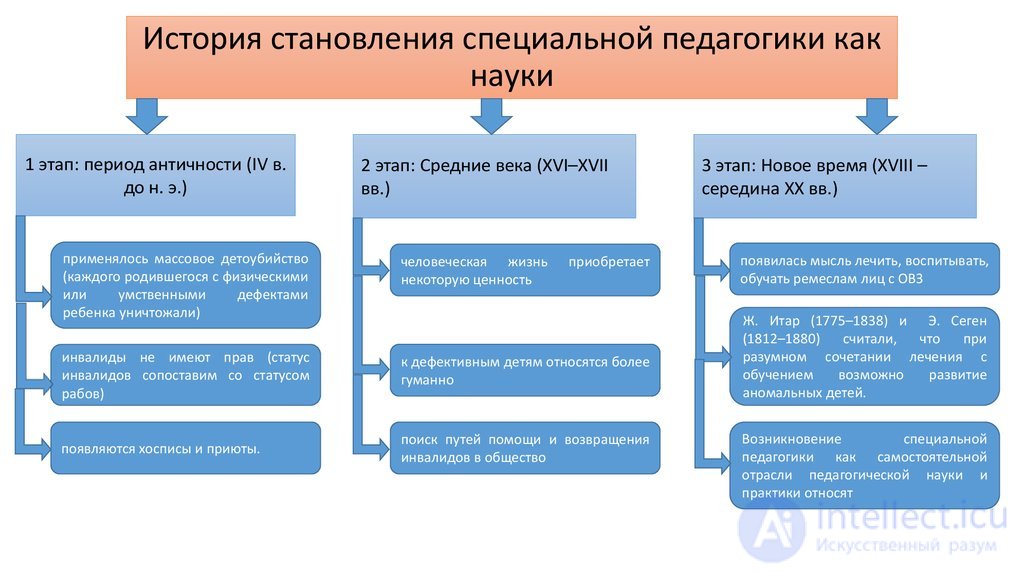
Correctional pedagogy as a science has developed and taken shape over a long period, reflecting society's need to provide education and support to children with various types of disorders. Here are the stages in the formation and development of correctional pedagogy as a science:
Prerequisites: At the beginning of the 19th century the first ideas about the need for special pedagogical support for children with intellectual and physical disorders began to take shape. However, the methods of the time were poorly developed and systematized.
Founding of special schools: In the second half of the 19th century, a number of countries began establishing special educational institutions for children with special educational needs. This gave impetus to a deeper study of methods for teaching such children.
Psychological research: At the beginning of the 20th century, the development of psychology, especially child psychology, provided new knowledge about the psychological characteristics of children with disorders. This contributed to the development of more targeted teaching methods.
Creation of a theoretical foundation: In the 1920s-1930s, active development of the theoretical foundations of correctional pedagogy began. The founders of many pedagogical schools and movements in this field were well-known scholars and educators, such as Maria Montessori, Janusz Korczak, Leonhard Schlegelmilch, and others.
Industrialization and wars: In the mid-20th century, the growth in children's health disorders caused by industrialization, wars and other social factors intensified the need to develop specialized methods and approaches in education.
Educational reforms and inclusion: In recent decades correctional pedagogy has been actively developing in the direction of inclusive education, calling for the inclusion of children with special educational needs in general-education classes.
Research and development of methods: With the emergence of modern technologies and new psychological research, correctional pedagogy continues to develop, adapting methods to children's individual needs and introducing innovations into instruction.
Today correctional pedagogy is a complex and multifaceted science, combining knowledge from pedagogy, psychology, medicine, sociology and other fields. It is developing actively, striving to ensure equal opportunities for all children in education and to provide them with support and development in accordance with their needs.

Comments