
Lecture
The modern periodization of the history and philosophy of science (S.S. Averintsev, V.V. Ilyin, F.V. Lazarev, S.A. Lebedev, N.N. Moiseev and others),
which distinguishes the following periods: the pre-scientific (mythological) period, the period of ancient science, the period of medieval science, the period of classical
science of the modern era (17th–18th centuries), the period of non-classical science
(19th century – the first half of the 20th century) and, finally, from the second half of the past century – the beginning of the stage of development of post-non-classical science, or the science
of postmodernism. S.S. Averintsev proposed a periodization of the history of European culture of thought, which distinguishes the stages most significant for
the formation of scientific approaches. According to this periodization, the earliest period, confirmed in surviving ethnographic
records, was the epoch of mythological thinking, characteristic of ritual society.
The first intellectual revolution, which took place in the 6th–4th centuries BC, brought to life the second period, which laid the foundation for the application of
logical and mathematical reasoning in the cognition of the surrounding
world – the epoch of metaphysics and natural philosophy, the epoch of the first rationalism, when thinking was based on a priori principles, dogmas, and on
Aristotelian logic. This epoch already belonged to traditional society. Its result was the constructivization of myths, above all myths
about the origin and structure of the world, their interpretation on the basis of logical
and mathematical reasoning.
The second intellectual revolution took place in the modern era (17th–18th centuries) owing to the emergence of experimental natural science and
comparative morphology, and gave rise to the third period in the development of European culture of thought, namely the epoch of the second rationalism, or
the epoch of the development of the particular sciences. Here thinking was based on models
of construction, on empirical verification and on the technical application of particular
scientific theories, thereby ensuring the constructivization of the experience of natural observations. This stage in the development of European culture of thought
corresponded to the formation of a society of techno-economic growth.
The technological and information revolutions that occurred in the 20th century prepared the transition to the fourth period, to the next epoch in world self-awareness – the epoch of the theorization and axiologization of the socio-natural sphere.
An analysis of the history of special pedagogy from the analytical standpoint
of this periodization shows that scientific knowledge in the field under study
arose on the wave of the second intellectual revolution owing to the establishment of the rationalist method of cognition, the emergence of experimental natural science, and the experimental direction in the particular
sciences, and continued its development on the basis of the particular sciences, among which
the most important for it were biology, medicine, linguistics
(and above all the phonetics of the national European languages), Christian pedagogy, and subsequently – psychology, sociology, social
psychology, human biology, natural science, and pedagogy proper.
The phenomena of special pedagogy must be examined in a socio-cultural context in order to understand the features of the current state of special pedagogy. Special education represents
a special social institution, and its development is conditioned by civilizational changes. In particular, the position of a person with special features of psychophysical development in the world of social relations is
to a large extent determined by the nature and level of special education.
Qualitative transformations and transitions from one stage in the formation
of the state system of special education to another, as well as transformations within each of the stages, are determined by socio-cultural
factors.
It is impossible to understand and explain the history of the education of children with mental and physical deficiencies, and to soundly forecast the development of the domestic system of special education, if historical facts are considered outside the context of the development of civilization.
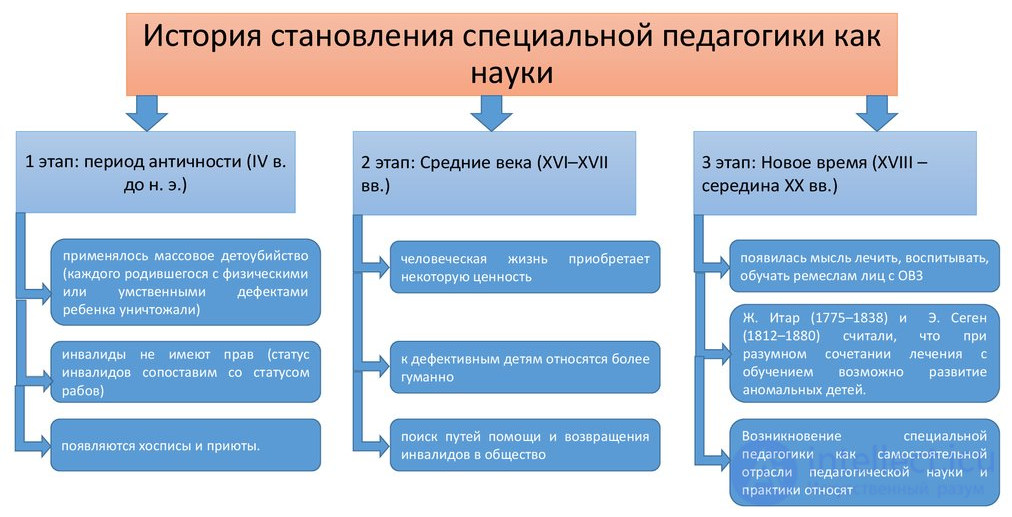
It is expedient to begin the analysis of the first period of evolution with the legendary laws of Lycurgus, which reflected the ancient world's aggressive rejection of the disabled child. A person with a congenital mental or physical deficiency faced either physical or civil death.
The law discriminated even against those of them who belonged to the privileged estate.
In Eastern cultures, manifestations of social care for people with disabilities were already observed as early as the 3rd–5th centuries AD. Thus, in India
of this period there existed special homes where the crippled and
the maimed, orphans, and the chronically ill were kept. The blind could not only receive
caritative (charitable) assistance, but could also be socially in demand as storytellers, musicians, and singers. From the history of tiflopedagogy
it is known that in the 9th century in Japan the blind held a monopoly, granted to them by the emperor, on the professions of musicians and masseurs. In order to obtain the right
to work as a masseur, the blind in Japan and China underwent a long
training period lasting about nine years. Sighted people did not have access to this
system of training and employment.
New ideals, a new view of the human being, were brought by the Christian
faith. Mercy was proclaimed not only a virtue but also
a duty of the Christian. However, the new ideals were assimilated with difficulty and slowly by yesterday's pagans. Medieval legislation followed the ancient understanding of the rights of people with special features of psychophysical development.
The first to be able to cross the invisible line and set an example of a merciful attitude toward people rejected by the majority were
church ascetics. Hospices and shelters appeared at monasteries,
where people with developmental deviations could receive shelter and food. Over
the following five centuries the West European countries traveled
the path from the opening of monastic institutions to the creation of the first secular shelters and
hospitals and, finally, a special secular refuge (France, 12th century).
A structure of charitable care and medical assistance gradually took shape, with institutions characteristic of it (hospices, hospitals, shelters, refuges,
leprosaria). Some of them were cared for by the church, others by the sovereign or municipal authorities.
Owing to the church's desire to bring as many people as possible
to God, deaf people, above all children, received the opportunity for instruction, motivated by church aspirations: in the 5th–6th centuries the baptism of newborns became universally accepted. This procedure was also undergone by
deaf children, who at that moment were not yet identified as deaf.
Later, as they grew up and their deafness was established, a dilemma arose between the baptized child's belonging to the church and his inability to perform religious rites (confession, communion, prayer, confirmation, etc.) and to master Christian teaching
because of muteness and deafness. This circumstance served as a kind of trigger mechanism for methodological searches and numerous experiments in
the individual instruction of deaf children by clergy.
The Catholic Inquisition not only excluded from participation in public life all, without exception, people who had physical and especially mental disorders, regardless of their social affiliation, but also subjected some of them to physical destruction: people
with mental illnesses («witches», «sorcerers»), with intellectual disability, and deaf people were often sent by inquisitorial courts to the stake or
subjected to cruel torture. The religiously determined views
of those in power predetermined the difficult social position
of children with physical and mental deficiencies. However, their social status still depended to a certain extent on the nature of the defect
(physical or mental). Thus, the blind traditionally found themselves in
a more favorable position, evoking in the population a feeling of pity and
Christian compassion. This helped them collect alms, which
the church regarded very favorably. At the same time, the deaf, who did not possess the «gift of God» – verbal speech – and who were inaccessible for communication with
those around them, evoked suspicion, fear, and a desire to avoid them.
In the countries of the Muslim world, as early as the beginning of the 8th century, there began to be created
shelters for people suffering from leprosy. In the 8th–10th centuries (the Abbasid dynasty) shelters appeared for the mentally ill, the blind and the elderly.
It should be noted that the medieval Arab East, relying on
numerous translations from Greek into Arabic of scientific, including
medical, works of ancient authors, made significant advances in the practice of healing and in the knowledge of the anatomy and physiology of the human organism. Ophthalmology in the Middle
East had already reached the highest level as early as the 11th century, and skillful operations were performed to remove
cataracts. A scientific approach to explaining the causes of congenital disorders of hearing, vision and the intellectual sphere in the countries of Western Europe was
largely linked to the emergence and development of university science
and education. In the 12th century the University of Paris (the Sorbonne, France),
the University of Bologna (Italy), and Oxford and Cambridge (England) were established. In the 13th century a university opened in Spain, and in the 14th century – in Krakow (Poland) and Prague (Bohemia). The leading role in these institutions was given to
the faculties of philosophy, natural science and medicine, whose activity
contributed to the development of materialist views on the nature of physical and mental deficiencies and disorders in the human organism.
The pagan Slavs did not display aggression or pronounced hostility toward persons with developmental deviations; moreover, they treated them with tolerance and compassion. The Kievan princes readily adopted
the experience of Byzantium and placed the function of charitable care on the church, transferring to it
at the same time part of their income for the needs of charity. Unlike Europe, where monastic shelters appeared in the 4th–7th centuries, this
form of charitable care arose in Rus in the 10th–11th centuries and should be assessed as
borrowed (introduced from outside).
Feudalism in Rus had its roots in primitive-communal
relations, bypassing the slave-owning formation. Linguistic and religious insularity conditioned the creation of its own, distinctive world of culture and education, significantly
different from the West European one. In
Rus, large educational centers similar to the medieval universities never did appear at the same time as in Europe. Intellectual and spiritual work was directed toward the search for a perfect life, the «Kingdom of God», and was carried out, above all, in small monasteries. A distinctive feature of ancient Russian legislation lay in the combination and interaction of ecclesiastical and civil law, in which the influence was felt of
Byzantine laws on the customs and way of life of the Slavs. Gradually
care for children with physical and mental deficiencies became concentrated in the hands of the church. Such an early emergence in Kievan Rus, and later
in the Muscovite state, of almshouses and shelters contributed to
the formation of a more humane attitude of society toward disabled children than in the West. As A.I. Dyachkov justly remarked, such children
«were not isolated from the world; their deficiencies – physical and mental – were not regarded as a manifestation of an «evil spirit», which was characteristic in
the Middle Ages of countries where Roman Catholic church authority prevailed».
The science of the early Middle Ages was distinguished by the fact that it did not yet know how to pose questions and solve new problems. It collected facts, accumulated
experience, and made its first clumsy attempts to generalize it. Its distinctive
feature became compilation and «going around in circles». It is therefore not surprising that the connection between deafness and muteness, although fixed in the vocabulary, was not discovered,
the true causes of «mental illnesses» and intellectual disability were not found, and no scientific proof appeared
of the possibility of teaching children with developmental disorders and deviations.

Comments