
Lecture
The correctional-pedagogical process in special education
constitutes an integral system comprising a number of interrelated and interdependent components. Their content, on the one hand, is determined by the general goals and objectives of the harmonious development of each child's personality and of the class as a whole, and, on the other hand,
each structural link addresses its own specific goals and objectives.
In accordance with the modern concept of correctional-developmental instruction, the structure of the correctional-pedagogical process
includes the following components: diagnostic-consultative,
physical-health-improving, upbringing-and-instructional, correctional-developmental, and socio-pedagogical.
Diagnostic work occupies a special place in the correctional-pedagogical process, serving as an indicator of the effectiveness of health-improving, correctional-developmental, and instructional
measures.
The correctional-pedagogical process in special education
constitutes an integral system comprising a number of interrelated and interdependent components. Their content, on the one hand, is determined by the general goals and objectives of the harmonious development of each child's personality and of the class as a whole, and, on the other hand,
each structural link addresses its own specific goals and objectives.
In accordance with the modern concept of correctional-developmental instruction, the structure of the correctional-pedagogical process
includes the following components: diagnostic-consultative,
physical-health-improving, upbringing-and-instructional, correctional-developmental, and socio-pedagogical.
The essence of the process of correctional instruction
Instruction is a two-way process, presupposing, on the one
hand, the activity of the teacher (teaching) in organizing and
activating students' cognitive activity; and on the other hand, the activity of the students (learning) in perceiving educational information, its
processing, comprehension (assimilation of knowledge), and the formation of abilities
and skills.
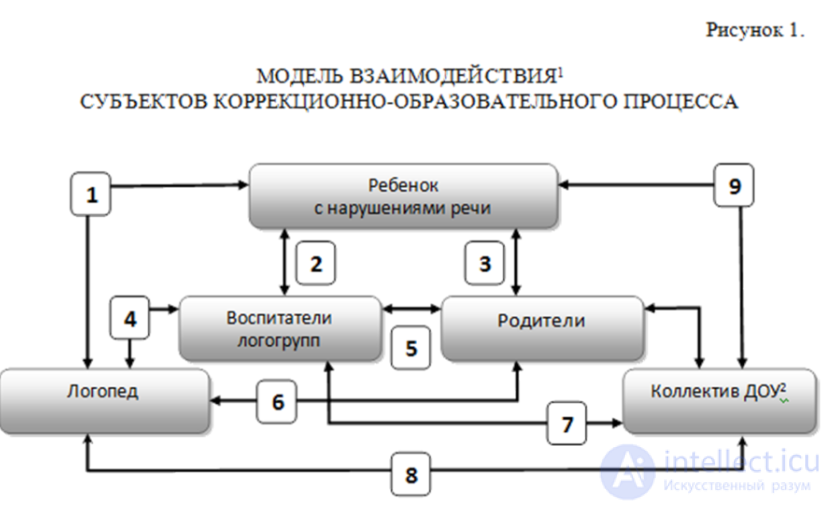
Thus, the substantive basis of instruction is formed by the interaction between the teacher as the subject and the student as the object of the integral pedagogical process.
Features of the instructional process in a special educational institution: purposefulness; two-sidedness; contradictoriness; systematicity; complexity; correctional orientation, etc.
Taking these features of the instructional process into account ensures its dynamism and effectiveness.
The main tasks of instruction in a special educational institution:
- organizing students' cognitive activity for acquiring knowledge, forming practical abilities and skills, and broadening their outlook;
- developing the aptitudes, abilities, and cognitive activity
of pupils or students;
- stimulating cognitive activity and independence;
- forming cognitive activity in students;
- forming the foundations of a scientific worldview.
- the all-round development of a self-valuing, self-sufficient personality,
and forming the prerequisites for adaptation in society.
The driving forces of the instructional process are the contradictions between the cognitive and practical tasks put forward by the course of the educational process and the students' existing level of knowledge, abilities, and skills
and their cognitive capacities.
Contradictions may be external or internal. An example of an external contradiction: the contradiction between the tasks of instruction and the actually existing conditions for their fulfillment. An example of an internal contradiction:
the contradiction between a person's striving for knowledge and the means of its
attainment. In the special educational process, these contradictions
are intensified by the children's deficits in mental development.
Any contradiction is resolved by drawing the student into activity, into an active search for the solution of a cognitive task.
The structure of the instructional process.
The instructional process is a complex dynamic system made up of numerous structural elements.
The structure of the instructional process comprises: the aim of instruction; the tasks of instruction; the content of the educational material; the methods of instruction; the means of instruction; the organizational forms of instruction; and the result of instruction.
In another interpretation, the structure of the instructional process includes the
goal-related, need-motivational, content-related, activity-operational, emotional-volitional, control-regulatory, and evaluative-result components.
Functions of instruction.
A function is the external manifestation of the properties of certain objects
within a particular system. Four main functions of the process of correctional instruction can be distinguished: developmental, educational, upbringing, and correctional.
The developmental function presupposes the development of the personality in the process of
instruction. Knowledge, abilities, and skills, like instruction as a whole, are means of personality development. L.S. Vygotsky put forward the theory
of two zones (levels) of personality development. The «zone of actual development»
denotes the existing, already attained level of thinking, memory, imagination, and so on, while the «zone of proximal development» denotes the potential level of development that exists in every student and that can
be reached under the guidance of a teacher. Under certain conditions the «zone
of proximal development» becomes the «zone of actual development,» and a new task then confronts
the teacher: to bring the student closer to the next «zone
of proximal development» and so on.
The educational function of instruction consists in forming basic scientific knowledge that constitutes the foundation of the information base,
as well as practical abilities and skills.
The upbringing function of instruction is aimed at achieving the goal
of the all-round, harmonious (many-sided, multifaceted) development of students, the basis of which is the basic culture of the personality,
representing a certain integral whole that includes a wide range of personal properties and qualities. A distinction is made among moral,
aesthetic, and physical culture, the culture of mental work, the culture of family relations, and so on.
The correctional orientation of the instructional process presupposes pedagogical influence by means of special methods and techniques
that stimulate compensatory processes in children for the development of their cognitive capacities.

Comments