
Lecture
Correctional (special) pedagogy is a field that interacts closely with various other branches of knowledge and disciplines in order to ensure effective instruction and support for children with special educational needs. Below are some of the branches of knowledge with which correctional pedagogy is interconnected:
Correctional pedagogy, as one of the branches of pedagogical science, is closely interconnected with the entire body of psychological-pedagogical and special disciplines. Correction, being an integral part of the unified pedagogical process and relying on it, is most closely connected with general pedagogy, which determines the goals, content, forms and methods of instruction and upbringing of the younger generation, and the all-round development of the child's personality. At the same time, correctional pedagogy introduces substantial adjustments to the methodology and technology of applying pedagogical knowledge, to the content of instruction and upbringing of children and adolescents in accordance with the nature and character of their developmental and behavioral disorders, and develops its own techniques and methods of correctional influence on the child and the social environment surrounding him.
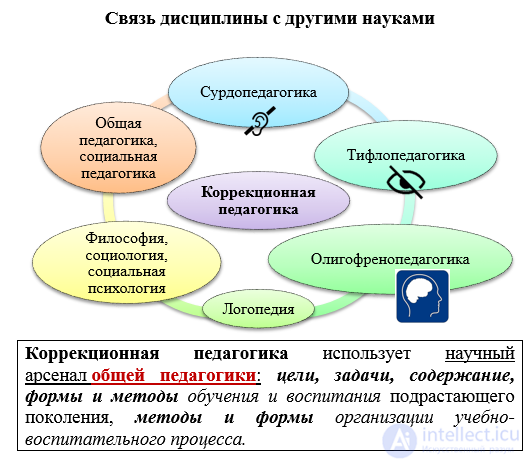
Building correctional-pedagogical work with children and adolescents, and organizing differentiated instruction and individual upbringing, cannot be accomplished without knowing the nature of the child's developmental deficiency and without clarifying and studying the causes of his behavioral disorders.
In a word, without a foundation in general psychology of the human being it is difficult to organize effective correctional work, especially since research findings on the patterns of a child's mental development show that they are identical for both normal and pathological development. Psychology plays an important role in correctional pedagogy, since it helps to understand the psychological characteristics and needs of children with various kinds of disorders. Psychological research helps develop individual approaches to instruction and development. Children with developmental deficiencies are characterized by mental features that are not always found in normal children:
a lag in general mental development, slowness, weakness and sluggishness of nervous processes, underdevelopment of sensory analyzers, incomplete (fragmentary) perception of the surrounding world, and so on. This dialectical unity of the general and the particular, the ordinary and the unusual, in the mental state of children and adolescents leads us to note the interconnection between correctional pedagogy and philosophy. Painstaking correctional work and everyday pedagogical influence on a deficiency in mental and physical development bring about the manifestation of the philosophical law of the transition of quantity into quality, reducing the disorder or compensating for the physical deficiency through the activation of healthy organs or organs with only minor underdevelopment.
Pedagogy and teaching methodology: An understanding of general pedagogical principles and teaching methods is also important for correctional pedagogy. Adapting pedagogical approaches to the individual needs of children requires knowledge of various teaching methods.
Correctional pedagogy shows a close interconnection with social pedagogy, whose subject is the study of the educative forces of society and the ways of actualizing them, and the ways of integrating the capacities of public, state and private organizations for the purpose of creating conditions for the development of a person's positive self-realization. Sociology helps in studying the patterns of the formation, functioning and development of society as a whole, of social relations and social communities. Sociological knowledge can help in understanding the influence of the social environment on the development of children with special educational needs. This is important for creating an inclusive educational environment and ensuring social adaptation.
Social work: Social work specialists can help provide support to children and their families facing special educational needs. They can provide assistance with social adaptation and interaction with various institutions.
Thus we see a fairly wide-ranging interconnection between correctional pedagogy and the philosophical and socio-pedagogical sciences.
Moreover, correctional-pedagogical work will be effective only when it relies on knowledge in the field of medical sciences. From a medical standpoint, a foundation for correctional pedagogy can be provided by pediatrics, which studies the child's health and developmental processes, physiology, pathology, and methods for preventing and treating diseases that threaten his harmonious development or pose a danger to the life of the child's organism.
Psychiatry, which studies the etiology, pathogenesis, pathomorphology, diagnosis, therapy and prevention of mental illnesses, helps correctional pedagogy find the right direction and choose the correct solution when working with children and adolescents who have disorders of mental development. Correcting and rehabilitating impaired mental functions is impossible without systematic mental interventions on the person, i.e., without psychotherapy, which acts as a complex of mental interventions on the patient aimed at strengthening his forces in the struggle against the illness and at creating a protective-restorative regimen that excludes mental trauma. The task of correctional pedagogy is to give a general picture, outline the general contours, and present the leading directions and tendencies inherent in this field of scientific knowledge.
Medicine: Medical knowledge is necessary for understanding the physiological and medical aspects of disorders that can affect children's learning and development. Medical diagnoses and recommendations help adapt educational programs and approaches.
Special medical care: In the case of children with physical or medical disorders, specialists in medical rehabilitation and physiotherapy can work with correctional educators to develop comprehensive instruction and rehabilitation programs.
Speech therapy and occupational therapy: Specialists in speech therapy and occupational therapy can work with correctional educators to develop children's communicative and practical skills.
Information technology: Modern technologies, such as computer programs and educational applications, can be effective tools for teaching children with special educational needs.
These are just a few examples of the interconnections between correctional pedagogy and other branches of knowledge. Interaction among these fields makes it possible to create more comprehensive and effective approaches to the instruction and development of children with special educational needs.

Comments