
Lecture
Deviant behaviour in adolescents and their difficulty to raise and educate can be caused by a variety of factors, including psychological ones. Below are some of these causes and factors:
Causes of deviant behaviour:
Social environment: The surrounding environment, including family, friends, school and neighbourhood, can influence the formation of an adolescent's behaviour. Negative influences emanating from the environment can contribute to the development of deviant behaviour.
Family factors: Negative family relationships, lack of support, dysfunctional family dynamics, violence or abuse within the family can lead to the development of problem behaviour.
Psychological problems: Emotional and psychological problems, such as depression, anxiety, low self-esteem and insecurity, can influence an adolescent's behaviour and become a factor in deviant behaviour.
Negative behavioural models: Adolescents may imitate the deviant behaviour of others, especially if they see such models among peers or adults with whom they associate.
Sociocultural factors: Cultural, social and economic conditions can also influence the formation of deviant behaviour in adolescents, especially if the environment instils in them a sense of alienation and inferiority.
Psychological factors of difficulty in upbringing:
Heightened indignation: Some adolescents may experience an elevated level of indignation, aggression and oppositionality, which makes them more difficult to raise.
Problems with self-regulation: An inability to control one's emotions and actions can lead to problems in behaviour and interaction.
Low motivation: Insufficient desire and interest in learning, socialisation and meeting social expectations can lead to behaviour that is considered difficult to manage.
Resistance to adults: Adolescents may show resistance and opposition toward adults, especially if they feel that attempts are being made to control them.
Communication problems: Insufficient communication skills can make it difficult to establish positive relationships with adults and peers.
Thus, both normal and deviant behaviour of an individual is a consequence of learning social behaviour, a product of the interaction of social, cultural and psychological characteristics.
The main causes of adolescents' difficulties lie in improper family relationships, shortcomings of the school, isolation from peers, social maladjustment in general, and the striving to assert oneself by any means and in any small group. Often it is a combination, a whole complex, of all these causes that is at work. Disorders of behaviour and of the emotional-volitional sphere in children, adolescents and young people are not inherited. Exceptions are linked to a number of illnesses caused by intellectual disability.
Mental development is characterised by age-related crises. When they occur, the child begins to resist the educational influences of adults, to come into conflict with them, and to behave rudely and disobediently. L.S. Vygotsky spoke of the crises of the newborn, and of 1, 3, 7, 13 and 17 years of age.
Many psychologists consider adolescence to be critical throughout its entire course. Mental disorders have certain stages of development, passing through which they reach their greatest degree of expression. During the adolescent crisis the speed of this painful cycle increases, with the result that one of the stages may be either very short or fail to appear at all. That is why the pathological cruelty of an adolescent is very often completely unexpected and inexplicable to his relatives, acquaintances, peers and observers.
The acceleration of biological and psychological processes during the crisis period causes behavioural deviations to arise suddenly. The period of growing up is not in itself an illness, but it can provoke the emergence of profound psychological problems. The adolescent crisis is understood as a state in which «distortions of the adolescent's relationship with reality» can arise.
It is important to understand that deviant behaviour and difficulty in raising adolescents can result from the interaction of numerous factors, including biological, psychological, social and environmental conditions. Working with specialists such as psychologists, teachers and social workers can help to identify the causes and develop appropriate support and intervention strategies.
The prevention of deviant behaviour is aimed at preventing the emergence of undesirable behavioural patterns in people, especially in children and adolescents. Proactive measures help to create a supportive environment, develop adaptive skills and forestall potential factors that contribute to deviant behaviour.
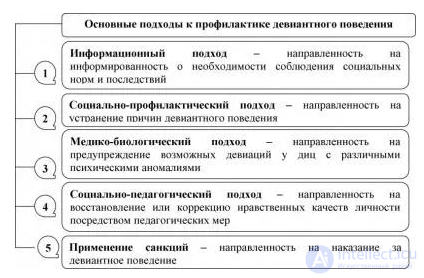
Here are some methods of prevention:
Family upbringing: Support and care from the family play an important role. Parents can foster positive relationships and teach effective methods of conflict resolution and communication.
Development of social skills: Teaching skills in emotional intelligence, communication, conflict resolution and cooperation helps children and adolescents adapt better to society.
School programmes: Schools can implement programmes for social adaptation and the development of moral values, as well as warn against breaking the law.
Social and mentoring programmes: Organisations and groups can create programmes that provide support, role models and activities for skill development.
Support in education: Special programmes and classes can help children with learning difficulties, which reduces the risk of alienation and deviant behaviour.
Psychological support: Educators, teachers and parents can turn to psychologists for help in the early identification and support of children with potential problems.
Providing alternatives: Sport, art, music and other activities can give children and adolescents constructive ways to express themselves and divert them from deviant behaviour.
Informing about risks: Educating children and adolescents about the negative consequences of deviant behaviour, including its legal, health-related and social aspects, can raise their awareness.
Creating a supportive environment: It is important to create surroundings in which children and adolescents feel support, respect and mutual understanding.
Strengthening personal identity: Helping children and adolescents understand their interests, values and goals fosters the development of positive self-esteem.
The prevention of deviant behaviour requires the joint efforts of society, the family, and educational and social institutions. It is aimed at creating the conditions for the healthy development of the personality and social adaptation.

Comments