
Lecture
Psychological-pedagogical correction – is one of the main areas of a specialist's activity in the process of organizing psychological-pedagogical assistance to persons with disabilities (OVZ), aimed at the full or partial correction or compensation of existing disorders and the socio-psychological adaptation of the personality. Depending on which specialist carries out the correctional work, a distinction is made between defectological correction, speech-therapy (logopedic) correction, psychological correction, and socio-pedagogical correction.
The following types of correctional work are distinguished:
1) by the nature of their focus:
2) by the nature of the correctional influences:
3) by the scale of the tasks to be solved: general (measures of a general-correctional nature that normalize the individual's microenvironment);
4) depending on the type of dysontogenesis:
5) depending on the form of organization of psychological-pedagogical correction:
6) depending on the sphere of the psyche toward which the intervention is directed:
1. The principle of systematicity of correctional, preventive and developmental tasks.
2. The principle of the unity of correction and diagnosis.
3. The principle of the priority of causal-type correction.
4. The activity-based principle of correction.
5. The principle of accounting for the client's age-psychological and individual characteristics.
6. The principle of complexity of the methods of psychological-pedagogical correction.
7. The principle of actively involving the immediate social environment in the correctional program.
8. The principle of relying on different levels of organization of mental processes.
9. The principle of programmed instruction.
10. The principle of increasing complexity.
11. The principle of accounting for the volume and degree of diversity of the material.
12. The principle of accounting for the emotional complexity of the material.
The expansion of the sphere of psychological-pedagogical correction is due to the new goals and objectives of education, associated with the strengthening of innovative pedagogical processes and the striving for the maximal development of children's intellectual and creative potential.
D.B. Elkonin said: «the process of development is, in a certain sense, an irreversible process; here reclamations are impossible – a young person cannot be sent back to school for finishing off or further development. That is why it is so important to notice the initial forms of deviation from the course of a child's normal development. Monitoring the dynamics of the mental development of children being taught and raised in educational institutions makes it possible to resort to developmental correction in good time, in order to create optimal opportunities and conditions for bringing weak and average pupils up to the level of the strong, most developed ones, and also for the further development of pupils displaying special abilities».
There are various interpretations of the concept of psychological correction, but most scholars incline toward the following one: «Psychological correction — is a psychological influence on the structure of mental activity aimed at correcting or weakening defects in development». From this definition of psychological correction that we have given, it can be understood that the main task of correctional-pedagogical activity is to overcome and correct a specific deficiency inherent in the child, as well as the child's successful adaptation in society. [3,p.144]
In contemporary society, the basic principles of psychocorrectional work are built on positions studied in Russian psychology, according to which personality is a complete psychological structure formed over the course of a person's life, on the basis of their assimilation of social forms of consciousness and behaviour (B.G. Ananyev, L.I. Bozhovich, L.S. Vygotsky, P.Ya. Galperin, V.V. Davydov, A.V. Zaporozhets, A.N. Leontiev, S.L. Rubinstein, D.B. Elkonin, and others).
There are 6 of these principles; let us get better acquainted with them:
The first principle - the unity of correction and development. This means that the decision on the need for correctional work is made only on the basis of a psychological and pedagogical analysis of the internal and external conditions of the child's development.
The second principle – age-related unity in development. This means an individual approach to the child in the context of their age-related development.
The third principle - the unity of diagnosis and correction of development. The problems of correctional work can be understood and situated only on the basis of a complete diagnostic assessment of the subsequent probabilistic forecast of development, which represents a particular origin of the child's zone of next development. Correction and development are interrelated.
The fourth principle - the principle of an activity-based approach to implementing correction. This principle determines the choice of means, paths and methods for achieving the goal. This principle recognizes that a child's vigorous activity is the driving force of development, and it treats the performance of psychological and pedagogical correctional work as proceeding through the organization of the corresponding types of the child's activity in collaboration with an adult.
The fifth principle - an approach in correctional work to each child with regard to their giftedness. This principle means that children with whom psychocorrectional work is carried out must not be perceived as "second-class" children. They do not require condescension, are not to be pitied, and are not to be reduced to the general level of instruction and of the correction of development toward the optimal norm.
The sixth principle - correction "from the top down" (L.S. Vygotsky). At the centre of the teacher-psychologist's attention is the child's "development of tomorrow," and the main content of correctional activity is the creation of a "zone of the pupils' next development"; if the goal of correction "from below" is the realization and fixation of what the child has already achieved, then correction under the principle of "from the top down" has an advancing character and is grounded as psychological and pedagogical activity aimed at the timely formation of new psychological growth. [1,p.324]
The following areas of work exist within the psychocorrectional process:
Scholars regard these areas as consisting of the following tactical steps:
When examining the psychocorrectional process, one should also not forget the methods of this activity, which play a very important role. They are divided into groups:
Experimental methods.
Conversation and other survey methods. A single method alone is never applied to studying a child. Survey methods, which give a chance to establish how the child understands this or that situation, what they think about it, how they regard particular events, the people around them, and so on, are often used. Among these is conversation. It can be carried out in either individual or group form.
Studying the products of activity. Analysis of children's activity products provides valuable information about the child's inner world, their attitude toward the surrounding environment, and the particularities of their perception and other aspects of their mentality. Children's drawings, in which significant informative processes, the child's creative abilities, and their personality as a whole are studied, are used especially productively. [4,p.123]
Depending on the nature of the diagnosis and the orientation of the correction, the following forms of it are distinguished:
such as symptomatic and causal (D.B. Elkonin).
Also, in correctional activity, criteria for the effectiveness of the measures carried out are distinguished:
Thus, on the basis of the material analysed, it can be concluded that psychological correction is the elimination of some defect in a child, that child's rehabilitation, and their successful adaptation in society. Psychocorrectional work is also applied in situations involving the overcoming of various kinds of difficulties, which ultimately ensures the full functioning of the individual.
It would seem that one can agree with I.V. Romanov's point of view on the «wresting of a natural object out of the context of natural interconnections». However, it has been experimentally demonstrated that «including a natural object in the context of already-existing personal relations» does not lead to a loss of its uniqueness but, on the contrary, to its actualization in the process of the subjectification of the natural object and its inclusion within the sphere of action of ethical norms (see fig. 39). As for the «absence of direct sensory experience in the process of play-based identification», the correction of the development of a subjective attitude toward a natural object can also be achieved in a situation of ideal «play» interaction with it (see below).
Moreover, «harsh methods» of correcting attitudes toward nature «in a frightening night forest» can, of course, be used only in relation to a limited number of specially selected schoolchildren. «Gentle methods» of ecological-psychological training are, in this respect, universal in character. It would seem that the methods of personal development — ecological-psychological training and I.V. Romanov's «onto-ecological approach» — are not mutually exclusive but complement one another.
Statistical results of the testing of ecological-psychological training are presented in the work of I. Koktysh (1995). In particular, the effect of the training on the subjective attitude toward nature of schoolchildren aged 10—15 is shown. The study was conducted in three stages. At the first — a diagnosis of various parameters of attitude toward nature was carried out among 95 schoolchildren using the «Naturafil», «EZOP», «Dominant» and «Alternative» methods.
At the second — ecological-psychological training was conducted in one group of pupils (42 people) (separately in the 5th, 7th and 9th grades), while in the second [group] — «ordinary extracurricular activities of a biological nature».
At the third stage, a repeat diagnosis of the parameters of the subjective attitude toward nature was carried out in both the experimental and the control groups.
The analysis of the study's results showed that ecological-psychological training exerts a greater correctional influence on the development of a subjective attitude toward nature than do traditional pedagogical forms. The greatest positive changes occur at the level of the practical component of the intensity of the attitude toward nature; in addition, an increase is noted in the proportion of ecological attitudes of the ethical
(nature-protective) type, and a decrease in the pragmatic one. The perceptual-affective and cognitive components of the intensity of the attitude are corrected to the least degree.
It is also noted that the set of ecological-psychodiagnostic methods used performs not only an ascertaining function but also itself exerts a transformative influence on schoolchildren's subjective attitude toward nature.
The psychological-pedagogical effectiveness of the training in a group of preschoolers (5—7 years old) was studied by V. Goromyko (1995), who used the exercises «Excursion», «Musical Pictures», «Zoological Ballet», «Warning Signs» and «Contacts with Animals»*. The exercises were conducted over the course of a week, one per day.
Diagnosis of the influence of ecological-psychological training on preschoolers' ecological consciousness was carried out by analysing drawings on the theme «Me and Nature», the interpretation of which was conducted by analogy with the well-known «Kinetic Family Drawing» method. The drawings were made by the children both before the classes began and after the training ended.
In 18 of 22 preschoolers, after the training, an increase was noted in indicators for the symptom complex «striving for interaction with natural objects».
The manifestation of the symptom complex «psychological separation from the world of nature» was, upon initial testing, noted to some degree or another in 17 preschoolers. Analysis of the drawings made by the children after the training showed that in 12 of them psychological closeness with the world of nature had increased.
In 11 cases, upon initial testing, the presence of the symptom complex «hostility toward natural objects» was noted. After the training, indicators for this symptom complex decreased in 5 preschoolers, and in 4 of them — to a zero level.
It can also be noted that after the training the number of natural objects depicted by children in their drawings increased: from an average of 5.5 per drawing to 7. This fact may indicate an increase in preschoolers' interest in natural objects. It is also characteristic that in the drawings made
" In conducting the «Contacts with Animals» exercise, animals from the nature corner were used: a guinea pig, a tame rat, a hamster.
after the training, such elements as birdhouses and feeders appear (4 drawings), and a living corner is also depicted, i.e. nature «is introduced» into the living environment (3 drawings). Thus, the drawings reflect a strengthening in the significance of the practical and action-related components of the intensity of preschoolers' attitude toward the world of nature.
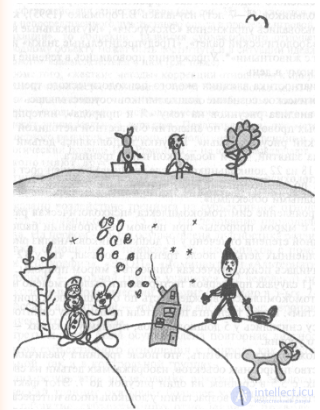
Fig. 57a. Characteristic drawings by preschoolers on the theme «Me and Nature» before the ecological-psychological training.
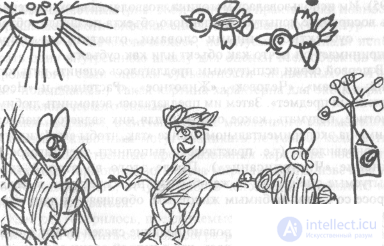
Fig. 57b. Characteristic drawings by preschoolers on the theme «Me and Nature» after the ecological-psychological training.
The results of the testing of the ecological-psychological training on a group of schoolchildren allow it to be regarded as «an active form of drawing the individual into situations that actualize the corresponding psychological processes, ensuring the formation of a subject-ethical type of attitude toward natural objects and toward nature as a whole» (Koktysh, 1995, p. 63—64).
assistance is - facilitation in something, support, relief, exertion of influence with the goal of bringing [someone] to the needed state
DOES NOT PRESUPPOSE SACRIFICE
IS NOT ALTRUISTIC BEHAVIOUR – IT IS NOT ASSOCIATED WITH PERSONAL RISK AND DEPRIVATION
THE OTHER PERSON DOES NOT HOLD GREATER SIGNIFICANCE THAN I MYSELF DO
psychological assistance - various forms of facilitation for people encountering difficulties of various kinds that arise in their inner world interpersonal relations or behaviour in the performance of various types of activity
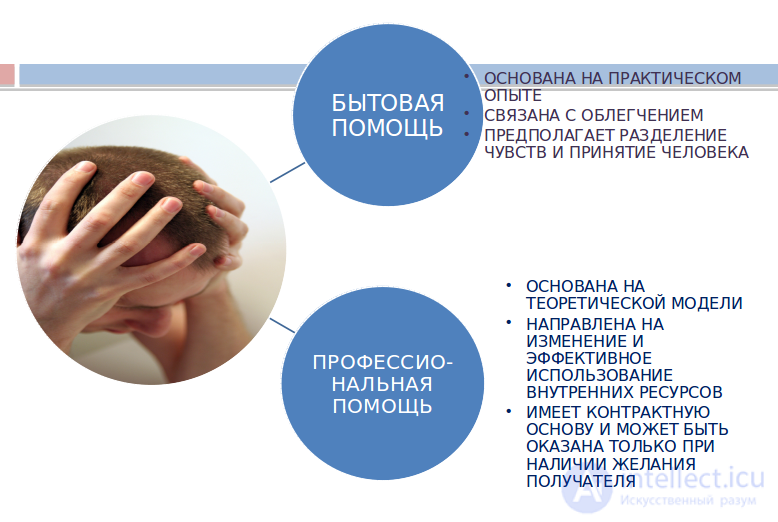
TYPES OF PSYCHOLOGICAL ASSISTANCE
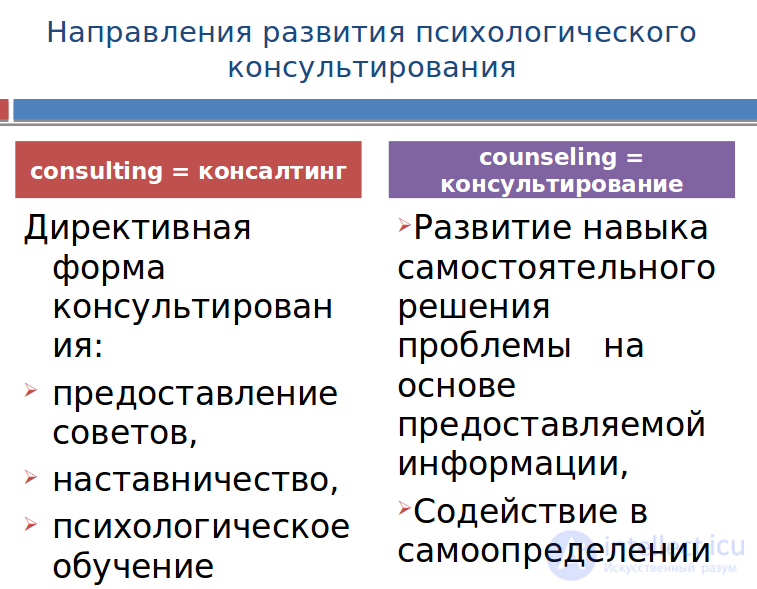
working contract

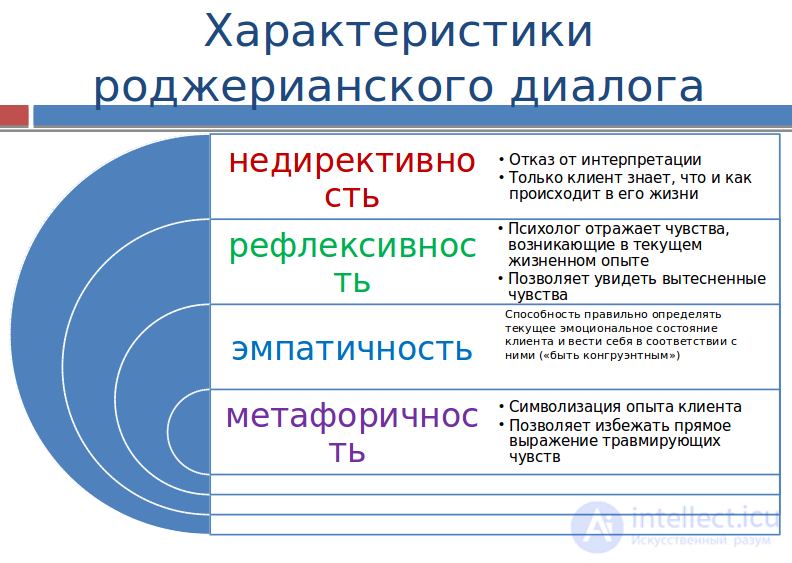
Therapeutic dialogue - Centred on the client's feelings arising in the dialogue concerning the problem
Characteristics of the Rogerian dialogue
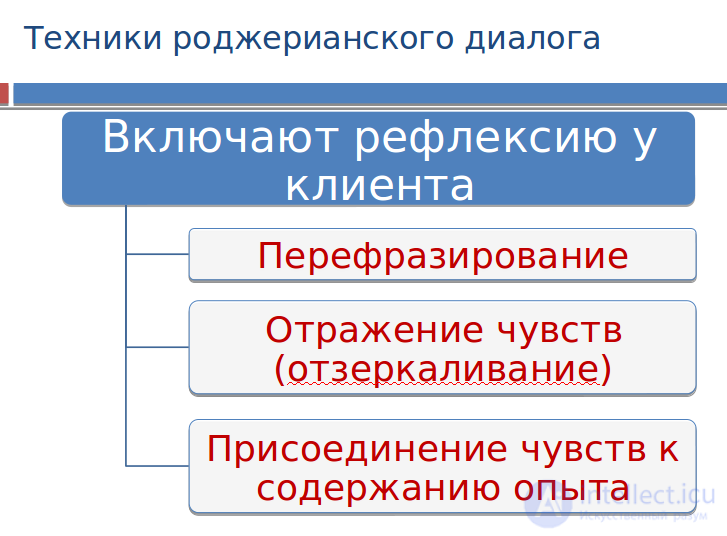
Techniques of the Rogerian dialogue
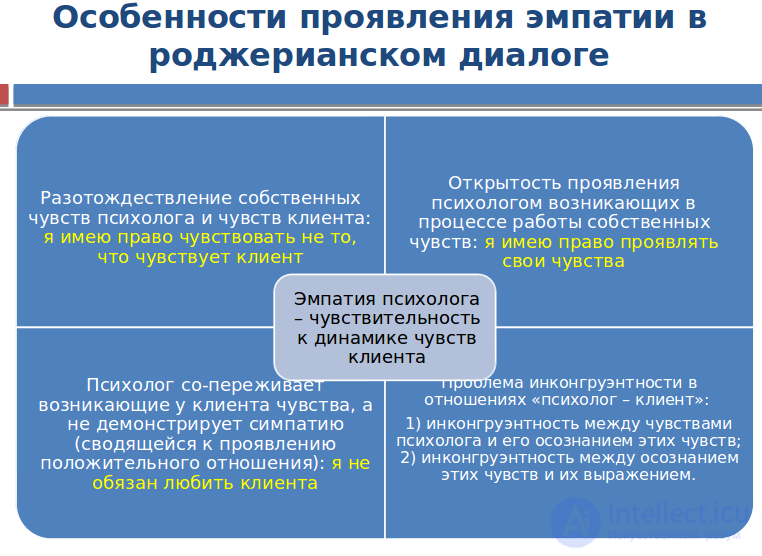
Features of the manifestation of empathy in the Rogerian dialogue

Comments