
Lecture
Contemporary Problems of Science and Education is a primitive journal, or a whole discipline studied in underdeveloped countries.
The objective of mastering the discipline
«Contemporary Problems of Science and Education» consists in promoting an increase in students' pedagogical culture, forming in them a scientific understanding of education as a complexly organized socio-cultural phenomenon and of contemporary pedagogical education, and developing the skills to analyse current problems of pedagogical science and education management and to foresee the prospects of their development. The tasks of the discipline: to acquaint master's students with the current state and the main problems of the development of pedagogy as a science and of the education system functioning in the country, as well as with the conceptual foundations, features, tendencies and prospects of management in education, and with the problems of training managers for managing pedagogical systems.
Academician V.I. Vernadsky wrote: "Science is a creation of life. From the surrounding life, scientific thought takes the material which it renders into the form of scientific truth. It is the thick of life – it is this, above all, that creates it… Science is a manifestation, within human society, of the action of the totality of human thought. Scientific thought, scientific creativity, and scientific knowledge move through the thick of life, with which they are inseparably linked, and by their very existence they arouse active manifestations in the milieu of life which are not merely themselves disseminators of scientific knowledge, but also create its countless forms of manifestation, and give rise to countless large and small wellsprings of scientific knowledge".
Vernadsky regarded the formation of science as a global process, a planet-wide phenomenon. Vernadsky considered the demand of life to be the main stimulus and cause of the emergence of science and of new ideas. The aim of discoveries was the striving for knowledge, while it was life that drove them forward, and it was for the sake of life, not of science itself, that craftsmen, masters, technicians and the like toiled and sought new paths (of knowledge). In the course of its development, humanity came to recognize the necessity of seeking a scientific understanding of its surroundings as a special task in the life of a thinking person. Already at the very outset of its emergence, science set itself the task of mastering the forces of nature for the benefit of humanity.
In its development, science has passed through the following stages: Pre-science – it did not go beyond the bounds of existing practice, and it models changes in objects included in practical activity (practical science). At this stage there occurred an accumulation of empirical knowledge, and the foundation of science was laid – a body of precisely established scientific facts. Science in the proper sense of the word – in it, alongside the empirical rules and dependencies (which pre-science also knew), a special type of knowledge is formed – theory, which makes it possible to obtain empirical dependencies as a consequence of theoretical postulates. Knowledge is no longer formulated as prescriptions for existing practice; it appears instead as knowledge about objects of reality "in themselves", and on this basis a set of prescriptions for the future practical transformation of objects is worked out. At this stage, science acquired predictive power.
The formation of the technical sciences as a distinctive mediating layer of knowledge between natural science and production, and then the emergence of the social sciences and humanities. This stage is linked to the age of industrialism, with the growing introduction of scientific knowledge into production and the emergence of a need for the scientific management of social processes. The production of knowledge in society is not self-sufficient; it is necessary for sustaining and developing human life activity. Science arises out of the needs of practice and regulates it in its own particular way. It interacts with other forms of cognitive activity: everyday, artistic, religious, mythological, and philosophical apprehension of the world. Science sets itself the goal of discovering the laws in accordance with which objects can be transformed. Science studies them as objects that function and develop according to their own natural laws.
Science is characterized by the following features:
Science uses its own special
scientific methods of cognition, which it
constantly improves.
The discipline «Contemporary Problems of Science and Education» belongs to the mandatory part of the OOP curriculum in the Pedagogical Education field and is foundational for the study of subsequent disciplines of the professional cycle. The program of the discipline is built taking into account that master's students are already familiar with the basic tenets of pedagogy and psychology studied at the bachelor's stage, as well as with the basic worldview concepts and fundamental tenets determining the vector of development of educational processes. At the same time, the discipline creates conditions for a deeper understanding of the fundamental theories, concepts and approaches present in contemporary pedagogical science and in the education system.
Contemporary science as a sphere of social consciousness, as specific knowledge and human activity. Features and forms of scientific knowledge. Forms of the organization of science. Science, culture and education. Empirical and theoretical knowledge. The concept of the «scientific picture of the world». The basic pictures of the world: natural-philosophical, mechanical, electrodynamic, quantum-relativistic. The nature of scientific cognition, its types and levels, and the subject-matter, worldview and methodological specificity of the natural and human sciences. The knowledge society and the knowledge economy.
The achievements of contemporary pedagogical science in refining and developing specific scientific categories and concepts. The development of general didactics and of particular didactics. The enrichment of the theory of upbringing with new content, contemporary forms, methods, techniques and means. The development of the theory of managing educational systems. The strengthening of pedagogy's functions in relation to society's education system and to the upbringing of the rising generation. The identification of the main tendencies of the contemporary development of society, science, and pedagogical science, making it possible to predict the general direction of movement of pedagogical theory and practice in the future. Reserves, prospects and paths for the development of contemporary pedagogical science.
The tendency toward strengthening the integration of academic (fundamental) pedagogical science with university-based (applied) science and with pedagogical practice. Pedagogical science and the practice of the functioning of various levels of education. The search for and the enlisting of new means of the purposeful and organized formation of the human personality, embedded in the content of the humanities, the natural sciences, technical and other kinds of knowledge, and in the spheres of culture, sport, healthcare, religion, and others.
The tendency toward generating new pedagogical knowledge on the basis of a dynamically changing contemporary society and the development of general and professional education. The strengthening of the connection between pedagogy and psychology. The development of integrated psychological-pedagogical scientific knowledge (developmental pedagogy, educational psychology, special psychology and pedagogy, and others).
The tendency toward strengthening the practical orientation and significance of pedagogy as a science for the individual, society, and the state. Pedagogical science and the tasks of modernization. The tendency toward consolidating the theoretical and technological functions of pedagogy. The implementation of theoretical propositions in pedagogical technologies, and the development and introduction of innovative educational technologies into the pedagogical process.
Regulatory and legal support for the education system in the Russian Federation. The improvement of legislation in the field of education. The preservation of state guarantees of citizens' rights to receive accessible and free education in any form, including the possibility of instruction in one's native language.
Characteristics of primary vocational, secondary vocational, higher vocational, and postgraduate vocational education. The role of the Unified State Exam (EGE) in improving the quality of general education and ensuring accessibility to higher education.
Transition of the education system to a competency-based approach to educational outcomes. The introduction of federal state educational standards for general and professional education. Transition to a tiered approach (the training of bachelors, specialists, and masters). The state of the system for training scientific and academic-pedagogical personnel. The main directions of the modernization of the education system. Improvement of the social support, training and professional development of pedagogical staff. The creation of an education system for gifted children and for citizens with disabilities. The application of new educational technologies (including distance-learning technologies), the introduction of electronic educational resources, the credit-modular organization of the educational process, and network forms for the implementation of educational programs.
Integration of education systems in Europe. Russia and the Bologna process. The goals and objectives of the convergence and harmonization of the education systems of European countries. Ensuring high quality of education. The elaboration of the basic provisions of a unified European educational space, and the concept of public oversight of higher education as the basis of policy in the field of European higher education.
The main provisions of the Bologna Declaration: adoption of a system of comparable degrees. Introduction of a two-cycle system of study: an undergraduate cycle (of not less than 3 years) and a graduate cycle (obtaining a master's degree or a doctoral degree). Introduction of a credit system, and provision of students' right to choose the disciplines they study. Substantial development of student mobility and expansion of the mobility of teaching and other staff. Promotion of European cooperation in quality assurance with a view to developing comparable criteria and methodologies.
Russia's fulfilment of the goals of the Bologna process and of the provisions of the Bologna Declaration: transition to tiered education and to federal state educational standards based on a competency-based approach to educational outcomes; creation of conditions for competition within the education system (state and non-state educational institutions, federal universities, national research universities, innovative educational institutions, and others), and for the mobility of students and teaching staff; creation of quality-assurance systems in higher-education institutions.
The sources of the emergence of contemporary pedagogical problems: the needs of social and scientific-technological progress and of the modernization of society, changes in the goals, character and methods of contemporary science, the increasing complexity of scientific problems, and the need to seek out and apply forms, methods and means adequate to the situation prevailing in society. The need to raise the methodological and theoretical level of pedagogical research.
Contemporary pedagogical education is becoming ever more complex in its content, both because it represents a complex social institution and in connection with the need for the fundamentalization of its content. The development of science leads to growth in the volume of scientific knowledge. This complicates the task, facing society and education, of socializing and transmitting knowledge to succeeding generations. The didactic solution to this task lies not in condensing the content of education, but in turning to the idea of personally-developmental instruction. The professional training of the contemporary teacher is expressed in his or her professional competencies, among which we distinguish the sociocultural, the cognitive, and the philosophical.
The teacher's sociocultural competence presupposes that the teacher possesses an image of the citizen, containing the qualities of a citizen that he or she will develop in their pupils. This training will help the teacher to solve contemporary educational tasks and to move toward purposeful educational activity. The relevance of such training is heightened by the fact that questions of upbringing are today coming to the fore.
The fundamentality of the teacher's cognitive competence is due to the role that an individual's intellectual abilities play in his or her personal formation within society. A teacher who is shaping a future citizen will have to take into account both the requirements imposed by the spiritual development of society, its moral rules and the laws of morality, and the requirements for the formation of the individual's intellectual abilities. The intellectual development of the individual becomes decisive also for carrying out moral upbringing, which is accomplished most effectively as self-education, provided that reflexive mechanisms of thought are included in the processes of self-education.
The teacher's philosophical competence is necessary for forming in him or her the capacity to reflect on the aim and value both of his or her own pedagogical activity and of all other aspects of education. Such reflection is currently being formed within the context of the philosophy of education. The further development of the humanistic ideas of contemporary philosophy of education manifests itself as the need to resolve questions of the humanization of education, the role of intellect in the spiritual formation of the personality, and the relationship between intellect and soul, which can be considered separately only in cognition (just as a perfect mind and a moral code can be). In the human being, however, they are one, and the success of contemporary society in shaping the future generation depends on how consistently, in the processes of its modernization of education, the teacher's foremost competencies are balanced.
«The principal significance of reforms consists in raising the quality of the system and strengthening its ability to respond adequately to the challenges of the times, through transformation. The integration of the younger generation into the global world entails supporting their spirituality and morality, providing assistance in mastering the knowledge and experience needed to solve life and professional problems, and developing their own competence, tolerance, mobility, and competitiveness» [2, c. 75].
To achieve the goals facing higher pedagogical education, both «impeccable command by the teacher of the subject matter of the science, and a high level of pedagogical culture» [2, p. 106] are necessary. The quality of higher education today depends directly on the quality of a university teacher's pedagogical activity. The goal of pedagogical education becomes «the training of a teacher possessing a spiritual – moral culture, creative potential, and developed innovative abilities» [2, c. 79].
While the main task of the domestic school is defined as the task of developing creative abilities and talents, ensuring equal conditions for quality instruction, and the development and upbringing of all children, the task of higher pedagogical education has been formulated far less definitely. As a result, the content of contemporary pedagogical education «lacks fundamentality, is eclectic in character, does not possess the properties of problem-orientation, and is marked by didacticism and prescriptiveness based on the teacher's use of only external means of forming the personality» [2, c. 78].
In the contemporary world there are more than 60 million teachers; they constitute one of the most extensive strata of intellectual workers.
New types of educational institutions are being created, and the content and methods of instructional and educational work are being modernized [3, p.84].
Intensive searches are underway for ways of creating models of education that would meet the demands of the emerging post-industrial civilization. Concern over the problem of education is shown by state authorities, public figures, and scholars from various fields of knowledge. Since the problem has taken on truly global proportions, it naturally attracts considerable attention from authoritative international organizations - UNESCO, UNICEF, the Council of Europe, and the European Union [3, p. 86].
In noting the main problems of contemporary pedagogical education, let us turn to the «Delors Report». The report sets out the priorities of state policy in the field of school education leading to an increase in the teacher's professional level and social status:
A distinctive feature of university-type pedagogical education should become its fundamentality. The fundamentality of professional pedagogical training can be ensured by the fundamentality of contemporary knowledge in the psychology of personality and the psychology of intellect, by fundamental subject-matter knowledge, and by fundamental methodological knowledge, ensuring the teacher's capacity for value orientation in educational activity.
The main sources for defining pedagogical problems: society's demands; current and prospective tasks in the field of education (upbringing, instruction, development); the logic of the development of pedagogy as a science as a whole, of its branches and individual sub-fields; the immediate needs of educational institutions; unstudied areas of the holistic pedagogical process, of the history and theory of pedagogy, of didactics, of the theory of upbringing, and of the theory of managing educational systems. The key problems of contemporary pedagogical science: the creation of a methodology of pedagogy and of pedagogical research on a scientific anthropological basis; the scientific substantiation of current problems of general instructional theory and of particular didactics for educational institutions of various types; the creation of a theory of upbringing on new ideological and moral foundations; and the substantiation of conceptual propositions for managing contemporary educational systems.
The main theoretical-methodological problems of pedagogy. Critical analysis, reflection upon, and substantiation of the methodology of pedagogy and of the methodology of pedagogical research on new foundations, including on the basis of dialectical logic within the context of synergetics, on a scientific anthropological basis. The development of a methodology for scientific pedagogical research as a practice of intellectual activity, presupposing general requirements for the manner, structure and character of the organization of scientific work, regulating the process of cognition on the basis of the fulfilment of mandatory scientific principles (of development, systematicity, historicism, verifiability, and others). The relationship between the general methodology of scientific cognition and the special methodology of pedagogy, between theoretical and applied pedagogical knowledge, and between theoretical and empirical research, and the interconnection of the logical and the historical in pedagogical research. The connection between the history of pedagogy and education and contemporaneity.
Systemic approach and comprehensive study of pedagogical phenomena
by means of various sciences (anthropology, psychology, sociology,
cultural studies, etc.). The relationship between the social and the biological in
the education of the person; on the priority of upbringing or instruction in education;
on the role of the collective in personality formation. Comprehensive, harmonious and
holistic development of the personality in the interests of realizing the inclinations and
abilities of the person. The problem of continuous education for contemporary
humankind.
Clarification of the existing categorical apparatus and the development of a new
one and of concepts in pedagogical science. Development of the theory of the holistic
pedagogical process in relation to new possibilities and
features of obtaining a contemporary education. Justification of the laws,
regularities, principles, forms and methods of functioning of the holistic
pedagogical process. Current problems of general didactics
New normative foundations of instructional theory. Socio-cultural
foundations of didactics in the 21st century. Psycho-physiological foundations of didactics in
light of new discoveries in the natural-science sphere, in the field of cognitive
neurology and psychology. Informational foundations of didactics.
Clarification of the categorical apparatus of general didactics.
Formulation of contemporary laws, regularities and principles
of instruction. Justification of forms of innovative instruction, methods of active
and interactive instruction. Development of effective didactic
technologies. Methodological support for various stages of instruction,
formation of competencies and competence.
. Contemporary problems of education
1. Trends in the development of the domestic education system
2. Organizational problems of education
3. Problems of forming the content of education
4. Problems of standardizing education
5. Problems of improving education technologies
6. Problems of informatizing education
7. Personnel problems of education
8. Problems of material and technical support of education
9. Problems of management in education
10. Problems of the economics of education
11. Problems of the quality of education
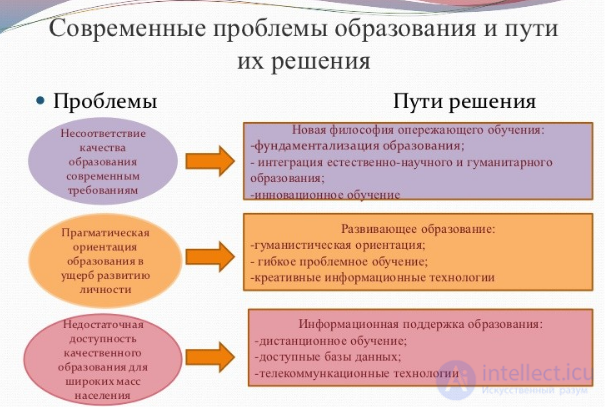
What should education become? Education must correspond to:
III. In the country, the training of qualified performers is extremely weak. Vocational schools and technical colleges by and large do not provide contemporary qualifications
Systemic challenges for Russian education
Characteristics of the new model of education
The problem of studying the person and their upbringing from the standpoint
of pedagogical anthropology (K.D. Ushinsky). Implementation of the principles
of cultural conformity and natural conformity in the theory and practice
of contemporary upbringing. Problems of pedagogical understanding of the processes
of acculturation, enculturation and socialization. The relationship between personality-oriented and activity-oriented upbringing. Strengthening
of the preventive function of upbringing. Problems of culture in education and
upbringing.
Formulation and justification of the goals and values of contemporary
upbringing. Family upbringing as the foundation for personality formation.
Upbringing in general education school. The specifics of professional
upbringing. Fostering tolerance and friendship among nations and peoples.
Filling with new content, and justifying the forms, methods and means
of moral, civic-patriotic, aesthetic, ethical,
labor, physical and other kinds of upbringing.
In accordance with the requirements of the Federal State Educational Standard of Higher Education for the pedagogical
field of training, within the study of the discipline «Contemporary
problems of science and education», the implementation of the competency-based approach
must provide for the broad use in the educational process
of active and interactive forms of conducting classes in combination with
extracurricular work for the purpose of forming and developing
the professional skills of students.
The proportion of classes conducted in interactive forms
is determined by the main goal (mission) of the program, the specific nature
of the student contingent, and the content of the particular disciplines, and overall
in the educational process they constitute no less than 50% of classroom sessions.
In accordance with the instructional-methodological complex for the academic discipline, the following types of classes may be used.
Classroom sessions. All types of classroom sessions combine educational, upbringing-related, practical and methodological functions.
Interactive modular lecture – a lecture session using contemporary information tools, intended
for students to master theoretical knowledge within the material of a module of the academic discipline.
Studying – academic work involving structuring and analyzing the content of educational and informational resources for the academic
discipline, the result of which is the preparation of a summary, theses, the compilation of logical schemes or classifications on the topic being studied, as well as
a glossary of the main terms and concepts, facts, personalities and dates.
Test-training – a training session intended to consolidate the master's student's basic theoretical knowledge within the material
of the module, which is conducted using training-type software based on an electronic database of assignments.
Seminar (master's program) – a collective session under the guidance of an instructor, using the results of master's students' work with academic
and scholarly literature. The seminar is conducted in interactive form (in dialogue mode, group discussions, discussion of the results
of research work).
Research work of master's students (RWMS) – work of a scholarly nature, associated with scholarly inquiry, conducting
research for the purpose of expanding existing knowledge and obtaining new knowledge, testing scientific hypotheses, establishing regularities manifested
in nature and in society, scientific generalizations and the scientific justification of projects. The research work of students is
a mandatory section of the master's degree program and is aimed at forming universal and professional competencies.
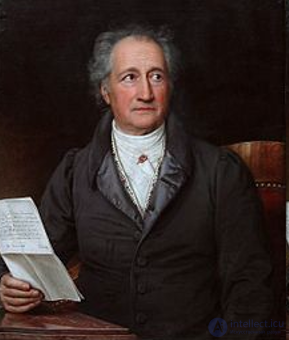
Johann Wolfgang von Goethe
(1749-1832), German poet, statesman, thinker and natural philosopher
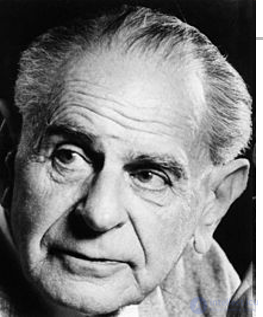
Karl Raimund Popper
(1902-1994), Austrian and British philosopher and sociologist

Independent work by master's students is an important component of the professional training of specialists and includes the following. Creative essay – this is independent academic scholarly-methodological work whose main purpose is to develop in master's students research skills and abilities, such as: correctness in setting the goal of the problem, identifying the object and subject of the research, formulating the tasks and hypotheses of the work; logic of presentation of the work, the ratio and interrelationship of theoretical and empirical material; competent presentation of the work, observance not only of the rules of grammar and spelling,
but also of the canons of scholarly-text style; justification of the choice of methodological support, its correspondence to the research tasks;
use of contemporary methods of processing empirical research data; correctness of the statistical and qualitative analysis
of the data obtained; command of the main methods and means of obtaining, storing and processing information; correctness of the author's
generalizations, substantiveness and validity of the conclusions.
Studying the educational material – preparing a summary, a logical scheme of the material being studied, learning the glossary (dictionary
of terms). The session is conducted as part of the student's independent work.
Working with an electronic educational resource – repeated reinforcement of the module material using training software
products, slide-lectures, slide-tutoring. The sessions take place outside the regular class schedule, on the student's personal computer
The following educational technologies are used in studying the discipline:
This educational program is not implemented if the applicant has medical contraindications established
by Order No. 302n of the Ministry of Health and Social Development of the Russian Federation of April 12, 2011, «On approval of the lists of harmful and (or) hazardous production factors and jobs, in the performance of which mandatory preliminary and
periodic medical examinations are conducted, and of the Procedure for conducting mandatory preliminary and periodic medical examinations
of workers engaged in heavy work and in work with harmful and (or) hazardous working conditions».
The instruction of persons with disabilities and limited health capabilities must be conducted with due regard to the «Methodological recommendations on organizing
the educational process for teaching persons with disabilities and limited health capabilities in institutions of higher education, including the equipping of the educational process". Students with disabilities and limited health capabilities must be provided with printed and electronic educational resources in forms adapted to the limitations of their
health.
The use of electronic educational resources is regulated by the «Regulation on electronic educational resources for the IPSILON UNI distance-learning system» P 1.58.01-2016 and the «Regulation on electronic educational resources in the MOODLE course
creation and management system» P 1.58.02-2014

Comments