
Lecture
The term "hell" (Ancient Greek ᾅδης — «unseen», from ᾅ- — «not» and ειδω —«I see») (Hebrew גֵיהִנוֹם, Latin Infernus, English hell) is usually associated with religious and mythological contexts and can carry different meanings depending on culture and belief. Here are several common interpretations of this term:
Religious meaning: In many religious traditions, such as Christianity, Islam, and Judaism, "hell" denotes a place intended for the punishment of wicked souls after death. This place is associated with torment and suffering, and it is typically contrasted with paradise.
Mythological meaning: In various mythologies there are conceptions of underworld realms or worlds inhabited by the spirits of the dead, where an element of suffering or trial is present.
Metaphorical meaning: In a general metaphorical sense, "hell" can be used to denote severe trials, difficult situations, suffering, or misfortunes that a person may experience in life. For example, "I went through absolute hell when I lost my job."
Literary meaning: In literary works and art, "hell" can be used as a symbol for depicting dramatic plotlines, encounters with inner demons, or moral dilemmas.
It is important to note that the interpretation of "hell" may differ across cultural and religious contexts. The term is often used to describe a sphere of suffering and trial and may carry different meanings depending on context.
In religion and folklore, hell is a place or state in the afterlife in which souls are subjected to punitive suffering, most often by means of torture, as an eternal punishment after death. Religions with a linear divine history often depict hells as eternal destinations, the largest examples being Christianity and Islam, whereas religions with reincarnation usually depict hell as an intermediate period between incarnations, as is the case in the dharmic religions. Religions usually locate hell in another dimension or below the surface of the Earth. Other afterlife destinations include heaven, paradise, purgatory, limbo, and the underworld.
Other religions, which do not regard the afterlife as a place of punishment or reward, simply describe the abode of the dead, the grave, a neutral place located beneath the surface of the Earth (see, for example, Kur, Hades, and Sheol). Such places are sometimes equated with the English word hell, although a more accurate translation would be «underworld» or «world of the dead». Ancient Mesopotamian, Greek, Roman, and Finnish religions include an entrance to the underworld from the land of the living.
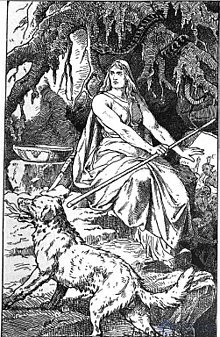
Hel (1889) by Johannes Gehrts depicts the Old Norse Hel, a goddess-like figure, in the eponymous location she watches over.
The modern English word hell derives from the Old English hel, helle (first attested around 725 AD to denote the underworld of the dead), going back to the Anglo-Saxon pagan period. The word has cognates in all branches of the Germanic languages, including Old Norse hel (which refers both to a location and to a divine being in Norse mythology), Old Frisian helle, Old Saxon hellia, Old High German hella, and Gothic halja. All forms ultimately derive from the reconstructed feminine Proto-Germanic noun *xaljō or *haljō («hidden place, underworld»). In turn, the Proto-Germanic form derives from an o-grade form of the Proto-Indo-European root *kel-, *kol-: «to cover, hide, preserve». Indo-European cognates include the Latin cēlāre («to hide», related to the English word «cellar») and the Early Irish ceilid («hides»). After the Christianization of the Germanic peoples, extensions of Proto-Germanic *xaljō were reinterpreted to denote the underworld in Christian mythology (see Gehenna).
Related early Germanic terms and concepts include Proto-Germanic *xalja-rūnō(n), a feminine compound noun, and *xalja-wītjan, a neuter compound noun. This form is reconstructed from the Latinized Gothic plural noun *haliurunnae (attested by Jordanes; according to the philologist Vladimir Orel, meaning «witches»), Old English helle-rūne («sorceress, necromancer», per Orel), and Old High German helli-runa 'magic'. The compound consists of two elements: *xaljō (*haljō) and *rūnō, the Proto-Germanic predecessor of the modern English rune. However, the second element in the Gothic haliurunnae may be an agent noun from the verb rinnan («to run, to go»), which would literally mean «one who travels to the underworld».
Proto-Germanic *xalja-wītjan (or *halja-wītjan) is reconstructed from Old Norse hel-víti «hell», Old English helle-wíte «hellish torment, hell», Old Saxon helli-wīti «hell», and the Middle High German feminine noun helle-wīze. This compound is a combination of *xaljō (discussed above) and *wītjan (reconstructed from such forms as Old English witt «sound mind, wit», Old Saxon gewit «understanding», and Gothic un-witi «foolishness, understanding»).
The concept of the "9 circles of hell" has its roots in the "Divine Comedy" (Divina Commedia), the epic poem by Dante Alighieri. This literary work was written in the fourteenth century and describes a journey through hell, purgatory, and paradise. In the section devoted to hell, Dante describes 9 circles of hell, each representing a place for different kinds of sins and punishments.
Here is a brief description of each of the 9 circles of hell:
Limbo (Limbo): In this circle are the righteous pagans and unbelievers who could not accept Christianity. They are not subjected to torment, but they cannot enter paradise.
Reinforcement (People in the Wind): Here are the souls who committed the deadly sin of negligence. They must wander eternally, buffeted by the wind, finding no comfort.
Sludge (Sinners Against the Gods): This circle is a place for wrathful souls who tear at one another.
Gloom (Misers and Wasters): Here are the souls devoted to a passion for material goods. They freeze in darkness, within vast waters.
Eternal Bargemen (The Venomous): Here are the souls guilty of betrayal. They sail eternally on the river Styx, terribly hungry.
Burning (Sinners of Tin): In this circle are the hypocrites and deceivers, who blaze in fire.
Seething (The Violent): Here are the violent and the transgressors. They are in a swamp, enveloped in poisonous gases.
Icy Wind (Deceivers and Criminal Schemers): In this circle are the souls who committed crimes against society. They freeze in icy ponds.
The Center of Hell (Traitors): This is the lowest circle of hell, where the traitors are found. Here Dante describes Lucifer, the devil, who holds evil souls eternally imprisoned.
The concept of the 9 circles of hell from Dante Alighieri's "Divine Comedy" has become a classic and has influenced many aspects of art and culture
Hell appears in several mythologies and religions. It is usually populated by demons and the souls of the dead. A fable about hell, recurring in the folklore of several cultures, presents an allegory of the long spoons
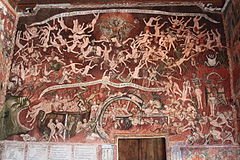
Surviving colonial-era wall paintings from 1802 depicting hell, by Tadeo Escalante, inside the church of San Juan Bautista in Huaro, Peru.
Punishment in hell usually corresponds to sins committed during life. Sometimes these distinctions are specific, with the damned souls suffering for each sin committed, as for example in Plato's myth of Er or in Dante's «Divine Comedy», but sometimes they are general, with condemned sinners sent to one or several chambers of hell or to a level of hell of suffering.
In many religious cultures, including Christianity and Islam, hell is often depicted as fiery, painful, and harsh, inflicting suffering on the guilty. Despite these common depictions of hell as a place of fire, some other traditions depict hell as cold. Buddhist – and especially Tibetan Buddhist – descriptions of hell include equal numbers of hot and cold hells. Among Christian depictions, Dante's «Inferno» portrays the innermost (9th) circle of hell as a frozen lake of blood and guilt. But cold also played a role in earlier Christian depictions of hell or purgatory, beginning with the Apocalypse of Paul, dating to the early third century; the «Vision of Dryhthelm» by the Venerable Bede of the seventh century; «St. Patrick's Purgatory», «The Vision of Tundale» or the «Visio Tnugdali», and «The Vision of the Monk of Eynsham», all from the twelfth century; and «The Vision of Thurkill» from the early thirteenth century.
The "hell-paradise" system is a metaphor or symbol denoting a system of rewards and punishments that may be part of various religious, moral, or ethical teachings. This system presupposes that, depending on a person's actions, his or her soul will after death be directed either to "hell," where it will experience suffering or punishment, or to "paradise," where it will enjoy bliss and reward.
Across different religious and philosophical traditions there exist various versions of "hell" and "paradise," as well as different systems of rewards and punishments. For example, in Christianity "hell" is usually associated with a place of punishment for sins, while "paradise" is associated with a place of salvation and bliss. In Buddhism and Islam there also exist their own conceptions of "hell" and "paradise."
Systems of rewards and punishments can serve as moral and spiritual guidance, directing people toward good deeds and restraining them from evil. However, interpretations and beliefs regarding "hell" and "paradise" can differ greatly depending on the particular religion or philosophical school.
It is important to note that these concepts are religious and spiritual in nature and may be based on faith and belief. They often serve as a foundation for moral teaching and guidance within religious communities.
Hell in Swahili mythology is called kuzimu, and belief in it arose in the seventh and eighth centuries under the influence of Muslim merchants on the East African coast. [17] It is believed to be a very cold place. [17] The Serer religion rejects the general notion of paradise and hell. [18] In the Serer religion, acceptance by the long-departed ancestors comes as close as possible to any paradise. Rejection and transformation into a wandering soul is a kind of hell for the departed. The souls of the dead must journey to Jaaniw (the sacred abode of the soul). Only those who lived their life on earth according to the doctrines of the Serer will be able to make this necessary journey and thus be accepted by the ancestors. Those who cannot make the journey become lost, wandering souls, but they do not burn in «hellfire».
According to Yoruba mythology, no hellfire exists. Wicked people (guilty of, for example, theft, sorcery, murder, or cruelty [20]) are confined in Orun Apaadi (the paradise of potsherds), while good people continue to live in the realm of the ancestors, Orun Baba Eni (the paradise of our fathers). [21]
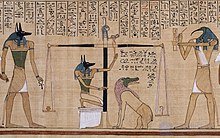
In this scene from the «Book of the Dead» (1275 BC), the heart of the dead scribe Hunefer is weighed on the scales of Maat against the feather of truth by the jackal-headed Anubis. Thoth, with the head of an ibis, the scribe of the gods, records the result. If his heart is lighter than the feather, Hunefer will be allowed to pass into the afterlife. Otherwise, he is devoured by the crocodile-headed Ammit.
With the rise of the cult of Osiris in the Middle Kingdom, the «democratization of religion» gave even the most humble of its followers the prospect of eternal life, with moral fitness becoming the dominant factor in determining a person's suitability. After death a person was brought before a tribunal of forty-two divine judges. If they had lived a life in accordance with the precepts of the goddess Maat, who personified truth and righteous living, the person was welcomed into the paradisal reed fields. If a person was found guilty, they would be thrown to Ammit, the «devourer of the dead», and condemned to a lake of fire. A person seized by the devourer is first subjected to a terrifying punishment and then annihilated. These depictions of punishment may have influenced the medieval conception of hell through early Christian and Coptic texts. The purification of those considered vindicated appears in descriptions of the «Island of Flame», where people experience triumph over evil and rebirth. For the damned awaits complete destruction into a state of non-being, but there is no hint of eternal torture; the weighing of the heart in Egyptian mythology could lead to annihilation. «The Tale of Khaemwaset» describes the torments of a rich man who lacked mercy when he dies, and compares them to the blessed state of a poor man who also died. Divine forgiveness at the judgment always remained a central concern for the ancient Egyptians.
The modern understanding of Egyptian conceptions of hell relies on six ancient texts:
The hells of Asia include the Bagobo «Gimokodan» (which is regarded rather as an otherworld, where the Red Region is intended for those who died in battle while ordinary people go to the White Region) and in the dharmic religions, «Kalichi» or «Naraka».
According to several sources, hell is located underground and is described as an unappealing damp or fiery place intended for sinful people in Ainu religion, as stated by the missionary John Batchelor. However, belief in hell is not found in Ainu oral tradition. Instead, in Ainu religion there exists a belief that the soul of the dead (ramat) will become a kamuy after death. There is also a belief that the soul of a person who behaved dishonestly during life, committed suicide, was killed, or died in great agony will become a ghost (tukap), which will haunt the living in order to achieve fulfillment of that which it was denied in life.
In Taoism, hell is represented by Diyu.
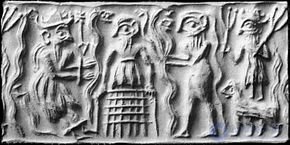
An impression of an ancient Sumerian cylinder seal depicting the god Dumuzid being tortured in the underworld by galla-demons.
The afterlife of the Sumerians was a dark, dreary cavern located deep underground, [35] whose inhabitants were believed to continue «a shadowy version of life on Earth». [35] This bleak realm was known as Kur, and was believed to be ruled by the goddess Ereshkigal. All souls went to the same afterlife, and a person's actions during life did not affect how he would be treated in the world to come. [35]
It was believed that the souls in Kur ate nothing but dry dust, and family members of the deceased ritually poured libations into the grave of the deceased through a clay pipe, thereby allowing the dead to drink. [36] : 58 Nevertheless, funerary evidence indicates that some people believed the goddess Inanna, the younger sister of Ereshkigal, held the power to grant her devotees special favors in the afterlife. During the Third Dynasty of Ur, it was believed that how a person was treated in the afterlife depended on how he or she had been buried; those who were buried lavishly would be treated well, [36] : 58 but those who were buried poorly would fare badly.
It was believed that the entrance to Kur lay in the Zagros Mountains in the far east. It had seven gates through which a soul had to pass. [35] The god Neti was the gatekeeper. [ Ereshkigal's sukkal, or messenger, was the god Namtar. The galla were a class of demons believed to inhabit the underworld; [36] : 85 their principal purpose, it seems, was to drag hapless mortals back to Kur. They are frequently referenced in magical texts, and in some texts there are seven of them. Several surviving poems describe a galla dragging the god Dumuzid down into the underworld. [36] : 86 Later Mesopotamians knew this underworld under the East Semitic name: Irkalla. In the Akkadian period, Ereshkigal's role as ruler of the underworld was assigned to Nergal, the god of death. The Akkadians attempted to harmonize this dual rulership of the underworld by making Nergal Ereshkigal's husband. [35]
The hells of Europe include «Anaon» from Breton mythology, «Uffern» from Celtic mythology, «Peklo» from Slavic mythology, Náströnd from Norse mythology, hell from Sámi mythology, and the Finnish «Tuonela» («Manala»).
In classical Greek mythology, beneath the sky, the Earth, and Pontus lies Tartarus, or Tartaros (Ancient Greek: Τάρταρος). It is either a deep, gloomy place, pit, or abyss used as a dungeon of torment and suffering, located within Hades (the whole underworld), with Tartarus being its infernal component. In the «Gorgias», Plato (c. 400 BC) wrote that the souls of the dead were judged after paying for passage across the river of the dead, and those who received punishment were sent to Tartarus. As a place of punishment, it can be regarded as hell. The classical Hades, on the other hand, is more akin to the Old Testament Sheol. The Romans later adopted these views.
In most Abrahamic religions, hell is understood as a place or form of punishment.
In Judaism there is no specific doctrine of the afterlife, but there is a mystical/orthodox tradition describing Gehinnom. Gehinnom is not hell, but originally a grave, and in later times a kind of purgatory, where a person is judged by their life's deeds, or rather, where a person becomes fully aware of their own shortcomings and negative actions during life. Kabbalah explains it as a «waiting hall» (usually translated as an «entrance way») for all souls (not only the wicked). The overwhelming majority of rabbinic views hold that people are not in Gehinnom eternally; the maximum period of residence there is said to be 12 months, though notable exceptions occur from time to time. Some regard it as a spiritual forge, where the soul is purified for its final ascent to Olam Haba (Hebrew עולם הבא; literally «the World to Come», often regarded as an analogue of heaven). This is also mentioned in Kabbalah, where the soul is described as splitting apart, like a candle flame lighting another: the ascending part of the soul is pure, while the «unfinished» part is reborn.
According to Jewish teaching, hell is not entirely physical; rather, it can be compared to a very intense feeling of shame. People are ashamed of their misdeeds, and this is a suffering that offsets bad deeds. When someone strays so far from the will of God, they are said to be in Gehinnom. This refers not to some moment in the future, but to the very present moment. It is said that the gates of teshuva (return) are always open, and so at any moment a person can align their will with the will of God. According to the Torah, transgressing the will of God is itself the punishment.
Many scholars of Jewish mysticism, especially Kabbalah, describe seven «compartments» or «abodes» of hell, just as they describe seven divisions of heaven. These divisions bear different names, the most frequently mentioned being the following:
In addition to those mentioned above, there are also additional terms often used to denote hell in general or some region of the underworld:
For further information, see Qliphoth.
Maimonides states in his 13 Principles of Faith that the hell of rabbinic literature was a pedagogically motivated invention intended to encourage respect for the commandments of the Torah among a humanity considered immature. Rather than going to hell, the souls of the wicked would in fact be annihilated.
In the Judaism of Jesus' time, almost all followers believed that their descent from Abraham automatically prevented them from entering hell. However, in order to merit this, most Jews «acknowledge their sinfulness and confess their sins».
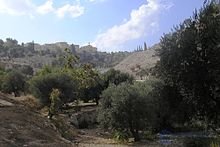
«Gehenna», the Valley of Hinnom, 2007.
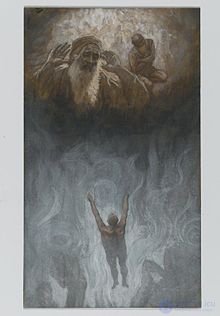
The parable of the rich man and Lazarus, depicting the rich man in hell begging for help from Abraham and Lazarus in heaven, by James Tissot
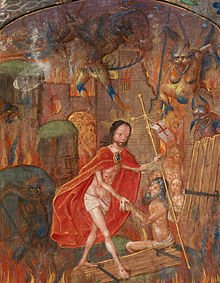
The Harrowing of Hell. Christ leads Adam by the hand, circa 1504.
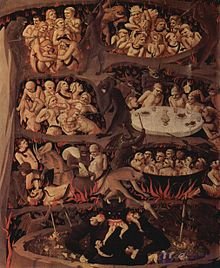
The Last Judgment, Hell, circa 1431, by Fra Angelico
Christian teaching on hell derives from passages in the New Testament. The English word hell evidently does not appear in the Greek New Testament; instead, one of three words is used: the Greek words «Tartarus» or «Hades», or the Hebrew word «Gehinnom».
In the Septuagint and the New Testament, authors used the Greek term Hades to render the Hebrew Sheol, but often had in mind Hebrew rather than Greek concepts. In the Hebrew conception of Sheol, expressed for example in Ecclesiastes, Sheol or Hades is a place where there is no activity at all. However, since the time of Augustine, some Christians have believed that the souls of the dead either rest peacefully, in the case of Christians, or suffer, in the case of the damned, after death until the resurrection.
| Hebrew OT | Septuagint | Greek NT | occurrences in the New Testament | Vulgate | KJV | NIV |
|---|---|---|---|---|---|---|
| שְׁאוֹל (Sheol) | Ἅιδης (Haides) | ᾌδης (Hades) | x10 | infernus | Hell | Hades |
| גֵיא בֶן־הִנֹּם (Ge Hinnom) | Εννομ (Ennom) | γέεννα (gehenna) | x11 | gehenna / gehennam ] | Hell | Hell |
| (Not applicable) | (Not applicable) | Ταρταρόω (Tartaroo) | x1 | tartarus | Hell | Hell |
Although these three terms are all rendered in the KJV as «hell», they carry three quite different meanings.
The Catholic Church defines hell as «a state of final self-exclusion from communion with God and the blessed». A person ends up in hell as a result of dying in mortal sin, without repenting and without accepting God's merciful love, thereby becoming forever separated from Him by their own free choice immediately after death. [74] In the Roman Catholic Church, in many other Christian churches such as the Methodists, Baptists, and Episcopalians, as well as in some Greek Orthodox churches, hell is taught as the final fate of those who are not found worthy after the general resurrection and the Last Judgment, where they will be eternally punished for their sins and forever separated from God. The nature of this judgment is inconsistent with what many Protestant churches teach, namely that salvation comes from accepting Jesus Christ as one's savior, whereas the Greek Orthodox and Catholic churches teach that judgment depends on both faith and works. However, many liberal Christians within mainstream Protestant churches believe in universal reconciliation (see below), even though it contradicts the traditional doctrines usually held by evangelicals within their denominations. With regard to belief in hell, the interpretation of Extra Ecclesiam nulla salus is also relevant.
Some modern Christian theologians hold the doctrine of conditional immortality. Conditional immortality is the belief that the soul dies with the body and does not live again until the resurrection. As in other Jewish writings of the Second Temple period, the New Testament text distinguishes two words, both of which are translated in older English Bibles as «hell»: Hades, «grave», and gehenna, where God «can destroy both body and soul». A smaller group of Christians understands this to mean that neither Hades nor gehenna are eternal, but refer to the final annihilation of the wicked in the Lake of Fire, in a consuming fire, after the resurrection. However, because of the Greek words used in translating the Hebrew text, Hebrew ideas became confused with Greek myths and ideas. In the Hebrew text, when people died, they went to Sheol, the grave, and the wicked eventually went to gehenna and were consumed by fire. Hebrew words meaning «grave», «death», or «the eventual annihilation of the wicked» were translated using Greek words, and later texts became a mixture of mistranslation, pagan influence, and Greek myth.
Christian mortalism is the teaching that all men and women, including Christians, must die, rather than continuing to live or remaining conscious after death. Thus annihilationism includes the doctrine that the «wicked» are also annihilated, rather than being eternally tormented in the traditional «hell» or lake of fire. Christian mortalism and annihilationism are directly linked to the doctrine of conditional immortality, the idea that the human soul will not be immortal unless it is granted eternal life at the second coming of Christ and the resurrection of the dead.
Biblical scholars who examine this question through the Hebrew text deny the teaching of innate immortality. Rejection of the immortality of the soul and the defense of Christian mortalism have been a characteristic feature of Protestantism since the earliest days of the Reformation, when Martin Luther himself rejected the traditional idea, although his mortalism did not carry over into orthodox Lutheranism. One of the best-known English opponents of the immortality of the soul was Thomas Hobbes, who describes the idea as a Greek «infection» within Christian doctrine. Among modern proponents of conditional immortality are members of the Anglican Church, such as N. T. Wright, , as well as denominations such as the Seventh-day Adventists, the Bible Students, Jehovah's Witnesses, the Christadelphians, the Living Church of God, the International Church of God, and some other Protestant Christians. The Catholic catechism states: «The souls of sinners descend into hell, where they suffer «eternal fire»». However, Cardinal Vincent Nichols, the highest-ranking Catholic in England and Wales, has said that «there is nowhere in Catholic teaching that actually says any single person is in hell». The 1993 Catechism of the Catholic Church states: «This state of final self-exclusion from communion with God and the blessed is called «hell»» and «they suffer the punishments of hell, «eternal fire»». «The chief punishment of hell is eternal separation from God» (CCC 1035). During an audience in 1999, Pope John Paul II remarked: «The images of hell that Scripture presents to us must be correctly interpreted. They show the complete frustration and emptiness of life without God. Hell indicates not a place, but the state of those who freely and definitively separate themselves from God, the source of all life and joy».
The official beliefs of the Seventh-day Adventist Church support annihilationism. They reject the Catholic purgatory and teach that the dead lie in the grave until they are resurrected for the last judgment, and both the righteous and the wicked await the resurrection at the Second Coming. Seventh-day Adventists believe that death is a state of unconscious sleep until the resurrection. They base this belief on biblical texts such as Ecclesiastes 9:5, which states that «the dead know nothing», and 1 Thessalonians 4:13–18, which contains a description of the dead rising from the grave at the second coming. It is argued that these verses indicate that death is merely a period or form of sleep.
Adventists teach that the resurrection of the righteous will occur soon after the second coming of Jesus, as described in Revelation 20:4–6, which follows Revelation 19:11–16, whereas the resurrection of the wicked will occur after the millennium, as described in Revelation 20:5 and 20:12–13, which follow Revelation 20:4 and 6–7, although Revelation 20:12–13 and 15 actually describe a mixture of saved and condemned people rising from the dead and being judged. Adventists reject the traditional doctrine of hell as a state of eternal conscious torment, believing instead that the wicked will be permanently annihilated after the millennium by the lake of fire, which is called «the second death» in Revelation 20:14.
These Adventist doctrines about death and hell reflect an underlying belief in: (a) conditional immortality (or conditionalism) as opposed to the immortality of the soul; and (b) the monistic nature of human beings, in which the soul is not separable from the body, as opposed to bipartite or tripartite conceptions in which the soul is separate.
Jehovah's Witnesses believe that the soul ceases to exist when a person dies and, consequently, hell (sheol or hades) is a state of non-existence. In their theology, gehenna differs from sheol or hades in that it offers no hope of resurrection. Tartarus is considered a metaphorical state of humiliation of the fallen angels between the moment of their moral fall (Genesis chapter 6) and their post-millennial annihilation together with Satan (Revelation chapter 20).
The Bible Students and the Christadelphians also believe in annihilationism.
Christian universalists believe in universal reconciliation, the belief that all human souls will ultimately be reconciled with God and admitted to heaven. This belief is held by some Unitarian Universalists.
According to the Christian revelation of Emanuel Swedenborg's «Second Coming», hell exists because evil people want it. They, not God, brought evil to humanity. In Swedenborgianism, each soul after death joins the group of like-minded souls in which it feels most comfortable. Hell is therefore considered to be a place of happiness for souls who delight in evil.
Members of the Church of Jesus Christ of Latter-day Saints (LDS Church) teach that hell is a state between death and resurrection, in which those spirits who did not repent on earth must suffer for their sins (Doctrine and Covenants 19:15–17 [104]). After that, only the Sons of Perdition, who committed the Eternal Sin, will be cast into Outer Darkness. However, according to Mormon belief, committing the Eternal Sin requires so much knowledge that most people are incapable of it. [105] Satan and Cain are considered examples of Sons of Perdition.
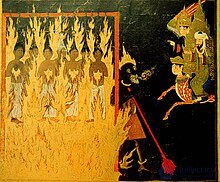
Muhammad, accompanied by Buraq and Gabriel, visits hell and sees «shameless women» being eternally punished for having displayed their hair to strangers. Persian, 15th century.
In Islam, jahannam (Arabic: جهنم) (related to the Hebrew word gehinnom) is the counterpart of paradise and is likewise divided into seven layers, both coexisting with the temporal world, filled with blazing fire, boiling water, and many other torments for those condemned to it in the afterlife. In the Qur'an, God states that the fire of Jahannam is prepared for both humankind and the jinn. After Judgment Day it is to be occupied by those who do not believe in God, who did not obey his laws, or who rejected his messengers. «Enemies of Islam» go to hell immediately after death. Muslim modernists downplay the vivid descriptions of hell common in the classical period, on the one hand affirming that the afterlife cannot be denied, while at the same time asserting that its exact nature remains unknown. Other modern Muslims continue the Sufi line of thought of hell as an inner state, combining the eschatological ideas of Ibn Arabi and Rumi with Western philosophy. Although this is disputed by some scholars, most scholars consider jahannam to be eternal. There is a belief that the fire symbolizing one's own bad deeds can already be seen during the punishment of the grave, and that the spiritual pain caused by it can lead to the purification of the soul. Not all Muslims and scholars agree on whether hell is an eternal destination or whether some or all of the condemned will eventually be forgiven and allowed to enter paradise.
A narrow bridge called As-Sirat is stretched over hell. On the Day of Judgment one must cross it to reach paradise, but those destined for hell will find it too narrow and will fall into their new dwelling. [ Iblis, the temporary ruler of hell, is considered to dwell at the bottom of hell, from where he commands his hosts of infernal demons. But contrary to Christian tradition, Iblis and his infernal hosts do not wage war against God, his enmity extending only against humankind. Moreover, his dominion in hell is itself his punishment. The executors of punishment are the 19 zabaniyah, created from hellfire. Muhammad said that the fire of Jahannam is 70 times hotter than ordinary fire and far more painful than ordinary fire.
The seven gates of Jahannam, mentioned in the Qur'an, inspired Muslim exegetes (mufassirun) to develop a system of seven stages of hell, analogous to the seven gates of paradise. The stages of hell take their names from seven different terms used in the Qur'an to denote hell. Each is intended for a particular type of sinner. The concept, later adopted by Sunni authorities, lists the levels of hell as follows, although some stages may vary:
The highest level (jahannam) is traditionally considered a kind of purgatory intended for Muslims. Polytheism (shirk) is regarded as a particularly grave sin; therefore, a polytheist (mushrik) is forbidden entry into Paradise, because his place is hell; and the second-lowest level (jahim) comes only after the bottomless pit for the hypocrites (hawiyah), who outwardly claimed to believe in God and his messenger but did not believe in their hearts.
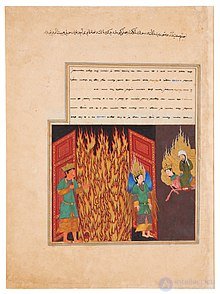
Muhammad asks Malik to show him hell during his celestial journey. Miniature from the David Collection.
Although the earliest accounts of Muhammad's journey through the heavens do not indicate the location of hell within the heavens, only brief mentions of a visit to hell during the journey appear. But extensive accounts of Muhammad's night journey in the non-canonical but popular Mi'raj literature tell of an encounter with the angels of hell. Malik, the keeper of the gates of hell, appears precisely in the «Isra and Mi'raj» of Ibn Abbas. The doors to hell are located either on the third or fifth heaven, or (though implicitly) in the heavens near God's throne, or immediately after entering the heavens, after which Muhammad asks for a glimpse of hell. Ibn Hisham gives detailed accounts of how Muhammad visited hell and its inhabitants were punished there, but they can bear only the punishments of the first layer of hell. Muhammad's encounter with Malik, the Dajjal, and hell was used as evidence of Muhammad's night journey.
Medieval sources often identified hell with the seven earths mentioned in Qur'an 65:12, inhabited by devils, harsh angels, scorpions, and snakes tormenting sinners. They described thorny bushes, seas filled with blood and fire, and darkness lit only by the flames of hell. According to one popular conception, the earths are arranged as follows:
In the Bahá'í Faith, conventional descriptions of hell and paradise are considered symbolic depictions of spiritual states. In the Bahá'í writings, closeness to God is described as paradise, and conversely, remoteness from God as hell. The Bahá'í writings state that the soul is immortal and that after death it will continue to develop until it finally attains the presence of God
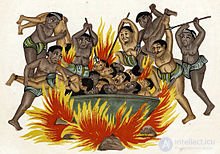
Naraka in a Burmese representation
In the «Devaduta Sutta», the 130th discourse of the Majjhima Nikaya, the Buddha describes hell in vivid detail. Buddhism teaches that there are five or six realms of rebirth, which can then be subdivided by degrees of agony or pleasure. ) Of these worlds, the hell realms, or Naraka, are the lowest realm of rebirth. Of the hell realms, the worst is Avīci (Sanskrit and Pali for «without waves»). The Buddha's disciple Devadatta, who three times tried to kill the Buddha and also to cause a schism in the monastic order, is said [by whom?] to have been reborn in the Avīci hell.
Like all realms of rebirth in Buddhism, rebirth in the hell realms is not permanent, although suffering may persist for many ages before rebirth occurs again. In the Lotus Sutra, the Buddha teaches that eventually even Devadatta himself will become a Pratyekabuddha, emphasizing the temporary nature of the hell realms. Thus Buddhism teaches the avoidance of endless migration through rebirths (both positive and negative) by attaining Nirvana.
The Bodhisattva Kṣitigarbha, according to the Kṣitigarbha Sutra, while still a young girl took a great vow not to attain nirvana until all beings are freed from the hell realms or other unwholesome rebirths. In popular literature, Kṣitigarbha travels to the hell realms to teach beings and deliver them from suffering.
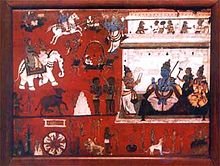
The judgment of Yama and hell. The blue figure is Yamaraja (the Hindu god of death) with his consort Yami, and a 17th-century painting of Chitragupta from the Government Museum in Chennai.
In the early Vedic religion there is no concept of hell. The Rigveda mentions three realms: bhur (earth), svar (heaven), and bhuvas or antariksha (the middle region, that is, the air or atmosphere). In later Hindu literature, especially in the law codes and the Puranas, more worlds are mentioned, including a hell-like realm called Naraka. Yama, as the firstborn of humanity (together with his twin sister Yami), by virtue of seniority becomes the ruler of people and their judge upon departure.
In the law codes (Smriti and Dharmashastra), Naraka is a place of punishment for misdeeds. It is the lowest spiritual plane (called naraka-loka), where the spirit is judged and partial fruits of karma affect the next life. In the Mahabharata there is mention of the Pandavas and Kauravas who went to heaven. First Yudhishthira arrives in heaven, where he sees Duryodhana enjoying that realm; Indra tells him that Duryodhana is in heaven because he worthily fulfilled his duties as a kshatriya. Then he shows Yudhishthira hell, where his brothers appear to be. It is later revealed that this was a test for Yudhishthira and that all his brothers and the Kauravas are in heaven, living happily in the divine abode of the devas. Various kinds of hell are also described in various Puranas and other scriptures. The Garuda Purana gives a detailed description of each hell and its features; it lists the durations of punishment for most crimes, very much like a modern criminal code.
It is believed that people who commit misdeeds go to hell and must undergo punishments according to the misdeeds they committed. The god Yama, who is also the god of death, rules hell. Detailed records of all the misdeeds committed by a person are kept by Chitragupta, who is the keeper of records at Yama's court. Chitragupta reads out the misdeeds committed, and Yama orders the individuals to be punished accordingly. These punishments include immersion in boiling oil, burning in fire, torture with various weapons, and so on, in various hells. Individuals who have completed their share of punishments are reborn according to the balance of their karma. All created beings are imperfect and therefore have at least one misdeed on their record; but if a person has on the whole lived a worthy life, he ascends to Svarga, a temporary realm of pleasures similar to Paradise, after a short period of atonement in hell and before the next reincarnation, according to the law of karma. Except for the Hindu philosopher Madhva, time in hell is not regarded as eternal damnation in Hinduism.
According to the Brahma Kumaris, the Iron Age (Kali Yuga) is considered hell.
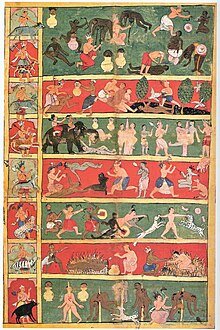
A 17th-century cloth painting depicting the seven levels of the Jain hell and the various tortures endured there. The left panel shows a demigod and his animal vehicle presiding over each hell.
In Jain cosmology, Naraka (translated as hell) is the name of a plane of existence experiencing great suffering. However, Naraka differs from the hell of the Abrahamic religions, since souls are not sent to Naraka as a result of divine judgment and punishment. Moreover, the duration of a being's stay in Naraka is not eternal, although it is usually very great and is measured in billions of years. A soul is born in Naraka as a direct result of its previous karma (actions of body, speech, and mind) and remains there for a finite period of time until its karma reaches its full effect. Once its karma is exhausted, it may be reborn in one of the higher worlds as a result of earlier, not-yet-matured karma.
The hells are located on seven levels at the lower part of the universe. The seven levels are as follows:
Hell beings are a type of soul dwelling in the various hells. They are born in hell through spontaneous manifestation. Hell beings possess a vaikriya body (a malleable body that can transform and take various shapes). They have a fixed lifespan (from ten thousand to billions of years) in their respective hell, where they reside. According to the Jain scripture «Tattvartha Sutra», the following are causes of rebirth in hell:
According to Meivazhi, the purpose of all religions is to lead people to heaven. However, it is believed that those who do not draw near to God and are not blessed by Him are condemned to hell.
According to the Sikhs, heaven and hell are not places in the afterlife; they are part of a person's spiritual topography and do not otherwise exist. They refer to good and evil stages of life respectively, and can be lived here and now, during our earthly existence. For example, Guru Arjan explains that people entangled in emotional attachment and doubt live in hell on this Earth, that is, their life is hellish.
So very many are drowning in emotional attachment and doubt; they dwell in the most terrible hell.
- Guru Arjan, Guru Granth Sahib 297
In ancient Taoism there was no concept of hell, since morality was considered a man-made distinction, and there was no concept of an immaterial soul. In its native country, China, where Taoism adopted the dogmas of other religions, the popular view endows the Taoist hell with numerous deities and spirits who punish sins in various terrible ways.
Buddhist hells became «such an integral part of [many Taoist sects] that during funerals priests hang up scrolls depicting» such scenes. Taoist hells are usually said to «number ten» and are «sometimes said to be located beneath a high mountain in Sichuan province». «Each is ruled by a king who acts as judge, surrounded by ministers and servants who carry out his decisions». Punishment is usually «administered with the use of instruments of torture», although some non-physical and more metaphysical punishments also exist. However, this type of Taoist hell is usually not final, and the soul will make a journey of purification, passing through at least several hells and their punishments, until it is reincarnated in another body in the human world.
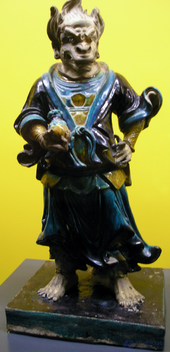
Chinese glazed earthenware sculpture «Hell Tormentor», 16th century, Ming dynasty.
Diyu is the realm of the dead in Chinese mythology. It is largely based on the Buddhist concept of Naraka combined with traditional Chinese beliefs about the afterlife and numerous popular extensions and reinterpretations of these two traditions. Ruled by Yanluo Wang, the King of Hell, Diyu is a labyrinth of underground levels and chambers to which souls are sent to atone for their earthly sins.
Having absorbed ideas from Taoism and Buddhism, as well as traditional Chinese folk religion, Diyu is a kind of purgatory that serves not only to punish but also to renew spirits in preparation for their next incarnation. Numerous deities are associated with this place, whose names and purposes are the subject of conflicting information.
The exact number of levels of the Chinese hell – and the deities associated with them – differs depending on Buddhist or Taoist conceptions. Some speak of three or four «courts», others of ten. [145] The ten judges are also known as the 10 Kings of Yama. Each court deals with different aspects of atonement. For example, murder is punished in one court, adultery in another. According to some Chinese legends, hell has eighteen levels. Punishment also varies depending on belief, but most legends speak of highly unusual chambers where criminals are sawn in half, beheaded, thrown into pits of mud, or forced to climb trees adorned with sharp blades.
However, most legends agree that once a soul (usually called a «ghost») has atoned for its deeds and repented, Meng Po gives it the Drink of Forgetfulness and sends it back into the world to be reborn, perhaps as an animal or as a poor or sick person, for further punishment.
Zoroastrianism has historically offered several possible fates for the wicked, including annihilation, purification by molten metal, and eternal punishment, all of which are mentioned in the writings of Zoroaster. Zoroastrian eschatology includes the belief that evil souls will remain in Duzakh until, after the arrival of three saviors at intervals of a thousand years, Ahura Mazda reconciles the world, destroying evil and resurrecting tormented souls to perfection.
The sacred Gathas mention a «House of Lies» for those «who belong to the power of evil, to evil deeds, evil words, an evil self, and evil thoughts, the
продолжение следует...
Часть 1 Hell: its features and essence in different religions
Часть 2 In literature - Hell: its features and essence in different

Comments