
Lecture
Dynamism and adaptation: The modern world introduces changes into traditional religious structures, which leads to the emergence of new approaches in the interpretation and practice of faith. Alternative movements often form as a reaction to these changes.
The influence of globalization: The rapid spread of information and cultural interactions contribute to the emergence of syncretism — the blending of traditions. This is characteristic both of the evolution of religions and of new religious movements.
Reaction to contemporary challenges: Both themes address how religious systems and movements adapt to the challenges of modernity — technological changes, scientific discoveries, and shifts in societal values.
The search for identity and meaning: People seek new forms of expressing their spirituality, whether through reforming traditional religions or creating innovative and unconventional practices.
The individualization of faith: Increasing attention is being paid to personal spiritual experience rather than adherence to strict dogmas. This is noticeable in alternative movements and new forms of religious belief.
The history of humanity and the history of religion testify to continuous changes in the religious sphere. Types of religions changed, various forms of national religions disappeared, world religions strengthened and developed, and changes occurred within the religions themselves. This process of change in the forms of religion among different peoples and in different regions did not always occur peacefully. Thus, the history of the spread of Christianity, as well as of Islam, testifies to the violent displacement of old beliefs during the conquest of countries and peoples.
It suffices to recall the Arab conquests of the 7th-8th centuries in Palestine, Syria, Egypt, Central Asia, North Africa, and the Iberian Peninsula, during which the religion of Allah was imposed on subjugated peoples under the banner of holy war. During the colonial development of Latin America and other «pagan» lands, Christianity was forcibly imposed. The establishment and spread of Protestantism in the states of Western Europe was more complex and ambiguous, often accompanied by real military clashes and bloodshed. Thus, various evolutionary and «revolutionary» processes have taken place in the history of religion.
The evolution of religion, in the broad sense of the word, can be understood as a relatively peaceful, gradual process of changes, appearing both in the emergence and disappearance of various forms of religion, in the mutual influence of different religions, and in the form of changes within a particular religion occurring under the influence of changing social relations. Evolution can be assessed as an objective historical process, independent of the will and desire of people, although proceeding through the struggle and clashes of representatives of various organizations. In this process, the personal qualities of the founders of various religious movements cannot be ignored.
The evolution of religion is now recognized by both theologians and religious scholars. The efforts of religious scholars, ethnographers, archaeologists, and historians of various countries since the mid-19th century have played an important role in establishing the view of religion as a historically changing cultural phenomenon.
The modern era, with its ever-accelerating pace of change acquiring a global character, more clearly reveals the relationship between the development of scientific knowledge, scientific and technological progress, changes in people's way of life, and the evolution of religion. Of course, this relationship should not be oversimplified, and even less should it be claimed that with the development of science the sphere of influence of religion automatically narrows, or that some scientific or technological achievement is evidence in favor of «refuting religion». For example, in the 1950s-60s there was much talk (even among theologians) of a «crisis of religion» in the modern world; such judgments reflected some reality, but it is hardly legitimate to speak of a «global crisis» of religion.
In reality, the relationship between the evolution of religion and the development of science, technology, social relations, and people's way of life is more complex and mediated; it manifests specifically at different levels of religious consciousness, cult, and religious activity. The fact is that a person lives not only in the natural world, but also in the world of «second nature», in the world of material and spiritual culture created and changed by people themselves. By transforming it, a person changes himself, his views and ideas, habits and customs, and the norms of relations between individual people and peoples. All this cannot fail to be reflected in religion, in changes to all its components, since both believers and theologians live in this same changing world. The changes that have taken place in recent years are global in character; they affect all countries and peoples living in different corners of the globe.
The current stage of the scientific and technological revolution, which began at the turn of the 1970s-80s, opens up broad prospects for the development of society's productive forces. The leading directions of this stage of the STR are new scientific and technical branches such as microelectronics, informatics, robotics, biotechnology, and the creation of materials with predetermined properties. Research continues into the possibilities of creating new sources of energy, including thermonuclear fusion energy. On the basis of scientific and technical achievements, as they spread to different regions of the world, the interconnection and interdependence
of all economic, social, and political processes in the world intensifies. It can be said without exaggeration that the rapid scientific and technical development is accompanied by equally significant socio-political processes. The political map of the world is changing fundamentally. Colonial countries have almost disappeared, and states and unions of states that until recently belonged to dependent countries — India, Indonesia, the countries of the Arab East, Brazil, and others — have emerged onto the world stage as an influential political force. All these scientific-technical and socio-political changes lead to changes in the way of life of different peoples, in their consciousness, including in the sphere of religion.
One of these notable changes is the process of secularization, which is most clearly manifested in the developed countries of Europe and makes itself felt in other countries and regions. In medieval Europe, the term «secularization» meant the conversion of church or monastic lands into state property. The same term was used to denote the transfer of certain functions from ecclesiastical jurisdiction to civil authorities. At present, secularization is understood as a complex, multifaceted process of freeing various spheres of society and culture from the dominance of religious institutions and symbols.
If we are speaking of institutions and societies belonging to the recent history of the West, secularization here manifests itself in the loss by the Christian church of spheres formerly under its control or influence: in the separation of church from state, in the expropriation of church landholdings, in the liberation of the education system from the power of ecclesiastical authorities. If, however, we speak of culture and symbols, then secularization is understood as something greater than a social process. It affects the entire integrity of the cultural life of society. It can be observed in the decline in the growth of religious themes in art, philosophy, and literature, and, most importantly, in the development of science as an autonomous, purely secular view of the world. The process of secularization also has a subjective side: alongside the secularization of society and culture, there also exists the secularization of consciousness. This means that modern society is producing more and more individuals who, in their attitude toward the world and toward themselves, do not make use of religious ideas.
If secularization is regarded as a global phenomenon characteristic of the modern era, it is evident that this process proceeds unevenly throughout the world. It affects different groups of the population differently. Specialists' research shows that men are more susceptible to the influence of secularization than women, middle-aged people more than the young and the elderly, city-dwellers more than rural residents, and representatives of social strata directly connected with modern production more than people engaged in more traditional labor, and so on.
One of the most obvious effects of the secularization process at the beginning of the century was a «crisis of trust» in religion. It can be said that secularization was the result of a widespread disillusionment with the truth of traditional religious definitions of reality. If a modern person shows indifference to questions connected with religion, he objectively encounters a multitude of religious and non-religious authorities, each of which defines reality in its own way. These authorities struggle among themselves, contesting attention to their own positions against religious definitions of reality.
At present, in many developed countries of the world, the church is separated from state structures. Law, politics, economics, science, and art, in carrying out their functions, increasingly appeal not to this or that dogma, but mainly to the «worldly» interests of the individual, of society, of particular social groups. Thus, the United Nations, as an international body uniting almost all the states of the globe, proclaims in its Charter and Declaration of Human Rights, as one of the most important principles of its activity, ensuring the rights of the individual to decent living conditions regardless of racial and religious affiliation. International organizations have adopted declarations recognizing a person's right to choose a non-religious worldview, as well as their right to religious choice.
All these factors indicate that it is now possible to speak of the fact that, alongside various forms of religious worldview, a non-religious, secularized worldview is also forming and developing. It does not constitute an internally coherent system, and what essentially unites it is a single trait — non-religiousness. At different levels of social consciousness, the degree, depth, and awareness of this non-religiousness vary, and it is quite difficult to determine the general characteristics of such a worldview. Its main feature is probably the intuitive awareness, the sense of the growing role of the human being himself in changing all the conditions of his existence. For such a worldview, the basic principle of value orientation becomes the recognition that the chief value for a person is the person himself, regardless of his attitude toward religion. At the theoretical level, this worldview is represented by a multitude of different currents, trends, and philosophical concepts. Among them one can distinguish natural-scientific, sociological, and anthropological directions.
The most general name, established in the literature, for all representatives of this non-religious worldview is «freethinkers». In addition, they also use such concepts as «agnostic», «skeptic», «atheist», «secularist», «humanist», and others to designate their positions. At the same time, the most general features of this secularized worldview are humanism and an orientation toward science. Among the freethinkers well known to the domestic reader, one can name L. Feuerbach, S. Freud, B. Russell, A. Camus, J.-P. Sartre, and others.
Thus, for most of human history, religion held a monopoly on the right to regulate individual and social life. At present we are witnesses to the fact that secularization is leading to the formation of a radically different situation — a situation of pluralism. This situation, by demonopolizing religion, makes it difficult to preserve viable religious structures and to create new ones. Within modern society, it is becoming increasingly difficult to preserve religion's former positions, as well as religious beliefs as eternal and unchanging truths. Taken together, these phenomena form a «crisis of trust» in religion.
The pluralistic situation leads to an increase in the number of diverse, mutually competing religious structures. Religion is increasingly becoming a «matter of individual taste», a matter of subjective preference, and religious traditions are losing their character as universal symbolic systems.
At present, religious organizations have two possibilities. They can either adapt to the situation, or try to preserve their viability in the face of numerous competitors. Neither option can be realized without solving the problems that together constitute what is called the «crisis of religion in modern society».
The evolution of religion in the modern era is also manifested in the weakening of the influence and authority of traditional forms.
By traditional religions we mean religious complexes that have survived over a long period of time and are passed down to succeeding generations within a particular territory, among a particular ethnos and community of people. They are revived and develop within the framework of corresponding ethnic or state borders. Traditional religions are deeply rooted in daily life, in the system of festivals and rites, in the type and manner of thinking, in culture, in psychology.
The mid-20th century was marked by the appearance of a significant number of new religious movements, organizations, and cults, which in the literature are most often called non-traditional religions. The concept of «non-traditional religions» refers to religious complexes that are not historically inherited from past epochs by a particular ethnos, are not characteristic of its religious spirituality, and are not rooted in daily life or culture, but have spread as a result of the missionary activity of preachers from their historical homeland.
The question of the emergence of non-traditional religions is quite complex. It cannot be linked to any single political, social, or ideological process. Among the primary causes must be counted the global problems of humanity. To varying degrees, the danger of wars, ecological problems, and the demographic factor become sources of negative moods: feelings of pessimism, of the hopelessness of life, and psychological sensations of the fragility of the surrounding world. A complex of social causes (the impossibility of establishing harmonious relations in society, of realizing humane ideals) has created favorable conditions for the spread of non-traditional religions, which promise everyone personal salvation and boundless possibilities for moral self-perfection and self-expression. The social causes of non-traditional religiosity have both given rise to and now continue to reproduce certain social needs. Non-traditional religions, like religions in general, perform compensatory, worldview-forming, regulative, integrative, and communicative functions.
Non-traditional religions often seek, in an illusory form, to compensate for the need for contact, communication, and spiritual closeness through a specific way of life in a religious commune that isolates a person from the whole diversity of social ties. The breakdown of the family, the decline of parental authority, and a deficit of love find their alternative in the creation of a cult of a charismatic leader, in boundless veneration and recognition of his unquestionable authority. Complete submission to the charismatic leader and dependence on the religious group, under conditions of isolation from other authorities, transform the religious worldview into a social, moral, and epistemological ideal that determines the person's behavior, thoughts, and feelings. It is this circumstance that determines the path toward fanaticism traveled by adherents of non-traditional religions. The result of such an ideological transformation is social passivity and indifference, to achieve which violence against the psyche, control over thoughts, and an abrupt breaking of the way of life are carried out.
Quite widely used in characterizing new religious movements is the concept of a «non-traditional cult». This concept refers to an authoritarian, hierarchical organization that practices deceptive recruitment and resorts to the use of mind control in order to keep its adherents dependent on and submissive to the doctrine and to the leaders, who deliberately deceive them in order to bind them to themselves.
Unlike world religions, non-traditional cultures have different forms and organization, namely, centers, missions, colonies, communes, families. They do not follow traditional church worship. All believers are expected to take part in cult practice; diligent assimilation of the new doctrine is required of them, though special attention is devoted to missionary work and to replenishing the budget of the religious organization.
The most general characteristics of non-traditional cults are as follows:
How can one explain that certain categories of people willingly associate themselves with the activities of non-traditional cults? Here it is worth noting that every cult is a close-knit collective, inspired by group goals. Upon joining it, a person feels like a particle of a common home, is freed from a sense of loneliness, and becomes attached to those values which, in his opinion, have long been forgotten by the surrounding world. The leaders of the communities, understanding the appeal of such feelings and moods, persistently advertise their organizations as oases of genuine humanity, saving colonies of the elect. Such appeals attract people tormented by the indifference and callousness of those around them. This is aided by a carefully worked-out system of recruitment on the streets, at train stations, stadiums, clubs, and in educational institutions.
Contemporary literature devoted to the analysis of non-traditional cults does not provide a unified classification of them.
The most substantial approach seems to be the principle of typologizing non-traditional cults from the standpoint of their affinity to one or another religious tradition. In this case, four basic types of non-traditional religiosity are distinguished: evangelical (neo-Christian) teachings, Eastern cults, occultism, and pseudo-scientific (science-like) beliefs. Of course, such a typology is to some extent conventional, but it helps one orient oneself in the kaleidoscope of non-traditional cults.
One of the best-known new religious movements in the CIS countries is the «White Brotherhood» movement. Its activity, beginning in 1990, had a markedly antisocial orientation and caused a wide resonance in the press.
However, no serious scholarly study of this organization has been conducted. This is perhaps explained by the fact that the «White Brotherhood» is an example of a closed-type sect whose inner life was not publicized.
The movement calls itself the «White Brotherhood». Under this name there once existed a mysterious organization of holy teachers, the «mahatmas», hiding from the world in the depths of the Himalayas. They considered their main task to be watching over the development of humanity's movement, so as to come to its aid at a critical moment and not let it perish. In the 1920s, the «White Brotherhood» appeared in Bulgaria; at present its center is located in France (the city of Nantes) headed by a certain Aivanhov, author of numerous writings devoted to the ideas of the brotherhood.
In the CIS, the «White Brotherhood» began its activity initially in Ukraine. Its real leader, organizer, and coordinator was Yu. Krivonogov, and his assistant was Marina Tsvigun. The movement has a second name — «Yusmalos». This abbreviation is decoded as follows: YUS — Yuann Svami, a pseudo-Eastern distortion of «John the Holy» (the Baptist), a name assumed by the leader of this organization. MA — Maria Devi Christ, likewise from the distorted «Virgin Mary», she being the living incarnation of Jesus Christ and simultaneously his mother and bride. LOS — short for «Logos» — one of the hypostases of God. Thus the abbreviation, as it were, encapsulates the idea of a new divine Trinity, and is simultaneously used by members of the organization as a mystical mantra formula, which, when repeated rhythmically, is capable of putting the believer into a trance. Interestingly, in literal translation from Latin the word «yusmalos» means «teaching of evil». The leaders of the «White Brotherhood» demand that believers, in the name of the coming salvation, leave their families and abandon their jobs and studies in order to preach the new teaching throughout the world together with the monastic brotherhood. By now the leaders of this organization, Yu. Krivonogov and M. Tsvigun, have been arrested for their inhumane activity and convicted on the territory of Ukraine.
Among the non-traditional cults of the evangelical type one can include the «Bogorodichny Center», which calls itself both the Church of the Most Holy Transfiguring Mother of God and the Church of the Third Testament, and the Church of the Spirit of the Paraclete. According to the testimony of the paraclites (as adherents of the «Bogorodichny Center» call themselves), in 1984 in Smolensk, Father John, the founder of the community of paraclites, received a revelation of the Mother of God from the icon of the «Hodegetria». Since then, Father John has periodically experienced moments of insight, which take the form of prophetic books. The paraclites are given to understand that these books have a special character, distinct from other Christian revelations. It is precisely these prophetic books that, at the end of the world, are supposed to bring salvation to their devotees. In words, members of the «Bogorodichny Center» do not separate themselves from either Orthodoxy or Catholicism, yet their teaching clearly stands in contradiction to the doctrines of both Christian traditions.
The most widespread movement among non-traditional cults is the Unification Church, whose founder was the Korean Sun Myung Moon. At present the Unification Church operates in 130 countries, with a broad network of various international organizations. For members of this church the sole authoritative book is the «Divine Principle» — a new interpretation of the Bible drawing on one of the Eastern religions — Taoism. According to this theory, everything at its base possesses a positive and negative, a masculine and feminine principle. The duality of the universe begins with God and permeates all creation. According to Moon's teaching, human beings do not fully embody the greatness of God. The reason is that Eve, out of inexperience, sinned at the age of 15 with Satan, who had taken the form of a serpent, and therefore could not bear «perfect offspring» from Adam. Her sin forever poisoned the human race and doomed it to prolonged suffering. Like Adam and Eve, Christ (the second Adam) was born sinless, but could not enter into marriage with a perfect woman, since he was betrayed by his own people and crucified. The «Third Adam», or the new Christ of the second coming, was, according to Moon's prophecies, to appear in the 1980s in order to unite all nations. The Third Adam is Moon, who is paving the way for the messiah.
As we can see, the «Divine Principle» contradicts the basic tenets of the Bible and is not a revelation of God, but Moon's own opinion. In the activity of the Unification Church another feature of non-traditional cults is manifested — namely, the close intertwining of religious and financial-entrepreneurial activity, each complementing the other,
Among the diverse new cults, a special place is occupied by the society «Krishna Consciousness», as the most uncompromising and radical movement of a monastic type. It propagates a doctrine and a system of ritual practice in which elements of scientific knowledge and prejudices are fused. In addition, the society is alien to authoritarianism; the communities are governed by a Council of the society, to which the most venerated mentors are elected. The society «Krishna Consciousness» appeared in the USSR at the beginning of the 1970s. At present, in the CIS countries there are approximately 15 thousand believers organized into religious associations. Its members are mainly young people of various nationalities, of different social backgrounds and levels of education — engineers, physicians, journalists, workers, and students.
According to its charter, members of the society «Krishna Consciousness» enjoy autonomy in their activity. Their relations with the spiritual teacher (guru) are built on the principles of unity of doctrine, the necessity of communion with the spiritual teacher, and the independence of the society in resolving administrative and economic matters. The beliefs of the society are Hindu. It adheres to traditional monistic pantheism, according to which all gods are forms of the Absolute God Krishna. Krishna is the life of all living beings, a living essence which, being a small part of the Supreme Lord, is his qualitative part.
Salvation can be attained through a series of deeds. To be rid of ignorance, one must diligently repeat the name of Krishna, listen to and sing his praise, repeat the name of God while counting beads, and also repeat the mantra 1,728 times a day. For salvation, self-renunciation of the material and the offering as sacrifice of water, rice, flowers, and other objects are necessary. At the end of life a person must think only of Krishna, and this will help him attain the ultimate goal — to merge with the divine and rise to the «spiritual heaven».
The religious corporation Aum Shinrikyo, founded in 1986 by the preacher Shoko Asahara, a former restaurant owner, is quite active. According to his followers, Shoko Asahara, by practicing Buddhism, yoga, and Taoism, attained the highest enlightenment and liberation of the soul, which means the attainment of absolute happiness, freedom, and joy. He found the way to enter nirvana and became free in his desire to leave the physical shell of his body at any time and place, and mastered supernatural powers. But being a great soul, he could not be happy alone, while other souls lived in a world of suffering. He realized that his mission was to spread the Truth for the sake of the happiness of other people.
Until recently, Aum Shinrikyo was active not only within Japan, but also in other countries of the world. However, the unlawful actions of members of this organization, connected with the use of poison gas in the Japanese capital, outlawed the existence of Aum Shinrikyo.
Standing apart is the supra-confessional syncretic religion «Baha'ism», which arose in the 19th century on the basis of Islam and was founded by Baha'u'llah (Husayn Ali Nuri). His descendants still lead the Baha'i church to this day. Baha'is believe that each successive prophet does not reject but complements the previous one. In all, they venerate nine prophets, including Jesus Christ, Buddha, Krishna, and others. In the Baha'i temple there are nine doors — corresponding to their number. Ritual is reduced to a minimum, and they have no priesthood. The Baha'i religion teaches one «to reject nothing» from the religious experience of humanity. Followers of this religion advocate for the abolition of state borders, for a single world government, and against national cultures and languages
The headquarters of the Baha'is is located in Israel, in the city of Haifa. In Muslim countries this church is banned. The teaching of the Baha'is is popular among the creative intelligentsia and youth in Europe and the USA.
In many countries of the world there operates the so-called Church of Satan, which traces its origin to the medieval East. Satanists consciously present themselves as bearers of evil and commune in prayer with the devil. The main enemy and antipode of the Satanists is Christianity. There is a widespread belief that they consider the killing of Christian priests and monks permissible. At the same time, it should be noted that there are more rumors and legends about Satanists than there is real information.
The overwhelming majority of non-traditional religions seek to reach young people. It is precisely young people who constitute the social group among whom the main missionary work of seeking new members is conducted. In non-traditional religions, young people are attracted by a peculiar romanticism, a system of secret initiations, the exoticism and extravagance of Eastern cults. The level of education among their followers is quite high: persons with an academic degree or higher education make up on average 30-40%, while those with secondary or incomplete higher education make up 50 to 70%. Another feature of the new cults is an increase in the number of men within the composition of communities, especially in the leadership and activist core of the organizations.
At the end of the 20th century, Russia has seen a rapid spread of new religious movements. This is to a large extent connected with a complex of social causes that gave rise to a sense of the hopelessness of life and the impossibility of establishing harmonious relations in society and realizing humane ideals. In addition, their emergence and spread are caused by mass secularization, the indifferent attitude of traditional systems toward the difficult lot of fellow citizens, and the schisms and internal strife of traditional religions, which inevitably give rise to disillusionment among ordinary believers, some of whom try to find answers to complex questions and consolation outside the traditional religions.
New religious movements, possessing considerable experience in missionary activity and material resources, are gradually crowding out Orthodoxy, increasing the body of their adherents not only from among unbelievers, but also from among the Orthodox. Thus, according to sociological research data, 21% of Orthodox believers show interest in missionaries' appearances before mass audiences, 36% assess them positively, and more than 30% of Aum Shinrikyo's followers are people who once considered themselves Orthodox.
The dynamics of change in the number of followers of non-traditional religions in Russia shows that in recent years the pace of their growth has sharply increased. The increase in their numbers occurs at the expense of an outflow of believers from traditional religions. The leadership of the Russian Orthodox Church, appealing to public opinion and to official structures of power, emphasizes the erosion of the fundamental foundations of the people and their cultural-national identity. This position finds a certain sympathy among Muslim, Buddhist, and Jewish organizations, which to one degree or another also suffer from the activity of foreign missionaries, who bring in a spirit alien to the mentality of their flock, corroding the structural integrity of their institutions. In order to regulate the religious-missionary activity of new religious movements on the territory of Russia, the state must adopt a number of measures, both legislative and organizational.
Assessing on the whole the spread of non-traditional religions and cults in the world, it can be noted that they have fertile ground for their existence owing to the peculiarities of the socio-economic and political life of contemporary society.
Cargo cult, or the cult of cargo (from English cargo cult — worship of freight), also known as the religion of airplane-worshippers or the cult of Heavenly Gifts — a term used to designate a group of religious movements in Melanesia. In cargo cults it is believed that Western goods were created by the spirits of ancestors and intended for the Melanesian people. It is believed that white people gained control over these items dishonestly. In cargo cults rituals are performed resembling the actions of white people, in order to increase the number of these items. The cargo cult is a manifestation of «magical thinking», and can also serve as an illustrative example of the third «Clarke's law».

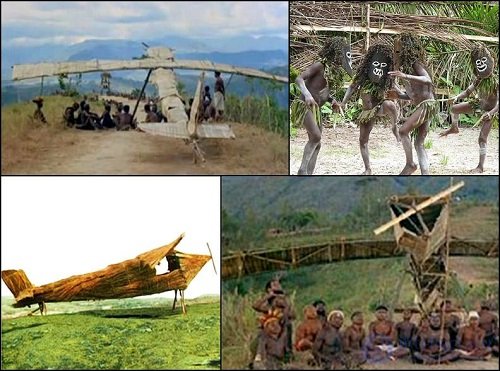
The cargo cult — worship of cargo, namely boxes of humanitarian aid; this movement originated among the natives back in the late 19th century, but gained popularity during the years of the Second World War, at a time when American military bases were located on the islands. the natives, who had never seen the benefits of civilization, watched the soldiers with interest; they discovered that a large bird regularly flew to the islands and brought divine gifts . flashlights, lighters, and cans of stewed meat and firewater. although the white people did not seem to do anything useful, only put on strange
headphones, shouted something incomprehensible into a tube, lit fires, and waved flags.
When the war ended, the Americans flew away on their iron birds; several years later anthropologists made their way to Melanesia and discovered that
the local inhabitants had organized a new cult — they began building wooden airplanes, made themselves headphones out of coconut halves and
shouted something into bamboo microphones, and sometimes they diligently marched with wooden rifles in their hands, their bodies painted to look like American military uniforms.
The inhabitants of the Yaohnanen tribe living in Vanuatu practice the cult of Prince Philip the husband of the British Queen Elizabeth II; the islanders believe that the Duke of Edinburgh is a divine being, the pale-skinned son of the spirit of the mountain; according to ancient legends, the son went off on a distant journey, married, and would soon return. The island's inhabitants, seeing how Queen Elizabeth II was respected as an official personage, came to the conclusion that her husband, Prince Philip, was that very son from their legends. When Prince Philip learned of the movement's existence, he graciously agreed to meet with its leaders and even presented them with photographic portraits of himself.

In the USA in the seventies, the community Heaven's Gate was founded; the creator and ideologist of the community was Marshall Applewhite. he considered himself a heavenly messenger or an alien from space, and his main mission was to bring people home, that is, to the next world. the physical body of a person was considered a container for the soul of an alien; the followers of Marshall Applewhite also considered themselves extraterrestrial beings and called themselves body-snatchers. sometimes in everyday usage the words cyber-monk and cyber-nun were used; all the adepts of the community lived together in spartan conditions — several people slept in one bed, they were strict vegetarians and often subsisted on juice and water, and they were keen on ufology. every night they went out to watch for UFOs. they tried carefully to smooth over gender differences: both men and women were cropped short and wore baggy jumpsuits. at the same time, the men underwent physical castration. the finale of the story turned out to be predictable and tragic; the commune existed for 21 years.
and in 1997 members of the organization, consisting of 39 people, committed suicide — taking a huge dose of sleeping pills, in order to travel to the so-called supra-human civilization back home — in space.
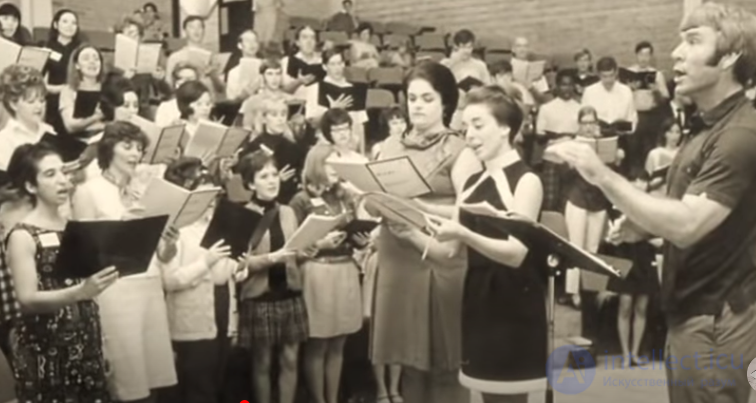

Raelians (the Raelian movement) — followers of the movement of Raelism, who hold that life on Earth was created scientifically by representatives of a highly developed extraterrestrial civilization, who transmitted to us their decisive message, debunking the myths about our origin. Raelians call the representatives of this civilization the Elohim. The movement was founded in 1973 in Geneva by the French journalist Claude Vorilhon (the so-called Rael).
Claude Vorilhon was an ordinary race-car driver and tried his hand at sports journalism, but in 1973 his life changed dramatically: an alien allegedly appeared to him and invited him aboard his ship. there the alien announced to Vorilhon that he was a representative of an extraterrestrial civilization and had come to help earthlings; the alien then gave the journalist a new name — Rael, which means messenger from the heavens; the former race-car driver became the leader of the international Raelian movement. today this organization numbers more than 50 thousand members in 85 countries around the world. adherents of Rael's theory believe that life on earth was created through genetic engineering . for this purpose, scientists from the Elohim tribe flew to earth from another galaxy in order to create life; according to Rael, the Bible was translated incorrectly. Christ was not resurrected at all, but was
cloned. for it is precisely cloning that is the key to eternal life. the former journalist claims that the day is not far off
when man will live 700 years. members of the Raelian movement created a large company, Clonaid,
which is engaged in commercial activity ranging from cloning to artificial insemination. members of the organization do not create any
special community settlements; Rael believes that
one must independently develop in one's professional sphere
in order to contribute money to the movement.
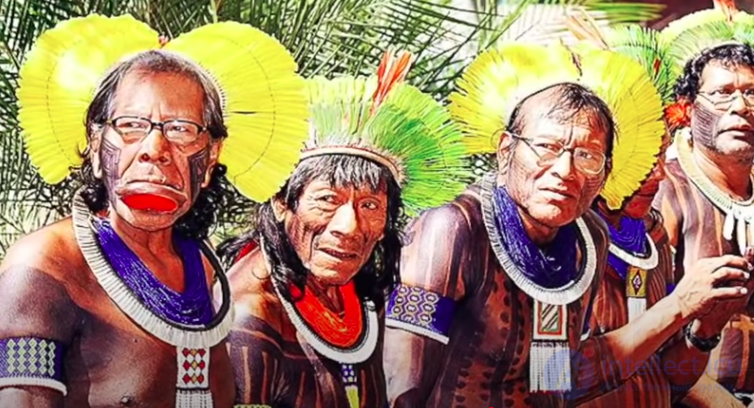
In Brazil there lives an ancient Indian tribe, the Tapirape; like most Indians they practice shamanism, and at the same time they deify parasites. According to representatives of the tribe, the spirits that created the surrounding world settled inside parasites. In order to watch over a person from within. If a person has become infested with worms or lice — this means that purification from sins awaits him, since this person carries God upon himself, and if a person tries to rid himself of parasites he is called abandoned by the spirits and is expelled from the settlement.
One of the most absurd religious organizations, Nuwaubianism — its founder Dwight York — a former rap performer who, under the pseudonym Dr. York, sang decent lyrical songs. In the 1970s York created a Muslim group and began spreading his strange religious doctrines, made up of medieval myths and misconceptions; for example, according to York's teaching, a woman who has given birth to a child is obliged to bury the placenta, otherwise Satan will make clones out of it. At the same time, York and his followers opposed abortion, but not at all out of any ethical considerations, but simply because embryos continue to live in the sewer system and could in the future take over the world. According to the teaching of the former rapper, people were originally symmetrical, but after a meteorite fell, a shift in the center of gravity occurred, and only the right arm remained fully functional; another of Dwight York's claims was that the great inventor Nikola Tesla arrived on earth from Venus; despite the sheer absurdity and ridiculousness of Dwight York's theory, he

found no shortage of followers. And the former rapper himself amassed a considerable fortune; in 2002 the religious leader was imprisoned for money laundering and the corruption of minors. But, strangely enough, his organization continues to exist and keeps finding new members.
Pastafarianism is a social movement that appeared in 2005 thanks to the American physicist Bobby Henderson; pastafarianism comes from the word pasta, that is, macaroni; another name is the church of the flying macaroni monster; Henderson came up with this religion as a protest when the state of Kansas decided, as an alternative to the theory of evolution, to introduce the concept of intelligent design into the school curriculum. Henderson's macaroni monster is a lump of

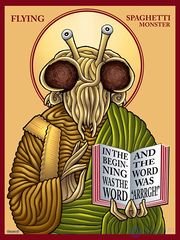
spaghetti with two meatballs instead of cheeks, which, in the founder's words, also deserves to be known in schools, since it is no more illusory than the theory of intelligent design. Henderson claims that the essence of his religion is not at all a mockery or a parody of Christianity, but a protest against creationism. for instead of remaining a religion, it tries to replace science itself. Pastafarianism has gained enormous fame throughout the world. The number of Pastafarians already numbers more than 400 thousand people. they wear colanders for macaroni on their heads. Their main commandment they consider to be save and feed. Despite its entirely unserious component, Pastafarianism has official status and the same legal rights as other religious movements.
6) Freemasonry (franc-maçonnerie, English Freemasonry) — a movement that appeared in the form of a secret society, which traces its origin from little-known sources at the end of the 16th — beginning of the 17th century. The main version of the origin of Freemasonry is considered to be the version of its origin from medieval stonemasons' building guilds, however there exist theories of a more ancient origin of Freemasonry, tracing its beginning to the orders of the Templars or — in other versions — to the order of the Rosicrucians . The name «mason» or «franc-mason» comes from French franc-maçon (in Old French masson, English freemason); a literal translation of this name is also used — free stonemason. The ethics and philosophy of Freemasonry are based on monotheistic religions, on the ancient constitutions of free stonemasons, their regulations, statutes, and ordinances. Freemasonry symbolically uses the tools of building fraternities and the legends of the construction of Solomon's Temple to express metaphorically what is described, both by Masons and by their critics, as «a system of morality veiled in allegory and illustrated by symbols». The religious beliefs of a candidate are a matter of his conscience. Upon initiation, the candidate takes an oath on the sacred book of the religion he professes; this may be the Bible, the Quran, the Torah, and so on. Usually the candidate belongs to one of the traditional religions, correspondingly Christianity, Islam, Judaism, and so on (in lodges enjoying recognition as regular), however in some lodges of liberal Freemasonry the requirements regarding a candidate's faith are relaxed, admitting a candidate who adheres to deism or to God as an abstract principle, an idea-symbol, as in the Grand Lodge of France, or are abolished altogether, and atheists and agnostics may be admitted to the lodge. A negative attitude toward Freemasonry is expressed by individual representatives of religious associations, political parties, and adherents of conspiracy theories. Despite Freemasonry's emphasized distancing of itself as a whole from politics and religion, criticism of Freemasonry is often based on exposés of a religious or political character, or on actions such as the Leo Taxil hoax
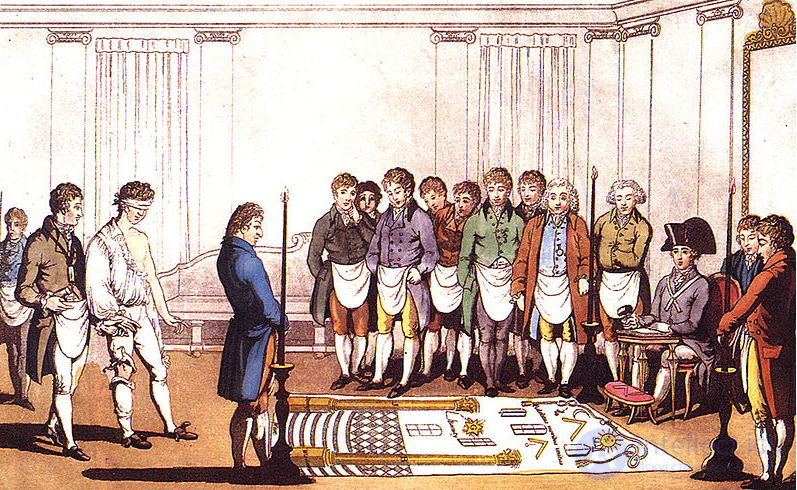
Initiation ritual
The attitude of Christian churches and religious movements toward Freemasonry differs. Despite the presence and activity of Masonic lodges in Catholic countries, the Roman Catholic Church expresses a negative attitude toward Freemasonry. In 1738 Pope Clement XII declared an interdict against Freemasonry, which meant the automatic excommunication of Roman Catholics from the church should they join a Masonic lodge. Leo XIII, in the encyclical Humanum Genus of April 20, 1884, condemned Freemasonry. The 1917 Code of Canon Law included a provision that joining a Masonic lodge meant automatic excommunication from the church. In 1983 a new code was adopted in which Masonic organizations are not mentioned, which created the impression that this provision had been partially relaxed by the Catholic Church. However, the Congregation for the Doctrine of the Faith issued a statement that same year, 1983, stating that membership in a Masonic lodge remains impermissible for Catholics
From Clement XII to Leo XIII, the Roman popes issued 17 bulls and encyclicals against Freemasonry , in which they characterized it as a «God-fighting sect» acting with the goal of undermining and destroying Christianity and corrupting the state and social order . In the bulls, it was noted in particular that Freemasonry is a sect preaching a doctrine that repeats the fall of Lucifer, and that the «God» of Freemasonry (the «Great Architect of the Universe») — is Lucifer himself
At present the Moscow Patriarchate does not officially express its position regarding Freemasonry. Unlike it, the ROCOR officially condemned Freemasonry in 1932, «as a teaching and organization hostile to Christianity and revolutionary, directed toward the destruction of the foundations of national statehood»
The process of secularization and the formation of a secularized worldview create a new situation for traditional religions. At present they operate in a world in which believers are subject to influence both from non-traditional religions and from the secularized worldview in all the diversity of its manifestations. Under these conditions, as a distinctive reaction to these changes, the movement of ecumenism arose and began to develop. The term «ecumenism» (from the Greek — universe, the inhabited world) is predominantly used to denote the movement for the unification of Christian churches and confessions. This movement is coordinated by the World Council of Churches (WCC), headquartered in Geneva. The WCC includes more than 300 Protestant, Orthodox, and so-called ancient-Eastern Christian communities, uniting approximately 450 million believers from more than 100 countries.
Ecumenical contacts are also carried out at the level of «international confessionalism» and «interconfessional associations» within the framework of a single country. Among international associations organized by confessional affiliation one can name such Protestant organizations as the Lutheran World Federation, the World Presbyterian Alliance, and others. Among associations within the framework of a single state, let us name the National Council of Churches of Christ in the USA, and the British Council of Churches. Within the ecumenical movement operate such organizations as the Conference of European Churches, the Pacific Conference of Churches, and the All Africa Conference of Churches. Although the term «ecumenical movement» arose within Christianity, it cannot fail to be noticed that analogous processes are occurring in other religions as well. There exist the World Islamic Congress, the World Muslim League, the World Fellowship of Buddhists, and others.
At present a great many church and non-church organizations are engaged in ecumenical activity. Interregional contacts, initiated by representatives of various confessions, are constantly being carried out throughout the world.
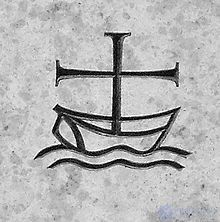
At the end of 1961, the Russian Orthodox Church joined the ecumenical movement. Since then its representatives have taken part in the activity of the World Council of Churches: they sit on the central and executive committees of this international organization, and take part in ecumenical assemblies, conferences, and symposia. An understanding of the need to develop the movement for the unification of Christian confessions is now shared by most leaders of the Russian Orthodox Church. The spiritual ailments of society, the problems of the family, of poverty, of lonely old age, of the humanization of the individual and of interpersonal relations under conditions of a «wild market», of local armed conflicts, of ecology, and other problems cannot remain outside the attention of the church. It was precisely to these problems that the conference «Christian Faith and Human Enmity», held in Moscow in 1994, was devoted.
In order to ensure coordinated action in social service, and also to resolve problems and disputed questions that might arise among Christians, the conference deemed it advisable to create a permanently functioning mechanism of inter-Christian cooperation.
Under the new socio-political conditions, the ecumenical movement began to acquire a different content, character, and scale. First, it became a matter of the free choice and self-expression of its participants. Second, it is becoming filled with more adequately, properly religious content, becoming, as it were, a natural continuation of the processes taking place within the confessions themselves. As a result of this, the former globalism of the subject matter and the solemn-declarative character of its treatment have given way to significantly more concrete, practically significant questions requiring concrete solutions. Third, the ecumenical movement is ceasing to be the prerogative of a narrow circle of leaders of religious associations; grassroots clergy and ordinary believers are being drawn ever more widely into it.
The religious situation in the CIS countries is undergoing serious changes. A feature of the life of post-Soviet society in recent times has been a significant increase in the number of believers, as well as a growth in sympathy toward religion. Some specialists consider this a return to lost values. Others see in this process an attempt by people to overcome, with the help of religion, the moral and social ills of contemporary society. Still others regard all this as a temporary phenomenon, subject to fashion.
Sociological studies of the religious situation in Russia and Ukraine show that it has changed substantially in recent years. To the question, «Do you believe in God?», in the mid-1990s three times more people answered positively than had done so 10 years earlier. This amounted to 30% of all those surveyed. Over the same period, the number of convinced atheists fell from 25 to 10-12%. Among the population, an increase in the prestige of religious organizations has been noted; the process of forming new religious organizations continues; and there is evident an attraction to religion among people previously indifferent to it.
Connected with the democratic transformations of recent years is the restoration of historical justice with respect to religious organizations. Their social and legal status has been recognized. Places of worship and other property are being returned to the Orthodox and other churches. The legal basis for resolving this problem in Russia is formed by the decree of the President of the Russian Federation «On the Transfer to Religious Organizations of Places of Worship and Other Property» of April 23, 1993, and the resolution of the Government of the Russian Federation «On the Procedure for the Transfer to Religious Associations of Property of Religious Purpose Belonging to Federal Ownership» of March 14, 1995. As for the conditions of transfer of places of worship and other property of religious purpose, the President in his decree stipulated the necessity «of taking into account, as far as possible, the interests of culture and science, and access to them by tourists, excursionists, and all citizens». In accordance with this, the government resolution provides for the transfer to the church of places of worship and other movable and immovable property for use, either exclusively by it or jointly with institutions of culture.
In recent years, according to data from the State Committee for the Management of State Property of Russia, in accordance with this resolution, approximately 500 monuments have been transferred to the Russian Orthodox Church alone. The actual number is probably greater, since in many regions there are cases of direct transfer of cult monuments, bypassing the Ministry of Culture and the State Committee for the Management of State Property of Russia. However, within church circles the prevailing conviction is that the church should be returned absolutely everything that ever belonged to it, and that it should become the full and unconditional owner and possessor of this property. Of course, it would be a serious oversimplification to see in the difference of positions between the state and the Orthodox Church regarding the use of property of cult purpose merely material interests. At the root of the contradiction lie such fundamental divergences in the worldview positions of the secular state and the church. Whereas the church regards temple structures and other works of architecture and fine art, in accordance with their functional purpose, as bearers exclusively of the «sacred», the secular state proceeds from a broader understanding of them as general cultural values, which should be accessible not only to believers, but also to the non-religious part of society. Such a position of the state appears all the more appropriate and just given that, among the population of Russia, unbelievers, according to sociological research data, make up approximately 40%.
Beyond the importance of the changes in the spiritual sphere of the life of contemporary society, attention is also drawn to a number of negative aspects connected with the religious boom. Thus, religion is often used by certain political forces for their own selfish purposes. On the other hand, there is a growing fascination with non-confessional mysticism (especially among young people). There is evident interconfessional rivalry, and foreign religious associations, possessing enormous financial resources, are brazenly intruding into our spiritual life.
How can one explain the heightened
продолжение следует...
Часть 1 12. The evolution of religion in the modern world: new, contemporary, non-standard and alternative religious
Часть 2 1. The main trends in the evolution of religion. -
Часть 3 7. Parody religiosity - 12. The evolution of religion in

Comments