
Lecture
tests in religious studies
This test is designed to check your knowledge of religion in the context of religious studies and its role as a social institution. The test contains questions related to the basic concepts, theories, and historical facts pertaining to this subject.
Instructions:
Recommendations:
It is important to remember that the purpose of the test is to check and assess your knowledge, not to assign you to a particular level. The results can help you identify areas that require further study and deeper knowledge.
Ready to begin testing? If so, click "Start" and good luck completing the test!
Please note that this instruction is an example and may be adapted to specific requirements and test formats.
In the tests presented, choose one or more correct answers.
1. Religion as a subject is studied by (list):
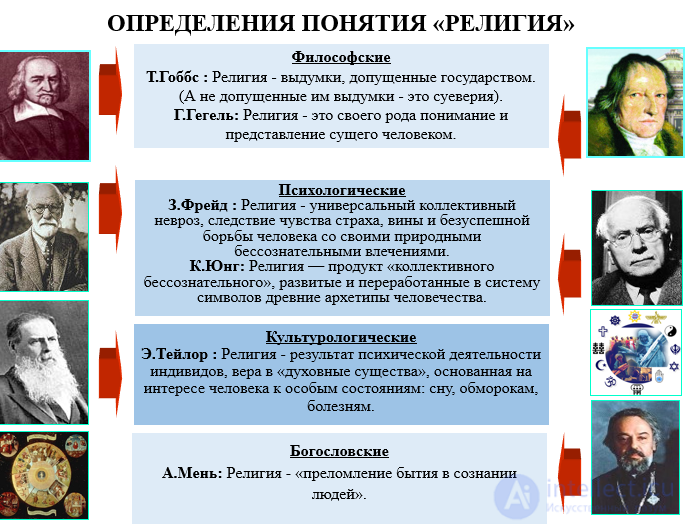
2. List the founders of Christian theology.
3. Who regarded Christian theology as a system of definite knowledge (indicate):
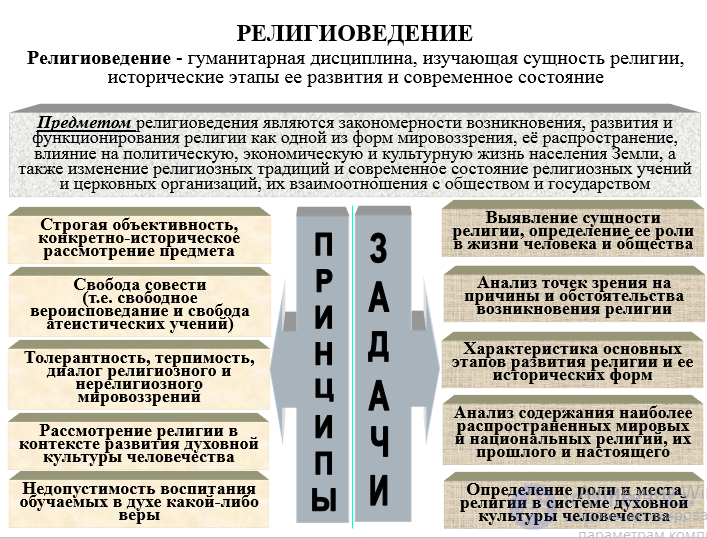
4. List what the content of religious studies includes.
5. What is the main principle of studying religious studies?
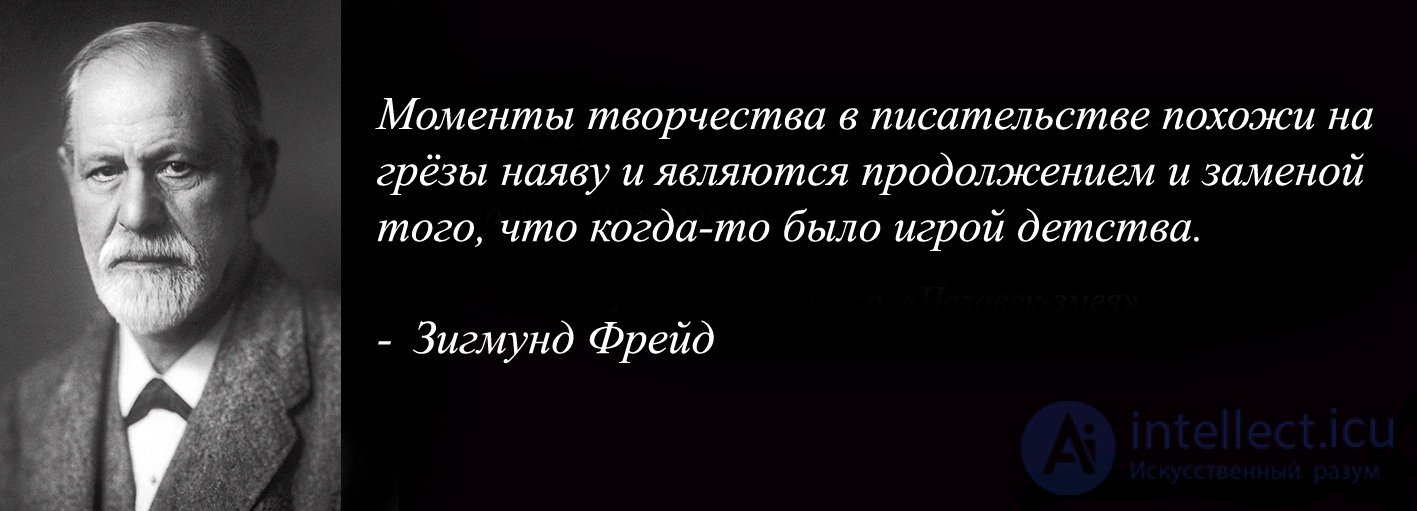
6. Which of the following scholars regarded religion as a sublimation of prohibitions?
7. Which of the following scholars believed that religion is a product of social development and social values?
8. Which of the following scholars believed that religion is a form of social consciousness?
9. According to G. Hegel, religion is a totality consisting of the following interrelated elements (list):
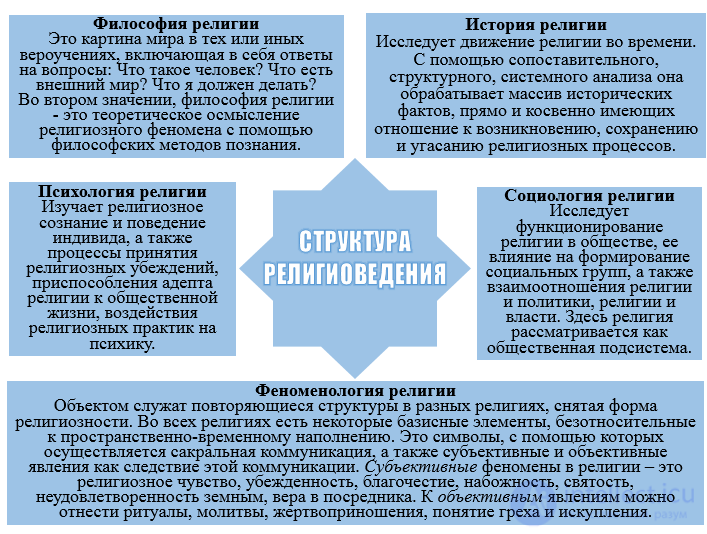
10. List the elements of the structure of religious studies.
11. Which of the following scholars believed that all religion is nothing but a fantastic reflection, in the minds of people, of those external forces which dominate them in their daily life – a reflection in which earthly forces assume the form of unearthly ones?
12. Which of the following scholars understood religion as any system of views and actions adhered to by a certain group of people, which gives the individual a system of orientation and an object of worship?
13. List the composition of religion as a phenomenon.
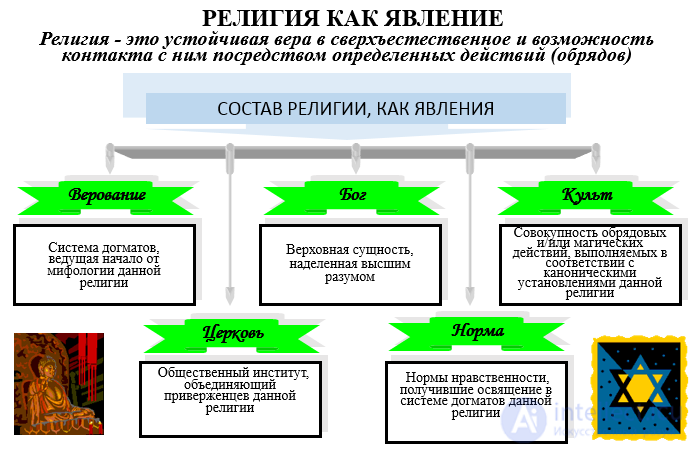
14. List the kinds of rites that exist.
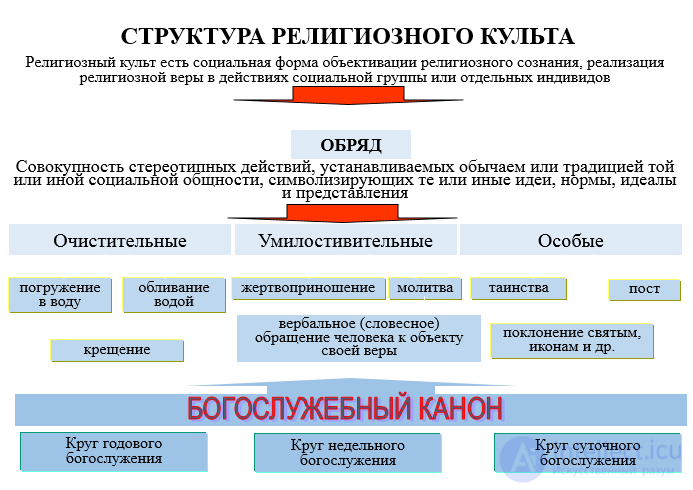
15. List the elements of the structure of religion.
16. Religious studies as a science of religion arose in (indicate):
17. Which of the following scholars believed that religion is a product of human consciousness, an individual psychological phenomenon?
18. Which of the following scholars believed that religion is given to people by some objective spiritual principle?
19. The subject of study of religious studies is the study of the emergence and development (list):
20. The philosophy of religion should be regarded from several angles as (list):
21. Subjective phenomena in religion – are (list):
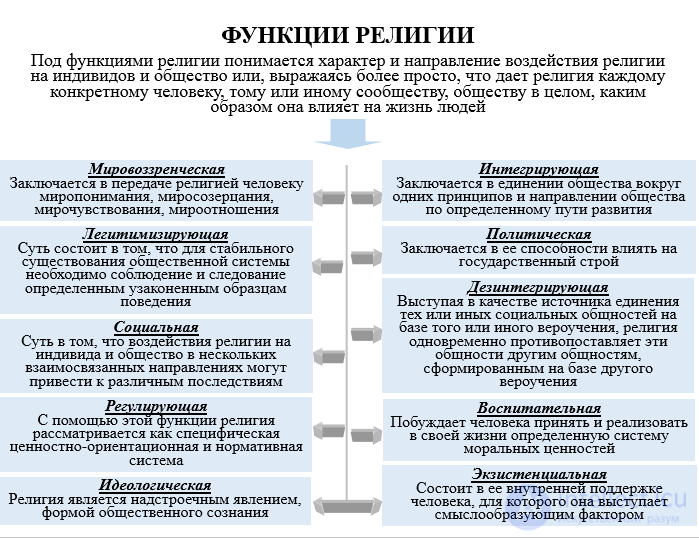
22. The function of religion consisting in its inner support of the person, for whom it acts as a meaning-forming factor, is called (indicate):
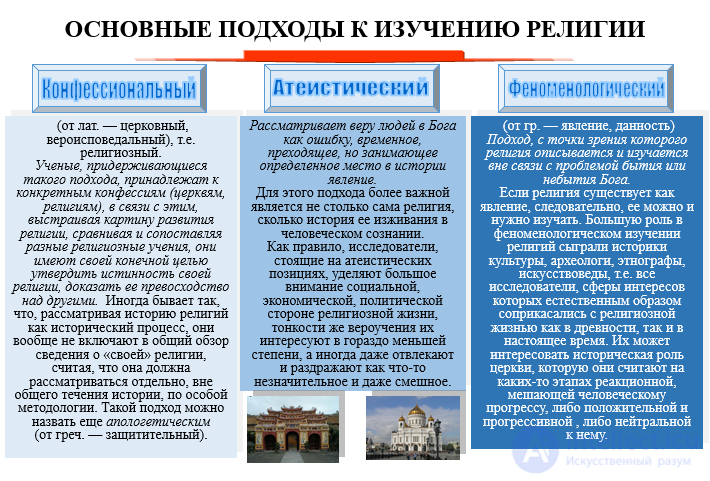
23. Among the variety of scholarly approaches to the study of religion, three main ones are used in religious studies (list):
24. The supreme being, endowed with the Supreme Reason, is (indicate):
25. Which of the Russian historians regarded the Church negatively, seeing in it a force hostile to enlightenment, greedy for money and power, and therefore dangerous to the state?
26. Which of the scholars listed below believed that religion is… «the sigh of the oppressed creature, the heart of a heartless world, ... the spirit of soulless conditions, ... the opium of the people»?
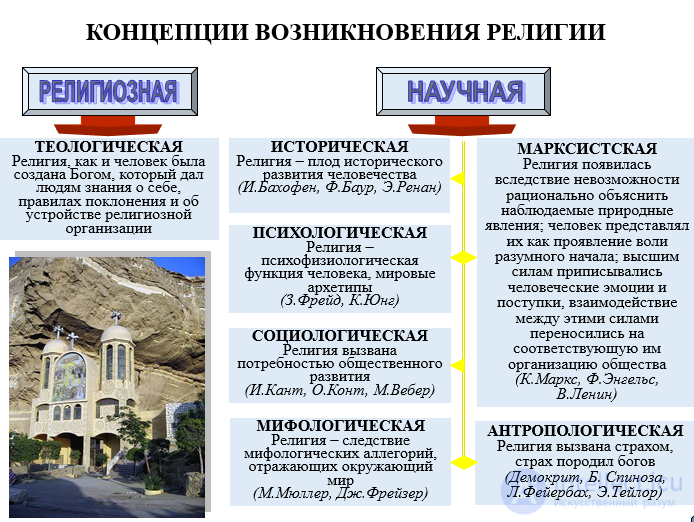
27. There are three main points of view on the process of the emergence of religion (list):
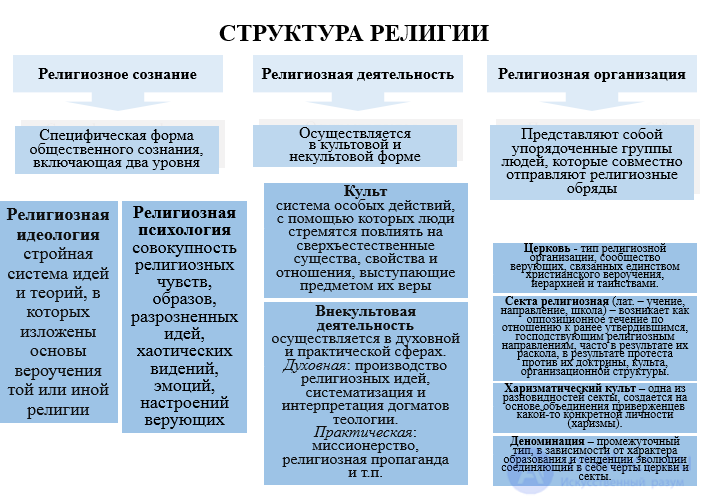
28. Structurally, religion is a system consisting of the following components (list):
29. The totality of ritual and/or magical actions performed in accordance with the canonical prescriptions of a given religion is called (indicate):
30. A social institution uniting the adherents of a given religion is called (indicate):
31. Practically all religions agree with one another on the following points (list):
32. The function of religion consisting in creating a certain system of values and norms that motivate and regulate people's behavior is called (indicate):
33. Which of the following scholars believed that religion is a kind of spiritual rotgut in which the slaves of capital drown their human image, their claims to a life at all worthy of a human being?
34. Which of the following scholars believed that religion, as a way of imparting meaning, brings «rationality» into everyday ethics as well and explains the world?
35. The function of religion consisting in uniting society around common principles and directing society along a certain path of development is called (indicate):
36. The function of religion consisting in its ability to influence the state structure of civil society is called (indicate):
37. The ideology and socio-political practice of the church as a social institution, aimed at strengthening the role of religion and the position of the church in the politics and spiritual life of society, is called (indicate):
38. List the types of religious organizations.

39. What is the process of sacralization of society?
40. List the varieties of freethinking.
41. Which science studies religion through human consciousness?
42. The function of religion consisting in religion's transmission to a person of a world-understanding (an explanation of the world as a whole and of particular questions within it), a world-contemplation (the reflection of the world in sensation and perception), a world-feeling (emotional acceptance and rejection), and a world-attitude (evaluation) is called (specify):
43. What is the secularization of society?
44. Structurally, religion appears as an integral unity of (list):
45. Religious consciousness has two levels (list):
46. The function of religion consisting in communication in the process of cultic and non-cultic activity is called (specify):
47. Religious ideas, based on faith in supernatural forces and contained in the Holy Scriptures, constitute a coherent system of conceptions of (list):
48. Religious doctrine consists of such elements as (list):
49. Religious cult is (list):
50. The subject of a cult may be (list):
51. The means of a cult include (list):
52. With the help of cultic actions, various (list) are reproduced in the consciousness of believers:
53. The primary cell of a religious association is (specify):
54. The literature identifies the following types of religious associations (list):
55. In the literature, the following functions of religion are identified as the most significant (list):
56. On the historical-cultural (chronological) basis, all known religions are divided into (list):
57. On the basis of theism (the presence or absence of the idea of God in them), religions are divided into (list):
58. Which religions place the human being, who attains a path to personal salvation, at the center of their system (list)?
59. Are the concepts of «theology» and «religious studies» identical?
60. Believers hold that God is (specify):
61. list the forms of religious doctrines

In the tests presented, fill in the blanks with the words you consider most appropriate. Observe the case and declension indicated in the sentences.
1. Theology is a systematic exposition and interpretation of religious teaching, based on the belief in the existence of …….. as the origin of all origins.
2. Scientific atheism approaches the study of …………. as a phenomenon that distorts reality.
3. Religious studies is a system of knowledge about ………., which examines it as a phenomenon of human life.
4. Freedom is a conscious …………………., a person's ability to act in accordance with their interests and goals, relying on knowledge of the laws of the surrounding world.
5. Conscience is a category of ……………, characterizing a person's ability to make a moral self-assessment of their actions and, on this basis, to adjust their activity.
6. Within religious ……………….. there exists a divine understanding of morality and all its categories.
7. Religion is a social …………., a type of worldview through which a person realizes their need to express their attitude toward one god or another.
8. Atheism represents a system of views that deny the existence of ………………. .
9. Clericalism is a socio-political ………….., seeking to strengthen the position and role of the church and clergy in the political, social, spiritual, and cultural life of society.
10. Religious studies is a science whose subject of study is ………………... .
11. The phenomenology of …………….. has as its object recurring structures across different religions.
12. The history of religion investigates the movement of ……………… through time.
13. According to the oldest and most widely accepted explanation, religion is a relationship between …………… and man.
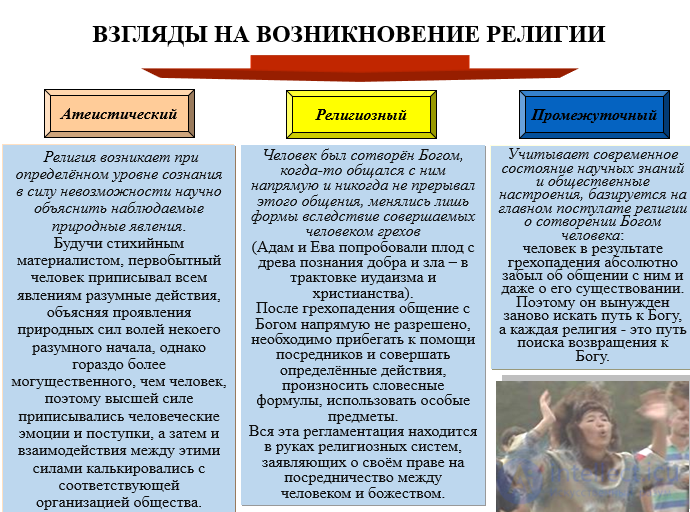
14. The atheistic point of view on the process of the emergence of religion holds that ………………. arises at a certain level of consciousness owing to the impossibility of scientifically explaining observed natural phenomena.
15. Religious ……………………. is a specific form of social consciousness, which includes religious ideology and religious psychology.
16. Religious consciousness manifests itself in religious activity, which is carried out in cultic ………………. and non-cultic form.
17. Cult is a system of special ………………., by means of which people seek to influence the supernatural beings, properties, and relations that are the object of their faith.
18. Non-cultic activity is carried out in the ……………. and practical spheres.
19. Religion is a very complex and multifaceted phenomenon consisting of the following elements: doctrine, the Supreme Mind (God), cult, ……….., norms.
20. Beliefs form a system of ………….., tracing its origin back to the mythology of the given religion.
21. God (or gods) is a supreme …………………, endowed with a Supreme Mind.
22. The church is a social ………………., uniting adherents of a given religion.
23. The integrating function of religion consists in its …………….. of society around common principles and in directing society along a defined path of development.
24. The political function of religion consists in its ability to influence the state …………… of civil society.
25. Sacralization is generally understood as the broad …………….. into the sphere of religious influence and sanctioning of various institutions, relations, and forms of social and individual consciousness.
26. A sect arises as an ……………………. movement within one religious tradition or another.
27. Worship in a temple or house of prayer, participation in the sacraments, and communal prayer are regarded as the main means by which believers commune and unite with …………. and with one another.
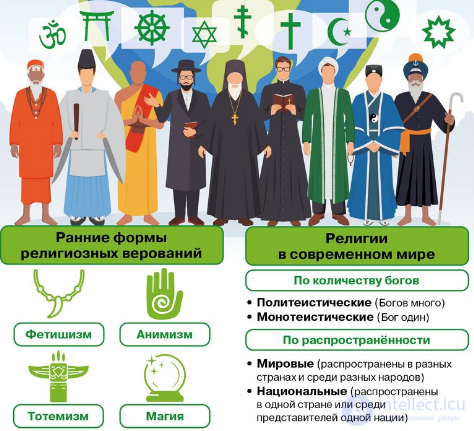
28. There is a classification of religions on the basis of …………… into national religions and world, or universal, religions.
In the tasks presented, indicate the correct statements (assertions).
Task No. 1
1. G. Hegel held that religion is a totality consisting of three interrelated elements: the dialogue of the human spirit with the Absolute Spirit, the result of which are religious representations (ideas); the feelings and experiences produced by these ideas; and cult as a synthesis of religious ideas and religious feelings.
2. G. Hegel held that religion is a totality consisting of two interrelated elements: the dialogue of the human spirit with the Absolute Spirit, the result of which are religious representations (ideas); and the feelings and experiences produced by these ideas. 3. G. Hegel held that religion is a totality consisting of three interrelated elements: the dialogue of the human spirit with the Absolute Spirit, the result of which are religious beliefs; the feelings and experiences produced by these ideas; and cult as a synthesis of religious ideas and religious feelings.
Task No. 2
1. The Marxist definition of religion, which arose in the 7th century, presented it as "the inverted world-consciousness of an inverted world," as "the spirit of soulless conditions," as "the heart of a heartless world," and, finally, as "the opium of the people."
2. The Marxist definition of religion, which arose in the 19th century, presented it as "the inverted world-consciousness of an inverted world," as "the spirit of soulless conditions," as "the heart of a heartless world," and, finally, as "the opium of the people."
3. The Marxist definition of religion, which arose in the 20th century, presented it as "the inverted world-consciousness of an inverted world," as "the spirit of soulless conditions," as "the heart of a heartless world," and, finally, as "the opium of the people."
Task No. 3
1. Religion is not an accidental formation imposed on people by philosophers, priests, deceivers, and tyrants, as many thinkers of the past believed.
2. Religion is an accidental formation imposed on people by philosophers, priests, deceivers, and tyrants, as many thinkers of the past believed.
3. Religion is not an accidental formation invented by people, philosophers, priests, deceivers, and tyrants, as many thinkers of the past believed.
Task No. 4
1. The ontological currents of religion are rooted in the relation of mortal man to Eternity.
2. The ontological foundations of religion are rooted in the relation of mortal man to Eternity.
3. The ontological thoughts of religion are rooted in the relation of mortal man to Eternity.
Task No. 5
1. The epistemological foundations of religion are rooted in man's cognitive relation to the end of the world, which is expressed in the contradiction between the potential possibility of knowing the world as a whole and the real impossibility of such knowledge.
2. The epistemological foundations of religion are rooted in man's cognitive relation to Infinity, which is expressed in the contradiction between the fatal possibility of knowing the world as a whole and the real impossibility of such knowledge.
3. The epistemological foundations of religion are rooted in man's cognitive relation to Infinity, which is expressed in the contradiction between the potential possibility of knowing the world as a whole and the real impossibility of such knowledge.
Task No. 6
1. S. Freud believed that without religion, humanity would long ago have slid over the edge into universal madness.
2. E. Fromm believed that without religion, humanity would long ago have slid over the edge into universal madness.
3. I. Kant believed that without religion, humanity would long ago have slid over the edge into universal madness.
Task No. 7
1. Religious ideas, based on faith in supernatural forces and contained in the Scriptures, form a coherent system of representations about God, hell as a whole, nature, society, and man.
2. Religious ideas, based on faith in the end of the world and contained in the Scriptures, form a coherent system of representations about God, the world as a whole, nature, society, and man.
3. Religious ideas, based on faith in supernatural forces and contained in scholarly works, form a coherent system of representations about God, the world as a whole, technology, society, and man.
Task No. 8
1. The object of cult can be a religious group or an individual believer.
2. The subject of cult can be a religious group or an individual believer.
3. The author of cult can be a religious group or an individual believer.
Task No. 9
1. The methods of cultic activity are determined by the requirements of religious beliefs and are in direct dependence on the means of the cult.
2. The methods of cultic activity are determined by the content of religious beliefs and are in indirect dependence on the means of the cult.
3. The methods of cultic activity are determined by the content of religious beliefs and are in direct dependence on the means of the cult.
Task No. 10
1. The result of non-cultic activity is, above all, the satisfaction of religious needs and the revival of religious consciousness.
2. The result of cultic activity is, above all, the satisfaction of religious needs and the revival of religious consciousness.
3. The result of cultic activity is, above all, the cognition of religious needs and the revival of religious consciousness.
Task No. 11
1. Religious organizations, in accordance with traditions and customs, church law, or statute, unite people of a particular faith.
2. Religious organizations, in accordance with traditions and customs, church law, or statute, divide people of a particular faith.
3. Religious organizations, in accordance with traditions and customs, church law, or statute, unite people of various faiths.
Task No. 12
1. Secular consciousness does not exist alongside religious consciousness.
2. Secular consciousness exists separately from religious consciousness.
3. Secular consciousness exists alongside religious consciousness.
Task No. 13
1. Spiritual and secular power do not belong to different institutions.
2. Spiritual and secular power belong to the same institutions.
3. Spiritual and secular power belong to different institutions.
Task No. 14
1. By the functions of religion should be understood the various ways in which it acts in society.
2. By the functions of religion should be understood the identical ways in which it acts in society.
3. By the functions of religion should be understood the various ways in which it lives in society.
Task No. 15
1. Religion cannot serve as a factor of integration for society or a group.
2. Religion can serve as a factor of integration for society or a group.
3. Religion can serve as a factor of disintegration for society or a group.
Task No. 16
Christianity, Islam, and Buddhism, which share a common root — the Old Testament — place man at the center of their system, as one who attains a path to personal salvation.
Christianity, Islam, and Judaism, which share a common root — the Old Testament — place man at the center of their system, as one who attains a path to personal salvation.
Christianity, Islam, and Hinduism, which share a common root — the Old Testament — place man at the center of their system, as one who attains a path to personal salvation.
Task No. 17
National religions (Judaism, Hinduism, Confucianism, Taoism, Shinto, and others), as their name suggests, are to a large extent not tied to a particular people, ethnicity, or nation.
National religions (Judaism, Hinduism, Confucianism, Taoism, Shinto, and others), as their name suggests, are to a large extent tied to a particular state.
National religions (Judaism, Hinduism, Confucianism, Taoism, Shinto, and others), as their name suggests, are to a large extent tied to a particular people, ethnicity, or nation.

Comments