
Lecture
Lecture plan
1. The transformation of Christianity into the state religion of the Roman Empire.
2. The Ecumenical Councils. Their role and significance in the history of Christianity.
3. The First Ecumenical Council at Nicaea (325), the Second Ecumenical Council (Constantinople, 381), and the Niceno-Constantinopolitan Creed.
4. The Christological disputes. Nestorius and Cyril of Alexandria. The Third Ecumenical Council (Ephesus, 431). The grounding of the dogmas of redemption and the Incarnation. Nestorianism. The struggle of the Roman popes for dominance in the Western and Eastern Church. The Council of Ephesus of 449 (the «Robber Council»). Dyophysitism and Monophysitism.
5. The Fourth Ecumenical Council (Chalcedon, 451). The separation of the Nestorians and the Monophysites.
6. The fall of the Western Roman Empire. The ecclesiastical policy of Emperor Justinian. The Fifth Ecumenical Council (Constantinople, 553). The Sixth Ecumenical Council (Constantinople, 680–681).
7. The Church in the Byzantine Empire in the 8th century. Iconoclasm. The Seventh Ecumenical Council (Nicaea, 787). The restoration of the veneration of icons in the Church. John of Damascus.
8. The completion of the formation of Christian dogma. The formation of separate Christian churches. The ancient Eastern (non-Chalcedonian) churches.
9. The Eastern and Western Churches: the history of their relations. The rise of the doctrine of the «filioque». The Schism of the Churches in 1054.
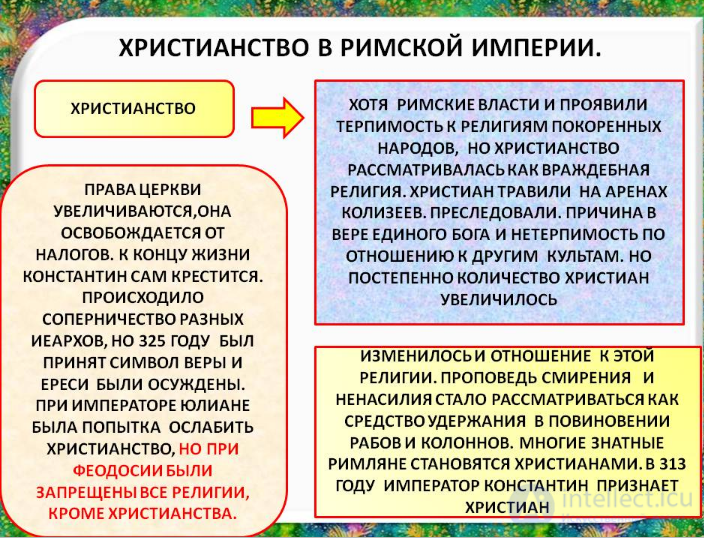
One of the important events of the reign of Constantine (306–337) was the so-called Edict of Milan of 313, which granted Christians freedom of worship and returned to them all confiscated churches and church property. Subsequently Constantine extended special patron-
age to Christians. From a persecuted teaching, Christianity was becoming the state religion, turning from a «church militant» into a «church triumphant».
But Constantine was not content merely to grant Christianity equal rights as a particular religious teaching.
Under him the clergy, like the pagan priests, were freed from bearing state taxes and duties, and from holding any offices that might distract clerics from the performance of their spiritual duties (the right of immunity). Every person had the right to make a bequest in favor of the church, which was thereby recognized as having a passive right of inheritance. Thus, together with the declaration of religious freedom, Christian communities came to be recognized as juridical persons, and this last circumstance created an entirely new legal position for Christianity.
Very important privileges were granted to episcopal courts. Any person had the right, by agreement with the opposing party, to transfer any civil case to an episcopal court, even if the case had already begun in a civil court. By the end of Constantine's reign the competence of episcopal courts had been expanded still further: 1) the decisions of bishops were to be recognized as final in the cases of persons of any age; 2) any civil case could be transferred to an episcopal court at any stage of the proceedings, even against the wishes of the opposing party; 3) the verdicts of episcopal courts had to be confirmed by secular judges. Such judicial privileges of the bishops, while raising their authority in the eyes of society, were at the same time a heavy 'burden for them, since they created no small number of complications; the losing party, owing to the finality of the episcopal verdict, which was not always correct, retained a sense of irritation and dissatisfaction. Moreover, the involvement of bishops in the performance of secular functions brought a great many worldly interests into their midst.
In addition to this, the church enjoyed rich offerings from state funds, in the form of land grants, monetary and grain allowances. Christians could not be compelled to take part in pagan festivals. Under the influence of Christianity certain mitigations were introduced into punishments.
In addition to all this, the name of Constantine is associated with the building of many churches in all parts of his vast Empire. The Basilica of St. Peter, as well as the Lateran Basilica in Rome, are attributed to him. He was especially interested in Palestine, where his mother, Helena, is supposed to have found the True Cross. In Jerusalem, on the site where Christ was buried, the Church of the Holy Sepulchre was erected; on the Mount of Olives Constantine built the Church of the Ascension, and in Bethlehem the Church of the Nativity. The new capital, Constantinople, and its suburbs were also adorned with numerous churches. The most famous are the Church of the Holy Apostles and the Church of St. Irene; Constantine may have laid the foundation of Hagia Sophia, which was completed by his successor Constantius. Many churches were built during the reign of Constantine in other places as well – in Antioch, Nicomedia, and North Africa.
After the reign of Constantine three important centers of Christianity took shape – early Christian Rome in Italy, although pagan sympathies continued to exist there for some time; Christian Constantinople, which very soon became a second Rome in the eyes of the Christians of the East; and finally Christian Jerusalem. After the destruction of Jerusalem by Titus in 70 AD and the founding on its site of the Roman colony of Aelia Capitolina, during the reign of Hadrian in the 2nd century AD, the old Jerusalem lost its significance, although it remained the mother church of Christendom and the center of the first apostolic preaching. Christian Jerusalem was revived to new life in the time of Constantine. In a political sense the city of Caesarea, not Aelia, was the capital of the province. The churches built during this period in these three centers became symbols of the triumph of the Christian Church on earth. This Church soon became a state church. The new idea of an earthly kingdom was directly opposed to the original Christian conception of the «kingdom of heaven» and the imminent approach of the end of the world.
Their role and significance in Christianity
The Ecumenical Councils – in Christian theology, doctrine, and ritual-cultic practice (as set forth by M. I. Gorchakov) – are an extraordinary «assembly of the pastors and teachers of the Church, as far as possible from the whole Ecumene», or a hierarchical representation of all the local, self-governing (autocephalous) churches, convened for the purpose of bearing witness to their common faith, for confirming the truths of doctrine given to the Church by Revelation and therefore certainly true, for establishing rules binding on the whole Church, and for resolving questions of general ecclesiastical importance. The Ecumenical Council is the sole supreme authority in the universal Orthodox Church in matters of doctrine and the sole organ of its ecumenical legislation. The Ecumenical Council possesses the property of infallibility in its definitions and rules; the effects of its authority extend to all local churches and to all times.
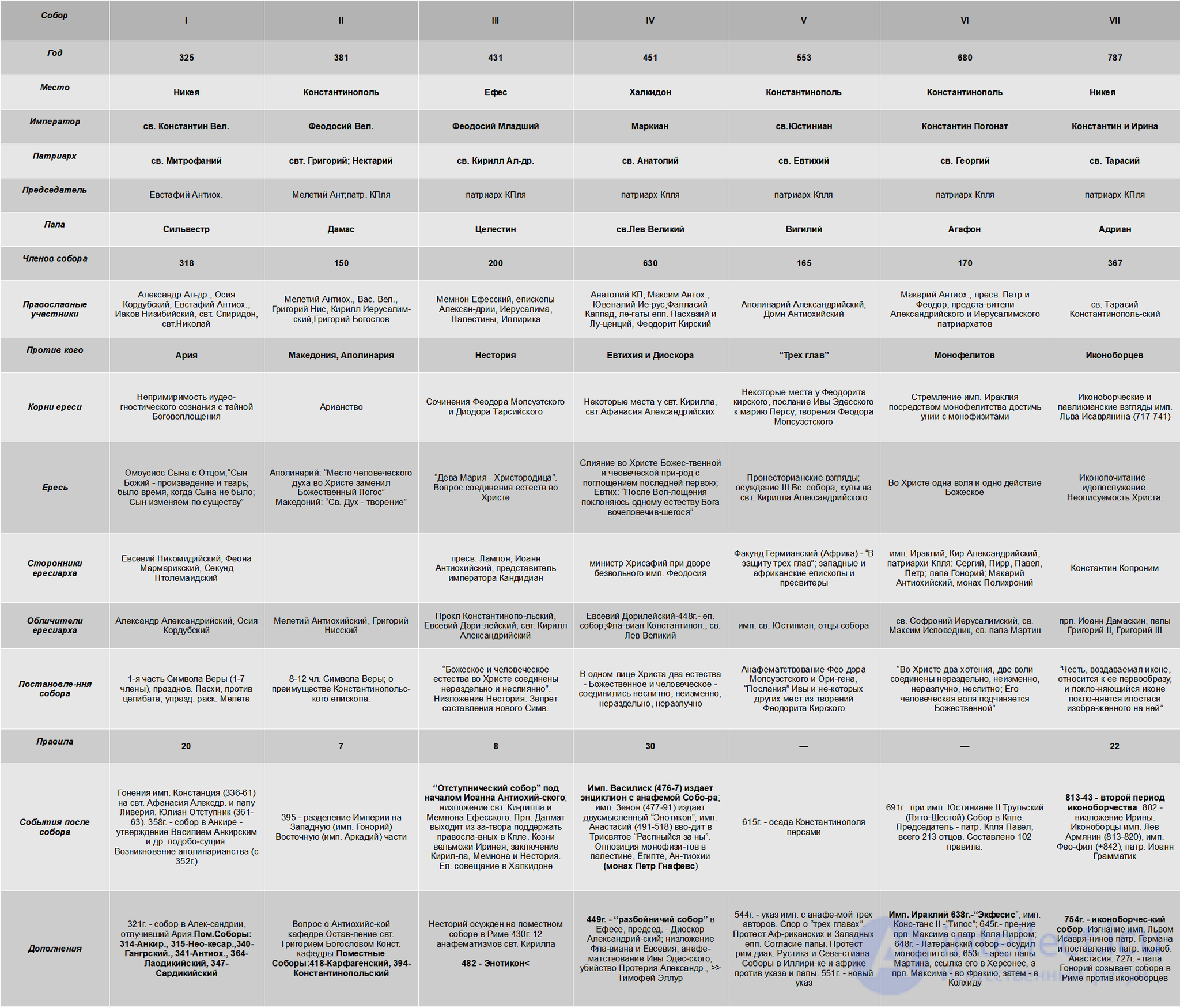
In the Orthodox Church the following seven are recognized as Ecumenical Councils: the First Council of Nicaea (325), the First Council of Constantinople (381), the Council of Ephesus (431), the Council of Chalcedon (451), the Second Council of Constantinople (553), the Third Council of Constantinople (680–681), and the Second Council of Nicaea (787
).
In the law of the Roman Catholic Church the number and significance of the Ecumenical Councils is defined differently from the law of the Orthodox Church. Roman Catholic canonists include the following twenty in the list of Ecumenical Councils: the First Council of Nicaea (325), the First Council of Constantinople (381), the Council of Ephesus
(431), the Second Council of Constantinople (553), the Third Council of Constantinople (680–682), the Second Council of Nicaea (787), the Fourth Council of Constantinople (869–870), the First Lateran Council (1123), the Second Lateran Council (1139), the Third Lateran Council (1179), the Fourth Lateran Council (1215), the First Council of Lyon (1245), the Second Council of Lyon (1274), the Council of Vienne (1311), the Council of Constance (1414–1418), the Council of Basel (1431), the Council of Florence (1439), the Fifth Lateran Council (1512–1516), the Council of Trent (1545–1563), the First Vatican Council
(1869–1870), the Second Vatican Council (1962–1965).
3. The First Ecumenical Council at Nicaea (325),
the Second Ecumenical Council (Constantinople, 381), the Niceno-Constantinopolitan Creed
The First Council of Nicaea – a council of the Church recognized as Ecumenical – took place in June 325 in the city of Nicaea (now Iznik, Turkey); it lasted more than two months and became the first Ecumenical Council in the history of Christianity.
The council was convened by the holy Emperor Constantine the Great in order to settle the dispute between Bishop Alexander and Arius. Arius, like the Gnostics, denied the divinity of Christ. In Arius's view, Christ was not God but the first and most perfect of the beings created by God. Arius found many supporters. Bishop Alexander accused Arius of blasphemy.
At the First Ecumenical Council 380 bishops were present, together with many presbyters and deacons. Many of them had only recently returned from penal labor and bore on their bodies the marks of torture. And now they had gathered in the palace at Nicaea, and the emperor Constantine himself presided over their assembly, something that had never happened before.
The council condemned Arianism and confirmed the tenet of the consubstantiality of the Son with the Father and of His eternal begetting. A Creed of seven articles was also composed, which was later called the Nicene Creed, and the privileges of the bishops of the four largest metropolitan sees – Rome, Alexandria, Antioch, and Jerusalem – were fixed (canons 6 and 7).
The council also established the time for the celebration of Easter as the first Sunday after the first full moon following the vernal equinox.
The Second Ecumenical Council, the First Council of Constantinople – an Ecumenical Council of the Church – was convened in 381 by Emperor Theodosius I (379–395) in Constantinople. It is recognized as Ecumenical both in the East and in the West. It confirmed the dogma of the procession of the Holy Spirit from the Father, and of the equality and consubstantiality of God the Holy Spirit with the other Persons of the Holy Trinity – God the Father and God the Son; it supplemented and confirmed the Creed in the version that came to be called the Niceno-Constantinopolitan (Nicene-Tsargrad) Creed.
In addition, it established (canon 3) the status of the Bishop of Constantinople as bishop of New Rome, second in honor after the Bishop of Rome, thereby passing over the Bishop of Alexandria, who had until then been considered first in the East and had borne the title «pope». As a result the so-called pentarchy was formed – the five chief episcopal sees (local Churches) of the Christian world: Rome, Constantinople, Alexandria, Antioch, and Jerusalem.
The council opened in May 381 in the Constantinopolitan church of St. Irene and concluded its work in July 381. Emperor Theodosius I was present at its opening, but neither he nor his representatives took part in the conciliar sessions.
At the First Ecumenical Council at Nicaea in 325 the Nicene Creed was composed.
In 381 it was expanded and supplemented by the Second Ecumenical Council in Constantinople, after which it came to be called the Niceno-Constantinopolitan Creed.
The Creed was the subject of the works of many outstanding theologians, the most famous being the treatise of Augustine of Hippo. The first word of the Latin text of the Creed, «Credo» («I believe»), became a household word.
The Niceno-Constantinopolitan Creed is read (sung) at liturgical services in Orthodoxy (as part of the Liturgy of the Faithful) and in Catholicism (as part of the Liturgy of the Word); it is recommended that all those present be invited to join in reciting (singing) it. The Creed is included in the Book of Common Prayer of the Anglican Church:
of redemption and the Incarnation. Nestorianism. The struggle of the Roman popes for dominance in the Western and Eastern Church. The Council of Ephesus of 449 (the «Robber Council»). Dyophysitism and Monophysitism
The Council of Ephesus, the Third Ecumenical Council – an Ecumenical Council of the Church – took place in the city of Ephesus (Asia Minor) in 431 on the initiative of Emperor Theodosius II. About 200 bishops from all corners of the Christian world were present.
The occasion for convening the Third Ecumenical Council was the conflict between the Patriarch of Constantinople, Nestorius, who distorted the Church's teaching on the incarnation of the Son of God by dividing in Him the union of the two natures and calling His most pure Mother not the Mother of God but the Mother of Christ, and St.
Cyril of Alexandria, who first tried to admonish him and then wrote his anathemas against him.
St. Cyril presided over the council, at first, before the arrival of the Roman legates, also acting as the representative of the Bishop of Rome. Nestorius arrived at the council and, as an unrepentant heretic, was deposed. There were 200 fathers at the council, most of them from the East.
The first six canons drawn up by the council concern matters of doctrine connected with the heresy of Nestorius and have no disciplinary significance.
Besides Nestorius, the council in its definition condemns the «teaching of Caelestius». Caelestius, or Celestius, preached the heresy of Pelagius, denying the significance of original sin and the necessity of grace for salvation.
Canon 7 speaks of how the Nicene faith is to be preserved undamaged. In Aristenus's exposition the canon reads as follows: «A bishop who preaches a faith other than the Nicene loses his episcopate, and a layman is expelled from the Church. Whoever proposes, besides the faith drawn up by the holy fathers assembled at Nicaea, another impious creed for the corruption and ruin of those turning to the knowledge of the truth from paganism or Judaism or from any heresy whatsoever – if a layman, he is to be anathematized, and if a bishop or cleric, he is to be deprived of his episcopate and clerical ministry». Later this canon was used by Orthodox polemicists against the Latin distortion of the Niceno-Constantinopolitan Creed through the addition of the «filioque».
The council's final, 8th, canon confirms the autocephaly of the Church of Cyprus, which was disputed by the see of Antioch, which claimed jurisdiction over Cyprus.
The canons of the Council of Ephesus were not included in the canonical collections of the Roman Church. Only fragments of the conciliar decrees, different from those that gained canonical authority in the East, are found in certain Latin manuscripts.
What took place at Ephesus on August 8, 449 has gone down in history under the name of the «Robber Council». The whole affair proceeded under the sign of genuine terror. Dioscorus, a supporter of the Monophysites, presided, relying on a mob of fanatical monks who had flooded the city. He held what amounted to a formal order from the Emperor to vindicate the Monophysite monk Eutyches and to eliminate all resistance to the one-nature doctrine. Under threat of beatings, under police pressure, amid shouting and chaos, all the required decisions were pushed through. Almost no one heard the indignant cry of the young Roman deacon: «I protest!» Half dead from beatings, Patriarch Flavian nevertheless managed to write a letter to the Pope; he was deposed and exiled. The rest, yielding to violence, signed. The Church had never before experienced such disgrace, such a fall. The Emperor sealed the decisions of this council with state sanction, and all the enemies of Eutyches were sent into exile.
Despite every obstacle, the Roman legate Hilary managed to return to Rome, to tell the Pope what had happened, and to convey Flavian's appeal. He was soon followed there by Eusebius of Dorylaeum and envoys from Theodoret of Cyrus. Leo immediately sent envoys to Constantinople, demanding that Theodosius reopen the whole case. But Theodosius died at this time, and he was succeeded by his sister Pulcheria, who in theology held to the moderate line of the deposed Flavian. In Constantinople the atmosphere changed at once: the rampage of the fanatics came to an end. Pulcheria and her husband, the emperor Marcian, understood that the time had come to settle the theological question that had thrown the Church into such turmoil, seriously and to the end, and thereby at last to establish a lasting peace. The Ecumenical Council, at first appointed to meet at Nicaea, was then transferred to the Asia Minor suburb of Constantinople – Chalcedon, where it opened in the basilica of St. Euphemia on October 8, 451.
The Council of Chalcedon – the Fourth Ecumenical Council – was convened by Emperor Marcian, with the agreement of Pope Leo I, at Chalcedon (present-day Kadıköy, a district of modern Istanbul) in 451, in connection with the heresy of Eutyches – Monophysitism.
The sessions of the Council of Chalcedon took place in the church of the holy martyr Euphemia, who had suffered martyrdom around 304. The council was opened on October 8, 451 and continued until November 1; seventeen plenary sessions were held.
According to the emperor's edict, the bishops first gathered at Nicaea, but were soon summoned to Chalcedon, closer to the capital, where the emperor could be present at the conciliar sessions; the sessions themselves were conducted by imperial officials: the magister militum (commander-in-chief) Anatolius, the praetorian prefect of the East Palladius, and the praefectus urbis (prefect of Constantinople) Tatian.
The convening of the council and its oversight by the emperor and the imperial administration were driven by the desire to ensure religious unity and thereby the political stability of the empire: the continuing rivalry between the patriarchates of Constantinople and Alexandria – after the Council of Constantinople of 381 had equalized the sees of Rome and Constantinople («New Rome»), relegating Alexandria to third place (canon 3, adopted at that council) – threatened the unity of the empire. The idea that the unity and stability of the state depended on right faith in the one Trinity was repeated by Leo I as well in his letters to the emperor; the relevance of this claim was confirmed by recent events in North Africa – first the armed struggle with the Donatist schism, and then the conquest of Carthage in 429 by the Vandals, who were joined by the Circumcellion Donatists.
Dioscorus, Patriarch of Alexandria, continuing the work of his predecessor Cyril at the Council of Ephesus of 431 in the struggle against the Nestorianism of the Antiochene theological school, decided at the Council of Ephesus of 449 to put a final end to the dogmatic struggle with Nestorianism – as a result, in the council's decision, the «excessively dual» Nestorian nature of Christ was replaced by a «monolithic» Monophysite one.
This formulation was at odds with the Epistola dogmatica sent to Archbishop Flavian, head of the Patriarchate of Constantinople, and to the council of 449, by Pope Leo I the Great. Leo I himself was not present at the council – the armies of Attila were at that time approaching Rome – but he sent legates to the council who were to defend his formulations; however, the legates failed in their task, and the council's decisions were confirmed by Emperor Theodosius II. The death of Theodosius, whose sister Pulcheria, who bore the title of Augusta, became the wife of the senator Marcian and raised him to the throne, changed the situation: Pulcheria was a supporter of Leo I, who, moreover, according to the sources, had declared during the brief interregnum that the diocese of Egypt belonged to him rather than to the emperor, which turned the imperial couple against him.
The chairman of the council was Anatolius of Constantinople, who had decisively gone over to the side of the Orthodox before Marcian's accession to the throne. The number of all the fathers present at the council, if one does not exclude
authorized persons of presbyteral rank who stood in for one bishop or another, may be reckoned at between 600 and 630. Among the most well known were: Domnus of Antioch, deposed by Dioscorus and restored from confinement by Marcian; Maximus, appointed in his place; Juvenal of Jerusalem; Thalassius of Caesarea in Cappadocia; the blessed Theodoret; Eusebius of Dorylaeum; Dioscorus of Alexandria; and others. Pope Leo, who had wished the council to be convened in Italy, nevertheless sent his legates (the bishops Paschasinus and Lucentius and the presbyter Boniface) to the Council of Chalcedon. At the council we find a large gathering of senior state officials and senators taking part in the council's proceedings, except in cases where purely ecclesiastical matters were being considered, such as the trial of a bishop.
First of all, the fathers of the council took up the examination of the proceedings of the «Robber Council» of 449 at Ephesus, and the trial of Dioscorus. The accuser was the well-known Eusebius of Dorylaeum, who presented a memorandum setting out all the acts of violence committed by Dioscorus at the «Robber Council». After the memorandum was read, the fathers stripped Dioscorus of his vote, after which he had to take his place among the defendants. Moreover, a number of Egyptian bishops brought many charges against Dioscorus of immorality, cruelty, and various acts of violence. The council condemned Dioscorus and deposed him, and likewise condemned the Robber Council and Eutyches. Those bishops who together with Dioscorus had taken part in the Robber Council were forgiven by the fathers of the Council of Chalcedon, since they showed repentance
and explained that they had acted under the threat of Dioscorus's intimidation.
The fathers then turned to defining the doctrine. They had to set forth a teaching on the two natures in the person of Jesus Christ that would be free of the extremes of both Nestorianism and Monophysitism. The teaching midway between these two extremes was precisely the Orthodox one. Taking as the model of Orthodox teaching the exposition of the faith by Cyril of Alexandria and John of Antioch,
as well as the epistle of Leo of Rome to Flavian, they thus defined the dogma of the manner of the union of the two natures in the person of Jesus Christ.
This definition of faith condemned both Nestorianism and Monophysitism. The blessed Theodoret, who had been suspected of Nestorianism at the council, especially by the Egyptian bishops, pronounced an anathema on Nestorius and signed his condemnation; the council therefore lifted the condemnation of Dioscorus against him and restored him to his rank, just as it lifted the condemnation of Ibas, bishop of Edessa. Only the Egyptian bishops behaved ambiguously with regard to the definition of faith. Although they signed the condemnation of Eutyches, they refused to sign the epistle of Leo of Rome to Flavian, on the pretext that, according to the custom prevailing in Egypt, they did nothing of importance without the consent and decision of their archbishop, whom they did not have, owing to the deposition of Dioscorus. The council bound them by oath to sign once an archbishop had been installed.
The number of those who signed the decision was approximately 150 fewer than the number of those who had gathered at the council. When it was reported to Marcian that everything had been completed, he came with Pulcheria to the council's sixth session and delivered a speech in which he expressed joy that everything had been done by common consent and peacefully.
The fathers then turned to drawing up canons, of which thirty were composed. The main subjects of the canons were church administration and church discipline.
Of the greatest importance was canon 28, which established the primacy of the see of the Bishop of Constantinople in the East.
After the council the emperor issued strict laws against the Monophysites. Everyone was ordered to accept the teaching defined by the Council of Chalcedon; Monophysites were to be exiled or banished; their writings were to be burned, and those who disseminated them were to be executed, and so on. Dioscorus and Eutyches were exiled to remote provinces.
The Council of Chalcedon did not put an end to the Christological disputes, but its definition of faith remained for centuries the foundation of Eastern Orthodoxy.
The disintegration of the Byzantine empire had already begun, and separatist tendencies, strongest at the empire's periphery and rooted in nationality, nevertheless, in keeping with the spirit of the times, sought to find expression and justification in dogmatic disagreement.
The unshakable authority of the Council of Chalcedon was solemnly restored at a council convened by Patriarch John in Constantinople in 518, composed of 40 bishops present in the capital, and of the abbots of the capital and its surrounding monasteries. The council condemned all who rejected the Council of Chalcedon and, in particular, condemned Severus, Patriarch of Antioch; it vindicated the memory of the deceased champions of Orthodoxy and decreed that the fathers of the Four Ecumenical Councils be entered in the diptychs.
The reign of Justinian (527–565) represents the last attempt to preserve the unity of the Roman «Ecumene», the completion and highest point of that world in which the dying «antiquity» entered into union with Christianity. From the very outset Justinian was enthralled by the great past of Rome, and at the foundation of all his policy lay not a sober awareness of reality but a dream – of the former glory of the Empire, of the greatness of imperial power, of the mission of Rome. «We hope,» he writes, «that God will return to us the lands possessed by the ancient Romans, as far as the two oceans»... But this was a dream. In reality Roman unity no longer existed. In 395, on his deathbed, Emperor Theodosius the Great divided the Empire between his two sons: Honorius received the West, Arcadius the East. In theory the Empire continued to be a single state with two emperors, but in fact it was precisely from this moment that the paths of East and West finally diverged. In the East, although organically linked to Rome by succession, a new Byzantine world was already growing; while the Roman West, under the blows of the barbarians, sank ever deeper into the chaos of those «dark ages» out of which Romano-Germanic Europe would later be born.
The beginning of the barbarian invasions, the «Great Migration of Peoples», was marked in 355 by the appearance of the Huns in eastern Europe. Under their pressure the Germanic tribes settled there began to breach the border of the Empire. Its eastern part was saved by Theodosius the Great. Then, pushed back from the south, the Germans moved westward. The first wave reached Rome at the beginning of the fifth century but was repelled. The barbarians nevertheless established themselves within the Empire. The Visigoths in Italy, the Vandals in Africa, the Franks in Gaul recognized Roman authority as «allies», so that the victory of 451 over the Huns on the Catalaunian Plains could still be regarded as a victory of Rome. But Rome itself was disintegrating: murders, betrayals, and conspiracies replaced one powerless Emperor after another, and in 476 the last of them disappeared ingloriously. And in 493 the Ostrogoths of Theodoric founded their kingdom in northern Italy. «Nominally» even now all these peoples continued to acknowledge the supreme and sacred authority of the Byzantine Emperor, and their petty princes gladly accepted from Constantinople hollow court titles; and yet the West sank into barbarism and darkness.
Byzantium, for its part, turned its back on it ever more evidently; the center of its interests shifted eastward, and from the 5th century one can already clearly sense the beginning orientalization of the Empire – in culture, in psychology, in art, in court «ritual». Beyond the borders of the Empire: in Georgia, Armenia, Persia – new Christian Churches were being born; the Byzantine «mission» was developing in the East, and it is characteristic, for example, that the break with Rome in
484 caused hardly any stir in Byzantium. The Church, alas, was subject to history, and history increasingly deepened the gulf between the two halves of the once-united «Ecumene».
But it was precisely this history of disintegration that Justinian refused to acknowledge. Everything in his consciousness, in his life and actions, was subordinated to the «Roman idea» in all its universalism. He took power at a critical moment: from the beginning of the century the pressure on Byzantium from the resurgent Persian Empire had been steadily increasing, and vital interests – as the events of the following century clearly showed – demanded the concentration of all forces in the East. But Justinian bought off the Persians and threw his army, under the command of Belisarius, against the West. In 534 Africa was taken from the Vandals; the following year the Byzantines occupied Sicily, and on December 10, 536 Belisarius entered Rome, abandoned by the Ostrogothic king... The dream became reality – in 559 it was crowned by the restoration of Roman rule in Spain. Dying, Justinian believed that the ancient unity of the Empire had been restored.
Justinian did not separate external restoration from internal restoration. The very first years of his reign were marked by a colossal systematization of Roman law, celebrated under the name of the «Code of Justinian» (529) and the «Digest» (533). This fame is not exaggerated: Justinian's code preserved the legacy of Roman law, made it the foundation of the new world born from the disintegration of the Empire, and confirmed our historical continuity. This legal work was matched at last by a profound administrative and financial reform. The Empire once again acquired a firm state «form».
All this makes Justinian the last great Roman emperor, but his significance in history, especially the history of the Church, cannot be understood without also seeing in him the first «ideologist» of the Christian Empire, who summed up the results of the Constantinian union. Under him the first «synthesis» of Christian Byzantinism was accomplished, and this synthesis, in turn, determined the whole subsequent path of Eastern Orthodoxy.
Justinian's dream, though realized for a short time, was still a dream. The effort proved too great, and almost immediately after Justinian's death his Empire began to disintegrate. In 568 the wave of the Lombard invasion swept over Italy, the pressure of the Moors in Africa increased, war continued unabated in Spain: Byzantine «enclaves» would hold out in the West for a long time yet, but it was no longer possible to speak of a Western Empire... The fate of Byzantium itself was decided finally, in the seventh century, in the East. From 572 the endless war with Persia resumed, the war Justinian had bought his way out of in order to free his hands in the West. By the 620s the Persians had conquered part of Asia Minor, Syria, Palestine, and Egypt. In 619 the Persian fleet appeared before Constantinople, and an enemy army occupied Chalcedon... From the north the invasion of the Slavs began, which would become one of the main military-political problems of the Empire in the following centuries. In 626, when Heraclius, far from the capital, was gathering his forces to fight Persia, the Avars (whose empire included the Slavs) surrounded Constantinople, and deliverance from this siege would be felt by the Byzantines as a miracle. Finally, one last upsurge: the victorious campaign of Heraclius against the Persians (626–629), which brought the Byzantine army all the way to Ctesiphon and freed the entire East. In 630 Heraclius solemnly returned to Jerusalem the Cross of Christ, which had been taken by the Persians. But this was only a respite. In that very same year, in distant Arabia, until then of interest to no one, a handful of fanatics gathered around Muhammad conquered Mecca, united the divided Arab tribes around a new religion of the one God, and created a source of inspiration, faith, and religious dynamism that would for many centuries become the chief and formidable rival of Christianity. Muhammad died in 632, and ten years later the empire of his followers already included Persia, Palestine, Syria, and Egypt. When Heraclius died in 641, the last of the great emperors of an empire still great, that empire had already finally lost the whole of the East.
The Second Council of Constantinople – the Fifth Ecumenical Council – was convened in 553, in the city of Constantinople, under Emperor Justinian I. It rejected the teachings of the theologians Theodore of Mopsuestia, Theodoret, and Ibas (the so-called «Antiochene school»), which were close to Nestorianism.
The council was convened in connection with disputes between the followers of Nestorius and of Eutyches. The main subject of the disputes were the writings of three teachers of the Syrian church who had once enjoyed renown, namely Theodore of Mopsuestia, Theodoret of Cyrus, and Ibas of Edessa, in which Nestorian errors were clearly expressed, whereas the Fourth Ecumenical Council had made no mention whatsoever of these three writings.
The Nestorians, in their dispute with the Eutychians (Monophysites), appealed to these writings, while the Eutychians used this as a pretext to reject the Fourth Ecumenical Council itself and to slander the Orthodox Ecumenical Church, claiming that it had allegedly lapsed into Nestorianism.
165 bishops were present at the council. The council condemned all three writings and Theodore of Mopsuestia himself, as unrepentant, while with regard to the other two the condemnation was limited to their Nestorian writings alone; they themselves were pardoned, since they had renounced their opinions and died in peace with the Church. The council once again repeated the condemnation of the heresies of Nestorius and Eutyches.
The Third Council of Constantinople, also the Sixth Ecumenical Coun-
cil – an Ecumenical Council of the Church, held in 680 in Constantinople under Emperor Constantine Pogonatus.
The council was convened against the false teaching of the Monothelite heretics, who, although they acknowledged in Jesus Christ two natures, Divine and human, held that there was only one Divine will. After the Fifth Ecumenical Council the unrest caused by the Monothelites continued and posed a serious danger to the Greek empire. Emperor Heraclius, wishing for reconciliation, decided to induce the Orthodox to make a concession to the Monothelites and, by the force of his authority, ordered that one will in two natures be acknowledged in Jesus Christ. The defenders and expounders of the true teaching of the Church were Sophronius of Jerusalem and the Constantinopolitan monk Maximus the Confessor.
At the Sixth Council there were about 170 fathers of the Church, among them legates of the Bishop of Rome, and at the drafting of the canons – 240.
The Sixth Ecumenical Council condemned and rejected the heresy of the Monothelites and defined that in Jesus Christ there are two natures – Divine and human – and, corresponding to these two natures, two wills, but in such a way that the human will in Christ is not opposed to but submissive to His Divine will.
Eleven years later the council resumed its sessions in the imperial halls called the Trullan, to resolve questions relating chiefly to church discipline. In the East the decisions of the Trullan Council are included in the canonical collections as decisions of the Sixth Ecumenical Council.
All historians of Byzantium agree that with the beginning of the eighth century a new period opens in its history. The seventh century ended in anarchy and the near-total ruin of the Empire. In 717 the Arabs besieged Constantinople, and internal disorder made it easy prey for a conqueror. It was saved by Leo the Isaurian, one of those – numerous in the Byzantine army – soldiers from the eastern borderlands who rose to the highest ranks and on whom the Empire in fact rested. Leo was proclaimed Emperor and founded a new – Isaurian – dynasty. Through a series of victorious wars he (717–745) and his son Constantine Copronymus (745–775) restored the situation, and from within strengthened it through a profound reform of the state: military, administrative, and economic. This reform, completing the evolution that had already begun under Heraclius, completes the metamorphosis of Byzantium from a world Empire into a comparatively small state, in which everything was subordinated to the need to withstand pressure – from the east, Islam; from the north, the Slavs; and very soon also from the west, the Normans. The Roman «Ecumene» finally turned into Byzantium.
For the Church this new period opens with a new turmoil, which forever stained in her memory the names of the Isaurian Emperors: this was iconoclasm, the struggle against which would stretch out for almost a century and a half. There has been much scholarly debate over the causes of iconoclasm. Some saw in it the influence of the Muslim East with its ban on human images, an attempt at a kind of psychological compromise with Islam; others saw the first revolt against the Church of the idea of a «secular» culture, inspired by the Emperors, a struggle to free art from every stifling «sacredness»; others still saw a new outburst of that same Hellenic «spiritualism», for which the veneration of icons was a manifestation of the sensual, the material, in religion. Since the 10th century it has in any case been customary to place the whole responsibility for the rise of the heresy and its spread upon the Emperors. But new studies show that the dispute over icons first arose within the Church itself and only afterward did state power intervene forcefully in it. They also show that there were sufficient grounds for such a dispute.
The early Church did not know the icon in its present, dogmatic sense. The beginning of Christian art – the painting of the catacombs – bears a symbolic character, or, as Professor V. V. Weidle defined it, a «signitive» one. This is not a depiction of Christ, the saints, or various events of sacred history, as in the icon, but an expression of certain thoughts about Christ and the Church, expressing above all the sacramental experience of baptism and the Eucharist, that is, the twofold «mystery» through which salvation is granted to the believer. «In an art of the signitive type, what is significant is not the treatment of its themes (for how they are treated is, for its purposes, indifferent), but the very choice of themes and their combination. It tends to depict not so much the deity as the function of the deity. The Good Shepherd of the sarcophagi and catacombs is not only not an image but not even a symbol of Christ; it is a visual sign of the thought that the Savior saves, that He came to save us, that we are saved by Him. Daniel in the lions' den is likewise not a «portrait» of Daniel (however conventional), but a sign that Daniel is saved and that we are saved as Daniel was. This art, in the true sense of the word, cannot really be called art at all. It does not depict and does not express: it signifies, and it signifies precisely that fiery kernel, that living sun of mystery-faith, to which the martyrs and pastors of those ages bear witness, as do the newly baptized pagans, the rite of their baptism, and even the enemies of the Christian Church itself». But, having renounced art for the sake of something else, this catacomb painting turned out in fact to be the cause of «the emergence of that new, medieval, thoroughly religious and Christian art which gradually established itself both in the East and in the West of the Empire. For it to arise, images and forms of body and soul had to become spiritual, naturalistic art had to become transcendental. In order to come alive and be reborn, art had to renounce itself and be immersed, as in a baptismal font, in the pure element of faith. It accepted «repentance unto life» and was washed in the «bath of regeneration», so as to become a «new creature...»» (V. V. Weidle).
By the 7th century the veneration of icons is attested by many monuments and is a firmly established fact of church life. «I draw and paint Christ and the sufferings of Christ in churches and in houses and in the squares,» writes Leontius of Neapolis, «and on icons, and on cloth, and in storerooms, and on garments, in every place, so that, seeing them clearly, I may remember and not forget... And just as you, venerating the Book of the Law, venerate not the nature of the skins and the ink, but the words of God contained in it, so too I venerate the image of Christ. Not the nature of the wood and the paints – God forbid!.. But in venerating the lifeless image of Christ, through it I intend to embrace Christ Himself and to worship Him... We Christians, in bodily kissing the icon of Christ, or of an apostle or a martyr, spiritually kiss Christ Himself or His martyr». And from this «Chalcedonian» meaning of the icon there follows also the manner in which icons are to be painted, as defined by canon 82 of the Trullan Council: «Honoring the ancient images and shadows handed down to the Church as signs and prefigurations of the Truth, we give preference to grace and truth, as the fulfillment of the Law. Therefore, in order that what is perfect may be represented to the eyes of all even through the art of painting, we decree that henceforth Christ our God be depicted in icons in His human form, so that through this image we may perceive the depth of the humility of God the Word, and call to mind His life in the flesh, His sufferings, His saving death, and the redemption of the whole world that resulted from it». In this text is already given both the foundation and the meaning of the icon as a witness to the Incarnation – a witness in the full sense of the word: an image filled with the power of what it depicts.
Meanwhile the veneration of icons, precisely because the line separating its «Chalcedonian» essence from actual idolatry is so fine, very soon began in many places to be perverted, to take on improper forms. In the mass of believers the veneration of icons was sometimes distorted into a coarse and sensual superstition. «Many think,» wrote St. Anastasius of Sinai, «that it is enough to honor baptism by entering the church and kissing all the icons, without paying any attention to the Liturgy and the divine services»... A custom arose of taking icons as godparents for children, of mixing paint scraped from icons into the eucharistic wine, of placing the host on an icon in order to receive it from the hand of the saints, and so on; «in this mass of phenomena there was undoubtedly a coarse distortion of church ritual at work, and the veneration of icons approached idol-worship and dissolved into the veneration of their very material» (Bolotov).
Iconoclastic sentiments arose at the very beginning of the 8th century among the bishops of the eastern borderlands of the Empire. And they immediately proved strong enough that Patriarch Germanus of Constantinople had to defend the truth of the veneration of icons in a special epistle. But the unrest that had begun reached Emperor Leo – and there it immediately acquired its «imperial» dimension: Leo openly took the side of the iconoclasts. This new intervention of state power in a theological dispute made it much more complicated, and tragically so, for a long time. Around 730 Leo issued an edict against icons. Patriarch Germanus, who refused to submit to it, was removed and replaced by Anastasius, who sympathized with iconoclasm. Soon the first blood was shed: in a clash between the crowd and soldiers, who by the Emperor's order were removing the venerated icon of Christ from the Chalke Gate, several people were killed. In Greece resistance to the new heresy turned into a political uprising, and the whole West once again unanimously condemned it: all this poured oil on the flames that were already blazing. But the real persecution of the venerators of icons was begun by Leo's son – Constantine Copronymus.
Constantine pursued his iconoclastic policy systematically. Having in a few years carried out a «purge» of the episcopate, he assembled in 754 an «Ecumenical» council in Constantinople, at which icons and the veneration of icons were condemned in a long and reasoned «horos». At this council, as always, it was an active minority – that is, the convinced opponents of icons – that triumphed. And the majority, unprepared for theological defense, having never «thought through» the veneration of icons, passively accepted the «general line».
Having secured the sanction of the council, Constantine set about enforcing its decision by fire and sword. From this «bloody decade» (762–775) many names of «new martyrs», as the Church called them, remain in our menologia. It must be said, however, that on the part of the mass of the church the first reaction to iconoclasm was fairly weak. Among the martyrs of this period we see hardly any bishops, secular clergy, or laypeople. Many did not give up the secret keeping and veneration of icons, but did not openly express their convictions. Thus St. Tarasius of Constantinople, the future hero of the Seventh Ecumenical Council, at which the dogma of the veneration of icons was proclaimed, made a brilliant state career under Copronymus. In fact it was monasticism alone that rose to the defense of icons, and, in the words of Professor I. M. Andreev, «one may argue over which term more accurately characterizes the reformers' work – iconomachy or monachomachy». And it was upon monasticism that the whole weight of the persecution fell. Alongside the destruction of monasticism went, of course, the destruction of icons as well, which were replaced by «secular art»: hunting scenes, ornament, and so on. And it is not known how or when this persecution would have ended, had the aged fanatic Emperor not died on September 14, 775. Under his son Leo IV the Khazar (775–780), although himself a convinced iconoclast, the persecution died down. The real reaction came when, after Leo's death, power passed – owing to the minority of his son Constantine VI – to his wife Irene (780–802). Irene, always a venerator of icons and of monks, began preparing for an Ecumenical Council, for which purpose she raised the state secretary Tarasius, a wise and moderate Orthodox man, to the patriarchate. But fifty years of iconoclasm had deeply affected the life of Byzantine society: the first attempt to gather a council – in Constantinople – was disrupted by soldiers who idolized the memory of Copronymus. Only in 787 – and no longer in the capital, but at Nicaea – did the Seventh Ecumenical Council assemble, under the presidency of Patriarch Tarasius, at which the dogma of the veneration of icons was formulated and proclaimed.
This dogma had been prepared by that reaction of Orthodox theological thought which iconoclasm provoked, through the creative work above all of St. John of Damascus (who died, in all likelihood, before the iconoclastic council of 753). John lived in Syria – under Arab rule – then became a monk in the Lavra of St. Sabbas in Palestine. He derives his defense of icons directly from the God-manhood of Christ. Before His becoming man only symbols were possible, only «shadows». In a certain sense the whole world is full of «natural images» of God, but something entirely new begins from the moment that «the Word became flesh» – «When the One who is bodiless and formless, without quantity and magnitude, incomparable by reason of the excellence of His nature, existing in the form of God – when He takes the form of a servant and humbles Himself in it, to the point of quantity and magnitude, and clothes Himself in bodily form, then depict Him on a board; and set Him up for contemplation, He who allowed Himself to be seen»... But because God united Himself completely with man, the image of the Man Christ is also the image of God: «everything human in Christ is already a living image of the Divine» (Fr. G. Florovsky). And in this union matter itself is renewed and becomes «praiseworthy»: «I do not worship matter, but the Creator of matter, who became material for my sake and through matter wrought my salvation; and I will not cease to honor the matter through which my salvation was accomplished». This means that everything in the world, and the world itself, acquire a new meaning in the incarnation of God; everything becomes open to sanctification, matter itself becomes a bearer of the grace of the Holy Spirit – no longer separating us from God but opening itself as a path to union with Him... We «venerate» all things because Christ has honored all things, and every veneration is a veneration of God Himself in everything.
This Christological definition of the icon and of the veneration of icons constitutes the content of the dogma proclaimed by the Seventh Ecumenical Council, and from this point of view this Council brings to completion the whole Christological turmoil,
giving it its final «cosmic» meaning. «Therefore we, walking as it were along the royal road and following the God-inspired teaching of our holy fathers and the tradition of the catholic church... with all diligence and care, decree: that, like the image of the precious and life-giving cross, precious and holy icons, painted, or made of mosaic, or of any other suitable material, are to be placed in the holy churches of God, on sacred vessels and vestments, on walls and boards, in houses and by the roads – icons of the Lord Jesus Christ... and of ... the Mother of God... and of all the saints and holy men».
The veneration accorded to these images is distinct from «the true worship of faith, which befits the Divine nature alone»; the council defines it as «venerative worship». In it «the honor paid to the image passes to the prototype, and he who venerates the icon venerates the hypostasis of the one depicted on it»... The dogma of the veneration of icons thus brings to completion the dogmatic «dialectic» of the age of the Ecumenical Councils, centered, as we have already said, on two fundamental themes: the doctrine of the Trinity and the doctrine of the God-manhood.
But, defeated dogmatically, iconoclasm rose again with new force after the death of Irene in 802. There were still enough adherents of the heresy, chiefly in government and military circles, where the glorious reign of Constantine Copronymus was surrounded by enthusiastic admiration. And all the misfortunes and failures befalling the Empire at the beginning of the 10th century – wars, invasions, uprisings – were there attributed to «icon-worship». In 815 Emperor Leo V the Armenian demanded of Patriarch Nicephorus that the icons
in the churches be raised above human height, so that it would be impossible to kiss them. From this moment everyone understood that persecution was inevitable. Only this time the Church was not caught unprepared: the decree of the Ecumenical Council and the works of the defenders of icons gave it a weapon it had lacked before. The whole Church rose to the defense of Orthodoxy against the Emperor. The first to suffer was Patriarch Nicephorus, who nevertheless managed to warn the Church of the coming struggle and to call it to resistance. He was deposed and exiled. At the head of the Orthodox he was replaced by the venerable Theodore the Studite, abbot of the famous Constantinopolitan monastery of Studios. On Palm Sunday 815 a thousand Studite monks processed through the city in a religious procession, carrying icons. The challenge to the authorities had been thrown down, and a bloody persecution began. It claimed more victims than the persecution of Copronymus: dozens of exiled bishops, monks drowned in sewn-up sacks, tortured to death in dungeons... Although somewhat weakened, the persecution continued under Leo's successors – Michael II (820–829) and Theophilus (829–842) – and from 834 the wave of terror intensified again. The final victory of Orthodoxy came once more through a woman. Theophilus's wife – the empress Theodora – ended the persecution immediately after her husband's death. In March 843 Methodius, one of those who had suffered for the veneration of icons, took the patriarchal throne. On the first Sunday of Great Lent, March 11, 843, the restoration of icons was proclaimed in Hagia Sophia, and this day has remained in the Church's memory as the «Triumph of Orthodoxy»: since then, every year on this Sunday, the Church celebrates the victory over the last of the great heresies and, solemnly proclaiming the Truth, excommunicates all those who do not recognize this truth. The «Triumph of Orthodoxy» is the epilogue of the age of the Ecumenical Councils.
There are six ancient churches that belong neither to the Orthodox nor to the Roman Catholic Church. They are divided into two groups, whose names go back to the Christological disputes of the 5th century: the Nestorian Church and the group of Monophysite (or non-Chalcedonian) churches (the Coptic, Ethiopian, Syrian (Jacobite), Malabar (Jacobite), and Armenian churches). These designations are of a predominantly historical character. In reality, adherence to Monophysite or Nestorian doctrine in practice often played a far smaller role
in the separation of these churches than geographical, ethnic, and church-political causes. At a meeting of representatives of the Orthodox and non-Chalcedonian churches held in 1964 in Aarhus (Denmark), agreement was reached on a whole series of Christological questions that had divided these churches for fifteen centuries.
The Nestorian, or Syro-Chaldean, Church. Christianity penetrated
into Mesopotamia and other regions of the area very early. By the beginning of the 4th century the Christians of this region were headed by the catholicos of Seleucia-Ctesiphon. After Christianity was recognized as the state religion of the Roman Empire in the 4th century, the Iranian authorities began to view the local Christians with suspicion, which apparently prompted the latter to emphasize their religious separateness. In 424 a council of local bishops proclaimed the independence of the catholicos from the church of the Roman Empire. The Christological teaching of Nestorius, condemned by the Council of Ephesus (431), spread in the East, and in 486 the Council of Mesopotamia approved the Nestorian doctrinal formulation. Beginning in the 6th–7th centuries Nestorian missionaries carried the Christian faith into Central Asia, India, and China. In the 7th century Iran was conquered by the Muslims, but the conquerors were tolerant of the Nestorians, who played a significant role in translating Greek philosophical and scientific works into Syriac and Arabic. The Nestorians enjoyed great influence among the Mongols, under whose rule
продолжение следует...
Часть 1 10. Christianity as the state religion of the Roman Empire: the development of the Christian
Часть 2 9. The Eastern and Western Churches: the history of their

Comments