
Lecture
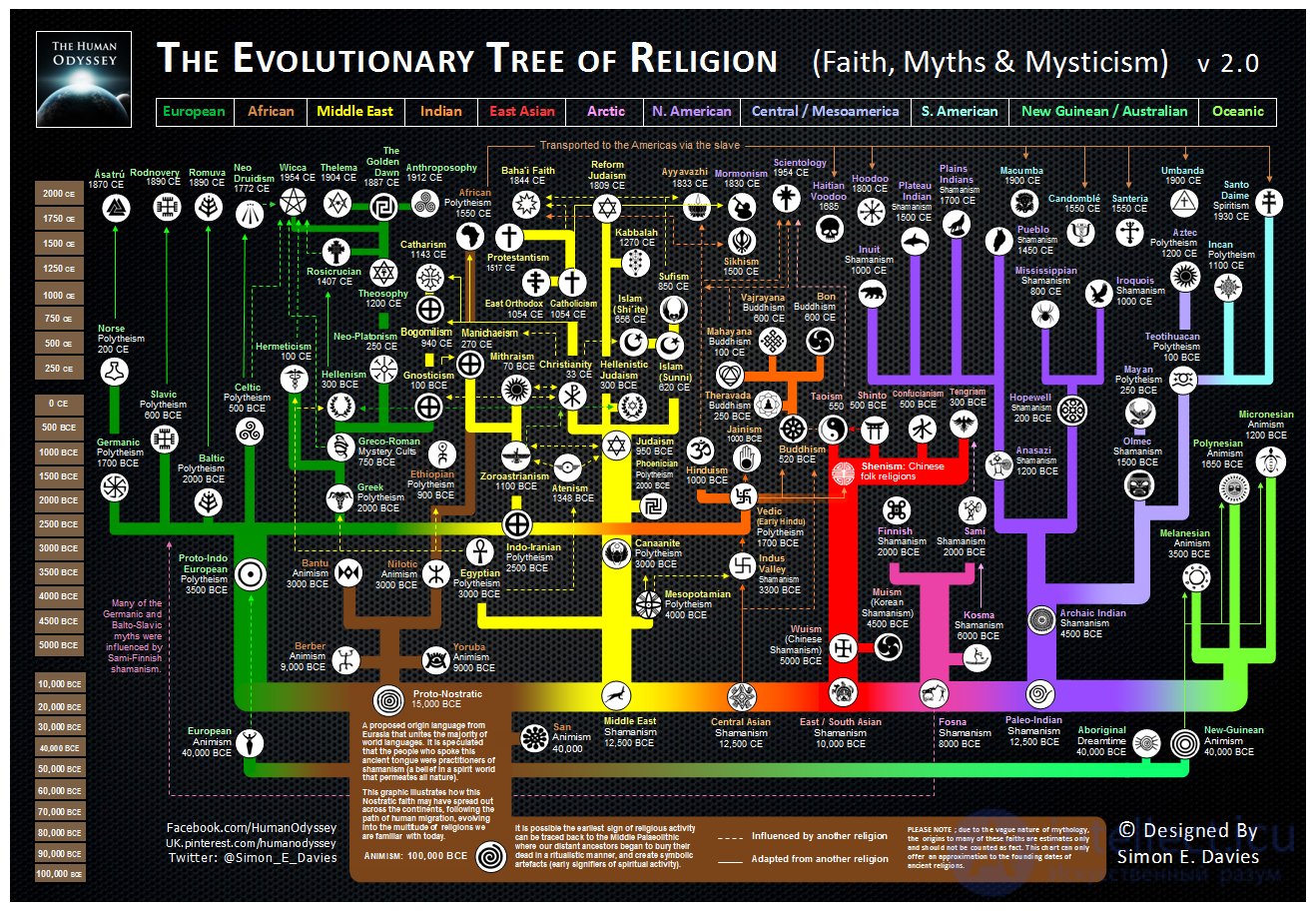
The evolutionary tree of religions
Since the dawn of humanity, people have tried to understand their world, especially when faced with unknown phenomena such as "what causes storms?", "what happens to us after death?", and "how was the world formed?" It is quite likely that our first primitive religions were formed out of such questions.
The earliest evidence of religious practice can be traced back 100,000 years, to when we began burying our dead. Although we cannot pinpoint this as the source of faith, it does indeed suggest that at the dawn of humanity we began to consider some form of afterlife.
Over time, this religious practice gave rise to a new ideology that spread across all continents, known today as "animism". This new faith was a belief system whose root would develop and expand into numerous other ideologies around the world. The development of these religions can be divided into three classical periods.
It should be noted that these periods do not indicate a new ideology improving upon older belief systems. As with many other aspects of life, religions change over time; their rituals and customs may become more complex, some die out, and others adapt to a new social and political environment.
Period 1: Animism (100,000 BC to the present)
People began to believe that natural forms (such as plants, animals, stones, and wind) possessed a spiritual essence. It was believed that these spiritual beings had energy and temperament that influenced our everyday world. By worshipping these godlike beings, people believed that they could maintain harmony with this world of spirits and obtain help (favor) from them.
Period 2: Polytheism (15,000 BC to the present)
The roots of polytheism may lie in the Epipaleolithic era. Linguists and historians have identified a hypothetical language family called Nostratic, which likely influenced all African and Eurasian dialects. Many of the words that can be linked to reconstructed nature gods (such as Mother Earth and Father Sky) suggest that the nature spirits of animism evolved into a new generation of gods, giving abstract beings of thunder and water a more human form. During the Neolithic Revolution, civilizations came to possess new fields of knowledge (such as lawmaking, metallurgy, agriculture, and trade). It was the descendants of the Nostratic gods (such as the Indo-Europeans and the Sumerians) who took on the role of guide and leader in the civilized world.
As a rule, these divine beings were divided into several classes, overseeing the heavens, the world of mortals, and the underworld. Each deity possessed its own powers, religious practice, and domain (for example, trade, diplomacy, the fortunes of war, and so on). A person could worship either one or all of these beings, benefiting from them through sacrifice, prayer, and even offerings.
Period 3: Monotheism (1348 BC to the present)
In the Bronze Age, a new movement arose that gave priority to a single God above all other deities. This system is known as monotheism — belief in one Supreme Being. In 1348 BC, the pharaoh Akhenaten elevated a lesser-known god called "Aten" to supreme status, diminishing the role of all other Egyptian deities. Somewhat later in Iran, Zoroaster (a Persian priest) claimed that "Ahura Mazda" was the one supreme deity. This new system gave rise to the notion that a single creator god formed the known universe and was fully self-sufficient, capable of dominating all other parts of it. This idea came to be traced through Judaism, Christianity, Islam, and Sikhism.
Most monotheistic systems tend to be exclusive by nature, meaning that the gods of the old world had to be purged from complete consciousness. As a consequence, monotheistic religions display less religious tolerance than polytheistic religions, resulting in their use in many wars and political disputes.
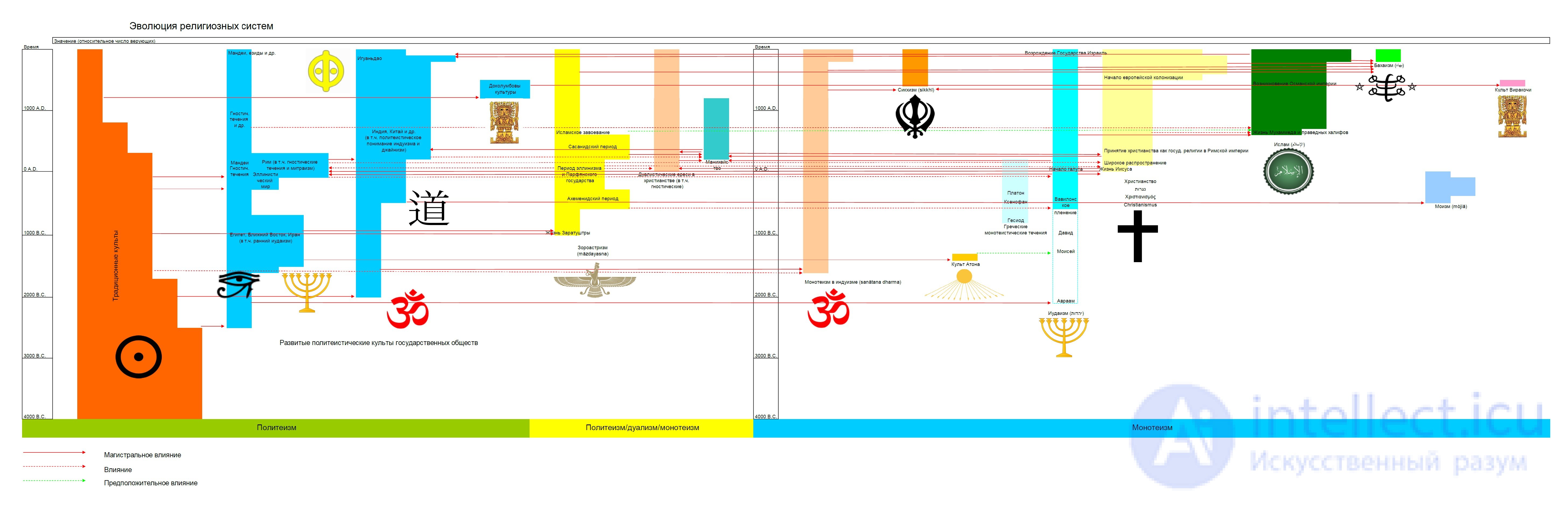
The prehistory of religion involves the study of religious beliefs that existed before the appearance of written sources. One can also study comparative religious chronology through a timeline of the emergence of religions. Writing played an important role in standardizing religious texts, regardless of time and place.
The earliest archaeological evidence of religious ideas dates back several hundred thousand years to the Lower and Middle Paleolithic. Archaeologists regard the apparently deliberate burials of early Homo sapiens as far back as 300,000 years ago as evidence of religious ideas. Other evidence of religious ideas includes symbolic artifacts from Middle Paleolithic sites in Africa. However, the interpretation of early Paleolithic artifacts in relation to their connection with religious ideas remains controversial. Archaeological data from later periods is less contested. Scholars sometimes interpret a number of artifacts from the Upper Paleolithic (50,000—13,000 BC) as representing religious ideas.[31] Examples of Upper Paleolithic remains associated with religious beliefs include the lion-man figurine, Venus figurines, cave paintings from the Chauvet Cave, and elaborate ritual burials from Sungir.
In the 19th century, researchers put forward various theories on the origin of religion, challenging views on religion previously expressed along the lines of Christianity. Early theorists Edward Burnett Tylor (1832−1917) and Herbert Spencer (1820−1903) emphasized the concept of "animism"[32], while the archaeologist John Lubbock (1834−1913) used the term "fetishism". Meanwhile, Max Müller (1823−1900) suggested that religion arose from hedonism[33], and the folklorist Wilhelm Mannhardt (1831−1880) suggested that religion began with "naturism" — by which he meant the mythological explanation of natural phenomena
Göbekli Tepe, the oldest pre-pottery Neolithic (PPNA) religious site[36] ever discovered, includes circles of massive erected T-shaped stone pillars, the oldest known megaliths in the world, decorated with abstract, enigmatic pictograms and carved animal reliefs. This structure was built before the so-called Neolithic Revolution, that is, before the beginning of agriculture and animal husbandry around 9000 BC. However, the construction of Göbekli Tepe implies an organization of an advanced order not previously associated with Paleolithic, PPNA, or PPNB societies. This site, abandoned around the time the first agricultural communities emerged, is still being excavated and analyzed, and thus it may shed light on the significance it held for the region as well as for the general history of religions.
The Pyramid Texts from ancient Egypt, the oldest known religious texts in the world, date to 2400—2300 BC.[37]
Surviving early copies of religious texts include:
Historians have designated the period from 900 to 200 BC as the "Axial Age", a term coined by the German-Swiss philosopher Karl Jaspers (1883−1969). According to Jaspers, in this era of history "the spiritual foundations of humanity were laid simultaneously and independently… and these are the foundations on which humanity still stands today". The historian Peter Watson summarized this period as the time in which many of humanity's most influential philosophical traditions were founded, including monotheism in Persia and Canaan, Platonism in Greece, Buddhism and Jainism in India, and Confucianism and Taoism in China. These ideas would in time become established, with Ashoka, for example, playing such a role in the spread of Buddhism.
The world religions of today became established throughout Eurasia in the Middle Ages:
In the Middle Ages, Muslims came into conflict with Zoroastrians during the Islamic conquest of Persia (633−654); Christians fought against Muslims during the Byzantine–Arab Wars (7th to 11th centuries), the Crusades (from 1095), the Reconquista (718−1492), the Ottoman wars in Europe (from the 13th century onward), and the Inquisition; shamanists clashed with Buddhists, Taoists, Muslims, and Christians during the Mongol invasions (1206−1337); and Muslims confronted Hindus and Sikhs during the Muslim conquest of the Indian subcontinent (8th−16th centuries).
European colonization during the 15th−19th centuries led to the spread of Christianity in sub-Saharan Africa, as well as in the Americas, Australia, and the Philippines. The invention of the printing press in the 15th century played an important role in the rapid spread of the Protestant Reformation under leaders such as Martin Luther (1483−1546) and John Calvin (1509−1564). Religious wars began, culminating in the Thirty Years' War, which devastated central Europe between 1618 and 1648. In the 18th century, secularization began in Europe, gaining momentum after the French Revolution of 1789 and in the years that followed.
In the modern world, the Abrahamic and Eastern monotheistic religions (Judaism, Christianity, Buddhism, Hinduism, Islam) continue to exist, giving rise to numerous religious movements. In addition, new religious movements (NRMs) continue to constantly emerge, for example so-called syncretic movements.
The history of religion in modern society is viewed by some scholars from the perspective of the decline of traditional religions, since they no longer correspond to the social structure of society, and the possible emergence and influence of new ones. Another aspect of the history of religion — desacralization — contributes to the development of religion in the 20th and 21st centuries, directly influenced by dissatisfaction with the state of traditional religions and the emergence of materialist theories of human development. However, the role of religion is nonetheless seen as important for the historical processes of achieving peace and tranquility on the planet to succeed.

Comments