
Lecture
Lecture Plan
When studying religions one must learn to notice both the general and the particular, and so the logical operation of classification should be carried out on the basis of the most essential feature. What is taken as the essential feature at any given time says a great deal about the era in which it is applied. Thus the very first classification of religions in religious studies, carried out by missionary-colonizers, was extremely simple: all religions were divided into true and false. Naturally, such a classification cannot be regarded as credible, given its subjective foundations.
Among the classifications of religions with a greater degree of objective grounding, the following approaches can be distinguished:
The evolutionary approach. Religion is compared to an object or process that has an emergence (or manifestation) in human society, an existence, and a decline. Indeed, as we shall see when we study the structure of religion, at different stages of its development certain of its functions dominate, corresponding to a period of religious rise or of disintegration. Since the nineteenth century there has existed a classification of religions by stages of development (by analogy with human maturation). This approach, when applied to the world process as a whole, has many shortcomings. An example is the classification carried out by G.W.F. Hegel.
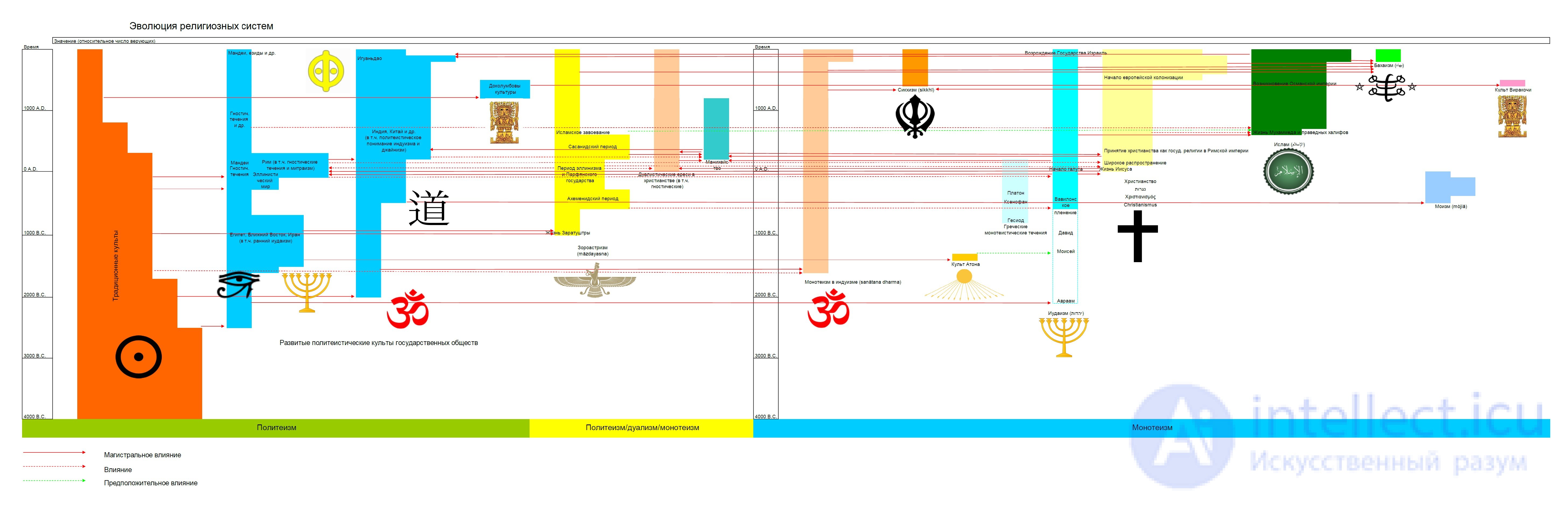
Hegel's evolutionary classification:
The evolutionary classification is applicable to individual religions taken separately, since one can trace their individual growth and decline along the timeline; however, applying this classification to all religions carries the risk of oversimplifying world development.
The morphological approach. In this approach religions are divided according to their composition and internal content (mythological / dogmatic religions), by their ideational content, by the form of their doctrine, by the character of their cult, by their ideal, by their relation to morality, art, and so on. Thus, depending on the object of worship, religions are divided as follows:
Undoubtedly this classification too has its flaws. Judaism, traditionally counted among the monotheistic religions, is considered by I.A. Kryvelev to be monolatry, and this is true in a certain sense, since in early Judaism the figure of Yahweh was not singled out as a transcendent, otherworldly God.
Atheistic religions differ greatly from one another. In early Buddhism the individual is indifferent to the existence of God. Satanism, in its various manifestations, may either deny the existence of the good God himself or reject his absolute authority, i.e. here we have a certain form of rebellion against God. Scientology grants the individual the possibility of becoming a «God» himself, while the role of God in governing the world and the individual is generally not emphasized there.
By the nature of their origin, spread and influence, national and world religions, natural religions and revealed religions, folk and personal religions are distinguished. This approach must be understood dialectically, since one and the same religion, taken in different temporal relations, may appear as national and as world, as folk and as personal.
By their relation to the world and to man, religions are divided into world-tolerant, world-denying and world-affirming. In a religion a non-utilitarian orientation may predominate (soteriological cults), or a gnostic, mystical (magical) or pragmatic one (religions of prosperity).
The statistical approach. The most positive approach, since here the basis for division consists of empirically fixed data – the number of believers, their age and sex composition, and geographical distribution.
The genealogical approach. This approach takes into account the actual historical and semiotic connections between religions. According to this classification one can group together and consider jointly Judaism, Christianity and Islam as Abrahamic religions; Hinduism, Jainism, Buddhism and Sikhism as religions of Southeast Asia; the religions of the Slavs, Germans, Celts, Greeks and Romans as Indo-European religions, and so on. Undoubtedly, this classification too is not ideal. Nevertheless, it allows one to trace the origin of religions and to identify a shared cultural space.
In asking about the source of religion, one inevitably runs up against a dead end of modern science – the problem of the origin of man. For even if we suddenly grant a divine source for religion, its bearer is nevertheless man himself.
The awareness of one's own mortality and the attempt to come to terms with one's mortal nature led to the emergence of belief in an afterlife. The desire to influence natural phenomena and events led to the emergence of magic and religion.
Religion is a definite system of views, conditioned by belief in the supernatural, encompassing a set of moral norms and patterns of behavior, rites and cultic acts, and uniting people.
The origin of man is explained either from a natural-scientific standpoint or from a religious one. The humanities can begin to explain human existence only from a certain point onward.
The natural-scientific approach to the origin of man and the emergence of religion can be summarized as follows: primordial man, observing and reflecting on the world around him and on himself within it, understood that he was surrounded not by chaos but by an ordered universe, subject to a supra-natural force. This approach implies that religion is a purely human product, especially in light of the ideas of the Big Bang and the evolution of species. Strictly speaking, religion here arises at a certain stage in the refinement of the australopithecine hand. As soon as the complication of operations performed by the hand contributes to the appearance of a greater number of convolutions [in the brain], our «ape-like philosopher» invents supernatural forces in order to somehow explain the phenomena of nature. Accordingly, man should have abandoned religion in the twentieth century, when the major scientific discoveries made it possible to rationally explain the structure of the world. If the world develops linearly, from the simple to the complex, from disorder to harmony and from myth to logos, then religion should have died. Yet religion has not surrendered its positions, while man has only sunk deeper into existential anguish, trying to overcome the experience of finitude. Despite the passage of time, we likewise cannot objectively say that humanity has grown wiser (otherwise it would not commit follies today; moreover, some believe that the truly wise man was the man of traditional culture, for he was close to nature). Whereas modern man withdraws further from nature and sets himself against it, which makes his existence all the more meaningless. Thus natural-scientific methods do not give us breadth of action; they force us to interpret religion as a purely human phenomenon.
A variant of the evolutionary interpretation of the genesis of man and religion is the hypothesis of the existence of a «pre-religious period» in the history of humanity. Adherents of this position hold that people living at the early stages of the development of society had no religious beliefs, since these people did not possess abstract thought and could not create or grasp religious abstractions. Many ethnographers and anthropologists at the turn of the nineteenth and twentieth centuries cited evidence of the existence of tribes so low in their development that they allegedly lacked religious ideas and concepts entirely. However, after a thorough study of their life, language, customs and modes of thought, definite religious beliefs and elements of cultic practice were invariably found. E. Tylor, a researcher of indigenous culture, having asked whether there were tribes with no religious concepts at all, concluded that science knows of no such tribes. Nor is there such evidence from a historical perspective. «Venus» figurines have been found across the area stretching from the Pyrenees to Siberia. They are dated to as early as 25,000 years BCE. The burial practices of ancient people indicate that religious beliefs were present as far back as 40,000 years ago. Special burials were arranged, preparing kinsmen for a future life. Bodies were covered with a layer of ochre, and weapons and household objects were placed beside the body of the deceased.
All this attests to the existence of ideas about the afterlife. That is why the hypothesis of a «pre-religious» period never developed into a theory.
The traditional approach to the origin of man, that is, the approach from the standpoint of the religions themselves, is simple – man was created by God, and religion was given to man as the laws of God. Thus, according to the creationist model of theologians, people were created «cultured», since the sons of Adam took up farming and animal husbandry, built an ark, and attempted to build the Tower of Babel. If one accepts the biblical version, then where did the wild hunters and fishermen on earth come from? To explain this cultural «gap», creationists began to claim that after the act of creation, culture went two ways – the path of the development of civilization and the path of degradation.
The traditional approach has its shortcomings owing to its dogmatism. Scholars had a sorry experience of building science on Judeo-Christian theology in the fields of geology, history and ethnology. On the other hand, the diversity of religious traditions does not allow one to choose any single one, since their explanations of the phenomena of man, time, space, and the beginning and development [of the world] do not coincide. On the contrary, some differ very sharply. The Abrahamic religions adhere to a linear paradigm, whereas the doctrine of cycles in Hinduism presents the world as a whole as a cyclical system in which entropy increases, with local possibilities for progress. For these reasons it seems advisable to leave the question of the original origin of religion aside altogether – that is a matter for religion itself alone. We can only try to make sense of the existing diversity of religious experience, taking it within the spatio-temporal span accessible to us.
The humanities approach makes it possible to draw a clear distinction between two types of humanity's religious experience, naturally with the possibility of their mutual interpenetration and overlap (Table 2).
Classification of religions
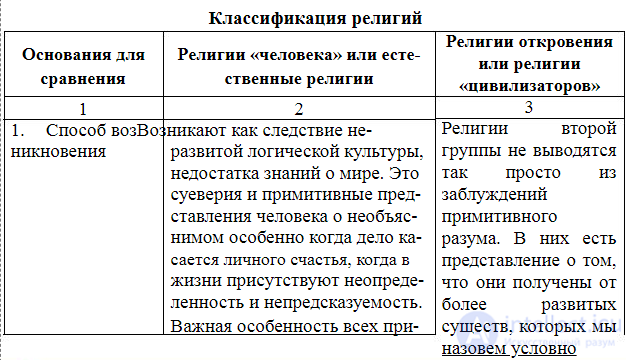
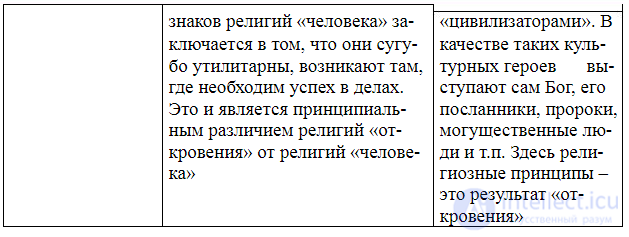

Thus there exist developed forms of religion, which are usually characteristic of more or less developed societies, and we can observe fairly earthbound religions whose localization coincides with the location of primitive cultures.
Primordial monotheism (Urmonotheismus) is a theory of the origin of religion built on the assertion that monotheism was the initial stage of the history of religious development. In scholarly circles the first proponents of the idea of the primacy of monotheism were certain representatives of the «mythological school». Thus J. Grimm suggested that a once-unified Deity later split, in later pagan consciousness, into trilogies and dodecalogies. W. Mannhardt attributed to paganism a certain «sense of divine unity». In the works of A. Lang the idea was developed that primitive people believed in a Supreme Being, a Creator and Judge; this belief, Lang held, was later displaced by polytheism. The theory of primordial monotheism received systematic development in the works of W. Schmidt, above all in his «The Origin of the Idea of God» (12 vols., 1912–1955), and also in the works of his followers. Drawing on an enormous body of ethnographic field-research material from the peoples of Africa, Oceania and North America, Schmidt tried to discover in «primitive» beliefs in a supreme being common traits that would confirm their dependence on the most ancient monotheism. To justify his conception, Schmidt, in polemic with animism, relied on the methodology – authoritative in the early twentieth century – of the «culture-historical school» and the theory of culture circles. According to Schmidt's views, the most ancient image of the Heavenly God, the God-Creator, was the «purest» expression of monotheism; the development of the economy, especially of agriculture, and of social relations (the establishment of matriarchy), conditioned the emergence of religious veneration of nature, totemism, fetishism, magic and mythology, which had a negative effect on the preservation of the original monotheism, based on belief in God the Father. A number of Schmidt's observations, based on ethnographic material, are of serious scholarly significance, but the general theory of primordial monotheism developed in his works has not received wide support in contemporary religious studies and is used mainly to justify theological approaches. The theory of primordial monotheism underlies the seven-volume work of the Orthodox theologian A. Men, «A History of Religion: In Search of the Way, the Truth, and the Life».
Over the course of the nineteenth and twentieth centuries, the expansion of modern knowledge concerning the Greco-Roman and ancient Near Eastern civilizations was aided by the archaeological discoveries of H. Schliemann, who excavated Troy; A. Evans on Crete; W.M. [Flinders] Petrie in Egypt; J. de Morgan in Elam; H. Winckler at Boghazköy (Anatolia); C. Schaeffer and C. Virolleaud at Ras Shamra; the final restoration of Masada, the Judean fortress, in 1963; the unveiling of the secret of the Indus Valley civilization by J. Marshall; and the discovery of cave paintings in the Dordogne, in northern
and eastern Spain, and in other places – all this gave scholars the opportunity to work out a scheme of the religious development of man from the earliest times. However, while stimulating the search for a religious history, literary and archaeological finds and fragments could hardly adequately reconstruct an originally true and whole body of knowledge.
In the methodology of religious studies, anthropological-ethnographic groundings are often bound up with sociological and psychological ones – all of them are empirical, proceeding from the existence of human religious behavior, of feelings and intentions of thought, in one or another culture or ethnos. All of them are analytical. In the nineteenth and twentieth centuries an enormous body of historical material was gathered describing the lives of tribes and entire societies, their ritual and confessional practice, based on data from expeditions to indigenous peoples, the decipherment of cave paintings, potsherds, and so on. Sometimes, however, the conclusions drawn from such analyses, beyond the obvious «facts of thought» of primitive people, often overstepped the bounds of the evident and touched on ideas about the origin and development of religion, and did so under the influence of the then-dominant theoretical model – evolutionism.
An early attempt to combine archaeological evidence about prehistoric peoples with anthropological data was the work of J. Lubbock, «The Origin of Civilisation and the Primitive Condition of Man». In it an evolutionary scheme can be traced, beginning with atheism and proceeding through fetishism, totemism, shamanism and anthropomorphism to monotheism. At the same time Lubbock recognized the distinction, later pointed out by R. Otto, between the unique holiness (separateness) of God and his ethical characteristics. In the same spirit religion is interpreted by E.B. Tylor, the father of anthropology, who regards animism as its primary form; H. Spencer, who produces the same classification of religion; and R. Marett, who regards the phenomenon of animatism as of first importance. Religion, [on this view,] is not so much thought as dance. No less extensive research, drawing on a mass of evidence, was presented by J. Frazer, who held that people began with magic and progressed toward religion. However, as a result of the criticism of these approaches by the scholars of religion Lang and Schmidt (who saw monotheism as primordial), evolutionism in anthropology began to fade, opening the way for specialized studies and for the investigation of the functional and structural models of religion's existence in society. In this view God was regarded as a personified symbol of the clan (E. Durkheim), and all objects of religious worship symbolized «social relations», playing a role in stabilizing the social group.
An influential anthropological thinker who shaped the paths of modern ethnology and the sociology of religion is considered to be Marcel Mauss (1872–1950), who in a series of works («A General Theory of Magic», «Sacrifice: Its Nature and Function», «Prayer», «Collective Representations and the Diversity of Civilization», «An Essay on the Idea of Death», and others) demonstrates the dependence of everything individual and inwardly religious on strictly defined rules dominant in society. Even our self-perception of the technique of our bodily movements bears the imprint of social structure. «Children are taught to restrain their reflexes; fears are suppressed; pauses and movements are chosen.» Mauss hoped to establish a new type of unity, in which «social nature merges in the most direct way with the biological nature of man». The social determination of the religious (psychological) is seen more clearly, since, despite its «imperceptibility» and «unconsciousness», it is fixed in linguistic and ritual experience. In the religious consciousness (being) of man, «myth and ritual merge into one». There is no religion without an organic system of concepts and collective rites relating to the sacred beings it recognizes. Nor, according to Mauss, are there any social phenomena that would be isolated from others – from the whole integral totality of the kinds of social institution
– religious, legal, juridical, economic. Every culture, like a woven fabric, is socially unified. Hence the proposed method is to regard everything, even sacred phenomena and symbols, as social facts. They are very numerous and inconspicuous, imprinted in our habits, and it is these that must be collected and defined. It turns out that in the smallest details, feelings, cries of the soul, prayerful interjections and sighs, one finds the imprint of a specific theological doctrine, hears the echo of an endless succession of formulas, sees a part of a whole literary and ritual tradition, the product of the efforts of entire generations.
In this respect, prayer for Mauss likewise appears as a social phenomenon, not only in content but also in form. «In religions that leave maximum room for individual action, any prayer becomes ritual speech, accepted by the religious community.» Consciously or not, a person submits to certain prescriptions, adopting the posture he considers fitting. The inner monologue consists of phrases taken from prayer books. Emphasizing the importance of the sphere of prayer and religion, Mauss points out that an entire category of social facts – legal and moral institutions – stand in close kinship with it. The same holds for the symbolically complex act of sacrifice, which carries within it the whole spectrum of existential-religious, cosmological and politico-economic conceptions of ancient man's consciousness. Purely religious acts can be understood only on the assumption of subconscious processes. Mauss makes this discovery before the discoveries of S. Freud.
Mauss's ideas about the kinship of myth and ritual were used by Lévy-Bruhl and C. Lévi-Strauss, in the works of B. Malinowski and P. Radin, and influenced the formation of an entire «myth and ritual» school.
Among religious anthropologists, renown was also won by Vittorio Lanternari, C. Geertz, E. Evans-Pritchard and G. Swanson – all of whom studied behavioral culture and symbolism, seeking correlations between beliefs and types of society.
The religious beliefs and cults of primitive people took shape gradually. The earliest form of religion was the worship of nature. Primitive peoples had no notion of «nature», and so the object of their worship was an impersonal natural force, denoted by the concept of «mana». Scholars borrowed this term from the aborigines of Polynesia and Melanesia, who used it to designate the force governing natural processes. A person possesses mana when he is happy, fortunate, and displays some unusual success, for example as a farmer, warrior or chief. Mana is sent by the gods, which implies that they possess mana first and foremost.
An early form of religious views should be considered totemism – the belief in the existence of a kinship bond between some group of people (tribe, clan) and a particular species of animal or plant. Totemism was the first form of the awareness of the unity of the human collective and its connection with the surrounding world. The life of the clan collective was most closely bound up with certain species of animal that all its members hunted. As scholars suppose, this circumstance served as the basis for the emergence of the totem (in the language of the Ojibwe, a North American Indian tribe, ototeman means «his kin») – an animal ancestor regarded as the patron of the clan.
In later times, elements of social relations, chiefly relations of blood kinship, were introduced into totemism. Members of a clan group (blood relatives) came to believe that they were descended from ancestors who combined the traits of humans and of their totem. This led, on the one hand, to a strengthening of the cult of ancestors and of belief in their special powers, and on the other, to a change in the attitude toward the totem itself, in particular to the appearance of prohibitions on eating totems, except in cases where the eating of the totem was ritual in character and recalled ancient norms and rules.
Subsequently, within the framework of totemism, a whole system of prohibitions arose, called taboos. They represented an important mechanism for regulating social relations. Thus, sex- and age-based taboo excluded sexual relations between close relatives. Food taboos strictly regulated the kind of food that was to go to the chief, the warriors, the women, the elderly and the children. A number of other taboos were meant to guarantee the inviolability of the dwelling or the hearth, to regulate the rules of burial, and to fix the social status, rights and duties of members of the primitive collective.
Among the early forms of religion is magic (literally, in translation from the ancient Greek – sorcery). It represents a belief, which arose among primitive people, in the possibility of influencing certain natural phenomena by means of particular symbolic acts (incantations, spells, and so on).
Having arisen in deep antiquity, magic persisted and continued to develop over many millennia. Whereas at first magical beliefs and rites were general in character, over time they became differentiated. Modern specialists classify magic by its methods and by the aims of its effect. By method of effect, magic is divided into contact magic (through the direct contact of the bearer of magical power with the object at which the action is directed), initial [or "imitative-at-a-distance"] magic (the magical act is directed at an object that is unreachable to the subject of the magical activity), partial magic (indirect influence through cut hair or nails, or leftover food, which in one way or another come into the possession of the holder of the magical power), and imitative magic (an effect on a likeness of the subject). By the aim of the effect, magic is divided into harmful, military, productive [hunting/gathering], healing, love magic, and so forth.
As a rule, magical practices were conducted by specially trained people – sorcerers and shamans – who sincerely believed in their ability to communicate with spirits, to convey to them the requests and hopes of their fellow tribesmen, and to influence supernatural forces. But the main thing was not that they themselves believed in their extraordinary abilities, but that the collective believed in them and turned to them for help at the most critical moments. That is why sorcerers and shamans enjoyed special honor and respect among primitive people.
Over time, magic became one of the most essential components of developed religion, including a definite system of magical acts – rites, sacraments, prayers, and so on. In everyday life, magic has survived down to our own day in the form of spells, fortune-telling, predictions, and belief in the «evil eye» and «curses».
For primitive people, the veneration of various objects that were supposed to bring luck and ward off all dangers held special significance. This form of religious belief is called «fetishism» (from the Portuguese «fetiço» – made [thing]). It was first discovered by Portuguese sailors in West Africa in the fifteenth century, and analogues of fetishism were subsequently identified in the religions of nearly every country, as well as in the course of archaeological excavations that yield material on the beliefs of primitive people.
Any object that struck a person's imagination could become a fetish: a stone of unusual shape, a piece of wood, the tooth of a fossil animal, a piece of jewelry. Properties not inherent to it were ascribed to this object (the ability to heal, to protect from danger, to help in the hunt...). Most often, the object that became a fetish was chosen by trial and error. If, after this choice, the person managed to achieve success in practical activity, he considered that the fetish had helped him in this, and he kept it for himself. If, on the other hand, some misfortune befell the person, the fetish was thrown away or replaced with another.
The way primitive people treated fetishes shows that they did not always show due respect toward the object they had chosen. For help rendered, it was thanked; for helplessness, it was punished. In this respect the African custom of tormenting fetishes is telling, and not only to punish them but also to spur them to action. For example, when asking a fetish for something, African women would drive iron nails into it, believing that afterward the fetish would better remember the requests addressed to it and would be sure to fulfill them.
An especially widespread form of fetishism was the veneration of stones and pieces of wood. Thus, members of the American Dakota tribe would find a round boulder, paint it, and then, calling this boulder grandfather, would begin to bring it gifts and ask it for deliverance from dangers. It is also known that many Brazilian tribes drove sticks into the ground and offered them sacrifices. The custom of worshipping stones and wooden posts existed among many peoples of North Asia. It did not bypass the peoples of Europe either. Several centuries ago, in England and France, there existed a prohibition on the worship of stones, which testifies to the long persistence of fetishism even during the era of the domination of the Christian religion in Europe.
Speaking of the wide spread of fetishism, it must be emphasized that the content of this system of beliefs changed significantly. The aforementioned veneration of stones and pieces of wood, accompanied by the offering of gifts and sacrifices, as well as the custom of tormenting fetishes, belong to a rather late stage in the development of fetishism. Evidently, in deep antiquity people did not endow the objects they had chosen with human properties, did not spiritualize them, still less deify them. The essence of primitive fetishism lay in the fact that a person discerned, in objects that had struck his imagination, properties that were detected in them by means of the ordinary organs of sense. In doing so, a person made objects «sensuously-suprasensuous», and the suprasensuous properties were ascribed to fetishes either on the basis of chance associations or on the basis of incorrectly understood cause-and-effect relationships.
Speaking of early forms of religion, one cannot fail to mention animism (from the Latin «anima» – soul) – the belief in the existence of souls and spirits. A detailed analysis of animistic beliefs was given by E. Tylor in his work «Primitive Culture». According to his theory, these beliefs developed along two lines. The first set of animistic notions arose in the course of ancient man's reflection on such phenomena as sleep, visions, illness, and death, and also from experiences of trance and hallucination. Being unable to correctly explain these complex phenomena, the «primitive philosopher» formed the concept of a soul, residing in the human body and leaving it from time to time. Later, more complex ideas developed about the existence of the soul after the death of the body, about the transmigration of souls into new bodies, about the afterlife, and so on.
The second set of animistic beliefs arose from primitive people's inherent tendency to personify and spiritualize the surrounding reality. Ancient man regarded all the objects of the objective world as something similar to himself, endowing them with desires, will, feelings, thoughts, and so on. From this arises belief in separately existing spirits of the formidable forces of nature, of plants, of animals, which, in the course of a complex evolution, was transformed into polytheism, and then into monotheism.
Animistic beliefs enter as a constituent and highly essential part into all the religions of the world. Belief in spirits, in evil forces, in the immortal soul – all these are modifications of the animistic conceptions of the primitive era. The same can be said of the other early forms of religious belief. Some of them were assimilated by the religions that succeeded them; others were pushed into the sphere of everyday superstitions and prejudices. Thus the belief, surviving down to our own day, in amulets, talismans and sacred relics is nothing other than a survival of primitive fetishism. Echoes of totemism can be found in the food prohibitions existing in many religions, in the depiction of supernatural beings in the guise of animals, and so on.
At the early stages of the development of human society, the primitive forms of religious belief did not exist in pure form. They intertwined with one another in the most bizarre way. It is therefore hardly possible to raise the question of which of these forms arose earlier and which later. Evidently, one should speak of a complex of religious beliefs. The composition of this complex could be quite varied. For example, among the aborigines of Australia the most preferred element of their religious complex was totemism with a carefully elaborated system of taboos. Among the numerous peoples of Siberia and the Far East, magic clearly predominated, along with the closely related practice of shamanism. As for the peoples of Africa, they were distinguished by their inclination toward fetishism. However, in each specific case, the coming to the fore of some part of the religious complex does not mean that primitive people were unfamiliar with its other elements. It was precisely the complex of the primitive beliefs examined here that became the core of the so-called tribal religions, which were distinguished by great diversity, since they reflected conditions of habitation, social ties and features of material culture specific to a given tribe.
The religions of Ancient Egypt, India, Greece, Rome, the Aztecs, the Maya, the ancient Germans, and ancient Rus' were characterized by belief in many gods — polytheism.
One of the most complex and carefully elaborated systems of polytheistic worldview was the religion of ancient Greece and ancient Rome.
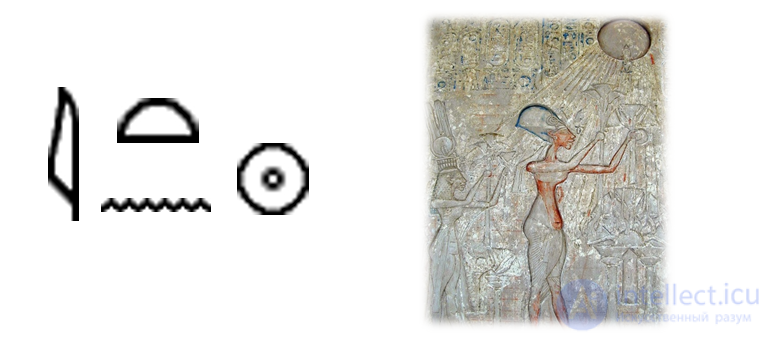
In Egypt the concept of monotheism (the belief in one God) was first formulated during the reign of the pharaoh Akhenaten. This pharaoh undertook an attempt at religious reform, the aim of which was to centralize the Egyptian cults around the sun god, Aton.
The concept of «tribal religion» refers to the period of the pre-class development of society, which was characterized by a low level of development of the productive forces and relatively simple social relations. This period stretched over many millennia, and within it significant changes took place both in social life and in religious beliefs. In the early stages of the clan system, which did not yet know social stratification, the main object of religious worship was nature. Depending on the geographical environment and economic specialization, various aspects of the reality surrounding primitive man were endowed with supernatural properties. Thus tribes engaged in gathering and primitive agriculture worshipped plants and heavenly bodies, while hunting tribes worshipped animals.
Tribal religions reflected not only the forces of nature and the specifics of economic activity, but also social relations. For example, the replacement of matriarchy by patriarchy and the new organization of society that arose on this basis led to substantial changes in religious consciousness. Female spirits, whose veneration had been universal in the era of matriarchy, were gradually displaced by spirits of the male sex. The performance of the cult also became a male occupation. In the era of the early clan system, religious beliefs also reflected the real equality of fellow tribesmen. Spiritual beings were mostly impersonal in character. Magical rites and reenactments, in which all members of the tribe took part, predominated in cultic activity. Sorcerers, shamans and conjurers of spirits had not yet been set apart from the mass of believers.
Substantial changes in the character of religious beliefs occurred amid the disintegration of clan-tribal relations and the deepening of social differentiation within tribes. Over time, material wealth began to accumulate in the hands of individual members of the community, and ordinary fellow tribesmen came under their subordination. The rise of chiefs and the strengthening of their role in the life of the tribe gradually led to their sacralization; they became objects of religious veneration not only after their death but during their lifetime as well. Social stratification within tribes and the formation of a tribal aristocracy were reflected in the content of religious ideas. Impersonal spirits were given names, particular functions were assigned to them, and a hierarchy of spirits arose that in many respects reproduced the social hierarchy.
The veneration of a multitude of spirits was replaced by polytheism, which turned the most venerated spirits into deities. Above the incorporeal spirits and the spirits of ancestors, the local genii of rocks, springs and trees, above the crowd of good and evil spirits, there began to rise more powerful deities whose influence was not confined to local clan or tribal interests.
A good illustration of the formation of polytheism is provided by the religious conceptions of the Konds, tribes living in the mountainous regions of India. In studying the life of these tribes, scholars discovered that the world of the Konds is populated by an enormous number of local spirits. They govern natural phenomena and influence human life. Above the local spirits stand the souls of outstanding people, who are regarded as the divine patrons of the tribes. Above them stand six great gods: the god of rain, the goddess of first fruits, the god of fertility, the god of the hunt, the god of war, and the god-judge of the dead. Even higher than these gods stand the sun god and his wife, the mighty goddess of the earth. Similar structures were found in Asia among the Samoyeds, among the indigenous peoples of Mexico, and among many tribes of Africa and Australia.
The highest place in such hierarchies was most often occupied by gods associated with the sky or with celestial phenomena. However, these gods were not impersonal beings. They were endowed with the attributes of social life and had to perform definite social functions. Alongside the celestial gods, deities of the earth were also placed. Thus, in ancient Greek religion, the personification of the earth was Gaia, who gave birth to the sky, the sea, and the mountains.
A high position in the polytheistic hierarchy was occupied by warrior-gods, which was connected with the wars of extermination characteristic of the period of transition from clan-tribal relations to class society. In the course of these wars, tribes were united and tribal unions formed. Correspondingly, a synthesis of religious conceptions took place. At the head of the polytheistic pantheon there usually turned out to be the god of the hegemon tribe. This is how henotheism arose – a variety of polytheism consisting in the fact that, while acknowledging the existence of many gods, a given community of people considered only one of the multitude of gods to be its patron and worshipped only him. From here it remained only a single step to monotheism, but a step so difficult that many peoples failed to take it even under conditions of a developed class society.
During the period of transition from the clan-tribal system to class society, substantial changes also occurred in the sphere of religious practice. It is clear that the attitude toward gods should differ from the attitude toward the spirits of the dead. Whereas at the early stages of the development of human society relations with the souls of the dead and with spirits were regarded as a further extension of people's everyday intercourse with one another, subsequently these relations acquired the character of intercourse between beings incommensurable in status. With the appearance of great deities, man falls to his knees and becomes a humble supplicant. The character of sacrifices also changes. Numerous sacrifices, including human ones, are offered not only to the souls of people standing high in the social hierarchy, but above all to the gods, and these sacrifices come to be strictly regulated. The fine points of sacrifice were known only to priests, who gradually separated themselves from the mass of ordinary believers and formed a special estate occupying one of the highest places in the social hierarchy. The priesthood often became a hereditary profession, passed down from generation to generation. At the same time, permanent shrines and temples appeared, which served as the center of religious life. Sacrifices, income from temple lands, and material support from secular authorities strengthened the economic and political position of the priesthood.
With the transition to class society, a new page opens in the history of religion, a page recounting the development and functioning of the religious systems of state-organized peoples.
Fetishism – is belief in the supernatural properties of certain inanimate objects. It is expressed in the worship of objects that have struck a person's imagination: a stone of unusual shape, a piece of wood, an animal's tooth, a piece of jewelry, a stone around which a great harvest grew. This object is ascribed properties not inherent to it: the ability to protect from danger, to bring luck, to help in the hunt, to heal, to give a harvest. It often happened that if, after appealing to the fetish, the desired outcome occurred, the person kept the fetish for himself; if the result was the opposite, the fetish was thrown away and replaced with another. Treatment of the fetish did not always bear the mark of the worship of God. A fetish could be tormented (in Africa, nails are driven into it so that it will better remember the requests addressed to it); for helplessness, a fetish could be punished. Fetishism should be distinguished from reverence before holy objects. Objects of worship are present in practically all religions; however, we do not consider such an object of worship a fetish if, within the tradition, there are objective grounds (for believers) for considering some object sacred. Such objective grounds may include:
•the object's connection with a Deity or a saint, which, it is believed, transfers to it a portion of holiness, of the power to purify a person (the Kaaba stone in Islam, the symbol of the crucifix);
•the object's possession of a certain spiritual status (relics, sacred rivers in India).
Animism – is the conception of a world populated by the spirits of things, of the presence of a soul in all objects. Addressing a thing by name, a person supposes that it hears and understands him, and that it can be placated. This notion – that every object, every phenomenon of animate or inanimate nature, has its own soul – is recorded in the beliefs of a great many peoples and tribes. Here, for example, is how V.G. Bogoraz describes such conceptions among the Chukchi: «Everything that exists is alive; the lamp walks about, the walls of the house have their own voice, and even the chamber pot has its own country and tent, wife and children, and serves as a familiar spirit. Skins lying in bags as stock for trade talk at night. Antlers on graves walk in a train around the graves and by morning return to their former place, and the dead themselves rise and come to the living.» In this or a somewhat less vivid form, the animation of everything that exists is recognized by the religions of many peoples studied by ethnographic science.
If all objects possess a soul, it means that they are alive. Such a conception leads to the view that there is no difference at all between the living and the non-living, since everything is alive. Sternberg sets out such a view of the world as follows: «...tree, mountain, cliff – are living, rational beings, hearing, understanding, moving, acting... the smallest animal, such as a frog, can be a terribly rational being, more rational even than man... a man can be born from a tree... and can even enter into marriage with such beings as a flounder; a felled tree can rise again if a small sharpened stick is driven into the stump», and «even objects made by man, such as a cauldron, a spear, a knife, a boat and so on, have a soul and can follow a person into the next world» [386, p. 16].
Animatism (from the Latin animatus – animated – a term coined by R. Marett) – is belief in an elemental, impersonal force that acts upon human life and, under certain circumstances, is likewise subject to influence. This supernatural force determines all vital processes in nature (harvest, success in the hunt, in war). Such a force, manifesting the universe and pervading nature, was called Manitou by the Algonquin Indians, was venerated as Mana by the Polynesians, was called Onim by the Papuans, Wangarr by the Australian aborigines, Nyama by the peoples of Western Sudan, Megbe by the Pygmies, Umoya by the Zulus, Jok by the Ugandans, Elima by the peoples of northern Congo, Wakan by the Dakota, Orenda by the Iroquois, and so on.
All these names indicate, among these peoples, a supranatural force that reveals its presence through the connection of things and phenomena. Often inexplicable phenomena then become an object of worship. This is a higher stage compared with animism, but it cannot be considered monism, or belief in the Holy Spirit, owing to the superstitious accretions that surround it.
Totemism – is another typical device of «religions of man». It is belief in a close bond between some group of people and their «relative», which may be a plant, an animal, or even an inanimate object – a particular animal or plant. The name of this form of religious belief comes from the word «ototeman», which in the language of the Ojibwe, North American Indians, means «his kin». The meaning of this practice lies in the deification of animals and plants that sustain life. The aborigines of Australia clearly expressed their attitude toward totems with the words «This is our flesh».
Magic – is a set of conceptions and rites based on belief in the possibility of a superhuman influence on people, objects and phenomena of the objective world by means of certain actions. Magic was employed when there was danger to life. In building a boat, the Polynesians used magic, since travel by sea was dangerous, whereas in building a house magic was not employed.
|
Varieties of magic by form |
Types of magic by purpose |
|||
|
|
|
|
|
|
|
1. |
Initial |
|
1. |
Agricultural |
|
2. |
Partial |
|
2. |
Hunting |
|
3. |
Imitative |
|
3. |
Harmful |
In antiquity it was believed that supernatural forces underlay magic. In the thought of Proclus, «the ancient priests, taking note that there is in natural things a certain affinity and sympathy of one thing to another and between manifest and occult powers, and discovering that all things are contained in all, created a sacred science on the basis of this mutual sympathy and resemblance... and used, for occult purposes, both celestial and earthly entities, by means of which, through a certain resemblance, they drew down divine powers into this lower dwelling.» In the thought of Iamblichus, «the magi claimed that, by means of priestly theurgy, they were able to rise to the more exalted and universal Entities, and to those established above fate, that is, to God and the Demiurge: not employing matter, and appropriating nothing beyond it, except by observing perceptible time.»
Since the time of Agrippa, the conception of the natural character of magic has prevailed: everything homogeneous exists in conditions of mutual exchange – the higher governs the lower, but the lower also acts in return. On this basis, all magical phenomena become merely the workings of a single all-embracing law of nature, and magic is grounded no longer in «operations unsanctioned by culture», carried out with the help of spirits, but in man's purposeful use of the Law of Similarity. Ritual acts, according to the views of adherents of magic, are capable of exerting an influence on nature and on man. Magic also serves as the core of most religious systems.
Magic includes: the performance of incantations, the carrying out of magical rites grounded in the [inner] state of the performer of the magical rites. Material objects built into it – amulets – are also an important element of magic. Magic represents the practice of using supernatural, «otherworldly» forces to establish control over the phenomena and processes of the material world and to act upon them. Magic also presupposes communication with supernatural forces and an explanation of physical processes based on belief in these forces.
The following magical practices have become the most widespread: occult magic, natural magic, theurgic magic, and shamanism. The occult direction is based on the traditions and rituals of Western European occultism, the Kabbalah, and ancient Germanic runic magic.
Natural magic involves the use of spells, love charms, herbal treatment and other methods, connected mainly with pagan traditions and rituals. It is represented by various kinds of healers and village folk-medicine practitioners.
Theurgic magic presupposes the active use of religious rites and prayers. Practitioners of this direction attempt to act within the framework of the existing religious tradition. Formally (for example, by baptism) they may belong to the bosom of the Church, but in essence they are not [fully] churched, and therefore suffer especially from rejection and condemnation on the part of clergy who regard their activity as offensive to God.
Shamanism represents the most ancient form of belief in spirits, presupposing above all animism, as well as a centering around the figure of the shaman – a powerful healer and clairvoyant, capable of communicating with spirits, subordinating them to his influence, and traveling through «other» worlds. To carry out magical acts, shamans often enter into special borderline psychosomatic states – ecstasy or trance. Entry into these states is achieved by various means: frequent beats on a drum, the performance of a rhythmic ritual dance, or the taking of hallucinogens contained in plant and animal tissues, and so on.
Also known is the magical practice associated with C. Castaneda's attempt to intellectually and scientifically comprehend the magical legacy of the ancient and little-known culture of the Toltecs, who inhabited Mexico long before its conquest by the conquistadors.
On other grounds, the types of magic are as follows:
In an article devoted to the problem of the relationship between magic and rationality (1973), the well-known philosophers of the second half of the twentieth century I. Jarvie and J. Agassi wrote: «We contend that magic is a false scientific theory, no more and no less. This makes it a science. Popper often says that we can be sure of the empirical and scientific character of a theory only after its falsification. But since the best science is open, false science can be at best relatively strongly rational. This is precisely where the superiority of a very strongly rational science shows itself: given the understanding of magic and science stated above, we prefer science only because it is better testable, explains more, and more precisely, and so on.»
Mythological consciousness – is a perception of the world caused by the absence or deficiency of logical culture. Myth as a distortion of reality is an obligatory stage in the development of every civilization, one of its earliest cultural achievements. A distinction should be drawn between myth in the sense of «narrative» («mythos» in Homer means speech, utterance, narration) and myth in the sense of «an implausible description of reality». In the latter sense, myth is indeed an attempt by man to give answers to those questions which his consciousness is unable to explain.

Religious syncretism (from Ancient Greek συγκρητισμός «union, combination») — the combination of heterogeneous doctrinal and cultic positions in the process of the mutual influence of religions in the course of their historical development [2
Mythology (Greek μυθολογία from μῦθος — «legend», «tale» and λόγος — «word», «account», «teaching») — a special form of human consciousness, a way of preserving traditions amid changing reality ; the basic method of communal-clan thought ; the
продолжение следует...
Часть 1 3. The origin of religion: typology of religions and early forms of religious culture
Часть 2 5. The evolution of beliefs and cult during the transition

Comments