
Lecture
Islamic theologians have enumerated the following major sins: missing the Ramadan fast without a valid reason; organizing the commission of sin, for example, organizing brothels and the like; refusing to pay zakat; pimping; fraud in buying and selling transactions; giving a false oath; severing relations with parents and relatives; missing the prayer (namaz) without a valid excuse; deserting the front when a war is being fought in defense of Islam; the use of interest (usury), engaging in sorcery and magic, deception, extravagance, and so on.
In Islam, 7 kinds of human organs are distinguished that can commit sins. These include: the eyes, ears, tongue, hands, feet, stomach, and genitals.
Zihar — is to say to one's wife: «You are to me like the back of my mother». Some use this expression (or words of similar meaning), meaning that he is comparing his wife to his own mother. Consequently, it is not permissible for him to approach his wife until he has atoned for this sin.
Baza (from Arabic بَذَاء — «indecency», «shamelessness», «foul language») — foul language, obscene talk. Giving a definition of the word baza, the medieval Islamic theologian Imam al-Ghazali said: «Foul language — is when a person speaks openly about indecent things» .
Namima (from Arabic نَمِيمَة — «slander», «gossip») — gossip, the passing of words from one person to another in order to set them at odds and spoil the relations between them. For such a transmission of words from one person to another to be considered namima, it is not necessary to deceive or convey false information; it is enough to say something untrue .
Ifk — slander directed at some person . This is an act forbidden by Islam, constituting a major sin. Slanderers will be subjected by Allah to a painful punishment. The greatest slander is polytheism (shirk), and belief in the power of anyone other than Allah is a lie. This kind of lie is spoken of in verse 50 of Surah Hud:
«We sent to the people of 'Ad their brother Hud.
He said: «O my people! Worship Allah, for you have no deity other than Him. You are but inventing a lie»
— 11:50
Zur (from Arabic زور — «lie») — a lie .
Buhtan (from Arabic بُهْتَان — «untruth», «lie», «slander», «defamation») — this is gossip, calumny, unreliable information about a person.
Once the Messenger of Allah (ﷺ) asked the people: «Do you know what backbiting is?»
They answered: «Allah and His Messenger know best».
He said: «It is your mentioning of your brother that which he would dislike».
Someone asked: «And what if my brother is indeed as I say?».He said: «If he is indeed so, then you have committed ghiba, and if he is not so, then it is buhtan».
— the collection of hadiths of Muslim
Ghibat, ghiba, gaybat (Arabic غِيبَةٌ — «backbiting», «defamation») — condemnation of a person behind their back, gossip directed at some person, the desire to find out a person's private secrets in order to make them public. Ghibat — «to speak of a third person in their absence in an unflattering way, to condemn them behind their back, to disparage them». This word shares the same root as the word «gayb — the unknown, the hidden»[10]. In the Quran and in the hadiths of the Prophet Muhammad, the concept of ghibat is often compared to eating the flesh of a dead person .
Would any of you like to eat the flesh of his dead brother
— 49:12
Ghibat is also considered to be any talk about an absent person that they would dislike, even if it is true . Islam forbids these acts and regards them as among the most abhorrent to God.
Ghibat is permitted only in the following cases:
Qadhf (from Arabic قذف — «reproach», «slander», «insult») — slander directed at some person regarding the commission of adultery by them. The Arabic word qadhf originally has the meaning «to throw», «to hurl something with all one's strength». Later this word acquired a new meaning — to accuse someone of committing some sin . In the Quran this is spoken of:
Indeed, those who accuse chaste, unwary, believing women [of adultery] are cursed in this world and the Hereafter!
For them is a great punishment
— 24:23
According to the Quran, one who has accused some woman of committing adultery and has failed to bring forth four witnesses in support of his words must be punished with 80 lashes:
Those who accuse chaste women [of adultery] but do not produce four witnesses, flog them with eighty [lashes] of the whip
and never accept their testimony afterward, for they are transgressors of the law
— 24:4
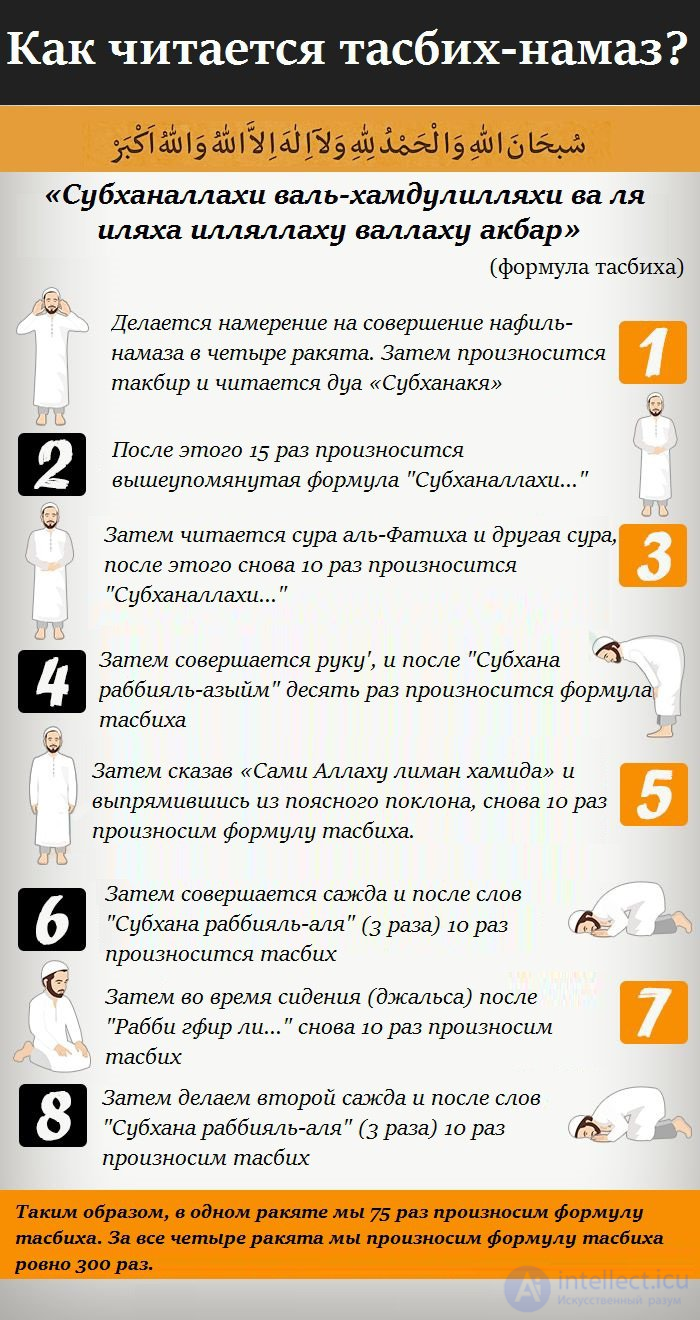
image: The prayer that erases 10 kinds of sins at once |
Tawba (Arabic توبة) — repentance, a prayer to Allah for the forgiveness of sins. Repentance performed often, after each sin, is called tawba al-istighfar. Repentance for some sin, performed together with the intention never to commit it again, is called tawba an-nasuh. Such repentance must be strictly adhered to. Repentance is an obligatory (fard) act after any sin committed, and it must not be delayed. Repentance is accomplished by fixing it in the heart and expressing it with the tongue. When all the conditions for performing repentance are fulfilled, a Muslim should hope that Allah will forgive him .
Good deeds in Islam include:
1. Associating partners with Allah
2. Sorcery
3. Failing to perform the prayer (if not prevented by health)
4. Killing a person without right
5. Evading the payment of zakat
6. Disobedience to parents
7. Usury
8. Encroaching on an orphan's property
9. Fabricating hadiths
10. Not observing the fast without a valid reason
11. Fleeing from the battlefield (desertion)
12. Adultery and fornication
13. Ruling a state by deceiving and tyrannizing (like Pharaoh) its citizens
14. Drinking alcoholic beverages
15. Arrogance, pride, haughtiness
16. False testimony
17. Homosexuality
18. Slandering a virtuous woman
19. Illegal use of spoils, public treasury funds, and donations
20. Appropriating another's property
21. Theft
22. Banditry
23. Making false oaths
24. Lying
25. Suicide
26. Dishonesty in rendering judicial decisions
27. Permitting loose behavior of one's wife, daughters, etc.
28. Men imitating women and women imitating men
29. Fraudulent nikah (fictitious marriage)
30. Consuming blood, carrion, and pork
31. Carelessness regarding urine
32. Unjust collection of taxes
33. Hypocrisy
34. Betrayal
35. Acquiring religious knowledge for worldly ends and concealing it for worldly ends
36. Reproaching someone for a favor rendered
37. Denying predestination
38. Prying into others' secrets
39. Cursing
40. Disobeying an order (if the order is issued by a believing Muslim)
41. Believing the words of soothsayers and fortune-tellers (kahin)
42. A woman's disobedience to her husband
43. Refusing to associate with relatives
44. Depicting living beings
45. Gossip
46. Loud wailing over the deceased
47. Defaming a person's lineage
48. Oppression and inflicting offense
49. Taking up arms against Muslims and accusing them of unbelief
50. Causing harm and insulting Muslims
51. Causing harm to the righteous
52. Lengthening one's garment for the sake of appearing important (showing off)
53. Men wearing silk clothing and gold
54. A slave fleeing
55. Sacrificing an animal not for the sake of Allah
56. Altering markers denoting the boundaries of land plots
57. Insulting the Companions of the Prophet
58. Insulting the Ansar
59. Calling to what is forbidden and to sin
60. Wearing a wig and getting a tattoo
61. Threatening Muslims with weapons
62. Claiming as one's father someone who is not so
63. Prophesying misfortune
64. Using gold and silver dishes for eating and drinking
65. Disputing
66. Castrating a slave, beating and oppressing him
67. Cheating a buyer on weight
68. Feeling secure from Allah's punishment
69. Losing hope in Allah
70. Ingratitude for blessings received
71. Refusing to give people water when it is available in large quantity
72. Branding an animal
73. Gambling
74. Crimes in Masjid al-Haram
75. Neglecting the Friday prayer without a valid reason and performing it alone
76. Spying on Muslims and secretly prying into their secrets

Comments