
Lecture
The history of religion, as a constituent part of religious studies, provides a picture of the world of religion as it changes over time in all its diversity, reconstructs the past of various religions in their concrete forms, and accumulates and preserves information about religions that have existed and continue to exist.
1. The history of religion – a constituent part of religious studies.
2. The functions of the history of religion as a science.
3 Methods of approach to the study of specific religions: historical, comparative, analytical, synthetic, and others.
4. The principal schools in the study of the history of religion: mythological, historical, evolutionist, anti-evolutionist, and others.
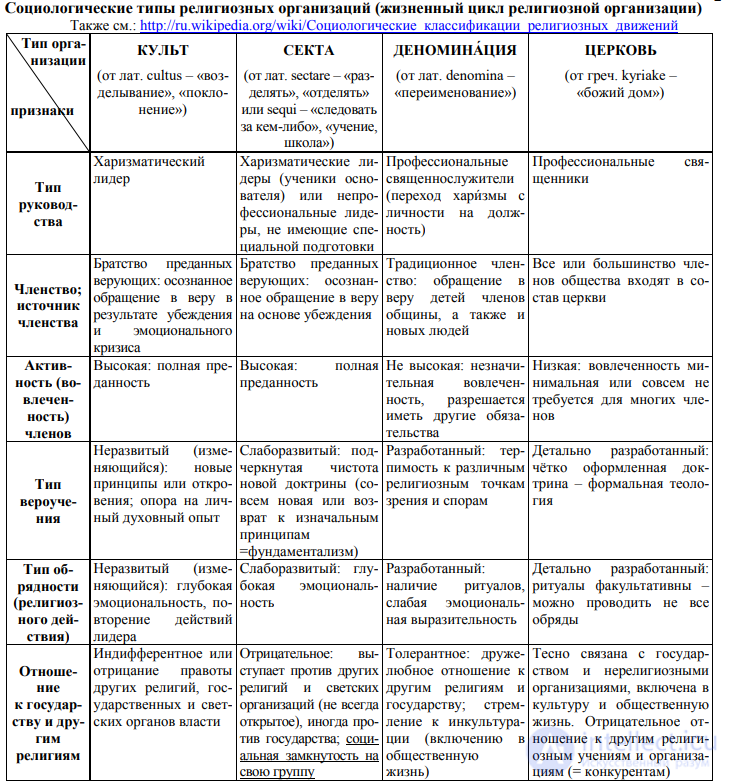
Sociological types of religious organizations (the life cycle of a religious organization)
Religious studies is a humanities discipline that examines the totality of phenomena through which people express an awareness of the radical finitude of their existence and its real overcoming. This definition encompasses, at the very least, those religions and spiritual processes that can only with difficulty be identified as religious, which set themselves the common goal of transcending the individual, of going beyond ordinary bodily experience. If one also takes into account that there are religions indifferent to the problem of a person's overcoming of his mortality, then religious studies can be defined as the discipline that studies the confessional practices of humankind.
In the short history of the development of religious studies, narrower fields have emerged, such as the philosophy of religion, the phenomenology of religion, the history of religion, the sociology of religion, and the psychology of religion.
The core of religious studies is the philosophy of religion, which can be understood in two ways: either as religious philosophy or as philosophizing about religion.
Religious philosophy is the picture of the world found in one or another set of religious teachings, encompassing answers to the questions: what is man? what is the external world? what must I do? In one form or another, all religions give answers to these fundamental questions, and some go even further, delving into such subjects as the structure of the universe, causal dependence, and the concepts of time, space, being, and consciousness
In its second sense, the philosophy of religion is the theoretical comprehension of the religious phenomenon by means of philosophical methods (dialectical, phenomenological, hermeneutical, etc.).
The phenomenology of religion is the second foundational branch of religious studies. Its object is the recurring structures found across different religions, the abstracted form of religiosity. The essence of the matter is that in every religion there are certain basic elements independent of any particular spatio-temporal content. These are the symbols through which sacred communication is carried out, as well as the subjective and objective phenomena that follow from this communication. The subjective phenomena in religion include religious feeling, conviction, piety, devoutness, holiness, dissatisfaction with the earthly, and faith in a mediator. Objective phenomena include rituals, prayers, sacrifices, and the concepts of sin and atonement.
Thus, the idea of divinity is found among different peoples. Among the inhabitants of Malaya it is identical with the idea of mana (a supramundane force). This force is distributed unevenly; people may possess it to a greater or lesser degree. A man who is accompanied by good fortune, who is distinguished by skill and beauty, is said to have «much mana». «Mana» can be transmitted from one person to another; a person can become a partaker of it through touch and initiation».
Religions of salvation also impose psychophysical requirements on a person, which are among the conditions for his perception of the divine: dietary restrictions, the taboo on sex, control of the mind, early rising, and so on.
In order to communicate with the unseen world, in various religions a person resorts to the help of a «mediator» – an object or symbol endowed with the special property of serving as a vessel for the divine. Stone, clay, bone, and wooden symbols are conventional signs pointing to what cannot be expressed.
Another kind of mediator is provided by individuals who carry out the process of communication between the mundane world and the sacred world. These leaders point the way to solving vitally important problems. Thus the Buddha, in his first (Benares) sermon, tells his disciples: «…there is suffering, there is a cause of suffering, there is the cessation of suffering, there is a path leading to the cessation of suffering». «A man not given to eloquence», Moses came «and told the people all the words of the Lord and all the laws». Having comprehended the ineffable Dao, Lao Tzu teaches: «He who has attained perfection is just; the just man may be King, for the way of the King is the way of Heaven; the way of Heaven is the way of the Dao; the way of the Dao is eternal and safe». Jesus Christ says in the Gospel of John: «I am the Way, and the Truth, and the Life… I have come that they might have life, and have it more abundantly». Krishna instructs his friend and devotee Arjuna: «I am the source of all material and spiritual worlds. There is no truth higher than Me. He who sees that I am the Supreme Being begins to serve Me with devotion».
Thus, in structural terms, religion puts forward two basic requirements that ensure the transcendence of the individual – control of psychophysical activity and symbolic practice.
The history of religion investigates the movement of religion through time. By means of comparative, structural, and systemic analysis, it processes an array of historical facts directly or indirectly related to the emergence, persistence, and decline of religious processes.
The sociology of religion sets itself the task of studying the functioning of religion in society, its influence on the formation of social groups, and also the relationship between religion and politics, religion and power. Here religion is regarded as a social subsystem.
The psychology of religion studies the religious consciousness and behavior of the individual, as well as the processes of adopting religious beliefs, the adherent's adaptation to social life, and the effects of religious practices on the psyche.
Our country, which for a long time did not take part in the formation of religious-studies knowledge, gave the world such a branch as freethought (formerly scientific atheism). Little recognized anywhere else, this branch in fact poses a serious hermeneutic problem of interpreting religious texts. Over the course of its history, humankind has accumulated many models of a non-dogmatic approach to religious teachings and ideas. «Scientific atheism», or godlessness in general, is only one manifestation of freethought, alongside many others such as deism («outside-godhood»), pantheism («all-godhood»), panentheism («in-godhood»), skepticism, nihilism, and secularism. In particular, a phenomenon such as secularization (the formation of a neutral attitude toward questions of religion) has, quite possibly, done more damage to religion than atheist propaganda. People who emotionally try to convince others that God does not exist are more likely to promote the spread of religion than to restrain it. Meanwhile, cold, indifferent consumers who ignore transcendence formalize religion and turn it into an inconspicuous social institution.
Thus, the history of religion, as a constituent part of religious studies, provides a picture of the world of religion as it changes over time in all its diversity, reconstructs the past of various religions in their concrete forms, and accumulates and preserves information about religions that have existed and continue to exist.
Within religious studies, the history of religion is a foundational field of knowledge, one that furnishes its data to other lines of research into religion, and from which, in turn, the history of religion draws theoretical approaches for systematizing and interpreting concrete historical material.
The teaching and mastery of the academic discipline «history of religion»:
The history of religion contributes, through its own means, to the realization of freedom of conscience. By shaping the concept of freedom of conscience and providing information about the legal norms concerning this issue, the history of religion helps form the civic qualities of the individual, provides orientation in certain socio-political processes, reveals what is common and what is particular in the policies of various parties and movements with respect to religion and freedom of conscience, and contributes to the growth of political culture.
At the basis of any methods, whether in the humanities or the natural sciences, lie such mental operations as comparison, analysis (the mental division of an object into its constituent parts), synthesis (the mental combination of parts of different objects), abstraction (disregarding certain properties of an object in order to study others in detail), and generalization. The history of religion relies on these operations of logical thought in the following methods:
From the standpoint of its subject-matter connections, the history of religion, as a branch of religious studies, is a comparatively young, interdisciplinary field situated at the intersection of philosophy and cultural studies. It also actively interacts with theology, history, sociology, and ethnology.
The natural-scientific approach requires an empirical layer of grounds, a theoretical layer of grounds, and experimental verification. In religious studies this method is called upon to resolve particular questions and is employed mainly through archaeology, astronomy, astrophysics, and geology. Through their arsenal of aerial photography, radiocarbon analysis, and the study of changes in the starry sky and tectonic shifts, these sciences make it possible to refine the dating of religious monuments and the period during which a given culture existed. Characteristic in this connection is the method of archaeoastronomy, so named by its inventor, the English astronomer Joseph Norman Lockyer. However, it can be applied only when the matter concerns the age of an ancient observatory. On the basis of a study of the observatory's construction, one determines the direction, built into its plan, toward the main astronomical event that was once observed there. As a result of the cyclical movement of the planets and heavenly bodies in the universe, this direction has shifted over the intervening centuries, but it can now be readily determined with the help of modern observational instruments. Having measured the angle between the former direction (fixed in an enduring material) and the present one, a specialist can, without particular effort, calculate the interval of time that separates them (all that remains is to find, at the site under study, three constituent elements: the observer's vantage point, the near sightline marker, and the far sightline marker, in order to make certain that this is not simply a pagan shrine). The sociological methods of studying religion are likewise entirely empirical (surveys, interpretation, observation, participant observation, experiment, textual analysis, content analysis).
The dominant approach in religious studies remains the humanities approach. Setting aside the question of the real existence of religious objects, we interpret human religious experience insofar as it has value significance. Here the main criterion for the truth of an interpretation remains the first requirement of the humanities method – the presence of a theoretical layer of grounds. A theoretical construction must be logically consistent and must explain, within its model, as broad a range of phenomena from this field as possible. In this way the anti-dogmatic character of the research is preserved.
In the case where a researcher attempts to give an interpretation in accordance with certain religious dogmas, we are dealing with the traditional method. In such a theological approach, the first two requirements of the humanities method may be sacrificed to the consistency of the official position of a given religion.
According to Richter, «a person can know what religion is only when he himself has made a choice in favor of religion and has thereby come to understand for himself the vitally important decisions that follow from it…».
By way of summing up, one further fundamental methodological premise should be noted. It is well described by C.-G. Jung: «…I would like to draw the reader's attention to a very significant difference between a dissertation in psychology and a sacred text. The scholar too easily forgets that the objective analysis of the material, perhaps,
on an unforgivably large scale, does damage to its emotional side. The scientific intellect is inhuman and cannot allow itself to be otherwise; it is unable to avoid such presumptuousness, however good its intentions may be. A psychologist analyzing a sacred text must, at the very least, be aware that such a text expresses a priceless religious and philosophical treasure that must not be desecrated by profane hands. I confess that I myself ventured to analyze such a text only because I know and value its merits» [397. P. 123124.].
While agreeing with Jung's assessment of sacred texts as a «priceless religious and philosophical treasure», it should be noted that the «inhuman scientific intellect» possesses, among its other merits, one such as conscientiousness (or, at least, a sincere intention to be conscientious). Hence, if the significance of emotional factors for an adequate understanding of texts has been identified and recorded, then in the course of a logical analysis it will be taken into account and studied dispassionately. At the same time, if the scientific intellect encounters problems that do not lend themselves to rational analysis, it itself registers its own limitations, delimits the spheres of the rational and the irrational, and, in venturing into the realm of the irrational with its own methods, is at any rate able to recognize that these methods are not entirely adequate here and that the results obtained are not absolute. But if our source of light is such that, like a candle or a kerosene lamp, it is able to illuminate only a small circle of objects, that is still no reason to reject it altogether, to sit and wait for sunrise, hoping to see everything at once – especially since there are places on earth into which a ray of sunlight is never able to penetrate at all.
The passages cited show that we encounter a methodological problem in both cases – in identifying with a religious tradition and in distancing oneself from it: either objectivity suffers because of the subjectivity of one's position, or the danger of falsification arises. This polarization can be avoided on the condition that the question of the truth of a given religion is left aside. Claims to truth are not tested but are described together with the methods that the religions themselves propose for their own verification. Thus, for example, in the Bhagavad Gita Krishna says: «To comprehend Me as I am is possible only through the process of devotional service, and He describes the method of this devotion as follows: «Always think of Me, become My devotee, worship Me, and offer Me homage. Absorbed in thoughts of Me, you will surely return to My abode».
The duty of scholars consists in an impartial approach, independent of the authority of any individual and of generally accepted assessments of historical events relating to religion.
Scholars and confessional authors stand opposed to one another. Tension between spiritual authorities and scholars is present, in one form or another, in all religious confessions. Although any given faith formally acknowledges the right to exist and the role of science, science inevitably causes it disquiet, since every current and religious movement has, and must have, knowledge of the historical circumstances in which its religion took shape and grew strong. Theologians impose their own vision of history when they educate the rising generation and carry out their mission in the world within the framework of traditional conceptions. In all religions the research activity of scholars, at the very least, troubles the minds of believers. Only a temporary truce exists between them.
An independent observer may, however, note that polarization among scholars leads more to dialectical opposition than to mutual understanding between people. The scholar and the orthodox theologian are two participants in a process in which the peaceful resolution of this tension is constantly taking place. In the end, the rivals need each other. Scholars need the orthodox and must make efforts to attract their attention to their work. They need the parables and specific tenets of established doctrine, drawn from theological writings. Researchers of religious movements need them as criteria that make it possible to establish the identity of the groups whose history science studies. The writings of the orthodox serve as a starting point for scholars. The orthodox, in turn, are the individuals most attentive to the work of representatives of science and the principal readers of their writings. They often function toward one another like bread and butter. For the orthodox believer, the scholar is a natural interlocutor in professional conversation, as well as a source of emotional support, whatever his citizenship may be.
The assistance of science is necessary even for traditionalist sects, toward which it is especially intolerant. The dull scholar, at the same time, breathes new life into them. Sects withstand social upheavals and continue their existence through constant adaptation to culture only when they are able to reconsider their history and discover in it a new meaning consonant with the mood of the age. Religious currents capable of addressing only the problems of the past turn into dead religions. Happiness is the self-confidence possessed by the researcher, but even criticism of a shallow scientific approach often leads to its revival. The scholar and the priest are an eternally quarreling pair, illustrating the biblical saying that a friend «sharpens» a friend, as iron sharpens iron. In a restless but useful combination, they walk at the head of the religious process, sustaining both each other and the convictions that suit them both. Scholars should not neglect the writings of the orthodox. A sincere exchange of views is necessary for them.
Interest in the study of religion arose quite long ago. Already the Church Fathers, in polemicizing with pagans, were involuntarily compelled to delve into the religious conceptions of their contemporaries, which often seemed to them devoid of any sense. Thanks to their works, important aspects of the religious conceptions of the Roman Empire have become known to us. Later, especially from the seventeenth century onward, Christian missionaries began to describe the features of the cults of the religions they had to contend with, mainly in order to make the task easier for those who came after them. In the Renaissance, to this was added the desire to find criteria that would make it possible to decide which religious beliefs and actions were worthy of a rational being.
The process of accumulating theoretical and empirical material proceeded especially rapidly in Europe over the last three centuries, which was connected
with the philosophical revision of many traditional views, including a reconsideration of the theological interpretation of religion as divine revelation. This interpretation of religion dominated medieval Europe, was fairly widespread in the modern era, and still has numerous adherents today. Its prevalence and persistence are explained by the fact that it finds confirmation in the texts of Holy Scripture, whose authority is beyond doubt among believers. Moreover,
its main tenets (above all the thesis of the existence of God) do not lend themselves to verification or falsification, and can therefore be withdrawn easily and without loss from the line of fire of philosophical and scientific criticism.
As for its role in the study of religion, it significantly limited the subject matter of research. Owing to their initial premises, Christian theologians and philosophers proclaimed only one religion true, while regarding the rest as errors or superstitions unworthy of attention. Even a minor deviation from Christian orthodoxy was classified as heresy, and polemics with heretics were most often conducted by forceful methods. Under these conditions, the study of religion in Europe was reduced mainly to the study of the Bible, the works of the Church Fathers, the decrees of church councils, and the like. In other words, instead of investigating religion as such, European thinkers for many centuries engaged in an in-depth study of the Christian religion.
The situation changed in the Age of Enlightenment, when it was Christianity, in its Catholic variant, that came under attack from the European philosophical elite. At this time, in England, France, and other European countries, the search intensified for a «natural religion», whose basic postulates could be derived from human nature. Philosophers seeking to formulate these postulates were compelled to turn, besides Christianity, to other religions, hoping to discover, through comparative analysis, beliefs common to all of humankind. The result of such investigations was a rapid growth in knowledge about religions such as Confucianism, Taoism, Buddhism, Hinduism, Islam, and the like. The interest that awakened in Europe toward the religions of non-European peoples, and the formation of a more tolerant attitude toward them, significantly broadened the subject of research, which was one of the most important preconditions for the formation of the modern science of religion.
Another shortcoming of the traditional theological interpretation of religion was
its anti-historicism. The divine revelation given once to humanity was considered not only unconditionally true but also unchanging. The task of Christian theologians and philosophers therefore consisted in transmitting the divine revelation to contemporaries and descendants in its unclouded and unperverted form. Their thought was retrospective; moreover, it constantly revolved around the biblical texts, regarding them as the alpha and omega of religious history. «The old dogmatic theology did not understand history… it thought not in terms of evolution and development, but in terms of universality and immutability»,– writes the contemporary Catholic philosopher B. Lonergan on this subject.
The ahistoricism of the theological interpretation of religion was overcome by German philosophy. In the second half of the eighteenth and the first half of the nineteenth century, many German philosophers developed conceptions of universal history within which various civilizations and religions were arranged in a certain temporal and logical sequence. Religion itself was understood by them in different ways, but the greatest representatives of German philosophy and liberal theology (Herder, Schlegel, Hegel, Schleiermacher) persistently advanced the idea of the historical development of religion, as well as the idea that the study of religion is impossible in isolation from the study of the history of society. In due course these propositions became axioms for the overwhelming majority of researchers of religion.
It should be noted that the philosophical preconditions for the formation of the science of religion discussed above could hardly have been formulated, and would subsequently have turned into abstractions divorced from life, had they not been reinforced by solid empirical material and by the findings of specialized branches of knowledge. A major role in shaping modern conceptions of religion was played by the testimony of missionaries and travelers concerning the religious beliefs and rites of peoples little known to the European public.
The pioneers in this endeavor may be considered the Jesuit missionaries Matteo Ricci (1552-1610) and Joseph-François Lafitau (1681-1746), as well as the French Enlightenment encyclopedist Charles de Brosses (1709-1777). The first of these preached in China and, in studying the religions of that country, found that Confucius's teaching on the nature of the divine was very close to the Christian teaching. He claimed that Confucius taught his followers to worship not Heaven but an invisible God dwelling in the heavens. Such a, to put it mildly, not entirely adequate interpretation of Confucianism aroused genuine interest in European scholarly circles and gave rise to a mass of literature devoted to China and Chinese religions, including translations of classical Chinese texts with extensive commentaries. Echoes of this interest can be found in Voltaire and Goethe, who admired Confucius and considered Confucianism almost a model of «natural religion».
No less interest among the scholarly public was aroused by J. Lafitau's book Customs of the American Indians, Compared with the Customs of Primitive Times (1723). In writing this book the author drew not only on his own observations, but also on the testimony of Jesuit missionaries about the life of the Iroquois and the Algonquin, which had been collected in the 71-volume «Jesuit Relations». Thus, J. Lafitau's work, in concentrated form, summed up many years of collective research and enabled Europeans to form a more or less coherent picture of the religious beliefs and customs of the Indians of North America.
Finally, C. de Brosses presented the scholarly community with data on the fetishistic beliefs of West Africa. In his «Treatise on the Gods-
Fetishes» (1760) he put forward the proposition that fetishism is the original form of religion, and pointed to the existence of modifications of fetishism in the religions of Egypt and Greece. This idea was taken up and developed by Christoph Meiners (1747-1810) and many other researchers of religion. The thesis that the worship of fetishes is the basis of all religions dominated European consciousness right up until the publication of Tylor's «Primitive Culture» (1871), in which the famous theory of animism was formulated.
Priceless material on the religious beliefs and rites of backward peoples was collected by missionaries, travelers, anthropologists, and ethnographers in the nineteenth century. From every corner of the world, reports reached European scholarly circles of the existence of savage tribes who spiritualized the formidable forces of nature, believed in a mysterious bond between humans and animals, worshipped deceased ancestors, performed magical rites, and so on. In other words, in the eighteenth and nineteenth centuries Europeans discovered a world of primitive man full of wonders and mysteries, which exerted an enormous influence on conceptions of the origin of religion and its essence.
Another precondition for the emergence of modern religious studies should be regarded as the study of Oriental languages, above all the study of Sanskrit. Here it is important to mention William Jones (1746-1794), who, comparing Sanskrit with the classical European languages, discovered a resemblance between them
and concluded that they belonged to a single language family. His conclusion was subsequently broadened, and common features were discovered in Indian, Greek
and Roman mythology. This served as the impetus for the development of comparative mythology. W. Jones's work was carried on by the German Sanskritist Franz Bopp (1791-1867), the author of the first comparative grammar of the Indo-European languages, which exerted a decisive influence on the subsequent development of philology and mythology, and also on the formation of modern religious studies.
In France, the undisputed leader in Oriental studies was Eugène Burnouf (1801-1852), known for his translations of ancient Indian texts and his research on the Pali and Avestan languages, and on Indian and Iranian mythology. Under the influence of a rapidly growing interest in the East, a chair of Sanskrit studies was opened in Paris in 1814, and the Asiatic Society was founded in 1822.
A sensation in European scholarly circles was caused by the decipherment of Egyptian hieroglyphs, accomplished in 1822 by Jean-François Champollion (1790-1832). Penetrating the secret of Egyptian writing opened wide prospects for the study of ancient Egyptian religion and for the verification of certain facts set forth in the Bible. However, the greatest influence on nineteenth-century biblical scholarship was exerted by archaeological excavations in Mesopotamia, European scholars' acquaintance with Assyro-Babylonian culture, and advances in the study of cuneiform writing. All this made it possible to take a fresh look at the biblical texts and to trace their organic connection with more ancient religious-mythological strata.
In the first half of the nineteenth century, the attention of many European scholars was focused on the study of mythology, and their efforts were directed mainly at uncovering the deep meaning contained in the myths of ancient peoples. One of the best-known researchers in this field was Georg Friedrich Creuzer (1771– 1858). In studying Greek mythology, Creuzer concluded that at its basis lay an «original wisdom», which had been brought from the East by priests and magi and was then assimilated by the indigenous population of Greece. This wisdom can be grasped only indirectly, through the signs contained in myths, and the key to unlocking it is therefore the study of ancient symbolism. Gottfried Hermann (1772-1848) worked in the same direction, though he sought traces of Eastern reason not in official mythology and religion, but in the mystical cults of ancient Greece. The final word in this chain of argumentation was pronounced by Joseph von Görres (1776-1848), who, under the influence of the ancient Indian texts discovered in his time, put forward the thesis that India is the cradle of European civilization and that it is there that the roots of all mythological and religious traditions can be found.
The opponents of this school of comparative mythology were Christian Gottlob Heyne (1729-1812) and Karl Otfried Müller (1797-1840). Heyne emphasized that myths changed over time and that they repeatedly underwent poetic reworking. Consequently, one cannot speak with certainty of their original form, still less of an original reason contained in them. According to Heyne, the main task of the scholar is not to search for a reason hidden within myths, but to reconstruct the process by which myths were formed, to trace their development in the history of human society, and to reveal in them not only common elements but also differences, which are to a great extent determined by differences in the sociocultural conditions of their functioning.
Müller held the same point of view, believing that all the myths known to us underwent a lengthy historical development and have reached us considerably modified. Preference should therefore be given to the historical study of different mythological traditions, rather than to an intuitive identification of the basic ideas inherent in every myth. He also maintained that mythology is not the creation of a priestly class, but a product of the activity of the popular masses, an expression of their attitudes toward social life and nature. Finally, Müller rejected the thesis that all myths are religious in nature, and this was a new word in comparative mythology.
Among the numerous researchers of ancient myths, mention must be made of Adalbert Kuhn (1812-1881), Wilhelm Schwartz (1821-1899), and Friedrich Welcker (1784-1868). Their views largely did not coincide with one another, and they often resolved the same problems in different ways, but this did not prevent them from formulating very important propositions that were recognized by all specialists. First, they distinguished the so-called «higher mythology», containing the generally accepted conceptions of the gods and their deeds. This was understood in different ways – either as a manifestation of a supramundane reason, or as a peculiar reflection in human consciousness of natural phenomena and historical events, or as an expression by man of his inner world,– however the aforementioned scholars agreed that the structure of myth is not exhausted by this. Second, a level of «lower mythology» was distinguished, containing the beliefs and customs of the popular masses, which were understood either as a degeneration of the «higher mythology», or as its foundation. It was emphasized here that «lower mythology» deserves the same attention as «higher mythology», notwithstanding the fact that the question of their interrelation remains open for discussion.
The conclusion that «lower mythology» exists, and the study of this level, gave impetus to the development of folklore studies, in connection with which the brothers Jacob (1785-1863) and Wilhelm (1786-1859) Grimm should be mentioned. Under the influence of the Romantic movement in Europe, the Grimm brothers believed that traces of ancient myths and conceptions of pagan gods could be found in oral folk creativity, in fairy tales and sagas. They gathered an exceedingly rich body of folklore material and, in studying it, discovered numerous parallels in the oral traditions of different peoples. This applied above all to the Indo-European peoples, on account of which the Grimm brothers were compelled to acknowledge a common source for these traditions.
Another outstanding researcher of folklore was Wilhelm Mannhardt (1831-1880), who devoted his chief attention to the study of agricultural rites. Information he received from correspondents in various European countries enabled him to discover among nineteenth-century rural inhabitants archaic beliefs preserved intact, including belief in spirits of fertility. In investigating the question of the origin of agrarian cults, W. Mannhardt went far beyond his predecessors, who had confined themselves to comparing the beliefs of their contemporaries with the mythology of the Indo-European peoples. He advanced the proposition that certain myths, rites, and customs have a more ancient source than had previously been supposed. In Mannhardt's view, they have their roots in a so-called «poetry of nature», which arose in the primitive era and analogues of which can be found among backward peoples who lack writing. Mannhardt's significance lay not only in the fact that he laid the foundations for the study of agrarian cults, but also in that he emphasized the importance of folklore studies for resolving the most complex questions of the history of religion. In this respect he influenced many scholars, above all James Frazer (1854-1941).
In Germany, from the beginning of the nineteenth century, interest in religious studies took on increasingly distinct scholarly forms, and German authors were for a long time regarded as the leading authorities in the field of religious studies, the origins of which should be sought in the peculiarities of German philosophy at the turn of the eighteenth–nineteenth centuries. Philosophers turned to the question of whether it was possible – and if possible, to what degree – to subject history to scientific reflection. As soon as ways were found that made it possible to regard the philosophy of history as a science, the views of scholars immediately turned to the history of religion. Of decisive importance here was Hegel's view that religion cannot be reduced to the problem of «morality», in contrast to the opinion held by Kant, who on this question shared the views of the Renaissance.
It was precisely the in-depth discussions surrounding the legacy of Hegelian philosophy that became the circumstance which set the scientific study of religion on false paths, the consequences of which are felt to this day. As is well known, Hegel presented religion as something like a form preceding philosophy, which was itself at the same time understood as reality unfolding itself in history. The all-embracing self-consciousness of the Absolute identical with the world finds its expression in religion still in images and symbols, rather than in concepts, as in philosophy. For this reason the earliest discussions among Hegel's pupils and followers were devoted above all to the question of whether, according to Hegel, philosophy – which he himself considered final and absolute – had overcome religion, thereby leaving it behind, or whether a Hegelian could nonetheless remain an adherent of some religion without thereby calling his commitment to philosophy into question. The division of the Hegelians into right, left, and center took place long before the matter came to politics: whereas the Right Hegelians, representatives mostly of the older generation, saw in Hegelian philosophy, in this supposedly final stage of philosophy, a new image of theology, the young radicals from the ranks of the Left Hegelians became critics of religion and atheists
This manifested itself most vividly in Marx and Engels, who held that religion appears, more or less unambiguously, as a superstition owing its existence to a certain imperfection – namely, to the circumstance that man has never yet succeeded in adequately understanding the circumstances of his life and, most importantly, in mastering them.
The factual material gathered in the eighteenth and first half of the nineteenth century, and the theoretical problems posed by researchers, contributed to the formation of a new branch of humanities knowledge, which received the name «religious studies». Arising in the second half of the nineteenth century at the intersection of philosophy, anthropology, ethnography, archaeology, linguistics, comparative mythology, and folklore studies, religious studies from the very outset set itself the task not of the apology of one or another set of religious dogmas, but of the impartial investigation of the religions of the world. In accordance with the norms of scientific research accepted at the time, the specialists developing this branch of knowledge strove to rely on empirical data that had undergone careful verification, to use rational methods of interpreting and generalizing it, and ultimately to formulate the general laws of the development and functioning of religion.
The attempt to create a science of religion provoked a negative reaction among European clerics and a whole storm of critical remarks. «Theologians, as a rule, did not display a friendly attitude toward the new science; on the contrary, official representatives of religion – and this can be said of representatives of all religions – were the most irreconcilable opponents of this branch of knowledge. Having entrenched themselves in traditional opinions and having attained high positions through the defense of their doctrines, they considered it self-evident that they should be in opposition to the new science». Many statements by theologians and churchmen of the late nineteenth and early twentieth centuries could be cited, demonstrating their negative attitude toward religious studies
The theoretical objections came down mainly to the claim that religion cannot be studied by rational methods, since it contains irrational, or, in theological language, «suprarational», elements. There were also objections of a practical character, according to which the comparative analysis of different religions would inevitably lead to the erosion of Christian meanings and values, and consequently to a decline in morality and the undermining of established social foundations.
However, despite the resistance of theologians and conservative scholarly circles, the interest of the European public in religious studies constantly grew. Beginning in the 1870s, lectures on the history and philosophy of religion are given at the major universities of England, Holland, Germany, France, Italy, and other European countries. Religion is also studied from various points of view by anthropologists, philologists, historians, jurists, sociologists, psychologists, and philosophers, who make a significant contribution to the development of the new science. In order to promote more effective cooperation among students of religion, scholarly journals began to be published, monographs by the most outstanding scholars were published in print runs large for their time, and international congresses and conferences were convened. At the turn of the nineteenth and twentieth centuries, a number of relatively independent disciplines took shape within religious studies, among which are usually numbered the philosophy of religion, the history of religion, the psychology of religion, and the sociology of religion, and the range of problems specific to these disciplines and to religious studies as a whole was finally defined.
In less than half a century of its existence, religious studies became an officially recognized science, one that in the years that followed went through periods of upsurge and crisis, made unprecedented breakthroughs into the realm of the unknown and ran into theoretical dead ends, was enriched by neighboring branches of knowledge and generously shared with them its ideas, methods, categories, and concepts. In the twentieth century, the findings obtained by religious-studies scholars came to be used not only by secular scholars and liberal theologians, but also by religious orthodox believers. At present, no representative of the humanities, and no believing or unbelieving person reflecting on the destinies of his country and of world civilization, can do without them.
Thus, the history of religious studies is the process by which numerous conceptions of religion arose and developed, conceptions which, in entering into conflict with one another, were compelled, on the one hand, to abandon notions untenable in the light of rational criticism, and, on the other, to refine their argumentation in order to justify what was recognized within their framework as vitally important and enduring. In this centuries-long «struggle for existence», a selection of the most fruitful ideas took place, and, most importantly, factual material was gradually accumulated, without which the modern science of religion would have been impossible.
One may now speak with certainty of two types of religious studies. The first religious studies is philosophical knowledge about religion, non-dogmatic reasoning about the nature of religion and God. Such an implicit presence of the subject matter of religious studies has been observed for a long time. One may name among the thinkers of antiquity Clement (the Eleatic school), Democritus; in the Renaissance, G. Bruno, L. Valla; in the Enlightenment – F. Bacon, T. Hobbes, B. Spinoza, P. Holbach, R. Descartes.
Modern religious studies is the fruit of the development of European culture. Its heart is Protestant and Catholic theology, which encountered the necessity of conveying the Christian teaching to «aboriginal» populations in their own language and by means of their own concepts. For example, in India, Peter's words from the Gospel of Matthew, «Thou art the Christ, the Son of the living God» (16.16), were translated as «Ap khrIst hain, jIvit izvar ke putr», and it was rather difficult for Hindus to understand the position of Jesus within Christianity. The expression «izvar ke putr» is very widespread. In the ancient Indian epic literature, the Puranas, one constantly encounters stories of how the god Vishnu comes as a son into some royal family. Hindus might also say: «What is special about Jesus, we are all children of God». Another similar case of cultural misreading can be cited from the history of the Christianization of China. The Nestorians wrote Jesus's name in Chinese, trying to preserve its original pronunciation – «i shu», and for a long time could not understand what it was that repelled the Chinese from perceiving this word as sacred. Only later did it become clear to them that the Chinese understand characters literally – the Savior turned out to be a «fleeing rat». Thus, in order to convey the Christian teaching, missionaries had to study the language and culture of the colonial peoples. This subsequently served as religious-studies knowledge, especially once, by the end of the nineteenth century, the classification of religions into «true» and «false» came to be regarded as untenable for a scientific approach. A multiplicity of schools appeared, each offering its own interpretation of all religions, including Christianity (Table 1).
|
|
|
Table 1 |
|
Major religious-studies scholarly schools |
||
|
|
|
REPRESENTATIVES |
|
SCHOOLS |
APPROACHES |
|
|
Mythological |
Sacred texts pre- |
M.Müller (1823- |
|
|
serve an allegorical narra- |
1900), J.Frazer |
|
|
tive of real earthly |
(1854-1941) |
|
|
life |
L.Feuerbach (1804 – |
|
Anthropolog- |
Religion originates from |
|
|
ical |
man. Fear of the phenomena |
1872), E.Tylor (1832 |
|
|
of nature, helplessness before |
– 1917), L.Lévy- |
|
|
fate compel man |
Bruhl (1857-1939) |
|
|
«to invent» a God |
|
|
Psychological |
The diversity |
of psycho- |
W.James (1842 – |
||||||
|
|
logical interpretations of religion – |
1910), S.Freud (1856 |
|||||||
|
|
from |
understanding |
religion |
as |
– 1939), C.G.Jung |
||||
|
|
the Oedipus complex to under- |
(1875 |
– 1961) |
||||||
|
|
standing the essence of religion as be- |
|
|
||||||
|
|
ing the world archetypes |
|
J.J.Bachofen (1815 – |
||||||
|
Historical |
Religion must be investigated |
||||||||
|
|
on |
the basis |
of the totality |
1887), F.C.Baur (1792 |
|||||
|
|
of all |
historical |
sour- |
– 1860), E.Renan |
|||||
|
|
ces bearing witness to it |
(1823 |
– 1892) |
||||||
|
Sociological |
Religion |
is |
a social |
The French encyclo- |
|||||
|
|
phenomenon and this is its main significance |
pedists, I.Kant |
|||||||
|
|
. By the end of the 19th century the accent |
(1724 |
– 1804), A.Comte |
||||||
|
|
shifts from explaining reli- |
(1798 |
– 1857), |
||||||
|
|
gion as an exploitative me- |
H.Spencer (1820 – |
|||||||
|
|
chanism |
to the study of |
its |
1903), R.Tawney, |
|||||
|
|
social roles. In order to under- |
E.Durkheim (1858 – |
|||||||
|
|
stand what is happening in the sphere |
1917), K.Marx (1818 |
|||||||
|
|
of economics and politics, in the sphe- |
– 1883), M.Weber |
|||||||
|
|
re of human |
relations, |
(1864 |
– 1920), |
|||||
|
|
one must rise |
to |
the level |
E.Troeltsch (1865 – |
|||||
|
|
of cultural attitudes, medi- |
1944), B.Malinowski |
|||||||
|
|
ated by religion |
|
(1884 |
– 1942), |
|||||
|
|
|
|
|
|
|
|
|
P.Sorokin (1889 – |
|
|
|
|
|
|
|
|
|
|
1968), S.N.Bulgakov |
|
|
|
|
|
|
|
|
|
|
(1871 |
– 1944) |
|
Phenomenolog- |
Religions should be studied, tak- |
R.Otto, G. van der Le- |
|||||||
|
ical |
ing into account the dichotomy «thing-in- |
euw, M.Eliade (1907 – |
|||||||
|
|
itself» – «thing-for-us» |
|
1986) |
|
|||||
|
Traditionalist- |
The study of religious experience |
R.Guénon (1886 – 1962), |
|||||||
|
ic |
by non-sectarian |
|
believing |
A.Men (1935 – 1990) |
|||||
|
|
theologians |
|
|
|
|
|
|
||
|
|
|
|
|
|
|
|
|
|
|

Comments