Religious Studies Tests: ORTHODOXY.
Instructions for taking online tests in Religious Studies - Orthodoxy, with answers and diagrams:
Step 1: Preparing for the Test
1.1 Check your internet connection: Make sure you have a stable internet connection to avoid possible problems accessing the test.
1.2 Create comfortable conditions: Choose a quiet place where you will not be distracted while taking the test.
1.3 Prepare your materials: Get a pen or pencil, paper for notes, and the device you will use to take the test (computer, tablet, or smartphone).
Step 2: Beginning the Test
2.1 Open the test: Follow the link provided for access to the test. If you have login credentials, enter them to authorize.
2.2 Study the instructions: Before starting the test, review the instructions and rules for taking it. Make sure you understand how to answer questions and navigate between pages.
2.3 Review the diagrams: If you have been provided with diagrams or charts, study them carefully before starting the test. They may help you answer the questions.
Step 3: Taking the Test
3.1 Read the questions carefully: As you begin the test, read each question attentively. Understanding the question is essential for answering it correctly.
3.2 Analyze the answer options: Before selecting an answer, review all the options provided. Use the diagrams, if available, for a better understanding of the questions.
3.3 Take notes: If you are unsure of an answer, make notes on paper. This will help you organize your thoughts and choose the most suitable answer.
3.4 Answering difficult questions: If you encounter difficult questions, do not spend too much time on a single question. Move on to the next one and return to it later if time permits.
3.5 Be attentive: Avoid hasty answers. Read the questions and answers several times to avoid mistakes due to carelessness.
Step 4: After Completing the Test
4.1 Analyze the results: If instant analysis of results is available to you, review your answers and the correct answers to the questions. Note your weak points in order to improve your knowledge of Religious Studies - Orthodoxy.
4.2 Retraining: If you have the opportunity to retake the test or undergo further study, take advantage of it to improve your knowledge and results.
4.3 Learn from your mistakes: Analyze your errors and use them as lessons for the future. Try to understand the reasons for incorrect answers and remember the correct ones.
I hope that these instructions will help you successfully complete the tests on Religious Studies - Orthodoxy. Good luck!
In the tests presented, select one or several correct answers.
1. Which Byzantine patriarch stood at the origins of the division of Christianity?
- 1. Alexius Pashkov.
- 2. Nikon.
- 3. Michael Cerularius. *
- 4. Methodius Askov.
- 5. Leo.
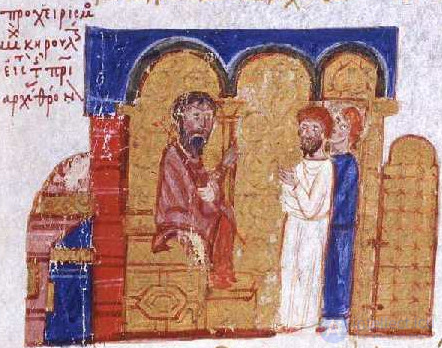
Michael Cerularius (miniature from the chronicle of John Skylitzes). Patriarch of Constantinople, 1043 — 1058
2. In what year were the Roman churches and monasteries in Constantinople closed?
- 1. 1010.
- 2. 1053.*
- 3. 1125.
- 4. 1467.
- 5. 1613.
3. Which pope stood at the origins of the division of Christianity?
- 1. Leo IX. *
- 2. Nikon I.
- 3. John VII.
- 4. Benedict XIX.
- 5. Peter III.
4. When did the final split between Western and Eastern Christianity occur?
- 1. November 24, 1010.
- 2. July 16, 1054. *
- 3. January 23, 1124.
- 4. September 12, 1354.
- 5. November 30, 1614.
5. In what century were the Orthodox Churches of Alexandria (Egypt) and Antioch (Syria, Lebanon) formed?
- 1. 1st century.
- 2. 2nd century.
- 3. 3rd century.*
- 4. 4th century.
- 5. 5th century.
6. When did Georgia adopt Eastern Christianity?
- 1. 1st century.
- 2. 3rd century.
- 3. 4th century. *
- 4. 8th century.
- 5. 10th century.
7. When did Moravia and Bulgaria adopt Eastern Christianity?
- 1. 9th century. *
- 2. 10th century.
- 3.12th century.
- 4. 14th century.
- 5. 20th century.
8. Which patriarch in the eastern part of the former Roman Empire laid claim to leadership over public affairs?
- 1. The Patriarch of Constantinople. *
- 2. The Patriarch of Alexandria.
- 3. The Patriarch of Antioch.
- 4. The Patriarch of Serbia.
- 5. The Patriarch of Jerusalem.
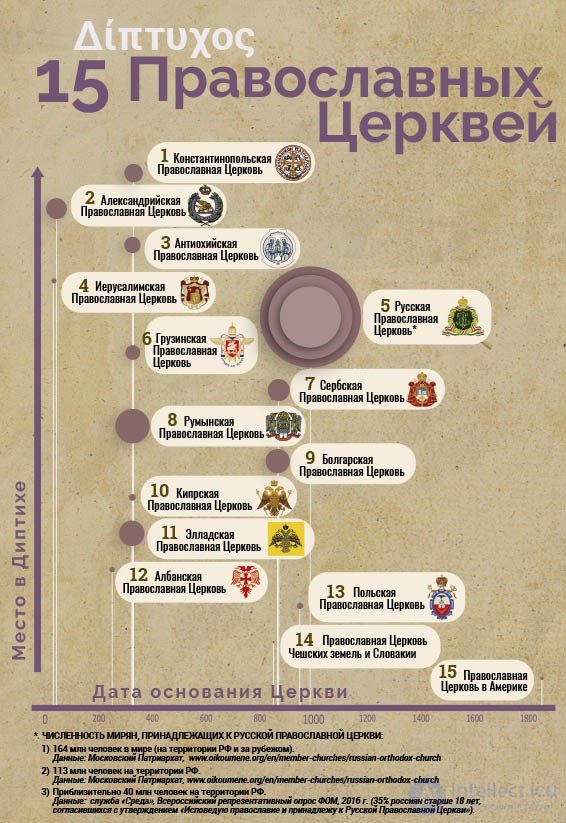
An important role was also played by the absence of a single ecclesiastical center in Byzantium. In the eastern part of the former Roman Empire there were four bishops who had attained the title of patriarch and laid claim to leadership over public affairs: the Patriarch of Constantinople, the Patriarch of Alexandria, the Patriarch of Antioch, and the Patriarch of Jerusalem. The first of these, exploiting his proximity to the emperor, claimed an exceptional status and was even called «ecumenical», although this gave him no real advantages. As Byzantium disintegrated, each of the named patriarchs came to head an independent (autocephalous) Orthodox church. Later, independent Orthodox churches arose in other countries as well.
9. In which document is the canonical standing of the autocephalous churches set forth?
- 1. The Diptych of Honor.*
- 2. The Nicene Creed.
- 3. The Old Testament.
- 4. The New Testament.
- 5. The Catechism.
10. Which Orthodox church is considered primary according to the official document?
- 1. Bulgarian.
- 2. Constantinople. *
- 3. Russian.
- 4. American.
- 5. Antiochian.
11. In what century was the Orthodox Church of Constantinople formed?
- 1. 4th century.*
- 2. 7th century.
- 3.8th century.
- 4. 11th century.
- 5.11th century.
12. What place does the Russian Orthodox Church occupy in the official list of Orthodox Churches?
- 1. 1.
- 2. 2.
- 3. 3.
- 4. 4.
- 5. 5.*
- 6. not on the list
13. In what year did the Russian Orthodox Church receive autocephaly?
- 1. 1376.
- 2. 1448. *
- 3. 1523.
- 4. 1617.
- 5. 1723.
13. In what year did the Ukrainian Orthodox Church receive autocephaly?
- 1. 1376.
- 2. 1448.
- 3. 1918.
- 4. 2018. *
- 5. 1723.
14. In what year did the Russian Orthodox Church attain patriarchal status?
- 1. 1354.
- 2. 1456.
- 3. 1589.*
- 4. 1765.
- 5. 1917.
15. In what century did the Georgian Orthodox Church arise?
- 1. 4th century.*
- 2. 7th century.
- 3. 8th century.
- 4. 11th century.
- 5. 14th century.
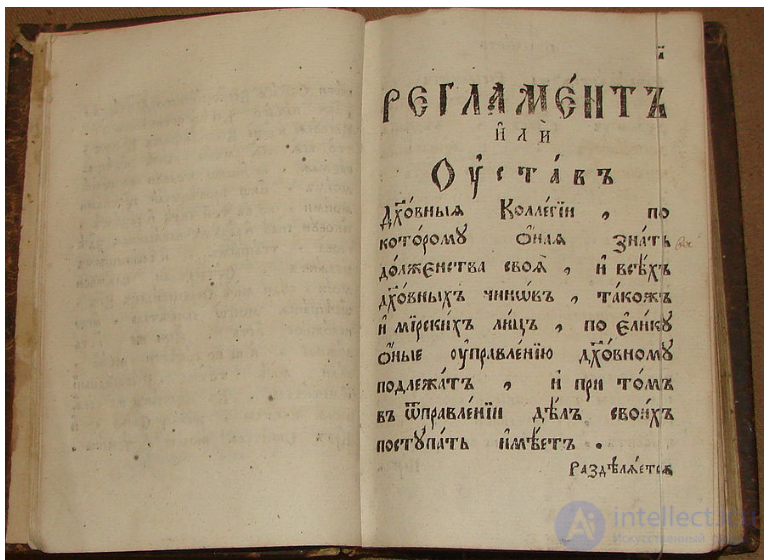
16. In what year was the «Spiritual Regulation» introduced, replacing the patriarchal form of governance of the Russian Orthodox Church with a synodal one?
- 1. 1354.
- 2. 1453.
- 3. 1549.
- 4. 1721.*
- 5. 1876.
17. List the main distinguishing features of Orthodoxy as opposed to Catholicism.
- 1. Unlike Catholicism, Orthodoxy considers Jesus Christ alone to be the head of the church.*
- 2. The foundation of Orthodox doctrine is the Nicene-Constantinopolitan Creed.*
- 3. All Orthodox churches regard it as their foremost duty «to preserve inviolate the deposit of faith entrusted to the original church.*
- 4. Only the dogmas confirmed by the first seven Ecumenical Councils are considered true dogmas.*
- 5. The church is endowed with the right to grant absolution of sins for an additional fee.
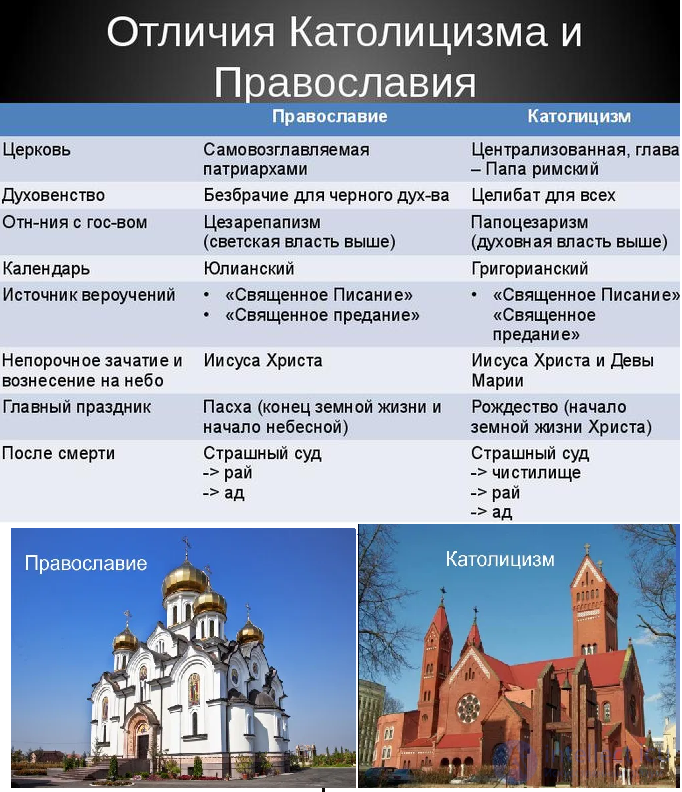
The main features distinguishing Orthodoxy from Catholicism are as follows:
- Orthodoxy considers Jesus Christ alone to be the head of the church (both earthly and heavenly), which in itself predetermines the character of many aspects of the life of the Orthodox churches, which are marked by religious tolerance, a striving for concord, the priority of spiritual values over worldly ones, and a passionate desire to preserve the faith of Christ in its authentic, undistorted form, and to defend and spread Orthodoxy by nonviolent means;
- all Orthodox churches are united by a common doctrine, the basic church canons, and the most important rites, while the differences in political orientation and social doctrines among the Orthodox churches depend on the social conditions in which they operate and on the way of life of the believers;
- the foundation of Orthodox doctrine is the Nicene-Constantinopolitan Creed, confirmed at the first two Ecumenical Councils;
- the Orthodox churches have declared all the main provisions of the Creed (dogmas) to be absolutely true, unquestionable, eternal, and immutable, communicated to man by God Himself; they are declared incomprehensible to reason, and therefore the basis for knowing them is faith;
- all Orthodox churches regard it as their foremost duty «to preserve inviolate the deposit of faith entrusted to the original church, adding nothing to this dogmatic heritage of the Ecumenical Church and taking nothing away from it»;
- only the dogmas confirmed by the first seven Ecumenical Councils are considered true; as for the Catholic dogmas established later (on the infallibility of the pope, on purgatory, on the immaculate conception of the Virgin Mary, and on her bodily assumption into heaven), all Orthodox churches declare them to be erroneous and contrary to Holy Scripture and Holy Tradition;
- the Orthodox churches devote great attention not only to affirming the infallibility of their doctrine but also to disseminating it widely among believers, requiring them to know the Creed by heart and to chant it in unison during the liturgy;
- the appeal of Orthodoxy lies in the beauty and grandeur of its worship, in which all forms of art are organically combined and express an elevated sacred meaning: music and singing, painting and architecture, theatrical action, and oratory.
18. The following are considered to be the prerequisites for Rus's adoption of Orthodoxy (list them):
- 1. The emerging state required a monotheistic religion, one more consistent with the idea of state unity.*
- 2. Paganism could not justify the emerging class relations with their property inequality and social injustice*
- 3. Paganism did not foster among the tribes living on the territory of the Kievan state an awareness of themselves as a single people.*
- 4. The arrival of the Varangians Rurik and Oleg led to a crisis of the ancient Slavic religion, threatening to bury forever the idea of a unified state.*
- 5. The invasion of the Tatar-Mongol yoke required the unification of the authorities in the face of the threat of enslavement of the state.
19. In what century did the Russian Orthodox Church withdraw from the Patriarchate of Constantinople?
- 1. 11th century.
- 2. 15th century.*
- 3. 18th century.
- 4. 19th century.
- 5. 20th century
20. In what year were the first men's monastery of St. George the Victorious and the women's monastery of St. Irene founded?
- 1. 1037.*
- 2. 1254.
- 3. 1356.
- 4. 1559.
- 5. 1614.
- 6. 2050.
21. In what year was the Kiev Pechersk Lavra founded?
- 1. 1045. *
- 2. 1356.
- 3. 1458.
- 4. 1549.
- 5. 1654.
- 6. 2050.

22. What was the size of the tax in kind or money paid to the Church in Rus'?
- 1. 3% of income.
- 2. 5% of income
- 3. 7% of income.
- 4. 10% of income. *
- 5. 15% of income.
23. Who was the first Russian chronicler of the Kiev Caves Monastery, whose «Tale of Bygone Years» served as the basis for other Russian chronicles?
- 1. Nikon.
- 2. Nestor.*
- 3. Peter.
- 4. Paul.
- 5. Cyril.

24. List the principal sacraments of Orthodoxy.
- 1. Baptism.*
- 2. Communion.*
- 3. Marriage.*
- 4. Unction.*
- 5. Obedience.
- 6. Donations
25. What is the specific feature of contemporary worship in the Church of Alexandria?
- 1. The use of Arabic alongside Ancient Greek in worship.*
- 2. The use of Russian alongside Ancient Greek in worship.
- 3. The use of English alongside Ancient Greek in worship.
26. In what year did the Romanian Orthodox Church proclaim autocephaly?
- 1. 1137.
- 2. 1254.
- 3. 1456.
- 4. 1559.
- 5. 1865.*
27. Who baptized Rus'?
- 1. Prince Vladimir.*
- 2. Prince Konstantin.
- 3. Prince Oleg.
- 4. Princess Olga.
- 5. Prince Vasily.
- 6. President Zelensky
28. What innovations did Patriarch Nikon (1605-1681) introduce with the aim of strengthening the church organization?
- 1. Instead of writing «Isus», they began writing «Iisus» (Jesus).*
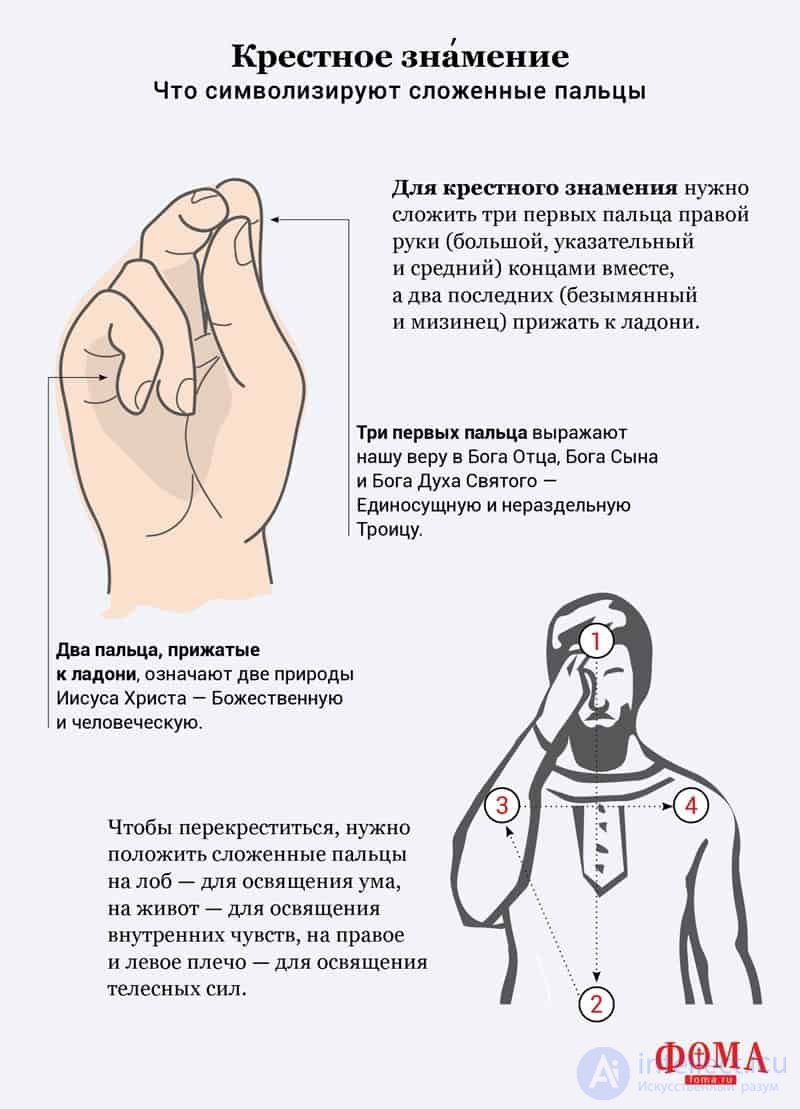
- 2. Instead of the sign of the cross with two fingers (a symbol of Christ as God-man), they began crossing themselves with three fingers (a symbol of the Holy Trinity).*
- 3. They recognized the four-pointed cross alongside the eight-pointed one.
- 4. They recognized Jesus the God-man as the Lamb of God.
- 5. Instead of statues, they began venerating icons.
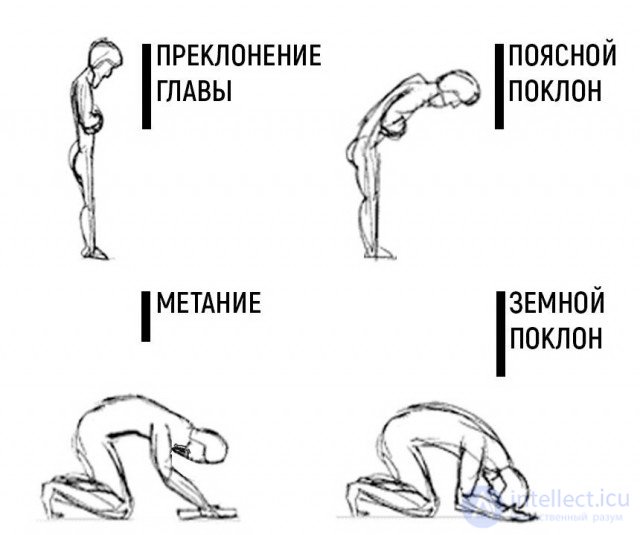
- 6. Full prostrations were replaced with bows from the waist. *
29. Under which tsar was the patriarchate abolished, with the Tsar of All Rus' becoming head of the church?
- 1. Ivan the Terrible.
- 2. Peter I.*
- 3. Peter III.
- 4. Feodor Ioannovich.
- 5. Nicholas I.
31. In what year was the Russian Church Abroad («Russian Orthodox Church Outside of Russia») founded?
- 1. 1000.
- 2. 1045.
- 3. 1921.*
- 4. 1941.
- 5. 1991.
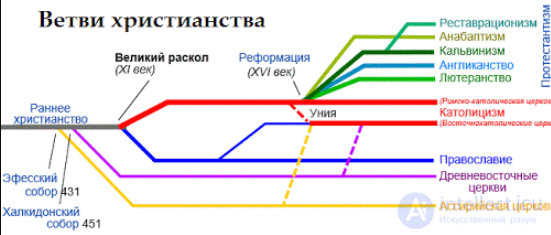
32. In what year did the split of the churches into Catholic and Orthodox occur?
- 1. 1054.*
- 2. 988.
- 3. 1000.
- 4. 1045.
- 5. 570.
33. How many autocephalous Orthodox churches are currently active in the world?
- 1. 15. *
- 2. 25.
- 3. 30.
- 4. 1.
- 5. 14.
34. In what year was the Baptism of Rus'?
- 1. 1054.
- 2. 988.*
- 3. 1000.
- 4. 1045.
- 5. 570.
35. List the main tenets of the Orthodox faith.
- 1. Belief in one God.
- 2. Belief in the immortality of the soul.
- 3. Belief in the existence of hell and paradise.
- 4. Belief in the third coming of Jesus Christ.
- 5. Belief in original sin.
36. In what year were the old rites of the Russian Orthodox Church (Old Belief) recognized?
- 1. 1000.
- 2. 1045.
- 3. 1745.
- 4. 1917.
- 5. 1971.*
37. What is a Lavra?
- 1. A religious community.
- 2. A large monastery. *
- 3. A temple.
- 4. A denomination.
- 5. A building.
38. What is a direct address to God
- 1. Communion.
- 2. Confession.
- 3. Baptism.
- 4. Prayer. *
- 5. Faith.
39. Who wrote the account of Christ's life in the Gospel?
- 1. Matthew.
- 2. Luke.
- 3. Mark.
- 4. John.
- 5. Methodius.
40. Who is the supreme mind in Orthodoxy?
- 1. Allah.
- 2. God. *
- 3. Buddha.
- 4. Shiva.
- 5. Brahma.
OPEN-ENDED TEST WITH ONE OR MORE WORDS OMITTED
In the tests presented, fill in the blanks with the words you consider most appropriate. Observe the case and declension indicated in the sentences.
1. The formation of independent Orthodox churches began in the early centuries of the emergence of Christianity: in the ___ century the Church of Alexandria (Egypt) and the Church of Antioch (Syria, Lebanon) emerged, later followed by the Church of Jerusalem; in the ___ century Georgia adopted Eastern Christianity; in the ___ century – Moravia and Bulgaria.
- In the 3rd century the Church of Alexandria (Egypt) and the Church of Antioch (Syria, Lebanon) emerged, later followed by the Church of Jerusalem. In the 4th century Georgia adopted Eastern Christianity, in the 9th century - Moravia and Bulgaria.
- In the 5th century the Church of Alexandria (Egypt) and the Church of Antioch (Syria, Lebanon) emerged, later followed by the Church of Jerusalem. In the 6th century Georgia adopted Eastern Christianity, in the 7th century - Moravia and Bulgaria.
- In the 8th century the Church of Alexandria (Egypt) and the Church of Antioch (Syria, Lebanon) emerged, later followed by the Church of Jerusalem. In the 9th century Georgia adopted Eastern Christianity, in the 11th century - Moravia and Bulgaria.
2. The autonomous Church of Finland and the semi-autonomous Church of Crete, as well as the monastic communities on the «Holy Mountain» of Athos in Greece, fall under the jurisdiction of the _____ Orthodox Church.
- Constantinopolitan *
- Ukrainian
- American
- Martian
3. Although it has no real power over the other churches, the Patriarchate of Constantinople nevertheless enjoys well-deserved authority in the Orthodox world, and its head - __ - is considered «first among equals».
- matriarch
- patriarch *
- president
- director
4. The Serbian Orthodox Church was formed at the end of the __ century, and received autocephaly in 1219.
- 9th century *
- 10th century
- 11th century
5. For a long time, by the will of the Turkish authorities, the Romanian Orthodox Church was subordinate___ to the patriarch; it proclaimed autocephaly only in 1865.
- Elon Musk
- Green Grasshopper
- Patriarch of Constantinople*
- Supermarket Director
6. The Bulgarian Orthodox Church was formed in the ___ century, was recognized as autocephalous in 1945, and the patriarchate was restored in 1953.
- 9th century *
- 10th century
- 11th century
7. The Cypriot Orthodox Church traces its origins to __, founded back in the year 47 by the Apostle Barnabas.
- the first Christian communities*
- the swindlers of Europe
- the idlers of Cyprus
8. According to the Christian account, the Christian faith was brought to the territory of present-day Greece by the Apostle___, and Saint John the Theologian wrote the book «Revelation» on the island of Patmos.
- Vahka
- Paul *
- Matthew
- Moses
9. Orthodoxy, unlike Catholicism, considers only __ to be the head of the church, which in itself predetermines the character of many aspects of the life of the Orthodox churches, which are characterized by religious tolerance, a striving for concord, the priority of spiritual values over worldly ones, and a passionate desire to preserve the _____ faith in its authentic, undistorted form, and to defend and spread Orthodoxy by nonviolent means.
- God, of God
- Jesus Christ, of Christ *
- The Chairman of the Federal Reserve System, in the Dollar
- The Head of the European Central Bank, in the Euro
- The Head of the Moscow Backyard Bank, in the Tree
10. The foundation of Orthodox doctrine is the Nicene-Constantinopolitan ___, established at the first two Ecumenical Councils.
- Dollar Sign
- Euro Sign
- Zimbabwean Dollar Sign
- Creed *
- Symbol of Hope
11. Only the dogmas established by the first ___ Ecumenical Councils are considered the true dogmas of Orthodoxy.
- 2 Ecumenical Councils
- 5 Ecumenical Councils
- 7 Ecumenical Councils *
- 9 Ecumenical Councils
12. After the adoption of Christianity, already under Vladimir's son Yaroslav the Wise (978-1054), a metropolitanate of the ___ patriarchate was established in Kiev.
- Patriarchate of Constantinople *
- Martian Patriarchate
- Lunar Patriarchate
- American Patriarchate
- Greek Patriarchate
13. In ___ Peter I abolished the patriarchate, establishing in its place a collegial body - the Spiritual College - which was soon transformed into the Most Holy Governing Synod headed by the Ober-Procurator.
- 1720.
- 1721. *
- 1722.
- 1821.
14. 1721 - the introduction of the «___ », which replaced the patriarchal form of governance of the Russian Orthodox Church with the synodal one.
- «Spiritual Regulation», *
- «Sporting Regulation»,
- «Flight Regulation»,
- «Refectory Regulation»,
15. From the 11th century and in subsequent centuries, irreconcilable territorial disputes began to arise between Rome and ___.
- Mongolia
- the Martian colony
- Byzantium *
- China
16. On July 16, ___, the final schism between Western and Eastern Christianity occurred.
Disagreements between the Pope of Rome (the Western part of the united Church) and the Patriarch of Constantinople (together with the four Eastern patriarchates of the Church) on matters of a dogmatic and canonical, as well as liturgical and disciplinary character, began long before the year 1054; however, it was in 1054 that Pope Leo IX sent legates to Constantinople headed by Cardinal Humbert. The immediate cause was the closing in 1053 of the Latin churches in Constantinople by order of Patriarch Michael Cerularius, during which his sacellarius Nikephoros threw the Holy Gifts, prepared according to the Western custom from unleavened bread, out of the tabernacles and trampled them underfoot. In 1054 Pope Leo sent Patriarch Cerularius a letter which, in support of the papal claims to fullness of power in the Church, contained lengthy extracts from a forged document known as the Donation of Constantine, insisting on its authenticity . The Patriarch rejected the Pope's claims to supremacy, after which Leo, that same year, sent legates to Constantinople to settle the dispute. The chief political aim of the papal embassy was the desire to obtain military assistance from the Byzantine emperor against the Normans . On July 16, 1054, already after the death of Pope Leo IX himself, three papal legates entered the Cathedral of Hagia Sophia and laid on the altar a bull of excommunication anathematizing the patriarch and two of his assistants. In response, on July 20 the patriarch anathematized the legates.
17. The canonical standing of the autocephalous churches is reflected in the official list – « __ ».
- Collection of Riddles
- Diptych of Honor *
- Triptych of the Pope
- Notes of a Sober Practitioner
18. The Antiochian Orthodox Church has, for the majority of its flock, Christians of ___ origin.
- Dagestani origin
- Chinese origin
- Jewish origin
- Arab origin *
19. Parishes of the Antiochian Orthodox Church are located in ___ and a number of other Middle Eastern countries.
- Muscovy
- Jordan
- Syria *
- Arabia
20. 398-404 were the years of the tenure of Patriarch of Constantinople ___, a talented preacher.
- John Chrysostom *
- Bartholomew
- Saint Andrew
- saint Stachys
21. From 1721 to 1917 the Russian Orthodox Church was headed by the Most Holy Governing ___., and from 1917 to the present – by the patriarch.
- Pentode
- Synod *
- Uncle
- Heptode
- Forum
22. The Orthodox churches pay great attention not only to affirming the infallibility of their doctrine, but also to its wide dissemination among believers, requiring of them knowledge by heart of the ___, and its choral performance during the liturgy.
- Symbol of the Moon
- Creed *
- Symbol of Love
- Dollar Sign
- Yen Sign
- Symbol of the Sun
-
23. The attractive power of Orthodoxy consists of the ___ and grandeur of its worship, in which all forms of art are organically united and express an elevated sacred meaning: music and singing, painting and architecture, theatrical action and oratory.
- cheapness
- costliness
- transparency
- beauty *
- hatred of outsiders
- simplicity
- love of humanity
- false worship
24. Before the adoption of Christianity, Rus' was a ____ country; its religion was polytheism.
- Atheist
- Pagan *
- Kievan
- Pechersk
- Rich
- Large
- Scientific
25. 1448 - the proclamation of autocephaly of the ___ Orthodox Church.
- Moldovan Orthodox Church
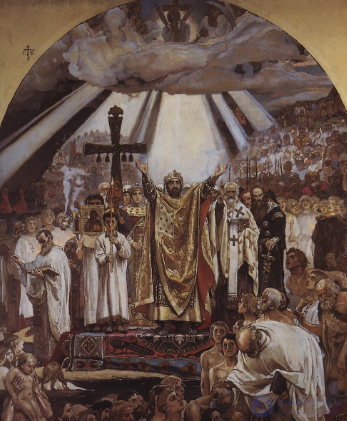
- Russian Orthodox Church *
- Martian Orthodox Church
- Orthodox Church of Saint Macaroni
26. Until the end of the ___ century, the Russian Orthodox Church was part of the Patriarchate of Constantinople as a special metropolitanate.
27. The first Metropolitan of Kiev was ___ (988 – 991), a native of Syria.
- Piekh
- Michael *
- Andrew
- Volodymyr
28. The judicial authority of the Church extended to the entire population of the state in matters connected with ____ relations, sorcery, and witchcraft.
- family and marital *
- credit and monetary
- departmental
- strong
29. 1589 - the establishment of the ___ in Russia.
- Matriarchy
- Democracy
- patriarchate *
- totalitarianism
- equal rights
- peasantry
- slavery
30. In Orthodox circles the view has taken shape that, since the majority of the population professes Orthodoxy or leans toward it, Russia, with the exception of certain regions, constitutes the «___ ___» of the Russian Orthodox Church.
- Classical enclosure
- Canonical territory *
- Catholic enclave
- Chancellor's district
31. Beginning with the __ century, the Christian church periodically gathered the higher clergy for so-called Ecumenical Councils.
32. The principal Sacred Book of the Orthodox is ……………., referred to in the Russian tradition as …………………, as well as …………………….., which comprises the decrees of the first …………….. Ecumenical Councils and the writings of the «Church Fathers» Athanasius of Alexandria, Basil the Great, Gregory the Theologian, John of Damascus, and John Chrysostom.
- The principal sacred book of the Orthodox is the Bible, referred to in the Russian tradition as Holy Scripture, as well as Holy Tradition, which comprises the decrees of the first seven *
- The principal sacred book of the Orthodox is the Quran, referred to in the Russian tradition as Holy Scripture, as well as Holy Tradition, which comprises the decrees of the first three
- The principal sacred book of the Orthodox is the Bible, referred to in the Russian tradition as Holy Scripture, as well as Holy Tradition, which comprises the decrees of the first six
- The principal sacred book of the Orthodox is the Bible, referred to in the Russian tradition as Absolute Scripture, as well as Holy Tradition, which comprises the decrees of the first seven
33. In Orthodoxy …………. (the number of) sacraments (rites) are considered the principal ones.
- three sacraments: baptism, holy orders, marriage, and unction (anointing of the sick)
- five sacraments: baptism, almsgiving, communion (Eucharist), holy orders, unction (anointing of the sick)
- seven sacraments: baptism, chrismation, penance, communion (Eucharist), holy orders, marriage, and unction (anointing of the sick) *
- nine sacraments: baptism, chrismation, penance, communion (Eucharist), holy orders, marriage, unction (anointing of the sick), almsgiving, charity
34. In Orthodoxy the sign of the cross is made with ……….. folded fingers; among the Old Believers - with ……….; among Catholics - with ………… fingers of the open palm; ……………… do not use the sign of the cross at all.
- In Orthodoxy the sign of the cross is made with two folded fingers, among the Old Believers – with three, among Catholics – with all the fingers of the open palm, Protestants do not use the sign of the cross at all. In Orthodoxy the sick and disabled are permitted to make the sign of the cross with the left hand.
- In Orthodoxy the sign of the cross is made with three folded fingers, among the Old Believers – with two, among Catholics – with all the fingers of the open palm, Protestants do not use the sign of the cross at all. In Orthodoxy the sick and disabled are permitted to make the sign of the cross with the left hand. *
- In Orthodoxy the sign of the cross is made with all the fingers, among the Old Believers – with two, among Catholics – with three fingers, Protestants do not use the sign of the cross at all. In Orthodoxy the sick and disabled are permitted to make the sign of the cross with the left hand.
- In Orthodoxy the sign of the cross is made with three folded fingers, among the Old Believers – with two, among Catholics – with all the fingers of the open palm, Protestants use the same form as Catholics. In Orthodoxy the sick and disabled are permitted to make the sign of the cross with the left hand.
OPEN-ENDED TEST WITH ONE CORRECT ANSWER
In the crossword presented, fill in the cells with the words that, in your opinion, answer the given questions (phrases, statements). Observe the case and declension.
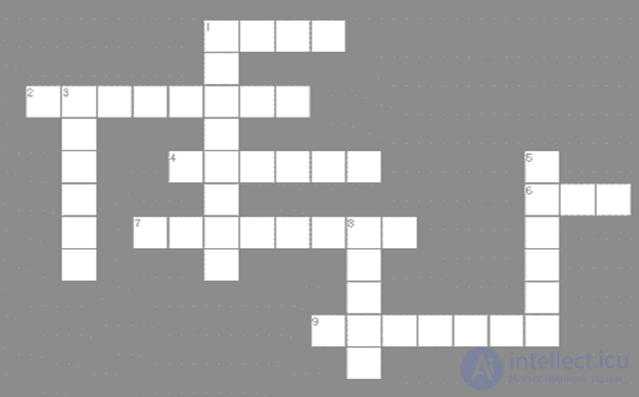
|
Across: 1. Tsar of All Rus' who abolished the patriarchate. 2. The state in which Orthodoxy originated. 4. The first Metropolitan of Kiev. 6. The Pope who was at the origin of the split of Christianity. 7. One of the Orthodox churches. 9. The mountain on which Jesus Christ was crucified.
|
|
Down: 1. The clerical rank of the head of an Orthodox church. 3. The superior of a men's monastery. 5. The place where the American Orthodox Church was formed. 8. The place in an Orthodox church from which the priest delivers the sermon during the service.
|
CONTROL AND TRAINING EXERCISES
In the exercises presented, indicate the correct formulations (statements).
1. Exercise correct answer:
- 1. In the middle of the third century, not having recognized the decisions of the Council of Chalcedon, the Armenian Apostolic (Gregorian) Church separated.
- 2. In the middle of the fifth century, not having recognized the decisions of the Council of Chalcedon, the Armenian Apostolic (Gregorian) Church separated.*
- 3. In the middle of the seventh century, not having recognized the decisions of the Council of Chalcedon, the Armenian Apostolic (Gregorian) Church separated.
The Council of Chalcedon, the Fourth Ecumenical Council — an ecumenical council of the Christian Church, convened in the year 451 by Emperor Marcian with the agreement of Pope Leo I in Chalcedon regarding the heresy of Eutyches — Monophysitism. The sessions of the Council took place in the church of the Great Martyr Euphemia
2. Exercise correct answer:
- 1. The heaviest blow to the unity of Christianity was struck on June 16, 1154, when the head of the Western Church, the Pope of Rome, and the formal head of Orthodoxy - the Patriarch of Constantinople - proclaimed anathema against one another, that is, subjected each other to church condemnation.
- 2. The heaviest blow to the unity of Christianity was struck on June 16, 1054, when the head of the Western Church, the Pope of Rome, and the formal head of Orthodoxy - the Patriarch of Constantinople - proclaimed anathema against one another, that is, subjected each other to church condemnation. *
- 3. The heaviest blow to the unity of Christianity was struck on June 16, 1254, when the head of the Western Church, the Pope of Rome, and the formal head of Orthodoxy - the Patriarch of Constantinople - proclaimed anathema against one another, that is, subjected each other to church condemnation.
3. Exercise correct answer:
- 1. Autocephalous churches have, in various countries, exarchates, dioceses, monasteries, metochia, and missions.
- 2. Autocephalous churches have, in various countries, exarchates, dioceses, deaneries, communities, and missions.
- 3. Autocephalous churches have, in various countries, exarchates, dioceses, deaneries, metochia, and missions. *
- 4. Autocephalous churches have, in various countries, exarchates, dioceses, deaneries, metochia, missions, bank accounts, charters, utility bills, candles for collecting donations, unrenovated buildings, and unfinished structures for which to collect funds for their repair.
- 5. Autocephalous churches have, in various countries, exarchates, dioceses, deaneries, metochia, missions, a website on WordPress or Bitrix, a sign made of polished copper
4. Exercise correct answer:
- 1. The heads of autonomous churches are elected by local councils, with their subsequent confirmation by the patriarch of the autocephalous church. *
- 2. The heads of autonomous churches are elected by public councils, with their subsequent confirmation by the patriarch of the autocephalous church.
- 3. The heads of autonomous churches are elected by local councils, with their subsequent confirmation by the metropolitan of the autocephalous church.
- 4. The heads of autonomous churches are elected by online voting in a Telegram bot, with the results subsequently announced on YouTube.
5. Exercise correct answer:
- 1. The Patriarch of Constantinople retains the title «Ecumenical Metropolitan», but he is not granted the right to interfere in the activities of other Orthodox churches.
- 2. The Patriarch of Constantinople retains the title «Ecumenical Patriarch», but he is not granted the right to interfere in the activities of other Orthodox churches.*
- 3. The Patriarch of Constantinople retains the title «Ecumenical Patriarch», but he is not granted the right to interfere in the activities of other Catholic churches.
- 4. The Patriarch of Constantinople retains the title «Ecumenical President», but he is not granted the right to interfere in the affairs of other states.
6. Exercise correct answer:
- 1. Common to all Orthodox churches is doctrine, religious organization, and canonical activity.
- 2. Common to all Orthodox churches is doctrine, cult, and canonical activity. *
- 3. Common to all Orthodox churches is doctrine, cult, and extra-cultic activity.
7. Exercise correct answer:
- 1. The foundation of Orthodox doctrine is the Nicene-Constantinopolitan Creed, adopted at the first three Ecumenical Councils (325 - the Council of Nicaea, and 381 - the Council of Constantinople (Constantinople was called Tsargrad in ancient Rus', hence the name Nicene-Constantinopolitan Creed).
- 2. The foundation of Orthodox doctrine is the Nicene-Constantinopolitan Creed, adopted at the first five Ecumenical Councils (325 - the Council of Nicaea, and 381 - the Council of Constantinople (Constantinople was called Tsargrad in ancient Rus', hence the name Nicene-Constantinopolitan Creed).
- 3. The foundation of Orthodox doctrine is the Nicene-Constantinopolitan Creed, adopted at the first two Ecumenical Councils (325 - the Council of Nicaea, and 381 - the Council of Constantinople (Constantinople was called Tsargrad in ancient Rus', hence the name Nicene-Constantinopolitan Creed). *
8 . Exercise correct answer:
- 1. The Creed was established in the form of 6 articles (paragraphs), containing dogmatic formulations of the basic tenets of the faith concerning God as creator, His relation to the world and to man, the triune nature of God, the Incarnation, redemption, resurrection from the dead, the saving role of the church, etc.
- 2. The Creed was established in the form of 12 articles (paragraphs), containing dogmatic formulations of the basic tenets of the faith concerning God as creator, His relation to the world and to man, the triune nature of God, the Incarnation, redemption, resurrection from the dead, the saving role of the church, etc. *
- 3. The Creed was established in the form of 20 articles (paragraphs), containing dogmatic formulations of the basic tenets of the faith concerning God as creator, His relation to the world and to man, the triune nature of God, the Incarnation, redemption, resurrection from the dead, the saving role of the church, etc.
9 . Exercise correct answer:
- 1. An Orthodox believer calls himself Orthodox because he proclaims it his duty to preserve intact «the pledge of the spirit entrusted to the original church, adding nothing to and taking nothing away from that dogmatic heritage of the universal church».
- 2. An Orthodox believer calls himself Orthodox because he proclaims it his duty to preserve intact «the pledge of faith entrusted to the original church, adding nothing to and taking nothing away from that dogmatic heritage of the universal church». *
- 3. An Orthodox believer calls himself Orthodox because he proclaims it his duty to preserve intact «the pledge of obedience entrusted to the original church, adding nothing to and taking nothing away from that dogmatic heritage of the universal church».
10 . Exercise correct answer:
- 1. As a result of the first three Ecumenical Councils, the Orthodox doctrine took shape, which believing Christians reproduce daily in the form of the prayer «I believe», as a sign of acknowledging the basic tenets of the faith.
- 2. As a result of the first five Ecumenical Councils, the Orthodox doctrine took shape, which believing Christians reproduce daily in the form of the prayer «I believe», as a sign of acknowledging the basic tenets of the faith.
- 3. As a result of the first seven Ecumenical Councils, the Orthodox doctrine took shape, which believing Christians reproduce daily in the form of the prayer «I believe», as a sign of acknowledging the basic tenets of the faith. *
11. Exercise correct answer:
- 1. Orthodox believers believe in a many-faced God who created the entire world, including man.
- 2. Orthodox believers believe in one God who created the entire world, including man. *
- 3. Orthodox believers believe in Allah, who created the entire world, including man.
12. Exercise correct answer:
- 1. The sacrament of chrismation — is one of the main sacraments symbolizing the reception of a person into the bosom of the Christian church.
- 2. The sacrament of unction — is one of the main sacraments symbolizing the reception of a person into the bosom of the Christian church.
- 3. The sacrament of baptism — is one of the main sacraments symbolizing the reception of a person into the bosom of the Christian church. *
13. Exercise correct answer:
- 1. According to Christian doctrine, the rite of baptism was instituted at the Last Supper by Jesus Christ himself, who thereby «gave praise to God the Father, blessed and consecrated the bread and wine, and united his disciples, and in their person all believers, to God».
- 2. According to Christian doctrine, the rite of matrimony was instituted at the Last Supper by Jesus Christ himself, who thereby «gave praise to God the Father, blessed and consecrated the bread and wine, and united his disciples, and in their person all believers, to God».
- 3. According to Christian doctrine, the rite of communion was instituted at the Last Supper by Jesus Christ himself, who thereby «gave praise to God the Father, blessed and consecrated the bread and wine, and united his disciples, and in their person all believers, to God». *
14. Exercise correct answer:
- 1. In the Orthodox church, unction is performed immediately after the rite of baptism.
- 2. In the Orthodox church, chrismation is performed immediately after the rite of baptism. *
- 3. In the Orthodox church, penance is performed immediately after the rite of baptism.
15. Exercise correct answer:
- 1. Penance - is a believer's appeal to God or the saints with their requests, complaints, gratitude, etc.
- 2. Prayer - is a believer's appeal to God or the saints with their requests, complaints, gratitude, etc. *
- 3. Chrismation - is a believer's appeal to God or the saints with their requests, complaints, gratitude, etc.
16. Exercise correct answer:
- 1. Orthodox Christians believe that archangels are intermediaries between God and men, heavenly patrons of those living on earth, and turn to them with requests concerning earthly matters.
- 2. Orthodox Christians believe that priests are intermediaries between God and men, heavenly patrons of those living on earth, and turn to them with requests concerning earthly matters.
- 3. Orthodox Christians believe that saints are intermediaries between God and men, heavenly patrons of those living on earth, and turn to them with requests concerning earthly matters. *
17. Exercise correct answer:
- 1. Following the Nativity of Christ in importance come the so-called Twelve Great Feasts - Easter, the Baptism of the Lord, the Presentation, the Annunciation, the Transfiguration, the Nativity of the Theotokos, the Dormition of the Theotokos, the Exaltation of the Cross, the Entry of the Lord into Jerusalem or Palm Sunday, the Ascension, and Trinity.
- 2. Following Trinity in importance come the so-called Twelve Great Feasts - the Nativity of Christ, the Baptism of the Lord, the Presentation, the Annunciation, the Transfiguration, the Nativity of the Theotokos, the Dormition of the Theotokos, the Exaltation of the Cross, the Entry of the Lord into Jerusalem or Palm Sunday, the Ascension, and Easter.
- 3. Following Easter in importance come the so-called Twelve Great Feasts - the Nativity of Christ, the Baptism of the Lord, the Presentation, the Annunciation, the Transfiguration, the Nativity of the Theotokos, the Dormition of the Theotokos, the Exaltation of the Cross, the Entry of the Lord into Jerusalem or Palm Sunday, the Ascension, and Trinity. *
18. Exercise correct answer:
- In 1961, at the Local Council of the Russian Orthodox Church, the anathema was lifted from the Old Believers, and thereby the canonical preconditions were created for rapprochement and reunification with the Russian Orthodox Church.
- In 1971, at the Local Council of the Russian Orthodox Church, the anathema was lifted from the Old Believers, and thereby the canonical preconditions were created for rapprochement and reunification with the Russian Orthodox Church. *
- In 1981, at the Local Council of the Russian Orthodox Church, the anathema was lifted from the Old Believers, and thereby the canonical preconditions were created for rapprochement and reunification with the Russian Orthodox Church.
See also
- [[b906]]
- [[b907]]
- [[b908]]
- [[b909]]
- [[b910]]
- [[b911]]
See also


Comments