
Lecture
In religion, paradise – is a place of exceptional happiness and delight. Conceptions of paradise are often laden with pastoral imagery and may be cosmogonic, or eschatological, or both, often contrasted with the sufferings of human civilization: in paradise there is only peace, prosperity, and happiness. Paradise is a place of contentment, a land of luxury and satisfaction, containing eternal bliss. Paradise is often described as a «higher place», the holiest of places, as distinct from this world or from the underworlds, such as Hell.
In an eschatological context, paradise is imagined as the abode of the virtuous dead. In Christianity and Islam, Heaven is a paradisiacal faith. In ancient Egyptian beliefs, the underworld is Aaru, the Field of Reeds, an ideal place for hunting and fishing, where the dead lived after judgment. For the Celts, it was the Fortunate Isle of Mag Mell. For the ancient Greeks, the Elysian Fields were a paradisiacal land of abundance, whose adherents hoped that the heroic and righteous dead would spend eternity there. In Buddhism, paradise and heaven are synonymous, with higher levels accessible to beings who have attained special achievements of virtue and meditation. In the Zoroastrian Avesta, the «Best Existence» and the «House of Song» are places for the righteous dead. On the other hand, in a cosmogonic context, «paradise» describes the world before it was corrupted by evil.
This concept is a subject of art and literature, especially of the pre-Enlightenment era. Milton's «Paradise Lost» is an example of such usage.
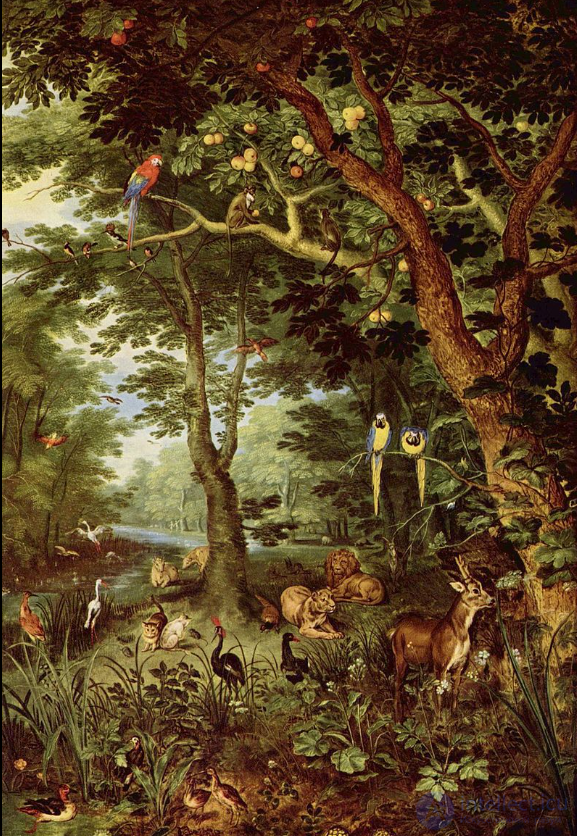
Paradise by Jan Brueghel
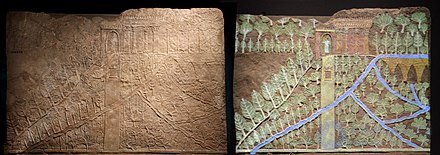
The lavish palace and gardens of the Neo-Assyrian king Ashurbanipal (reigned 668–631 BC) in Nineveh, with an original color reconstruction. Irrigation channels branch out from an aqueduct. The king appears beneath the portico. British Museum.
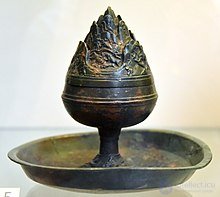
An incense burner, sometimes called a «hill censer» because of its shape (the Mountains of Paradise, Mount Bo, a paradise inhabited by immortals and mythical animals). Eastern Han Dynasty, 25–220 AD. From China. Victoria and Albert Museum
The word «paradise» entered English from the French paradis, inherited from the Latin paradisus, from the Greek paradeisos (παράδεισος), from an Old Iranian form, from Proto-Iranian *parādaiĵah- «an enclosed enclosure», whence Old Persian prdydam/paridaidam, Avestan pairi-daêza-. The literal meaning of this Eastern Old Iranian word is «walled around (enclosure)», from pari — «around» (cognate with Greek περί, English peri- of identical meaning) and -diz «to shape, form (a wall), build» (cognate with Greek τεῖχος «wall»). The etymology of the word ultimately derives from the PIE root *dheigʷ «to stick and place (a wall)» and *per «around».
By the 6th–5th centuries BC, the Old Iranian word had been borrowed into Assyrian as the «domain of pardesu». It subsequently came to denote the vast walled gardens of the First Persian Empire and was later borrowed into Greek as παράδεισος parádeisos «animal park» in the Anabasis of the early 4th century BC by the Athenian Xenophon, into Aramaic as pardaysa «royal park», and into Hebrew as פַּרְדֵּס pardes, «orchard» (occurring three times in the Tanakh; in the Song of Solomon (Song of Songs 4:13), Ecclesiastes (Ecclesiastes 2:5), and Nehemiah (Nehemiah 2:8)). In the Septuagint (3rd–1st centuries BC), the Greek παράδεισος parádeisos was used to translate both the Hebrew פרדס pardes and the Hebrew גן gan, «garden» (for example (Genesis 2:8, Ezekiel 28:13)): it is from this usage that the word «paradise» came to be used to denote the Garden of Eden. The same usage is also found in Arabic and in the Qur'an as firdaws فردوس.
The idea of a walled enclosure did not survive in most Iranian usages and generally came to refer to a plantation or other cultivated area, not necessarily walled. For example, the Old Iranian word survives as pardis in New Persian, as well as its derivative paliz (or «jaliz»), which denotes a vegetable garden.
The word "paradise" has several meanings and can be used in various contexts:
Religious meaning: In religious traditions such as Christianity, Islam, Judaism, and others, "paradise" often means a place of bliss and happiness after death, where the souls of the righteous find eternal salvation and joy.
Metaphorical meaning: In a more general metaphorical sense, "paradise" can be used to denote a place or state associated with exceptional comfort, happiness, and satisfaction. For example, "the walk in the park was a real paradise."
Geographical meaning: "Paradise" can also be used to denote a beautiful, picturesque place of natural beauty, for example, "the trip to this valley was like a trip to paradise."
The concept of "paradise" in literature and art: The concept of "paradise" is often found in literature, art, and folklore, where it can have different interpretations and associations depending on the work and context.
"Paradise" is a term with rich semantics, and its meaning can depend on the context in which it is used.
Religious sense: In a religious context, the "path to paradise" can mean a life path that leads to spiritual perfection and salvation. This may include observance of religious commandments and good deeds.
Metaphorical sense: The "path to paradise" can be used as a metaphor for life efforts and actions that lead to happiness, well-being, and satisfaction. This could be a happy family journey, a successful career, or the achievement of desired goals.
Art and literature: In literature and art, the "path to paradise" can be a theme or motif explored in various works. This can be a journey of characters toward an ideal place or state.
Philosophical aspect: In philosophy, the "path to paradise" can reflect discussions about the meaning of life, happiness, and the spiritual aspects of existence.
In ancient mythology
See Elysium
In Slavic mythology
See Iriy (Vyriy)
In Armenian mythology
See Draxt
In Germanic-Scandinavian mythology
See Valhalla
In Egyptian mythology
Aaru — the paradise of Osiris, located in the west, the final destination of the soul after death, which can only be reached after a journey in the solar barque and after passing the trial in the hall of Osiris's judgment.
In Georgian mythology
Zeskhneli — the abode of the higher beings, divided into seven heavens, of which the seventh and highest is the dwelling place of the Creator of the universe (Ghmerti), his first creations (khvtishvilni), and the souls of the righteous.
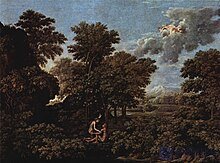
Nicolas Poussin, The Four Seasons of Paradise, 1660–1664.
The Hebrew word pardes appears only in the post-exilic period (after 538 BC); it occurs in Song of Songs 4:13, Ecclesiastes 2:5, and Nehemiah 2:8, in each case meaning «park» or «garden», the original Persian meaning of the word, where it describes the royal parks of Cyrus the Great in Xenophon's Anabasis. _
In Second Temple Judaism, «paradise» became associated with the Garden of Eden and with prophecies about the restoration of Eden and its transfer to heaven.
In the apocryphal Apocalypse of Moses, Adam and Eve are expelled from paradise (rather than from Eden) after the fall of man, having been deceived by the serpent. After Adam's death, the Archangel Michael carries Adam's body for burial in Paradise, on the Third Heaven.
The Greek word παράδεισος occurs in the New Testament three times:
According to Jewish eschatology, the highest Gan Eden is called the «Garden of Righteousness». It was created from the beginning of the world and will be gloriously manifested at the end of time. The righteous one dwelling there will enjoy the sight of the heavenly chayot, bearing the throne of God. Each of the righteous will walk with God, who will lead them in a dance. Its Jewish and non-Jewish inhabitants are «clothed in garments of light and eternal life and eat of the tree of life» (Enoch 58:3) beside God and His anointed ones. This rabbinic Jewish conception of the highest Gan Eden is opposed by the Hebrew terms gehinnom (the source of the English «gehenna» via Yiddish) and sheol, figurative names for a place of spiritual purification for the wicked dead in Judaism — a place considered to be at the greatest possible distance from paradise.
In modern Jewish eschatology, it is believed that history will conclude and that the final destination will be the return of all humanity to the Garden of Eden.
In the Talmud and the Jewish Kabbalah, scholars agree that there are two types of spiritual places called the «Garden in Eden». The first is more earthly, with abundant fertility and lush vegetation, known as the «Lower Gan Eden». The second is regarded as heavenly, the dwelling place of the immortal souls of the righteous, both Jewish and non-Jewish, known as the «Higher Gan Eden». The rabbis distinguish between the Gan and Eden. It is said that Adam lived only in the Gan, whereas Eden, it is said, was never witnessed by any mortal eye. In rabbinic Judaism, the word «Pardes» recurs, but less often in the context of the Second Temple or the restored Eden. A well-known mention is found in the story of Pardes, where the word may refer to mystical philosophy.
The Zohar gives this word a mystical interpretation and links it to the four kinds of biblical exegesis: peshat (literal meaning), remez (allusion), derash (anagogical), and sod (mystical). The initial letters of these four words then form פַּרְדֵּס – p(a)rd(e)s, which, in turn, was considered to represent the fourfold interpretation of the Torah (in which sod – the mystical interpretation – takes first place).
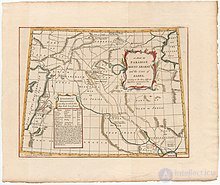
Braddock Mead, Paradise According to Three Different Hypotheses, 1747.
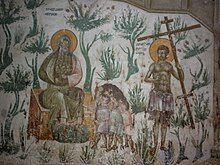
Abraham in Paradise, Gračanica Monastery, Serbia.
In the 2nd century AD, Irenaeus distinguished paradise from heaven. In his book «Against Heresies,» he wrote that only those deemed worthy would inherit a dwelling in heaven, while others would enjoy paradise, and the rest would live in the restored Jerusalem (which was largely in ruins after the Jewish-Roman wars, but was rebuilt starting with Constantine the Great in the 4th century). Origen likewise distinguished paradise from heaven, describing paradise as an earthly «school» for the souls of the righteous dead, preparing them to ascend through the heavenly spheres to heaven.
Many early Christians identified Abraham's bosom with paradise, where the souls of the righteous go before the resurrection of the dead; others were inconsistent in their definition of paradise, such as St. Augustine, whose views varied.
In Luke 23:43, Jesus speaks with one of those crucified with him, who asks: «Jesus, remember me when you come into your kingdom.» Jesus answers him: «Truly I tell you, today you will be with me in paradise.» This is often interpreted as meaning that on that very day the thief and Jesus would enter an intermediate resting place for the dead awaiting the Resurrection. [Various views on paradise and on when one enters it are perhaps the reason for the divergence in punctuation in Luke; for example, two early Syriac versions translate Luke 23:43 differently. The Sinaitic Palimpsest reads: «I say to you, today you will be with me in paradise.» Similarly, the two earliest punctuated Greek codices disagree: the Codex Vaticanus has a pause mark (a single point on the baseline) in the original ink, equidistant from «today» and the following word (without later corrections and without a point before the word «today» ), whereas the Codex Alexandrinus has the reading «today in paradise.» Moreover, the adverb of time is never used in almost 100 other places in the Gospels where Jesus uses the phrase «Truly I say to you.»
In Christian art, Fra Angelico's painting «The Last Judgment» depicts paradise on the left side. There is a tree of life (and another tree) and a round dance of liberated souls. In the middle there is a hole. In Muslim art this likewise indicates the presence of the Prophet or of divine beings. It is aptly written: «That which is here cannot be depicted.»
Jehovah's Witnesses, based on their interpretation of the Book of Genesis, believe that God's original purpose was and is to fill the earth with the descendants of Adam and Eve as caretakers of a global paradise. However, Adam and Eve rebelled against God's dominion and were banished from the Garden of Eden, expelled from paradise into toil and suffering.
Jehovah's Witnesses believe that disobedient and wicked people will be destroyed by Christ at Armageddon, while those obedient to Christ will live forever in a restored earthly paradise. The survivors will be joined by the resurrected righteous and unrighteous who died before Armageddon. The latter return because they have paid for their sins with their death and/or because they had no opportunity to learn of Jehovah's requirements before death. They will be judged based on their obedience, after the resurrection, to the instructions given in new «scrolls.» They believe that the resurrection of the dead on a paradise earth has been made possible by the blood of Christ and his ransom sacrifice. This provision does not extend to those whom Christ, as Judge, considers to have sinned against God's holy spirit.
One of Jesus's statements before his death was addressed to the man hanging next to him: «You will be with me in paradise.» In the «New World Translation,» a comma is placed after the word «today,» dividing it into two separate phrases: «I tell you today» and «you will be with me in paradise.» This differs from standard translations of this verse: «I tell you, today you will be with me in paradise.» Based on such verses as Matthew 12:40, 27:63, Mark 8:31 and 9:31, the Witnesses believe that Jesus's expectation of being bodily resurrected after three days ruled out his being in paradise on the very day he died.
In Latter-day Saint theology, paradise usually refers to the spirit world, a place where spirits dwell after death and await resurrection. In this context, «paradise» is the state of the righteous after death. By contrast, the wicked and those who have not yet learned the Gospel of Jesus Christ await resurrection in spirit prison. After the general resurrection, all people will be assigned to a particular kingdom or degree of glory. This too can be called «paradise.»
In the Qur'an, Heaven is designated as Jannah (garden), and the highest level is called Firdaws, that is, Paradise. It is used in place of «Paradise» to describe the place of greatest pleasure after death, accessible to those who pray, give charity, and believe in: Allah, the angels, His revealed books, His prophets and messengers, the Day of Judgment, and divine decree (Qadr), and who follow the will of God in their lives. Heaven in Islam is used to describe the sky in the literal sense and metaphorically to denote the universe. In Islam, the generosity and beauty of Heaven are so immense that they cannot be grasped by the worldly mind. There are eight gates of Paradise. These are the eight degrees of paradise:
Jannat al-Ma'wa is at the lowest level, Jannat al-Adn is in the middle, and Jannat al-Firdaws is at the highest.
Imam Bukhari also recorded a tradition in which the Prophet said:
«When you ask Allah for something, ask Him for Al-Firdaws, for it is the middle of Paradise and the highest place, and from it flow the rivers of Paradise.» (Bukhari, Ahmad, Bayhaqi)
In this tradition it is evident that Al-Firdaws is the highest place in Paradise, yet it is stated to be in the middle. Giving an explanation of this description of Al-Firdaws, the great scholar Ibn Hibban states:
«That Al-Firdaws is in the middle of Paradise means that, in terms of the width and breadth of Paradise, Al-Firdaws is in the middle. And as for «the highest place in Paradise,» that means it is at the highest elevation.»
This explanation agrees with the explanation given by Abu Hurayrah (may God be pleased with him), who said that
«Al-Firdaws is a mountain in Paradise from which rivers flow.» (Tafsir al-Qurtubi, vol. 12, p. 100)
The Qur'an also warns that not all Muslims, or even believers, are guaranteed to be allowed to enter Jannah, except those who struggled in the way of God and endured trials of the kind that God's messengers or the ancient prophets faced:
Or do you think that you will enter Paradise while such [trial] as came to those who passed on before you has not yet come to you? They were touched by poverty and hardship and were shaken until [even] their messenger and those who believed with him said, «When is the help of Allah?» Unquestionably, the help of Allah is near.
- Qur'an 2:214 (Al-Baqarah) (Sahih International)
Other examples of the mention of paradise in the Qur'an include descriptions of springs, silk garments, adorned carpets, and women with beautiful eyes. These elements can also be seen in depictions of Islamic art and architecture.
«The likeness of Paradise (Jannah), which is promised to the righteous and the pious (this is a likeness of a garden), with rivers of water that will not spoil, and rivers of milk whose taste will not change, and rivers of wine, delicious to those who drink it, and streams of pure honey, and every kind of fruit in it, and forgiveness from their Lord.»(47:15).
There are several passages in the Qur'an that mention paradise or «Jannah.» The Holy Book contains 166 mentions of gardens, of which nineteen mention «Jannah,» denoting images of paradise through gardens, bodies of water, and fruit-bearing trees. Scholars cannot confirm that specific artistic decisions were intended exclusively to reflect the description of paradise in the Qur'an, since there are no extensive historical records to reference. However, many elements of Islamic art and architecture can certainly be interpreted as reflecting the paradise described in the Qur'an, and there are specific historical records supporting a number of case studies in favor of this claim.
Historical evidence supports the claim that certain Islamic garden structures and mosaics, especially those of Spanish, Persian, and Indian origin, were intended to reflect the paradisiacal scene described in the Qur'an.
The Alhambra, Court of the Lions, Granada, Spain.
The structural layout of the gardens of the Alhambra in Granada embodies the idea of water as a symbol of paradise in Islamic gardens. In particular, the Court of the Lions, which follows the quadripartite garden or «Chahar Bagh» layout typical of Islamic gardens, has a serene fountain at its center. The fountain is adorned with stone lions, and water flows from the mouths of these lions. The static nature of the locally sourced water features in the Court of the Lions at the Alhambra adds an atmosphere of serenity and stillness typical of Islamic gardens, which use water features reminiscent of the image of paradise described in the Qur'an.
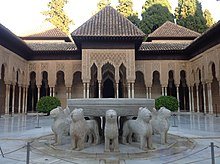
The central fountain in the Court of the Lions, the Alhambra, Granada.
There is as yet no specific evidence that Islamic gardens were intended solely to depict images of paradise. However, from certain inscriptions and the design of structures, it can be inferred that creating an atmosphere of divinity and serenity was among the intentions of the artists.
Tombs became a metaphorical «paradise on Earth» for Islamic architecture and gardens; they were a place of eternal peace where the devout followers of God could rest.
The Taj Mahal
On the exterior of the Taj Mahal mausoleum-tomb, inscriptions of passages from the Qur'an adorn the outer facades framing the iwans. These inscriptions repeat passages of an eschatological character, referring to the Day of Judgment and themes of paradise. Likewise, the placement of the tomb structure within a water garden reinforces the conceptual connection between tomb gardens and the paradisiacal place discussed in the Qur'an. Likewise, the white marble used to build the tomb's mausoleum contributes to the interrelation between purity and divinity of the tomb, elevating the tomb's status to the level of paradise.
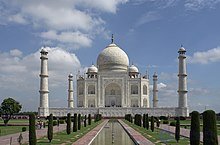
The mausoleum-tomb at the Taj Mahal
Surviving historical records from an interview with a craftsman of the Prophet's Mosque in Medina, between 705 and 715, reveal how mosaic depictions of gardens inside this mosque were in fact created «after the image of the Tree of Paradise and its palaces.» Structures that are likewise adorned with naturalistic mosaics and were created in the same period as the Prophet's Mosque in Medina can be said to have had the same intended effect.
The Mosaic of the Dome of the Rock, Jerusalem.
Built between 690 and 692, the Dome of the Rock in Jerusalem is adorned with a large-scale mosaic inside its domed structure. It is quite likely that this richly decorated and detailed mosaic was intended to reproduce the image of paradise, depicting fruit-bearing trees, plant motifs, and flowing rivers. The mosaic, complemented by a calligraphic frieze, depicts symmetrical plant scrolls of grapevine, surrounded by trees of blue, green, and turquoise mosaic. Jeweled ornaments and gold pigment complement the mosaic. Mosaics of this type not only sought to reflect the paradise described in the Qur'an but were also believed to symbolize and proclaim the victories of Muslims.
The Mosaic of the Great Mosque of Damascus, Syria.
Similarly, the mosaic of the Great Mosque of Damascus, built in the same period as the Dome of the Rock, presents the most prominent elements of the paradisiacal garden described in the Qur'an. It is therefore reasonable to assume that the mosaic on the outer facade of the Great Mosque of Damascus was likewise intended to reproduce the image of paradise in the viewer's mind.
In the text «On the Origin of the World,» preserved in ancient Gnosticism from the Nag Hammadi library, paradise is described as located beyond the circle of the Sun and the Moon, in the lush east of the Earth, among the rocks. The Tree of Life, which will provide for the souls of the saints after they leave their corrupted bodies, is located to the north of Paradise, next to the Tree of Knowledge, which contains the power of God.

Comments