
Lecture
Lecture Plan
1. The history of the origin and evolution of the Old Believer movement. Archpriest Avvakum. The main sects and consents. Features of doctrine, cult, organization, and activity.
2. Christian movements in Russia that arose on the basis of Orthodoxy: the Dukhobors, the Khristovers, the Molokans. Socio-historical conditions of origin and evolution. Features of doctrine, cult, and organization.
Features of doctrine, cult, organization, and activity
The Old Believer movement (Old Ritualism) is a collection of religious currents that arose in the 17th century within Russian Orthodoxy as a result of the Schism.
The reforms initiated by Patriarch Nikon caused confusion and protest among a significant part of the faithful. The rites conciliarly rejected in 1653-1660, quite naturally, owing to their long-standing roots in Russian church practice, were perceived by the protesters as symbols of «ancient piety», and abandoning them seemed tantamount to abandoning Orthodoxy as such. Among these rites were the two-fingered sign of the cross (as opposed to the three-fingered sign confirmed by the reform), the «double» alleluia during the service (instead of the «triple» alleluia), the custom of walking during baptism, weddings, and the consecration of a church «sunwise», with the sun (rather than against it), the celebration of the liturgy with seven prosphora
(rather than five), the predominant use of the eight-pointed or six-pointed cross (rather than the four-pointed cross, partially permitted by the reform, including in Eucharistic symbolism), and a number of others. The authority of the old books, which affirmed the legitimacy of the two-fingered sign, the seven-prosphora practice, and so on, as well as the spelling «Isus» (instead of «Iisus»), the use of the word «True» in the 8th article of the Creed (with respect to the Holy Spirit – instead of the single epithet «Life-giving»), and other formulations that were now corrected, was of enormous significance in deepening the schism. All the textual corrections and the corresponding ritual unification were carried out hastily, with extreme intolerance toward the «heretics», who were for the most part entirely orthodox zealots of church tradition; these zealots, in turn, declared the «Nikonians», who had placed a strict ban («curse») on the customary rites, to be apostates.
Repressions fell upon the adherents of the old ways: many were sent into exile (like the noblewoman F.P. Morozova), others were physically destroyed (as victims of the «Solovki Sitting» – the mass protest of the brethren of the Solovetsky Monastery, crushed by government troops in 1676, or as the «Pustozersk sufferers» – Archpriest Avvakum, the priest Lazar, the deacon Fyodor, and the monk Epiphanius – who were burned at the stake in a log cabin in 1682 after many years of imprisonment). Many lives were claimed by the «gari», fires in overcrowded huts where people, praying, sought refuge from the persecuting soldiers — which in most cases were probably collective suicides. The victims of the persecutions became martyrs of the Old Believer movement, whose deaths strengthened among their comrades a feeling of irreconcilable hostility toward the «Nikonians», whose cruel deeds were perceived as signs of the coming of the Antichrist. Private admissions by some hierarchs of the dominant church (including Nikon himself) that the different rites were «of equal honor» could no longer correct the situation. The protest, whether open or secret (secret, since some priests performed the old rites quietly, without entering into open disputes with the «new-ritualists», as Avvakum did), took shape as a distinct church.
The process of this formation was complex and contradictory, reflecting the contradictory policy of the government toward the Old Believers, which was at times repressive (under the pre-Petrine autocrats, as well as under Anna Ivanovna, Alexander I toward the end of his reign, or Nicholas I), and at other times comparatively more tolerant (under Peter I or Catherine II). Initially, a centrifugal impulse prevailed among the Old Believers: seeking to preserve the old rites, books, icons, and their entire religious way of life (down to a special kind of prayer beads, the «lestovka») from the prevailing «impiety», they fled to less populated or entirely uninhabited places (Kerzhenets in Nizhny Novgorod province, Starodubye in the Chernigov region, Vetka in the Kingdom of Poland, Irgiz on the border of the Kuibyshev and Saratov provinces, and others), setting up male and female «sketes» there – this was the name given,
owing to their secrecy, to Old Believer monasteries. Those who remained «in the world» tried to go underground, maintaining contact with «their own» on the principle of strict secrecy. Concessions by the authorities were usually closely followed by new persecutions (thus, Peter I allowed Old Believers to live openly in the cities, but at the same time imposed an additional tax on them and repeatedly sent soldiers to destroy the sketes – as a result, a reverse outflow of Old Believers into the cities began, intensifying in the 19th century). Under these conditions, various sects of the Old Believer movement took shape, among which three of the most important should be noted.
The Priestless sect (Bespopovtsy) – a movement that arose in the 17th century after all the priests ordained before Nikon had died, that is, those priests with whom the «people of ancient piety» could remain in liturgical communion. Since communion with the «Nikonian» priests was forbidden, and the Old Believers had no bishops with the right to ordain new priests, many of them came to what seemed to them the only possible conclusion:
that in the approaching «last times» priests were no longer needed, and that the sacraments essential for salvation – baptism and repentance – could be performed by laypeople as well. In this case, new-ritualists joining the community had to be rebaptized. The leading center of the Priestless was the Vyg Hermitage (in Karelia), where the brothers Andrei and Semyon Denisov lived; they are credited with the final version of the «Pomorian Answers», the famous 18th-century «Old Believer catechism»; under Nicholas I the hermitage was ruthlessly destroyed.
The most radical of the Priestless believed that in the «last times» one should not even enter into marriage – thereby forming (by the end of the 17th century) a distinct sect of «non-marriers», or «Fedoseevtsy» (named after their spiritual leader Feodosy Vasilyev). A whole series of other currents also arose in this milieu (for example, the «Netovtsy consent»), which had neither churches nor church services, but which, owing to their narrowly sectarian character, mostly disappeared over time.
Edinoverie («Common Faith») is the opposite of the Priestless sect, being, on the contrary, the most compromising in relation to the dominant church. It arose in 1799-1800, when Old Believer merchants of Moscow appealed to Metropolitan Platon (Levshin) with a request to allow them to bring new-ritualist priests into their communities. For this, the Holy Synod had to lift the curses on the old rites, and also agree that all services would necessarily be conducted according to the old books. Metropolitan Platon partially granted these requests; however, Edinoverie was officially regarded as a purely temporary, transitional phenomenon, and moreover was canonically closed to new-ritualists. Thus the church schism was not overcome as a result, although the authorities sought to support the temporary «agreement» by transferring, under Nicholas I, churches, chapels, sketes, icons, and other communal property confiscated during police and military raids into the ownership of the Edinovertsy as less dangerous «semi-schismatics».
The Priested sect (Popovtsy). The Priested sect proved historically the most enduring and continuous, and, despite all its opposition to the «Nikonians» (an opposition far stricter than in Edinoverie), it recognized the necessity of church hierarchy and all the traditional sacraments. The initial form of this sect was «Beglopopovstvo» (fugitive-priesthood, from the end of the 17th century), when the hierarchy was replenished by new-ritualist priests who defected to the schism; it was this form that then predominated at Kerzhenets, Starodubye, Vetka, and Irgiz. In the 18th century, at Kerzhenets, and later at the Rogozhskoye Cemetery in Moscow (where another Old Believer center arose in the 1770s), fugitive priests began to be received into the community through a special renunciation of heresy, after which the rite of chrismation was performed over them. The year 1846 proved fateful for the Old Believers, when their envoys succeeded in attracting the Bosnia-Sarajevo Metropolitan Amvrosy (in the world, Andrei Popovich) to head the «ancient-Orthodox» church. Thus the Belokrinitskaya hierarchy was established (named after the village of Belaya Krinitsa in Austrian Galicia, now in the Chernivtsi region of Ukraine), where by that time Popovtsy from Russia had settled. Most of the largest Old Believer communities recognized the supreme authority of Belaya Krinitsa, which contributed to the consolidation of the Old Believer movement (although different sects were preserved); on the basis of the Rogozhskaya community, the Moscow Archdiocese was formed (in 1853).
By the beginning of the 20th century, the Old Believer movement represented an extensive and sturdy structure, strong not so much politically as economically, thanks to the fact that a number of major merchant clans were associated with it (the Ryabushinskys, the Morozovs, the Porokhovshchikovs, the Shibayevs, and others). In terms of aesthetics, the popularization of the images of the «people of ancient piety» was especially furthered by the novels of P.I. Melnikov (Pechersky), published in 1871-1881. At the turn of the century, a brief «golden age» of the Old Believer movement began (1905-1917). Following Nicholas II's manifesto «On the Strengthening of the Principles of Religious Tolerance» (1905), churches closed since Nicholas I were unsealed and new construction was permitted, which proceeded quite intensively – in the spirit of historicism or Art Nouveau. The Old Believer press developed vigorously. The religious center finally shifted from Belaya Krinitsa to Moscow. However, after the revolution the Old Believer movement once again entered
The revolutionary «storming of the heavens», a wave of repressions, intensified discord in the 1920s both within the Russian Orthodox Church (ROC) and within the Old Believer movement. The Edinovertsy attempted to establish their own (Ufa) hierarchy. Those of the «Beglopoptsy» who did not recognize the Belokrinitskaya-Moscow leadership found their own primate, Archbishop Nikolai of Novozybkov (Pozdnev), making the village of Novozybkovo in Bryansk region their center. «Ancient piety» of all sects passed through a dark period of arrests, exiles, and executions. Nevertheless, the Old Believers, accustomed to many years — more than two centuries — of secrecy, zealously preserved their traditions. The period of uneven political liberalization was marked by the historic decree of the Local Council of the ROC (1971), which, meeting «ancient Orthodoxy» halfway, confirmed the earlier decision of the Synod (of 1929) «on recognizing the old Russian rites as salvific, equal in honor to the new rites». An important milestone in the history of the Old Believer movement itself was the Consecrated Council of 1986, at which Bishop Alimpy (in the world, A.K. Gusev) was elected Archbishop of Moscow and All Rus; regarding the ROC, the view took hold that the mere «lifting of the curses» was insufficient, and that «repentance for the sin of the schism» needed to be added to it. The absence of such official repentance, in the opinion of the Old Believers, hinders the further rapprochement of the churches. Holding to their positions, they have nevertheless grown accustomed to many years of peaceful coexistence, in which the sharpest struggle now unfolds only in the sphere of scholarly and journalistic polemics — a period of severe persecution, now sharing the common fate of all other religious confessions.
As a result of emigration in the 18th-20th centuries, large communities of Old Believers from Russia formed in Romania, the USA, Canada, Australia, Argentina, Brazil, and a number of other countries.
Socio-historical conditions of origin and evolution. Features of doctrine, cult, organization
The Dukhobors (in Russia) are a group of spiritual Christians that finally took shape in the second half of the 18th century. The term «Dukhobors» itself came into use from 1785. The first adherents of the Dukhobor worldview were Russian ascetics – Siluan Kolesnikov (a native of Ekaterinoslav province), and later Illarion Pobirokhin and Savely Kapustin (natives of Tambov province). At the turn of the 19th-20th centuries, L.N. Tolstoy had a significant influence on Dukhobor ideas.
The Dukhobors do not recognize the sanctity of the Bible. Their main sacred tradition is the «Book of Life», transmitted orally from generation to generation. Despite certain borrowings in content from the Old and New Testaments, specialists assess most of the ideas of the «Book of Life» as quite original. The considerable volume of the «Book of Life» makes it impossible for any single adherent to master it, so it is preserved in the collective memory of the entire Dukhobor community (the study of fragments of the Book is carried out by children between the ages of 6 and 15, and this procedure is regarded as baptism).
According to the reconstruction by O.E. Kazmina, for the Dukhobors God is inseparable from man: «There is God – He is Spirit. He is in us – we are God». The traditional Christian Trinity (God the Father, God the Son, God the Holy Spirit), according to Dukhobor beliefs, appears as: «Light – Life – Peace». In his memory man resembles God the Father, in his reason God the Son, in his will the Holy Spirit. Jesus Christ, in the Dukhobors' view, is a man possessing the Divine mind to the highest degree. Thus each generation of people is ennobled by the presence of its own mortal Jesus – a moral and spiritual guide. The Dukhobors reject all church sacraments, believing that thanks to the descent of Jesus Christ everything hidden has become manifest. Not believing in an afterlife, the Dukhobors hold that the timeless principle is the memory that the deceased leaves behind. Nevertheless, the Dukhobors consider the transmigration of souls possible: the soul of a righteous person, after the death of its physical body, passes into the body of another righteous person or a newborn, while the soul of a sinner ends up in the body of an animal. The Dukhobors do not recognize original sin.
In everyday life the Dukhobors are vegetarians (a practice that took shape under the influence of L. Tolstoy); they are forbidden to take any oaths, to take the military oath, or to bear arms. The Dukhobors have no clergy; all believers consider themselves priests.
The total number of Dukhobors is more than 100,000 people; they live in Russia, Canada, and the USA, and are predominantly Russian by ethnicity. In the CIS the Dukhobors are organized into the «Regional Union of the Spiritual Warriors of Christ – Dukhobortsy of the CIS».
The Khristovers, the People of God, the Khlysts – one of the movements of spiritual Christians, which arose in the 17th-18th centuries. The founder of the movement was Danila Filippovich (Filippov, died 1700), who declared himself the incarnate God (Sabaoth) and preached in the Kostroma, Vladimir, and Nizhny Novgorod provinces (from 1645). In 1649 Danila Filippovich declared his assistant Ivan Timofeyev Suslov to be Christ. Suslov, together with «apostles» and a «Mother of God» whom he had chosen, preached the teaching in the Vladimir and Nizhny Novgorod provinces, and later in Moscow.
The greatest spread of the Khlyst movement in Moscow is observed under Suslov's successor, the new «christ» – Prokopy Lupkin (died 1732). In 1733 and 1745 two investigations were carried out, which revealed the extent of the Khlyst movement. Many leaders of the movement were beheaded, but this did not stop new «christs» from appearing one after another in various regions of Russia.
The followers of the teaching gathered in a prayer house, which they called the «House of God». Individual communities of Khristovers were called «ships», each headed by its own «christs» and «mothers of God».
The teaching of the Khristovers is a dualism of matter (evil) and spirit (the good principle). It was for this reason that the Khristovers rejected married life and called for the mortification of the flesh. However, among the Khristovers «spiritual» cohabitations and carnal relations between a husband and his spiritual wife were widespread, which, according to the teaching of the Khristovers, did not constitute a sin.
The Khristovers did not consider the Revelation given in Holy Scripture to be binding. Believing that God became incarnate in numerous «christs», they relied entirely on the teaching of their own christs and prophets. Therefore the Khristovers recognized the 12 commandments given by Danila Filippovich, which forbade entering into marriage, bearing children, drinking wine, smoking, using foul language, and eating meat (the later Khlyst prohibition on eating meat is partly connected with the doctrine of the transmigration of souls), and so on.
The Khlyst movement gave rise to the movements of the Skoptsy (castrates), the Postniki (fasters), the «New Israel», and others. Some of these movements have survived to the present day, while others have ceased to exist. One of the currents that branched off from the Khlyst movement, widespread in Russia in the 1890s, was the movement of the Malevantsy. The movement took its name from Kondrat Malevanny (1844-1913), who declared himself Christ and preached the imminent coming of the end of the world. In the early 1890s K. Malevanny was arrested and placed in an insane asylum, and the Malevanny movement continued to exist until 1920.
The Molokans are adherents of a religious movement that branched off from the spiritual Christians in the 1760s-1780s. The founder of the movement was the village tailor S. Uklein. The Molokans explained their name by the fact that they partook of the «spiritual milk» of God's teaching.
In their doctrine they are close to the Dukhobors. The Molokans rejected the clergy, monasticism, churches, and the veneration of icons. They based their teaching on the Bible (allegorical interpretation) and preached salvation through faith.
The role of clergy among the Molokans was performed by «elders» (presbyters), and their cult was reduced to prayer meetings, hymns, and sermons. They practiced fasting and paid great attention to the spiritual side of religion.
Molokan communities have survived to our time. They gave rise to the movement of the Pryguny (Jumpers).
Close to the Molokans in doctrine are the Nazarenes – followers of a religious movement that arose in the 1820s in Hungary and later spread to the territory of the Czech lands, Slovakia, and Russia. The Nazarenes rejected church authority (and some of them also secular authority), and opposed the veneration of relics and saints.
398-404 – the years of the reign of Patriarch John Chrysostom of Constantinople, a talented preacher;
988 – the baptism of Rus by the Kievan prince Vladimir Svyatoslavich;
Mid-13th century – the canonization, on the instructions of Alexander Nevsky, of the great Kievan prince Vladimir;
1448 – the proclamation of the autocephaly of the Russian Orthodox Church;
1589 – the establishment of the patriarchate in Russia;
1721 – the introduction of the «Spiritual Regulation», which replaced the patriarchal form of governance of the Russian Orthodox Church with the synodal form;
1917 – the restoration of the patriarchal form of governance of the Russian Orthodox Church;
1922 – the emergence of the Renovationist movement, an oppositional movement within Russian Orthodoxy;
1943 – the election of Metropolitan Sergius as Patriarch of Moscow and All Rus;
1988 – the Local Council of the Russian Orthodox Church, dedicated to the 1000th anniversary of the baptism of Rus;
1990 – the election of Metropolitan Alexy of Leningrad as Patriarch of Moscow and All Rus.
1. What does the concept of «Orthodoxy» mean?
2. What are the distinctive features of Orthodox doctrine?
3. How is the Orthodox Church governed?
4. What autocephalous Orthodox churches exist at present?
5. What is the Old Believer movement?
6. What was the role of the Orthodox Church in the history of the Russian state?
What feasts and fasts exist among the Orthodox?
How does the Russian Orthodox Church relate to other confessions and religions?
Name the most important events in the history of the Russian Orthodox Church.
Describe the fate of the Russian Orthodox Church during the Soviet period.
3. Name all the patriarchs of Moscow and All Rus.
4. Characterize the Russian Orthodox Church Abroad, the True Orthodox Church, and the Russian Free Orthodox Church, currently active.
5. Solve the crossword puzzle on the topic.
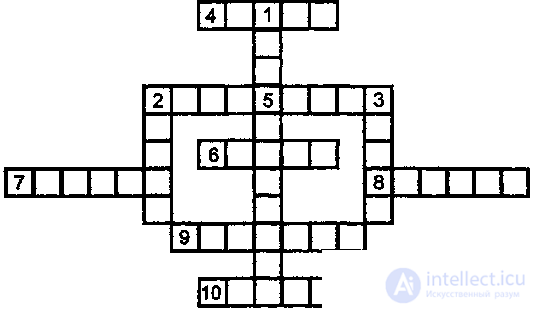
Down:
1. Metropolitan of Belarus during the Nazi occupation.
2. A monk's separate living cell.
3. The seventh Patriarch of Moscow and All Rus.
Across:
2. A religious symbol venerated in Christianity.
4. The roofing covering religious buildings.
5. The Patriarch of Moscow and All Rus elected at the Local Council in 1917.
6. Baked goods for the Christian Easter.
7. The place in a Christian church where the clergy perform the sacred rites.
8. A short prayer said by a priest at the end of a service.
9. A monk who leads an especially ascetic and reclusive way of life.
The firstborn of a flock, used as a sacrificial animal.

Comments