
Lecture
Criticism of religion can arise from various points of view and directions. Some of the main forms of criticism of religion include:
Philosophical criticism: It may address logical contradictions in religious doctrines, ethical problems arising from certain aspects of religious teachings, or reasoned analyses of the existence of God and the nature of the divine.
Empirical criticism: It is oriented toward the scientific aspects of religious beliefs, such as the lack of empirical evidence for the existence of God or contradictions between religious dogmas and scientific facts.
Sociological criticism: It analyzes religion from the point of view of its influence on society, including issues of power, control, and social inequality generated by religious institutions.
Historical criticism: It examines the historical aspects of religion, including mythologies, the origin of religious texts, the history of religious conflicts, and the influence of religion on historical events.
Ethical criticism: It may address moral dilemmas associated with religious practice or teachings, as well as issues related to how religion defines right and wrong behavior.
Criticism of religion can be constructive, aimed at improving faith and its influence on society, or destructive, seeking to reject religion altogether. Depending on the context and goals, criticism of religion can be carried out in various ways and from different points of view.
Ignosticism, or igtheism — a viewpoint on theology according to which any other viewpoint on theology (including agnosticism) makes too many unfounded assumptions regarding the concept of God/gods, and certain other theological concepts. The term «ignosticism» was introduced by Sherwin Wine, the founder of Humanistic Judaism.
Some philosophers regard ignosticism as a form of atheism or agnosticism, while others consider it a distinct concept in its own right. An ignostic holds the view that one cannot even answer whether one believes in God or not until the questioner provides a definition of God/gods.
Ignosticism and theological noncognitivism are sometimes considered synonymous, though the relationship between ignosticism and other non-theistic views is less clear-cut. Paul Kurtz finds it compatible with negative atheism and agnosticism.
I introduced the notion of «igtheism» because the theistic being discussed by theologians and philosophers is not intelligible. Here the particle ig- (ig-) derives from the word meaning «not knowing» (ignorant), since we cannot in any way know what is meant by the word «theism» when we use the concept of «God» to denote a transcendent being or the «ground» of being. The argument used by theologians (for example, Tillich) that «God-language» must be understood symbolically or metaphorically is, in my view, a subterfuge. Semantic fog makes one perceive something ambiguous in it, which upon clarification turns out to be false.
— Paul Kurtz, «The New Skepticism»
In the book «Language, Truth and Logic», Alfred Ayer argues that no one can speak of the existence of God, or even of the very possibility of his existence, since this concept is unverifiable and therefore meaningless. Ayer places it outside atheism, agnosticism, and theism, because all these positions presuppose the presence of meaning in the statement «God exists». Given the meaninglessness of theistic claims, Ayer expresses the opinion that «there is no logical basis for antagonism between religion and empirical knowledge», since theism does not entail any propositions that the scientific method could refute.
Following Ayer, Theodore Drange finds that atheism and agnosticism accept the proposition «God exists» as meaningful: atheists assess it as «false or probably false», while agnostics leave the question open until decisive proof is presented. If Drange's definition is accepted, ignostics are neither atheists nor agnostics, and the distinction between them can be expressed in simplified form as follows :
Atheist: «I do not believe that God exists»
Agnostic: «I do not know whether God exists or not»
Ignostic: «I do not understand what you mean when you say „God exists/does not exist“».
Despite self-identifying as an atheist, Sam Harris expresses frustration with this label and often uses ignostic arguments criticizing the ambiguity and inconsistency of definitions of God.
Ignosticism should not be confused with apatheism, a position of indifference toward the question of God's existence. To an apatheist, the statement «God exists» may seem either meaningless or meaningful, and possibly even true.
Agnosticism (from Ancient Greek ἄγνωστος «unknowable») — a philosophical concept according to which the world is unknowable and people cannot know anything reliable about the true essence of things; the position of religious agnosticism holds that people cannot know anything reliable about God (or gods) . For agnostics, the existence of God, the divine, or the supernatural is unknown or incomprehensible .
Proponents of agnosticism in the broad sense consider it fundamentally impossible to know objective reality through subjective experience, and impossible to know any ultimate and absolute foundations of reality. It also denies the possibility of proving or disproving ideas and statements based entirely on subjective premises. This term is used in philosophy, epistemology, and theology .
Besides philosophical agnosticism, there is also theological and scientific agnosticism. In theology, agnostics separate the cultural-ethical component of faith and religion, regarding it as a kind of secular school of moral behavior in society, from the mystical component (questions of the existence of gods, demons, the afterlife, religious rituals), and do not attach significant importance to the latter[10]. Scientific agnosticism exists as a principle in epistemology, holding that since the experience gained in the process of cognition is inevitably distorted by the consciousness of the subject, the subject is fundamentally incapable of grasping an accurate and complete picture of the world — that is, although cognition is possible, it always remains imprecise[11].

One of the unofficial symbols of agnosticism
Agnosticism has no official symbol, since there is no organization of agnostics that could approve such a symbol. The symbol of atheism is sometimes used to denote agnosticism, although these are different concepts. Amateur symbols of agnosticism can be found, but they are unofficial
The word agnosticism means «unknowable» and consists of the Ancient Greek ἀ- (a-), meaning «without», and γνῶσις (gnosis), meaning «knowledge». In common usage (especially in English-language literature), agnosticism is often conflated with atheism, with skepticism toward religion in general . The term was introduced into use by the English zoologist, professor Thomas Henry Huxley in 1869 , when the «Metaphysical Society» invited Huxley to become a participant in its meetings[12]. «When I reached intellectual maturity,» Huxley writes, «and began to wonder who I was — an atheist, a theist or a pantheist, a materialist or an idealist, a Christian or a free thinker — I came to the conclusion that none of these labels suited me except the last»[13]. By his definition, an agnostic is a person who does not deny the existence of gods, but also does not take the side of any religion or faith. An agnostic is also a person who does not deny the existence of gods, but also does not assert it, being convinced that the primary origin of things is unknown, since it cannot be known — either at the current stage of human development, or at all. The term is applied to the teachings of Herbert Spencer, William Hamilton, George Berkeley, David Hume, and others.
His own version of the origin of this term is given by P. A. Kropotkin[14]: «The word „agnostics“ was first introduced into use by a small group of unbelieving writers who gathered at the home of the publisher of the journal „Nineteenth Century“ („Nineteenth Century“), James Knowles (English)Russian., who preferred the name „agnostics“, that is, those who deny gnosis, to the name of atheists».
In the early Christian tradition, the Greek word gnosis («knowledge») was used to describe «spiritual», mystical knowledge. Agnosticism should not be understood as religious views specifically opposed to the religious movement of Gnosticism; Huxley used this term in a broader, more abstract sense[15]. Huxley defined agnosticism not as a creed, but rather as a method of skeptical inquiry based on facts[16].
In recent years, in English-language scientific literature devoted to neurobiology and psychology, this word has been used to denote «the incomprehensible»[17]. In English-language technical and marketing literature, «agnosticism» can also mean independence from certain parameters, for example, «platform-agnostic» (platform-independent)[18] or «hardware-agnostic»[19].
In philosophy, agnosticism is not called an independent concept, but rather a general skeptical position in cognition: both doubt in the adequacy of the methods available to humans, and epistemological pessimism regarding objective reality in general. Such views have been formulated in various forms across many different philosophical schools. For example, Kant's subjective idealism considers cognition of objective entities to be fundamentally impossible for the subjective mind, while positivism asserts the meaninglessness of posing questions that go beyond what is available to empirical verification.
An agnostic tendency was first voiced by the ancient Greek sophists: Protagoras taught that «everything is as it seems to us» (in the spirit of epistemological relativism), while Gorgias formulated a kind of manifesto of agnosticism: «Nothing exists; but even if something exists, it is unknowable; but even if it is knowable, it is inexplicable to another».
Empiricist philosophers pointed out that the experience we acquire acquaints us only with sensations, not with the things themselves. Therefore D. Hume concluded that we cannot know not only to what extent subjective perception corresponds to objective reality, but even whether it exists at all outside our sensations. I. Kant, in his Critical philosophy, postulated the existence of objective «things-in-themselves» (entities, noumena), the real sources of our sensations, yet considered subjective sensory experience to be the only form of cognition, and therefore concluded that cognition is fundamentally limited by the structure of the cognitive capacities of the subject himself: we can know not the real object, but only how it appears in human experience — the appearance (the «thing-for-us», phenomenon).
Agnosticism ignores the imperative, basic to philosophy, of seeking a universal objective foundation, and is therefore subject to constant criticism both from the standpoint of religious philosophy and from the standpoint of materialism, which see such a foundation in God and in matter, respectively. Thus, Leo Tolstoy wrote: «I say that agnosticism, although it wants to be something distinct from atheism by putting forward the alleged impossibility of knowing, is in essence the same as atheism, because the root of everything is the non-recognition of God»[29]. And V. I. Lenin, discussing the opposition between materialism and idealism, on the contrary, reproached agnosticism for intellectual indecisiveness and reactionary character: «Agnosticism is a vacillation between materialism and idealism, that is, in practice a vacillation between materialist science and priestcraft. Among the agnostics are the followers of Kant (Kantians), of Hume (positivists, realists, etc.) and the modern „Machists“»[30]. In dialectical materialism, the epistemological basis of agnosticism was called the absolutization of relativity, and its historical precondition — the conflict between the religious and scientific worldviews, and the desire to avoid this alternative or an attempt to synthesize them.
Atheism (Ancient Greek ἄθεος «denial of god , godlessness », from ἀ «without» + θεός «god» ) — the rejection of belief in the existence of any deity/god, or the conviction that gods do not exist . In a broader sense, atheism is simply the absence of belief in the existence of gods.
The opposite of atheism is theism[15], understood in the most general case as belief in the existence of one or more gods[16][17].
Atheism is often also understood as the denial of the existence of the supernatural in general — gods, spirits, other immaterial beings and forces, the afterlife, etc. In relation to religion, atheism is a worldview that denies religion as belief in the supernatural.
Atheism is characterized by a conviction in the self-sufficiency of the natural world (nature)[19] and in the human (not supernatural) origin of all religions[19], including revealed religions. Many of those who consider themselves atheists are skeptical of the existence of any supernatural beings, phenomena, and forces, pointing to the lack of empirical evidence for their existence. Others argue in favor of atheism based on philosophy, sociology, or history. The majority of atheists are proponents of secular philosophies such as humanism[20] and naturalism[21]. There is no single ideology or pattern of behavior common to all atheists[22].
The term «atheism» appeared as a derogatory epithet applied to any person or doctrine that was in conflict with established religion[23]. Only later did this word come to denote a definite philosophical position. With the spread of freedom of belief, freedom of thought, scientific skepticism, and criticism of religion, this term began to acquire a more specific meaning and began to be used by atheists for self-designation.
In early Ancient Greek, the adjective ἄθεος meant «denying the gods». The word came to mean deliberate, active godlessness in the 5th century BC and acquired the meaning of «having broken off relations with the gods», «denying the gods, godless». To one who denied the local gods, although he might believe in other gods, the term ἀσεβής — «impious» — began to be applied. Today the word atheos is sometimes translated in classical texts as «atheistic». There was also the abstract noun ἀθεότης, «atheism». Cicero made a Latin transliteration of the Greek word — atheos. The term was widely used in disputes between early Christians and pagans, with each side using it disparagingly to designate their opponents[23].
The word atheist was first used to denote practical godlessness in 1577[25]. Related words arose later: deist — in 1621[26], theist — in 1662[27], theism — in 1678[28] (according to other sources — in 1743[29][30]), deism — in 1682[31] and non-theism — in 1852. The meanings of the words «deism» and «theism» changed somewhat around 1700 under the influence of atheism. The word «deism» originally had the same meaning as the modern word «theism», but later came to denote a separate philosophical doctrine[32].
Karen Armstrong writes that «in the sixteenth and seventeenth centuries the word atheist was used exclusively in polemics… The term atheist was an insult. It would never have occurred to anyone to call themselves an atheist»[33]. The word «atheism» began to be used in Europe to describe one's own beliefs in the eighteenth century and meant a rejection of belief in the monotheistic Judeo-Christian god[34]. In the twentieth century, thanks to globalization, the term spread and came to mean the denial of belief in any and all deities, although to this day in Russia and in the West atheism is customarily defined as «rejection of belief in god»[35][36][37].
Authors disagree on how best to define atheism[38], on precisely which supernatural entities are at issue, on whether atheism asserts their absence, and on whether atheism is a conscious, direct denial of everything supernatural. According to the Nobel laureate, academician of the Russian Academy of Sciences Vitaly Ginzburg,
The task of atheists is not to fight religion, but to engage in atheistic enlightenment, in particular, exposing creationism and various other unscientific «theories». I would especially note the utter untenability of the fairly widespread thesis: «If there is no God, then everything is permitted». Theism indeed, in a number of cases, but far from always (see certain currents in Islamic fundamentalism), has a beneficial influence on the strengthening of positive ethical and moral norms. At the same time, atheism «professes» analogous views and conceptions to no lesser degree.
— Open letter to S. L. Kravets, Executive Secretary of the Great Russian Encyclopedia
Several ways have been proposed to distinguish different types of atheism (generally equated with the «absence of belief in gods» in the broadest sense).
Some of the ambiguities and disputes concerning the definition of atheism arise from ambiguities in the definitions of such words as «deity» and «god». Since there is a wide variety of quite different conceptions of the supernatural, various opinions have arisen as to which of them the term «atheism» applies. If «theism» is taken to mean belief in a single personified Creator-God, then people who believe in a multitude of other gods, deists, and even polytheists could be classified as atheists. In the twentieth century this approach lost popularity, as the term «theism» came to be understood rather as the manifestation of belief in any deity[35].
Depending on the breadth of the definition, atheism can be understood as the rejection of various concepts, ranging from the idea of a god/deity as an acting personality to the denial of the existence of anything immaterial, supernatural, or transcendent whatsoever, including the concepts of Hinduism and Buddhism .
The scientific skeptic and igtheist Paul Kurtz[39] identifies, as a more generalized approach, ignosticism or igtheism — the viewpoint according to which any theology makes unfounded and mutually contradictory assumptions regarding the concept and attributes of gods. Most «new atheists» consider these two terms synonymous[39][not in source].
In simplified form, the distinction between the main «non-theistic» worldviews was expressed by Theodore Drange as follows[40]:
Atheist: «I do not believe that God exists»
Agnostic: «I do not know whether God exists or not»
Ignostic: «I do not understand what you mean when you say „God exists/does not exist“».
As the religious studies scholar Lev Mitrokhin notes, atheism, along with skepticism and freethought, has always symbolized the defense of personal self-awareness, protest against spiritual authoritarianism and intellectual ossification[41].
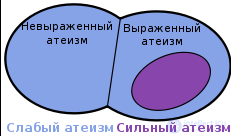
Euler diagrams showing the relationship between the definitions of weak/strong and explicit/implicit atheism. An implicit atheist has not considered belief in gods. An explicit atheist has made a conscious choice regarding their belief in gods. Such a person may refuse to believe in gods (weak atheism) or assert that gods do not exist (strong atheism)
Definitions of atheism also differ in how fully the concept of god must be understood by a person for that person to be called an atheist. According to some atheists, atheism can be regarded as the absence of belief in gods. As early as 1772 the atheist Paul-Henri Thiry, Baron d'Holbach wrote: «All children are atheists; they have no idea of God»[42]. George H. Smith proposed in 1979: «A person unfamiliar with theism is an atheist because he does not believe in a god. This category also includes children who are capable of comprehending the issues involved but who, as yet, have not been exposed to theism. The child's mere lack of belief in a god qualifies him as an atheist»[43]. Smith thus introduced the concept of «implicit atheism», describing «the absence of theistic belief without a conscious rejection of it», and the concept of «explicit atheism», describing the more commonly accepted definition of conscious disbelief.
The view that children are born atheists appeared relatively recently (although the epistemological purity of newborns was already debated in ancient Greece, see tabula rasa). Until the 18th century, the existence of god was so universally accepted in the Western world that even the very possibility of «true» atheism was denied. The doctrine that all people believe in god from birth is called the «theistic doctrine of innate belief». According to this doctrine, atheists simply deny the obvious[44]. One can also often hear the opinion that there are no «atheists to the core» and that in critical situations, for example on one's deathbed, atheists suddenly begin to believe in god. (See «There are no atheists in foxholes»). Atheists dispute such claims, citing examples of «atheists to the core»[45]. In response, atheist organizations among military personnel have also been created[46]. On the other hand, the aforementioned claim itself testifies that one of the causes of religious belief is fear of death. In particular, the American science-fiction writer James Morrow responded to this aphorism in 2001 with the following words:
«There are no atheists in foxholes» is not an argument against atheists, it is an argument against foxholes[47].
Philosophers such as Antony Flew[48] and Michael Martin[35] distinguish between weak (negative) and strong (positive) atheism. Strong atheism is the assertion that gods do not exist. Weak atheism includes all other forms of the absence of theism. According to this division, any person is either a theist, or a «strong», or a «weak» atheist[49]. The terms strong and weak appeared relatively recently, but the equivalent terms negative and positive atheism had already been used in philosophical literature[48] and (in a somewhat different sense) by Catholic apologists[50]. According to this distinction of atheism, most agnostics are «weak» atheists.
On the basis of the above definition, agnosticism can be considered «weak» atheism[51], however most agnostics separate their views from atheism, which they consider no more justified than theism[52]. The presumed unattainability of knowledge about the existence or non-existence of a given god is regarded as a sign that atheism does not manage without blind faith[53]. The usual response of atheists is that unproven religious claims deserve exactly as much distrust as all other unproven claims deserve[54], and that the unprovability of the non-existence of a particular god does not imply that its existence and non-existence are equally probable[55]. The Scottish philosopher John Smart also states that «sometimes a person who is in fact an atheist may call himself an agnostic because of an ill-thought-out extension of the sort of skepticism that warns us against being sure that we know when it is a question of what exists or does not exist ... in the very abstruse realms of, say, cosmology or particle physics»[56]. As a consequence, some popular atheist writers, such as Richard Dawkins, prefer to distinguish theistic, agnostic and atheistic views by the probability assigned to the truth of the statement «God exists»[57].
American commentator and host of the television program «The Atheist Experience[en]» Matt Dillahunty[en], to illustrate the burden of proof and the difference between strong and weak atheism, gives the example of a large jar of candy that may contain either an even or an odd number of pieces[58][59][60]. Before we obtain any information about the number of candies, we have no way of verifying either of these two claims, and in this case we withhold judgment in favor of either claim. From the standpoint of epistemology, when there is no personal preference toward either of the opposing claims, it makes sense to be skeptical of both claims[61]. This example shows that when a claim is disputed, the burden of proof falls on the one making the claim, since if the claimant lacks sufficient evidence to support the claim, such a claim may be considered an argument from ignorance. Applied to atheism, the position of not believing the claim that the number of candies is even is similar to weak atheism, while the position of accepting the claim that the number of candies is odd corresponds to strong atheism. Clearly, not accepting one claim does not automatically mean accepting the opposite claim.
Unreflective atheism is atheism based on something other than science (for example, as a consequence of a skeptical mindset, a lack of interest in the supernatural, ignorance of the existence of religions, and so on).
Scientific atheism is atheism based on the natural sciences and the denial of the supernatural, in which the scientific method is used as the primary tool for addressing the question of the existence of gods, supernatural beings, and phenomena[62].
The greatest divergence, from the standpoint of logical justification, is between practical and theoretical atheism[64]. Various kinds of theoretical atheism can be derived by means of various logical justifications, philosophical arguments, and rejection of belief in the existence of gods on moral grounds, among other things. Practical, unreflective atheism, by contrast, requires no specific argumentation; it includes both unfamiliarity with ideas about the supernatural and a lack of interest in religions.
Following practical, or pragmatic, atheism, also known as apatheism, people live without attaching importance to the presence or absence of gods, and explain natural phenomena without recourse to otherworldly forces. Here the existence of gods is neither denied nor asserted, but may be considered unnecessary or useless. According to this view, gods do not give life meaning and do not influence everyday life[65]. A form of practical atheism that affects the scientific community is methodological naturalism, «the tacit adoption of philosophical naturalism within scientific method». In this case, it is not necessary to accept or believe in philosophical naturalism[66].
There are various kinds of practical atheism:
According to epistemological atheism, people cannot know god or determine whether he exists or not. At the basis of epistemological atheism lies agnosticism, which takes various forms. In immanent philosophy, divinity is inseparable from the world as such, including from the human mind, and the consciousness of each person is enclosed within the subject. According to this form of agnosticism, such a limitation in principle does not allow conclusions to be drawn about the existence of god, whether through faith or logical inference.
The rationalist agnosticism of Kant and the Enlightenment accepts only knowledge obtained through human rationality. It is claimed that gods are in principle undetectable, and therefore it is impossible to know that they exist. Skepticism, based on the ideas of Hume, holds that nothing can be known with certainty, and therefore it is impossible to establish that god exists. The relation of agnosticism to atheism is disputed; agnosticism can be regarded as a separate worldview[65].
Other forms of atheistic argumentation that can be called epistemological include logical positivism and ignosticism, which assert that terms such as «god», and statements such as «god is omnipotent», are meaningless. According to theological non-cognitivism, the phrase «god exists» is not a statement but nonsense. There has been debate over whether such a view can be classified as atheism or agnosticism. The philosopher Alfred Jules Ayer rejected both of these categories, arguing that they mistakenly treat the phrase «god exists» as a statement. He regarded non-cognitivism as a separate, independent category .
Metaphysical atheism is usually based on materialist monism — the view that reality is homogeneous, indivisible, and material. Absolute metaphysical atheists hold to one or another form of physicalism, and therefore explicitly deny the existence of any immaterial entities. On the other hand, absolute metaphysical atheism is also bordered by the opposite, idealist conception — hylozoism — the animation of the entire world, in which there is likewise no place for god as an acting subject.
Relative metaphysical atheism consists in recognizing the existence of some higher immaterial entity (logos, nous, dao, brahman, substance, world spirit, absolute, universal mind, noosphere, etc.), but one that does not possess the unity of transcendence and being, and thereby also denies the existence of god as a person. Relative metaphysical atheism includes such currents as pantheism — Spinoza's «God or Nature» — and panentheism (from Greek pan en theo — all in god), that is, the «God-nature» concept, which developed from Eriugena to Hegel[65]. The metaphysics of the deists Cherbury, Rousseau, Voltaire, and Lessing likewise denies an individual god concerned with the fate of the universe and humanity, and thus also rejects all Abrahamic religions and most other historical and contemporary beliefs, but deism cannot be classified as relative metaphysical atheism, since it presupposes a creator-god who must have possessed, at least once, such a personal quality as will.
 |
|
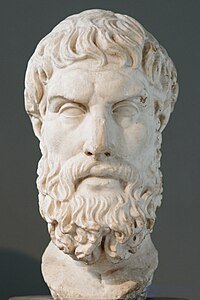
Epicurus is credited with the first formulation of the problem of evil
David Hume in his «Dialogues Concerning Natural Religion» (1779) restates in his own words the thought[70] of Epicurus, who expresses this argument as a series of questions: «Is he willing to prevent evil, but not able? Then he is impotent. Is he able, but not willing? Then he is malevolent. Is he both able and willing? Whence then is evil?»[71] |
Philosophers such as Ludwig Feuerbach and Sigmund Freud argued that belief in gods and religions are human inventions, arising to satisfy natural emotional, worldview, and social needs. The historian Edward Gibbon wrote on this subject: «The various modes of worship which prevailed in the Roman world were all considered by the people as equally true, by the philosopher as equally false, and by the magistrate as equally useful»[72]. This view is shared by most Buddhists as well[73]. Karl Marx and Friedrich Engels, influenced by the works of Feuerbach, argued that «…all religion is nothing but the fantastic reflection in men's minds of those external forces which control their daily life, a reflection in which the terrestrial forces assume the form of supernatural forces»[74], which allows religion to be used as a means of social control: «…the powerlessness of the exploited classes in their struggle against the exploiting ruling classes inevitably gives rise to a belief in a better life after death, just as the powerlessness of the savage in his struggle against nature gives rise to belief in gods…»[75] According to Mikhail Bakunin, «the idea of god implies the abdication of human reason and justice; it is the most decisive negation of human liberty, and necessarily ends in the enslavement of mankind, in theory and practice». He «turned around» Voltaire's famous aphorism that «if God did not exist, it would be necessary to invent him», and wrote that «if God really existed, it would be necessary to abolish him»[76].
According to logical atheism, various conceptions of gods (for example, god as a person) include logically incompatible properties. Proponents of this form of atheism offer logical proofs of the impossibility of god's existence, using contradictions among such qualities as perfection, the status of «creator», immutability, omniscience, omnipresence, omnibenevolence, transcendence, personhood, incorporeality, justice, and mercy[77].
Rejecting, above all on ethical grounds, the arguments of theodicy, atheists hold that observed reality does not accord with the qualities usually ascribed to gods by theologians. They argue that an omniscient, omnipotent, and omnibenevolent god is not compatible with a world in which there is evil and suffering, where the love of god is hidden from many people[78]. A similar line of reasoning is attributed to Siddhartha Gautama, the founder of Buddhism[79].
Axiological, or constructive, atheism regards not gods but human nature as the source of moral values. For this form of atheism, human nature is the sole source of ethics and moral values, and the concept of god is not required for resolving moral questions. Marx, Nietzsche, Freud, and Sartre held this view, spreading ideas of liberation, self-development, and unlimited happiness[65].
One of the most popular arguments against atheism asserts the opposite — that the denial of the existence of a just god leads to moral relativism, depriving a person of the foundations of morality[80], or deprives life of meaning and makes a person unhappy[81]. Blaise Pascal expressed such a view in 1669[82]. According to the 19th–20th century psychiatrist P. B. Gannushkin, however, there is a positive correlation between religiosity and cruelty[83].
It cannot be shown by scientific methods that «god does not exist», since precisely in this case there is no way to logically prove a negative proposition[84]. It is impossible to verify the «non-existence» of something lying beyond what is accessible to investigation. In other words, science can prove the absence of life on Mars, but one can only presume, not prove, the absence of life in the rest of the universe.
Empirical science is based not on faith or sacred traditions and texts, but on rigorous methods for constructing theoretical and practical models of natural phenomena and for advancing hypotheses that explain already known relationships among phenomena and predict effects not yet observed, with the obligatory subsequent verification of the hypotheses advanced through practice: observations and experiments that can be repeated and checked. Agreement between the conclusions of hypotheses and observed facts means the acquisition of new objective knowledge about nature. There have been, and still are, quite a few believers among scientists: among American scientists, in 1916, 42% were believers, and in 1996, 39% were believers, 45% atheists, and 14% agnostics (the journal Nature, vol. 386, p. 435, 1997)[85]. But regardless of personal beliefs, in their scientific work scientists explain the causes of phenomena exclusively within the natural domain, without recourse to the supernatural. As the academician Vitaly Lazarevich Ginzburg observed,
«In all the cases known to me, believing physicists and astronomers do not mention God even once in their scientific works. They live, as it were, simultaneously in two worlds — one material, and the other some kind of transcendent, divine world. They undergo, so to speak, a splitting of the psyche. When engaged in specific scientific activity, a believer, in effect, forgets about God and acts just as an atheist would. Thus, the compatibility of engaging in science with belief in God is by no means identical to the compatibility of belief in God with scientific thinking»[85].
The term atheism appeared in the 16th century in France, but there is evidence that ideas which today might be regarded as atheistic were already present in the times of ancient Sumer, ancient Egypt, Vedic civilization, and Antiquity .
Accounts of atheistic views in ancient Egypt, if any existed, are unknown[86][89]. Nevertheless, works criticizing the religious view of the world already appear there[86]. The oldest[90] and best-known[86] of these is the «Harper's Song», created in the Middle Kingdom era (around 2100 BCE[86]).
Atheistic schools were present in early Hinduism. The materialist and anti-religious philosophical school of Charvaka, founded in India approximately in the 6th century BCE, is probably the most striking atheistic philosophical school in India. This branch of Indian philosophy is classified as an unorthodox (nastika) system and is not regarded as one of the six orthodox schools of Hinduism, but it deserves attention as a materialist movement within Hinduism[87].
Chatterjee and Datta write that no texts of Charvaka philosophy have survived to our time, and our understanding of this philosophy is based mainly on the criticism of its ideas by other schools[91].
The Indian philosophical system of Samkhya is often classified as atheistic. The denial of god as a single creator is also present in Jainism and Buddhism[92]. At the same time, adherents of these religions themselves, as well as many researchers, do not consider them atheistic and prefer to use the term non-theism[93][94][95], which in Russian-language literature is usually translated as non-theism.
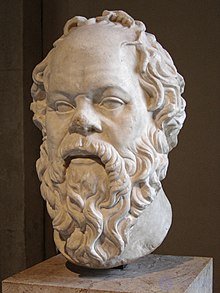
In the «Apology», Socrates is accused by Meletus of not believing in the gods at all. Yet God, Socrates observes, «is seen in his great works, but how he governs all this remains beyond our knowledge»[96]. «As for the human soul, which more than anything else in a person partakes of the divine, — Socrates holds, — it is known that it reigns within us, yet we do not see it either. Reflecting on all this, a person must not treat the invisible with contempt; on the contrary, one must come to know its actions in phenomena and honor the divine power»[97]
European atheism has its roots in pre-Socratic Greek philosophy, but it does not emerge as a distinct movement until the end of the Age of Enlightenment[88].
The Greek poet Diagoras (5th century BC) is known as the «first atheist»[98] and a fierce critic of religion and mysticism. Critias viewed religion as a human invention that used intimidation to keep people within certain moral bounds[99]. Xenophanes, criticizing the anthropomorphism of the gods of Greek popular religion, to which he opposed a certain single world deity, was the first to put forward the idea that it is people who created the gods in their own image and likeness:
«But if oxen and horses and lions had hands and could draw with their hands and create works (of art) as men do, then horses would depict gods resembling horses, and oxen gods resembling oxen…» («The Presocratics», part 1, Kazan, 1914, p. 111)[100].
Atomists such as Democritus attempted to describe the world in a purely materialistic manner, without recourse to spirituality or mysticism.
Socrates was accused of atheism for instilling in the citizens doubt in the gods honored by the city[101]. Although the philosopher disputed the charge of atheism[102], he was ultimately sentenced to death. Epicurus disputed many religious doctrines, including the afterlife and the divine essence. He believed that the soul is material and mortal. Although Epicureanism does not exclude the existence of gods, Epicurus believed that, if the gods do exist, humanity is indifferent to them[103]. Sextus Empiricus held that the punishment for skepticism, known as Pyrrhonism, should be abolished, since there is nothing terrible in it, and that ataraxia («freedom of mind» or «tranquility of the soul») could be attained by abolishing such punishment. His works, which survived in considerable number, significantly influenced later philosophers[104]. From Ancient Rome, a single complete major work of ancient atheistic philosophy has come down to us, by one of the greatest materialists and atheists of antiquity — Titus Lucretius Carus. Lucretius argued that if gods exist, they are indifferent to humanity and do not influence the surrounding world. For this reason, he believed that humanity should not fear the supernatural. His famous poem «On the Nature of Things» comprehensively expounds and substantiates the teaching of Epicurus. But the principal object of its criticism is religion, which Lucretius contrasts with science — inquiry based on firmly established facts and their reasonable, natural explanation. He sees in religion not merely an error, but above all an extremely harmful, pernicious doctrine for humanity[105]. Lucretius criticized not only religious conceptions but also Plato's doctrine of the immortality of the soul. The meaning of the word «atheist» changed over the course of classical antiquity. Early Christians were often called atheists for not believing in the pagan gods[106]. During the Roman Empire, Christians were executed for denying the Roman gods in general and the cult of the emperor in particular. When, in 381, during the reign of Theodosius, Christianity became the state religion of Rome, heresy became a punishable offense[107].
Other philosophers likely holding atheistic or agnostic views include the sophists Prodicus and Protagoras, the peripatetic Strato, and the Cyrenaics Theodorus and Euhemerus.
Adherence to atheistic views was a rare phenomenon in Europe throughout the early Middle Ages and the Middle Ages, during which interest in religion and theology predominated[108].
As Anatole France observed, in this period «the happy unanimity of the flock was undoubtedly aided also by the custom… of promptly burning anyone who thought otherwise».
Nicholas of Cusa held to a form of fideism which he called docta ignorantia («learned ignorance»), asserting that God lies beyond human understanding and that our knowledge of God is limited to conjecture. William of Ockham laid the foundation for anti-metaphysical teachings by declaring the nominalist limits of human cognition of extraordinary things. He argued that the divine essence cannot be intuitively or rationally known by the human intellect. Ockham's followers, such as John of Mirecourt and Nicholas of Autrecourt, developed these views further.
The separation of faith and reason influenced such theologians as John Wycliffe, Jan Hus, and Martin Luther[108]. After them, Catholicism lost its dominance in Europe and underwent a radical reformation, generally becoming more tolerant on matters of faith.
A number of prominent representatives of anti-religious free thought also appeared in this era in the Muslim world. These include Abu Bakr Muhammad al-Razi, Abu al-Ala al-Ma'arri, Ibn al-Rawandi, Abu Isa al-Warraq, Omar Khayyam, Ibn Rushd, and others.
The advances in navigation, trade, and industry, on the one hand, demanded the creation of an empirical science of nature, genuine knowledge about it, and, on the other hand, themselves created the foundation for the development of such a science. The development of empirical natural science became an urgent necessity for the bourgeoisie and for the progressive development of society that it led.
Leonardo da Vinci resorted to experimentation as a method of inquiry and disputed the arguments of religious authoritarianism. Other critics of religion and the church of that time include Niccolò Machiavelli, Bonaventure des Périers, and François Rabelais[104].
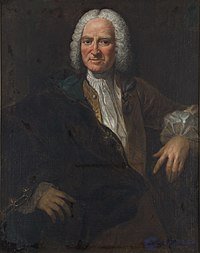
The 18th-century French author Baron d'Holbach was one of the first to consider himself an atheist[109]. In his philosophical work «The System of Nature» (1770), he describes the universe on the basis of materialism, determinism, and atheism. The works «The System of Nature» and «Common Sense» (1772) were condemned by the Parlement of Paris, and copies of the books were publicly burned
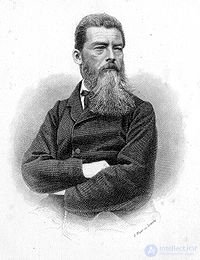
Ludwig Feuerbach, through his works «Das Wesen des Christenthums» (1841) (Russian translation «The Essence of Christianity» (1870)) and «Das Wesen der Religion» (1845) (Russian translation «The Essence of Religion» (1955)), had a strong influence on philosophers such as Engels, Marx, Strauss, and Nietzsche. Feuerbach regarded faith as a dream of reason, god as a human invention, and religious activity as the satisfaction of false needs, and held that love of god should be replaced by love of man, and faith in god by faith in oneself[110]
During the Renaissance and Reformation, religious passions intensified, evident in the spread of new religious laws, brotherhoods, and popular enthusiasms in the Catholic world, and in the emergence of increasingly ascetic Protestant religious movements such as the Calvinists. This was a time of interconfessional rivalry, which allowed the boundaries of theological and philosophical theory to expand even further, something that was later largely used to advance a skeptical (with respect to religion) worldview. During this time, biblical criticism began to develop, and ideas that the Bible represents a collection of myths and legends began to spread openly.
Criticism of Christianity intensified in the 17th and 18th centuries, especially in France and England, where, in the opinion of contemporaries, a crisis of religion was observed. Some Protestant thinkers, such as Thomas Hobbes, supported a philosophy of materialism and skepticism toward supernatural forces. By the end of the 17th century, deism began to be openly supported by intellectuals such as John Toland. In fact, virtually all French and English philosophers of the 18th century adhered to some form of deism. While mocking Christianity, many deists at the same time despised atheism as well. The first openly atheistic thinkers, such as Baron d'Holbach, appeared at the end of the 18th century, when expressing disbelief in god became less dangerous[111]. David Hume was the most systematic representative of enlightened thought, creating a skeptical epistemology grounded in empiricism and undermining the metaphysical foundations of theology.
The Great French Revolution carried atheism and anticlerical deism out of the salons and into the streets. The attempt to impose the Civil Constitution of the Clergy led to anticlerical unrest and the expulsion of many priests from France. The chaotic political events in revolutionary Paris ultimately allowed the more radical Jacobins, unleashing mass terror, to seize power in 1793. The violent dechristianization of France, which replaced religion first with the «Cult of Reason» and then with the state religious «Cult of the Supreme Being», ended with the Thermidorian Reaction, but some secularist measures of that period remained a permanent legacy of French politics.
During the period of the Directory, the Consulate, and the Empire, the secularization of French society was legally established, drawing first Northern Italy and then other territories in Europe into its orbit, where satellite states of France arose — at first republics, and later (after Napoleon's coronation in 1804) — monarchies. In the 19th century, many atheists and other anti-religious thinkers directed their efforts toward political and social revolution, contributing to the revolutions of 1848, the Risorgimento in Italy, and the growth of the international socialist movement.
In the second half of the 19th century, atheism gained prominence under the influence of rationalist philosophers and freethinkers. Many well-known German philosophers of the time, such as Ludwig Feuerbach, Arthur Schopenhauer, Karl Marx, and Friedrich Nietzsche, denied the existence of deities and were critics of religion[112].
The spread of atheism during this period was strongly influenced by Charles Darwin's book «On the Origin of Species» and the development of the ideas of the theory of evolution.
In academic biblical studies, a historical school emerged which, unlike the mythological school, regarded the events of the Bible as historical, but at the same time viewed them from the standpoint of atheism, rejecting the possibility of the reality of the supernatural manifestations (miracles, prophecies, revelations, appearances of angels) described in the Bible.
The classics of Marxism-Leninism sought to provide a scientific grounding for atheism. The theoretical foundation of Marxist atheism is dialectical and historical materialism[113].
«Marxism is materialism. As such, it is as ruthlessly hostile to religion as the materialism of the eighteenth-century Encyclopedists or the materialism of Feuerbach. This is beyond doubt. But the dialectical materialism of Marx and Engels goes further than the Encyclopedists and Feuerbach, applying materialist philosophy to the field of history, to the field of the social sciences. We must combat religion. This is the ABC of all materialism, and consequently of Marxism. But Marxism is not a materialism that has stopped at the ABC. Marxism goes further. It says: one must know how to combat religion, and for this one must explain materialistically the source of faith and religion among the masses». (V. I. Lenin, Collected Works, vol. 17, p. 418.)
The fundamental principles of Marxist atheism[114][115]:
The humanistic essence of atheism, according to Marx, consists in the following:
…the criticism of religion ends with the doctrine that man is the highest being for man[116].
Marx's widely known statement from «A Contribution to the Critique of Hegel's Philosophy of Right», that religion is the opium of the people (not «opium for the people»), is well known:
Religion is the sigh of the oppressed creature, the heart of a heartless world, just as it is the spirit of a spiritless situation. Religion is the opium of the people[117].
Some researchers believe that Marx merely recorded an expression that was popular at the time. The first to compare religion to opium was Novalis, as early as 1798[118]:
Your so-called religion acts like opium: it entices and dulls pain instead of imparting strength.
An even earlier comparison of religion and opium is found in the famous novel by J.-J. Rousseau, «Julie, or the New Heloise» (1761), where it is put into the mouth of the main heroine, Julie de Wolmar[119]:
Devotion … — is opium for the soul; in small doses it invigorates, animates, and sustains, in too strong doses it lulls to sleep or drives to frenzy, or even kills
Original text (French)La dévotion … est un opium pour l’ame; elle égaye, anime & soutient quand on en prend peu; une trop forte dose endort, ou rend furieux, ou tue

An example of revolutionary propaganda: a caricature by D. Moor, «Past Our Village», showing drunken priests and monks dancing with wenches. Russia, 1917
Atheism spread through many societies in the 20th century, especially in the form of practical atheism. Atheistic thought found acceptance within many other extensive philosophies and worldviews, such as existentialism, objectivism, secular humanism, nihilism, logical positivism, Marxism, and feminism[120].
Logical positivism and scientism paved the way for neopositivism, analytic philosophy, structuralism, and naturalism. Neopositivism and analytic philosophy abandoned classical rationalism and metaphysics in favor of strict empiricism and epistemological nominalism. Bertrand Russell, a proponent of analytic philosophy, argued in his essay «Am I An Atheist Or An Agnostic?» that the «Christian God» is no more probable than the Olympian gods[121]. Ludwig Wittgenstein, in his early work, attempted to separate metaphysics and the language of the supernatural from rational reasoning. Alfred Ayer, appealing to a commitment to the empirical sciences, declared religious statements meaningless and unverifiable. The related applied structuralism of Lévi-Strauss declared the human subconscious to be the source of religious language, denying its transcendental significance. John Findlay and John Smart argued that the existence of God is not logically necessary. Naturalists and materialist monists, such as John Dewey, regarded the natural world as the foundation of everything, denying the existence of God or immortality[56][122].
In the 20th century, atheism prevailed in the USSR. From 1919 onward, the Communist Party openly proclaimed as one of its tasks the promotion of «the withering away of religious prejudices»[123].
One of the leaders of the Dravidar Kazhagam (Dravidian Progress Party), E. V. Ramasamy Naicker (Periyar), fought against Hinduism and the Brahmins, who, in his view, discriminated against and divided people in the name of the caste system and religion[124][125]. Periyar attracted particular attention in 1956, when he placed a garland of shoes on a murti of the Hindu god Rama and made a series of antitheistic statements[126].
In 1966, in response to statements by a number of theologians about the death of god, an issue of 'TIME' magazine appeared with the question «Is God Dead?» on its cover[127]. The magazine cited statistics according to which approximately one in every two people in the world lived in anti-religious countries, and millions of people in Africa, Asia, and South America apparently did not even know of the Christian god[128].
The following year, the Albanian government led by Enver Hoxha announced the closure of all religious organizations in the country, proclaiming Albania the first atheist state[129]. Article 37 of Albania's 1976 constitution stated that «The State recognizes no religion and supports atheistic propaganda with the aim of instilling in the people a scientific materialist worldview»[130]. Under this article, criminal prosecution was carried out for the performance (even secret) of religious rites[131].
In Democratic Kampuchea, an officially atheist state[132], mass killings on religious grounds were carried out[133]. From 1975 to 1979, more than 180,000 Buddhists, Christians, and Muslims were killed in Kampuchea for professing their religion[133].
These measures reinforced negative attitudes toward atheism, especially in the United States, where anti-communist sentiments were strong, despite the fact that some well-known atheists held anti-communist views[134]. After the fall of the Berlin Wall, the number of active anti-religious regimes decreased significantly. In 2006, Timothy Shah of the Pew Research Center observed: «there is a worldwide trend across all major religious groups: trust in religious movements is increasing, and their influence relative to secular movements and ideologies is growing»[135]. Paul Gregory and Phil Zuckerman consider this a myth and argue that the real situation is far more complex and nuanced[136].

The prevalence of atheism by country (based on the results of 2006 surveys)

Richard Dawkins and Ariane Sherine against the backdrop of a bus with an advertising slogan reading «There's probably no god. Now stop worrying and enjoy your life» on the streets of London
Contemporary Western civilization is characterized by a decline in interest in religion among broad segments of the population, especially among the technical intelligentsia. In developed countries, church attendance is declining, the number of rites performed is decreasing, the number of people identifying themselves as agnostics or atheists is increasing, and even among believers religion is losing its dominant position. Characteristic in this respect is the publication by a well-known American bishop of a book titled «Why Christianity Must Change or Die: A Bishop Speaks to Believers»[139].
As a rule, in countries with high economic indicators the level of religiosity is relatively low, although there are some exceptions, the most notable of which are the United States and, among Islamic countries, Kuwait[140]. The situation in developing countries is quite different: as a rule, the poorer the country, the more important religion is for the population[141]. In Islamic countries such as Iran[142][143][144][145][146][147], Sudan[144][148], Pakistan, and Saudi Arabia[144], sharia law is in force[147], under which renouncing Islam is regarded as treason and punished by death[147][149][150].
Anti-Catholicism — hostility toward Catholics or opposition to the Catholic Church, its clergy, and/or its adherents . At various points after the Reformation, some Protestant-majority states, including England, Prussia, Scotland, and the United States, pursued anti-Catholic policies. This often resulted in religious discrimination against Catholics (who were often contemptuously called «papists» or «Romanists») in English-speaking Protestant countries.
Historian John Wolffe identifies four types of anti-Catholicism: constitutional-national, theological, popular, and socio-cultural .
Historically, Catholics living in Protestant countries were often suspected of conspiring against the state in the interests of the Pope. Allegiance to a foreign Pope led to accusations that they were disloyal to the state. In most Protestant countries that experienced large-scale immigration, such as the United States and Australia, suspicion of, or discrimination against, Catholic immigrants was often intertwined or conflated with nativism, xenophobia, and ethnocentric or racist attitudes.
During the early modern period, the Catholic Church struggled to preserve its traditional religious and political role in the face of growing secular power in Catholic countries. This struggle gave rise to hostility toward the substantial political, social, spiritual, and religious authority of the Pope and clergy, in the form of anticlericalism. The Inquisition became a favorite target of attacks. After the outbreak of the French Revolution in 1789, anticlerical forces gained strength in some predominantly Catholic countries, such as France, Spain, Mexico, and certain regions of Italy (especially Emilia-Romagna).
Political parties were formed that expressed hostility toward the substantial political, social, spiritual, and religious authority of the Catholic Church, in the form of anticlericalism
Christianophobia — various forms of negative reaction, intolerance, and discrimination toward Christians.
The term «Christianophobia» was proposed in 2004 by Joseph Weiler after the European Union rejected the candidacy of Rocco Buttiglione, a practicing conservative Catholic , for the post of EU Commissioner. Members of the European Parliament expressed disagreement with Buttiglione's statement that he considered homosexuality a sin, and that the low birth rate in Europe was caused by women thinking of nothing but their careers. The organization «Open Doors» publishes an annual report on the contemporary persecution of Christians.
In Russia, the term was raised at the international forum «Intercultural Dialogue and Its Religious Dimension», held in Kazan from November 30 to December 4, 2008, in partnership with the Ministry of Regional Development of the Russian Federation, the Council of Europe, the Interreligious Council of Russia, the Department for External Church Relations of the Russian Orthodox Church, and a number of religious organizations.
On January 24, 2008, Bishop Hilarion (Alfeyev) of Vienna and Austria raised the topic of «Christianophobia» in conversation with the President of the European Commission, J. M. Barroso, at a meeting with representatives of the Orthodox Churches.
On February 6, 2008, the issue of «Christianophobia» was raised at a meeting between Archpriest Alexander Abramov, representative of the World Russian People's Council to the UN, and Christopher Ferguson, representative of the World Council of Churches and its Commission of the Churches on International Affairs.
In April 2009, Archpriest Georgy Ryabykh, Deputy Chairman of the Department for External Church Relations of the Moscow Patriarchate, made a statement at the UN Conference against Racism in Geneva[10][11]:
It is very important for the Russian Orthodox Church to raise the issue of including Christianophobia, alongside anti-Semitism and Islamophobia, in the list of threats and problems facing the modern world.
The final document of the UN Geneva Conference expresses concern about
the rise of racial and religious intolerance, including Islamophobia, anti-Semitism, Christianophobia, and anti-Arabism.
Islamophobia — a form of xenophobia; a collective term for various forms of negative reaction to Islam, as well as to social phenomena associated with it.
Researchers G. Engelhardt and A. Krymin understand Islamophobia as «actions and statements assessed by Muslims as hostile to Islam», which includes pogroms, criticism directed at Muslims, Islamic activists, Islamic doctrine, and social practice .
In 1997, the British research center Runnymede Trust[en] published the report «Islamophobia — A Challenge for Us All» . Professor Gordon Conway[en], who headed the project, defined Islamophobia as «dread and hatred of Islam and Muslims, present in the media at every level and widespread across all sectors of society».
Islamophobia emerged at the same time as the spread of Islam began, but its scale was insignificant.
The sharp rise in Islamophobia worldwide is linked to the events of September 11 and the wars waged by the United States in Muslim countries; anti-Muslim sentiments (Islamophobia) became widespread among part of the American population. Pastor Terry Jones, who planned to publicly burn the Quran, gained particular notoriety .
Quasi-religion (Eng. quasi-religion), para-religion (Eng. para-religion), implicit (hidden) religion (Eng. implicit religion, invisible religion), secular (secularized) religion (Eng. secular religion, secularized religion) — a group of concepts (terms) used to describe the totality of new formations, phenomena, or forms of consciousness arising in society, under the influence of secularization, that possess certain characteristics of religion, but that fall outside the scope of one or another narrow definition of the term «religion». Quasi-religion has, from the very moment of its emergence, entered into confrontation with classical religion and seeks to supplant it .
Pseudo-religion, pseudo-theology — a non-mainstream system of beliefs or philosophy that is functionally similar to a religious movement, usually having a founder, a foundational text, worship services, and beliefs based on faith .
Systems of belief characterized as pseudo-religions include Scientology, Wahhabism, Salafism, and the «Nation of Islam» , as well as various New Age religions and political ideologies such as Nazism and «Positive Christianity (Eng.) Rus.» . In scholarly debates, political ideologies resembling religion are sometimes called political religions.
Members of these groups may consider themselves followers of the true religion or not associated with religion at all, but the mainstream assigns them a marginal status. Groups such as the Church of Scientology, the Raëlians, and Heaven's Gate, viewed as dangerous, exploitative, secretive, or closed, are classified as pseudo-religious cults.
Others may arise as a result of a schism within traditional religions, or as their legacy. These groups are based on apocryphal or pseudepigraphical texts not accepted within the original religion.
Marginal movements with founders, worship services, and recently invented traditions, which are regarded as legitimate social practices, include various New Age movements and millenarian movements such as the «Ghost Dance», and South Pacific cargo cults .
The German Lutheran theologian, professor of philosophy at the University of Frankfurt, Paul Tillich refined the concept of «pseudo-religion» introduced by his predecessor Joachim Wach, proposing to distinguish it from the concept of «quasi-religion»: «Sometimes what I call quasi-religions are called pseudo-religions, but this is as inaccurate as it is unjust. „Pseudo“ indicates a supposed but deceptive resemblance; „quasi“ indicates a genuine resemblance (Eng. genuine similarity) — not a supposed one, but one based on the identity of certain aspects» :5.
I. E. Zadorozhnyuk writes of the «quasi-religious», «quasi-ecclesiastical», and «quasi-cultic» features of American civil religion[en] , and therefore some researchers note that «the prefix quasi- in meaning approaches the prefix pseudo-, that is, quasi-religion is understood as a false religion. This interpretation differs substantially from the content given to it by P. Tillich and his followers» . And since, as the religious scholar K. A. Kolkunova notes, its main purpose is «to expose the conservative, chauvinistic side of this religious-political phenomenon» , it is precisely this that «leads to the use of the concepts „quasi-religion“, „super-religion“, „quasi-ecclesiastical“, none of which is defined in the work» .
V. M. Storchak, in describing messianism, including Bolshevik messianism, uses the concepts (terms) «quasi-religion» and «pseudo-religion» as synonyms: «many Russian philosophers classified it [Bolshevism] as a distinctive type of pseudo-religion (quasi-religion)»[10]. Kolkunova notes that since the author does not define the concepts (terms) he uses, «a conclusion about the author's position can be drawn from their usage», namely that the ideology of Bolshevism is a formal-symbolic substitute for traditional religion, because «one faith (Orthodox) was replaced by another (a quasi-religious Marxist one)»[11]. At the same time, his assessment of the development of quasi-religions differs from that described by Tillich, because the German theologian believed that the end of any quasi-religion would be its self-destruction , whereas Storchak asserts that «having reached its logical conclusion, atheism turned into an object of faith, into a religion»[10].
On the whole, Kolkunova notes «the use of the concepts under consideration without support from a theoretical basis or references to Western works», and «the equating of quasi-religions and pseudo-religions, and the use of other concepts, for example „super-religion“» .

Comments