
Lecture
Religious studies as a science is a system of scholarly disciplines: the psychology of religion, the sociology of religion, the phenomenology of religion, and the philosophy of religion.
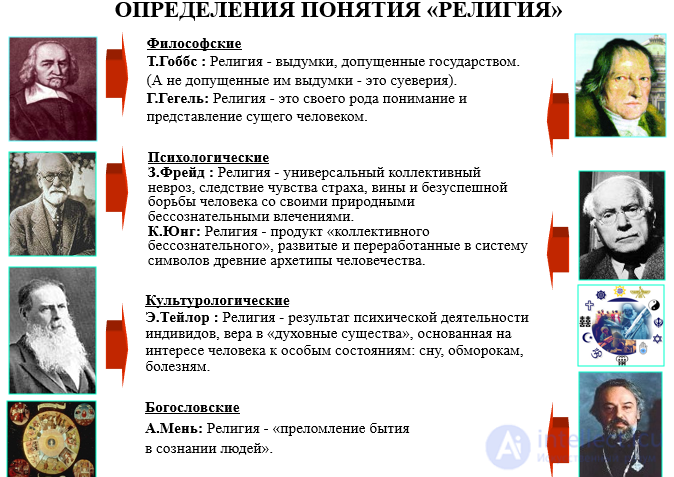
In G. W. F. Hegel's "Lectures on the Philosophy of Religion," the task of the philosophy of religion was formulated as the study of the essence of religion. Hegel defines religion as "the final and highest sphere of human consciousness, whether opinion, will, representation, knowledge, or cognition; it is the absolute result, the domain into which a person enters as into the domain of absolute truth."
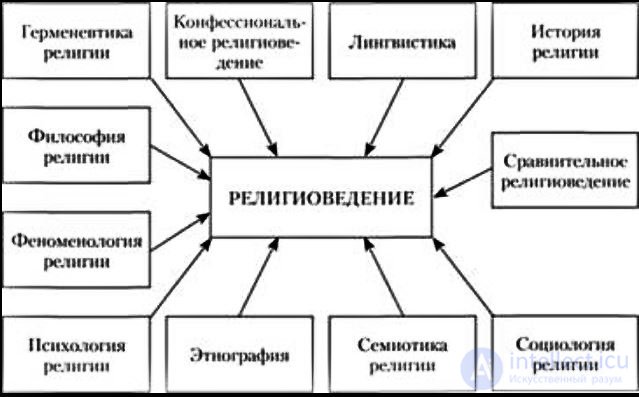
Fig. 1. Scholarly disciplines studying various aspects of religion
Friedrich Schleiermacher reveals the distinctive features of religion, proceeding from the premise that a person can comprehend religion only if he himself is a believer or is acquainted with it through experience: only under such conditions is it possible to understand the essence of religion. In his treatise "On Religion: Speeches" (1799), he calls it, alongside philosophy and morality, a fundamental sphere of being and formulates the task of precisely defining the distinctive features of religion in comparison with other spheres. His definition of the essence of religion as intuition and a feeling of universality is well known; he separates religion from other areas of culture and points to its distinctiveness.
In the works of Max Müller, the comparative method was applied for the first time to the analysis of religious phenomena. Examining the development of religion by analogy with the development of language and thought, the author rightly notes their genetic connection and, proceeding from it, builds his research on an enormous body of historical material.
In "Toward a Critique of Hegel's Philosophy of Right" (1844), Karl Marx asserts that man created religion, not religion man. The great German thinker saw the cause of man's creation of religion in the alienation of the social system. Man is not an abstract being squatting outside the world; he is the human world, the state, society. In an alienated condition, all this gives rise to religion – a distorted consciousness of the world.
Religion — a special form of awareness of the world, conditioned by belief in the supernatural, encompassing a set of moral norms and types of behavior, rites, cultic actions, and the association of people into organizations (a church, a religious community)
Religion (Lat. religare — "to bind, to connect") — a definite system of views, conditioned by belief in the supernatural, encompassing a set of moral norms and types of behavior, rites, cultic actions, and the association of people into organizations (a church, an ummah, a sangha, a religious community…).
Premorphism- a view of religion as belief in the existence of the supernatural
Other definitions of religion:
The term "religion" can also be understood in such senses as the subjective-personal (religion as individual "faith," "religiosity," etc.) and the objective-general (religion as an institutional phenomenon — "confession," "worship of God," "denomination," and so on).
The religious system of representing the world (worldview) is based on religious faith and is connected with a person's relationship to a superhuman spiritual world, a superhuman reality about which a person knows something and toward which he orients his life. Faith can be reinforced by mystical experience.
Concepts such as good and evil, morality, purpose, and the meaning of life are of particular importance for religion.
Good and evil — in philosophy, ethics, and religion, a dichotomy of normative-evaluative categories relating to social phenomena, the actions and motives of people, and denoting, in generalized form, on the one hand, that which is proper and morally positive, and on the other, that which is morally negative and condemnable.
Good — a general concept of moral consciousness, a category of ethics characterizing positive moral values. It was originally opposed to the concept of harm (that is, it denoted the result of the action of the good, as opposed to the result of the action of evil), and in later times it came to be used as the antonym of the concept of evil, denoting an intentional, disinterested, and sincere striving toward the realization of the good, a beneficial deed — for example, helping one's neighbor, or a stranger, or the animal and plant world. In the everyday sense, this term applies to everything that evokes a positive evaluation in people, or is associated with the happiness, joy, or love of particular people, that is, it becomes close to the relevant concept of "good."
Evil — the antagonist of good, a normative-evaluative category of moral consciousness opposed to the concept of "good"; in generalized form it denotes morally negative and reprehensible behavior in people's actions and motives and in phenomena of reality. It is used to characterize, understand, and evaluate harm, damage, and suffering. In a broad sense, evil includes negative states of a person and the forces that cause these states . In this sense, the term "evil" is applied to everything that receives a negative evaluation from people or is condemned by them in some respect. For example, both lying and ugliness fall under the concept of evil. In a narrower sense, evil denotes the suffering of living beings and their violations of the moral order. The question of the predominance of evil or good in the world is a subject of dispute between pessimists and optimists. Evil is the absence of good. Therefore, if a person does not do good, then he does evil. It is impossible to remain neutral in this process. Evil as such does not exist — it is emptiness, darkness, the absence of light, of grace. In order to do evil, one need not rob, rape, or kill. It is enough to remain passively honest.
In theology , ponerology (from Gr. poneros, "evil") - is the study or science of evil . The main subdivisions of this study are the nature of evil, the origin of evil, and evil in relation to Divine government.
Karl Immanuel Nitzsch divided his System der christlichen Lehre (System of Christian Doctrine) into three main headings. : Agathology , or the Doctrine (science) of good; Ponerology, or the Doctrine of evil; and Soteriology , or the Doctrine of salvation. He further divided ponerology into the themes of Sin and Death
Morality — a moral quality of a person, certain rules by which a person is guided in his choices. The term is most often used in speech and literature as a synonym for morals, sometimes for ethics. Morality is the subject of ethics as an academic discipline; it is what is studied by ethics. In a number of philosophical systems the concept of morality is set apart from morals, although such a conceptualization is author-specific and does not always correspond to everyday usage. In this narrower sense, the concept of morality is used to denote a part or level of morals as a whole, whereby morality is in some cases understood as the inner or interiorized side of morals, while the latter is regarded as external in relation to the individual
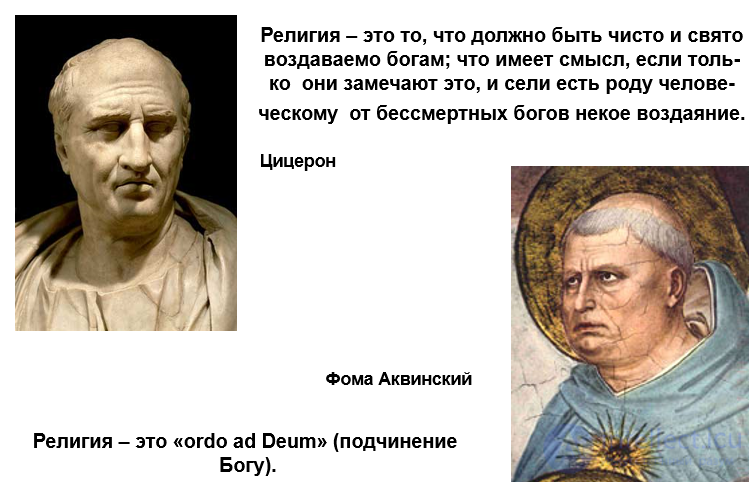
The Concept of Religion (Lat. re-ligio – restoration of connection) – is the striving of the individual and society for direct connection with the Absolute.
The Concept of the Absolute (Lat. absolutus – unconditional, unlimited) – a philosophical concept expressing the universal foundation of the world, the fullness of being and perfection, unity, eternity. The Absolute stands in opposition to all relative and unconditional existence.
The Concept of the Language of Religion – is the language of Revelation, in which the absolute deity reveals itself in images and concepts.
The Concept of Faith – the acceptance of something as true without prior factual or logical verification, solely by virtue of an inner, subjective, unshakeable conviction, which does not need proofs for its justification, although it sometimes seeks them out.
The Concept of Knowledge – the result of the cognition of reality, tested by practice and verified by logic, reflected in human consciousness in the form of representations, concepts, judgments, and theories.
The Concept of Confession (Lat. "acknowledgment, profession") – a particular religion, a specific creed, a distinct doctrine.
The Concept of Modern Religion – is a multi-confessional complex, a collection of a multitude (some scholars count up to 5,000 different religions and cults) of religious doctrines.
The Concept of Church (Gr. kyriakon – the house of the Lord) – a specific type of self-organized and self-governing religious organization uniting co-religionists and setting them apart from adherents of other faiths on the basis of a distinct doctrine and cult. In the Christian tradition: a designation for the whole totality of all religious-Christian communities in a country or in the world as a whole; a designation for a building or structure in which worship services are conducted; the building of a religious community.
The Concept of Cult (Lat. "tending, veneration") – a form of religious action representing a set of specific actions (rituals, rites, ceremonies) called forth by the corresponding doctrine and directed toward the sacred sphere. The orientation and significance of the cult can differ substantially among different types of religion, but the essence of the cultic action always remains unchanged – the possibility of direct appeal to the sacred, the belief in the possibility of being heard by "heaven."
The Concept of Virtue — a philosophical and religious term denoting a positive moral trait of the character of a particular person, determined by his will and actions; a constant active orientation of the will toward the fulfillment of the moral law (the commandments). The antonym of the words "sin" and "vice."
The Concept of Sin — an action or thought that, as a rule, is associated with departure from a righteous life, a direct or indirect violation of religious commandments (the instructions and precepts of God ); more rarely — a violation of the dominant moral-ethical rules, norms, and traditions established in society. The opposite of sin is virtue or, in another view, faith
The Concept of Vice, in ethics — a moral, spiritual deficiency, a negative moral quality of a person.
The Concept of Faith — the acceptance of something as true independent of factual or logical justification, mainly by virtue of the very nature of the subject's relation to the object of faith; conviction, deep certainty regarding someone or something.
Religious faith has as its distinguishing feature belief in the reality and substantiality of the supernatural; the object of the belief of the religious individual is objectified, the person is convinced that the object of his faith is not a thought or a concept of God but God Himself — the supernatural as really existing. A distinctive feature of the cognition realized in faith is adherence to the principles of dialogicity, according to which the subject of faith actively relates the self-revealing object of faith to himself. In this sense, religious faith differs from philosophical or scientific knowledge not in that it is not fully argued or certain of its object, but in its manner of acquiring and justifying its knowledge. In a number of religious systems, in particular in Christianity, faith occupies a central worldview position. On the whole, there is a great variety of assessments of the influence exerted by faith on the life of the individual and of society. Faith is conditioned by the particularities of the human psyche. Information, texts, phenomena, events, or one's own conceptions and inferences that are accepted unconditionally can subsequently serve as a basis for self-identification, determining some of a person's actions, judgments, norms of behavior, and relationships.
The foundations of the religious conceptions of most of the world's religions were recorded by people in sacred texts which, believers are convinced, were either dictated or inspired directly by God or gods, or were written by people who, from the standpoint of each particular religion, had attained the highest spiritual state — great teachers, especially enlightened or initiated persons, saints, and the like.
In most religious communities, a prominent place is occupied by the clergy (ministers of the religious cult).
Religion is the predominant worldview in most countries of the world; the majority of those surveyed identify themselves with one of the faiths
The problems of religion have always concerned humanity. Against the background of profound changes in our country, interest in religion has sharply increased. The study of religion helps one master one of the most important areas of world culture, achieve a conscious self-determination of one's worldview position, spiritual interests, and values, learn to conduct a worldview dialogue competently, and master the art of understanding other people whose way of thinking differs from one's own.
Religion has existed for many centuries, apparently for as long as humanity itself has existed. During this time, it has developed a multitude of varieties of religion. At present, the so-called world religions have become widespread: Buddhism, Christianity, and Islam. Besides them, national religions continue to exist (Confucianism, Judaism, Shintoism, and others). In order to understand what religion is, it is necessary to find something common, recurring, and essential in all its varieties.
Long-continuing attempts to explain what religion is have resulted in the formation of a special branch of knowledge — religious studies. Religious studies examines the process of the emergence, functioning, and development of religion, its structure and various components, the numerous manifestations of religion in the history of society and in the contemporary era, the role of religion in the life of the individual, of particular societies, and of society as a whole, and its interconnection and interaction with other areas of culture.
Religious studies is a complex branch of human knowledge. It was formed as a result of the efforts of representatives of theological, philosophical, and scientific thought.
Religion as a means of controlling people. Religion has always been, is, and will be one of the most controversial topics for discussion. Since time immemorial, religion has united peoples into a single whole, rallying them around one faith, faith in the Almighty. Empires and dynasties were built upon these beliefs, terrible wars were waged, states slaughtered one another because someone there was of the wrong faith! And all for what? Does God really need his children to kill one another? If the Almighty is one, then why is killing permitted in one religion and forbidden in another? There are more questions than answers.
Historically, the first form of religious studies is theology (from the Greek teos — God and logos — teaching) — the doctrine of God in the Catholic and Protestant tradition, and theology as the science of the glorification of God in the Orthodox tradition, since Orthodoxy rejects any possibility of the cognition of God and considers only His glorification to be possible. Theology arises from the striving to explain the basic tenets of religion, to translate the images and dogmatic formulas contained in the sacred books into the language of concepts, and to make them accessible to the mass of believers.
The philosophical analysis of religion takes shape in European culture beginning in the 17th—18th centuries, and it remains dominant right up to the middle of the 19th century. From the middle of the 19th century, the scientific approach begins to form. The difference between the philosophical and scientific approaches lies both in their subject area and in their research methods. The subject area of philosophy is the investigation of reality from the standpoint of resolving worldview problems. Philosophy therefore places emphasis on studying the worldview aspect of religion. For philosophers, the most essential thing is how religion resolves the problem of the structure of being (what is primary: the spiritual or the material principle; did God create this world, including man, or did man create God in his own consciousness). Science studies religion as one aspect of social life, in its connections and interaction with other areas of that life (how religion is formed, how particular religious systems explain the world, what values, norms, and patterns of behavior they instill in people, how particular religious organizations function, what the functions of religion in society are, and so on).
Religion is a complex, multi-level phenomenon. Therefore, the study and interpretation of the religious phenomenon is carried out by an entire range of disciplines: philosophy, sociology, psychology, phenomenology, the history of religion. Religious studies is not a science in the precise sense of the word. It is based on various approaches to interpreting the origins, nature, and purposes of religion. And this diversity does not allow religious studies to occupy a single, unambiguous worldview position, but calls for the manifestation of worldview pluralism, an equally respectful attitude toward the character of the argumentation of all its representatives.
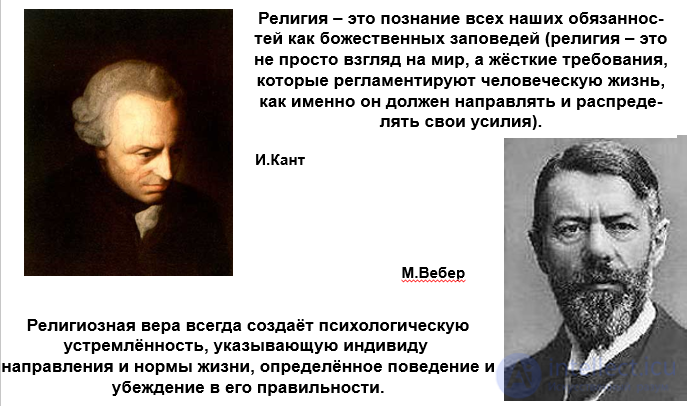
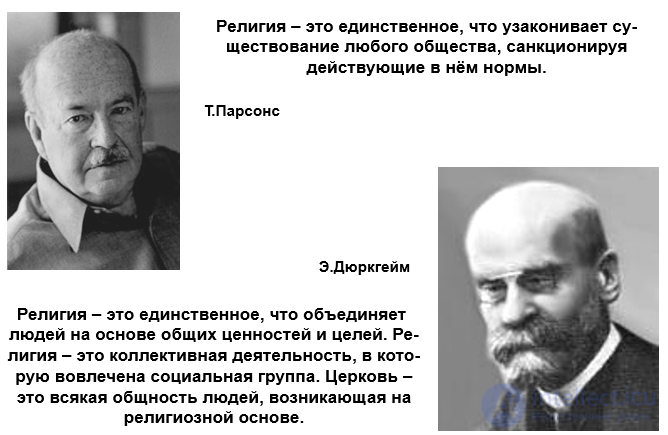
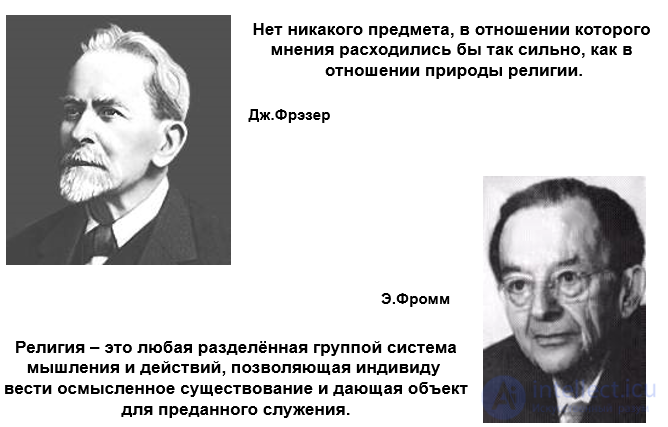

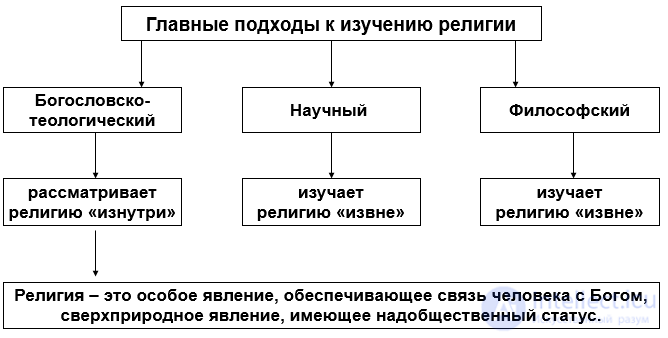
The main approaches to the study of religion
Faith, as a special emotional-psychological state of a person and his relation to certain phenomena of the surrounding world, is inherent in all people. This is a natural property of human consciousness: every person believes in something, although not all people believe in the same thing. The object of faith is that which is not an object of knowledge, that is, that which has not received the status of objective truths in a person's consciousness.
The object of religious faith, however, is the supernatural. The supernatural, believers are convinced, does not obey the laws of the surrounding world; it lies beyond them and disrupts their natural course. A religious person believes in the exceptional character of supernatural beings or forces and does not apply to them the usual criteria of empirical verification.
Religious faith is the foundation of religious consciousness. Religious consciousness is participation in certain religious ideas and values, as well as belonging to a certain religion and religious group. Scholars of religion distinguish at least two levels: everyday religious consciousness and theoretically formulated, conceptual religious consciousness.
At the everyday level, religious consciousness exists in the form of images, representations, moods, feelings, experiences, habits, and traditions. At this level, the rational, emotional, and volitional elements of religious faith are all present, but the dominant role belongs to the emotional-volitional element. The content of consciousness is clothed in vivid, imagistic forms. By the nature of its formation, it bears a largely individual-personal character. This level is therefore often called religious psychology.
Religious consciousness at the conceptual level exists in the form of a systematized and codified doctrine. The content of the doctrine is formulated in doctrinal books (the Bible, the Qur'an, etc.), affirmed by religious organizations in the form of unchanging, canonized formulas – dogmas, the acceptance of which is an indispensable condition of orthodoxy. The content of the doctrine is developed and substantiated in a special branch of religious knowledge — theology.
In developed forms of religion, the issue is not the priority of one or another level of religious consciousness, but rather their interaction and mutual influence upon one another.
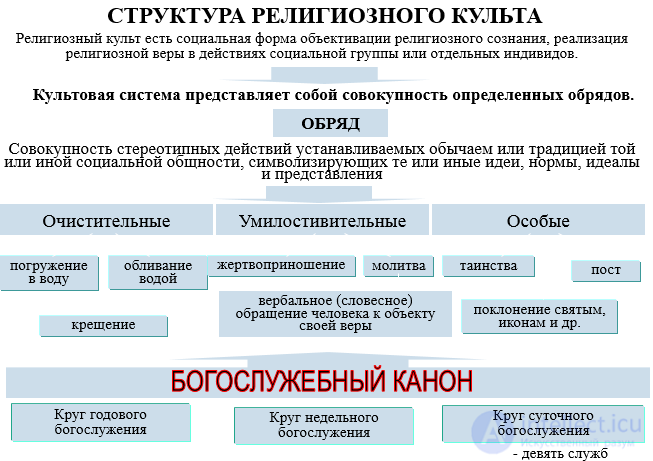
The basic element of religion, which gives it its distinctiveness and sets it apart from other forms of social consciousness and social institutions, is the cult system. The specificity of religion is manifested in the fact that religious representations, concepts, and images are incorporated into the cult system, acquire a symbolic character within it, and in that capacity function in social interaction. Religious cult is the social form of the objectification of religious consciousness, the realization of religious faith in the actions of a social group or of individuals.
The cult system represents a set of definite rites. A rite is a set of stereotyped actions established by the custom or tradition of a given social community, symbolizing certain ideas, norms, ideals, and conceptions. The most important feature of a rite is its symbolic character.
Religious cult is based on the belief that it is possible to establish certain relations between a person and the object of his faith. These relations are most vividly manifested in propitiatory actions, ranging from primitive forms of sacrifice to highly spiritual prayers. Prayer is the verbal (spoken) address of a person to the object of his faith. Ethnographers assert that prayer, as a specific religious rite, took shape on the basis of pagan spells and incantations, as an element of verbal magic (the magic of the word). As a verbal component, it originally formed part of the rite of sacrifice. Subsequently, prayer separated from sacrifice and became the most important component of the cult of many religions.
The formation of religion as a social institution represents the process of the institutionalization of religious cult systems. The primary unit of the institution of religion is the religious group. It arises on the basis of the joint performance of religious rites, in which particular religious conceptions are embodied.
In primitive society, cultic actions were interwoven into the process of material production and social life and were not set apart as an independent type of activity. The circle of participants in cultic actions coincided with the circle of participants in labor and other social actions. Therefore, the religious group coincided in scope with other social groups — the tribe, the clan, the community, and so on. Gradually, within religious groups, specialists in the performance of cultic actions emerge: sorcerers and shamans.
As cultic activity becomes monopolized, this professional stratum turns into a special social group and becomes part of the clan elite. A system of relations forms in which the leaders of communities, the elders of tribes, and other figures who carry out governing functions within them simultaneously play a leading role in the religious life of the community.
The formation of early class society leads to a substantial complexification of social life, including religious conceptions, which changes the social functions of religion. The task of regulating people's thoughts and behavior in the interests of the ruling classes comes to the fore. Relatively independent systems of cultic action begin to form — worship, and together with it the organization of the ministers of the cult — priestly corporations. A priestly corporation is not simply a professional organization of people engaged in the same type of labor, but a social stratum, a distinct estate.
As social relations become more complex, the religious superstructure is transformed and becomes more complex. In its developed form, religious organizations represent a complex social institution. The internal structure of such an institution represents the organizationally formalized interaction of various systems, the functioning of each of which is connected with the formation of social organizations that likewise have the status of social institutions. At the level of the church, the governing and governed subsystems are clearly distinguished. The governing subsystem includes a group of people engaged in the production and processing of religious information, the coordination of religious activity and relations, and control over behavior, including the development and application of sanctions. The governed subsystem includes the mass of believers. Between these subsystems there exists a system of normatively formalized, hierarchically consistent relations that make it possible to carry out the management of religious activity.
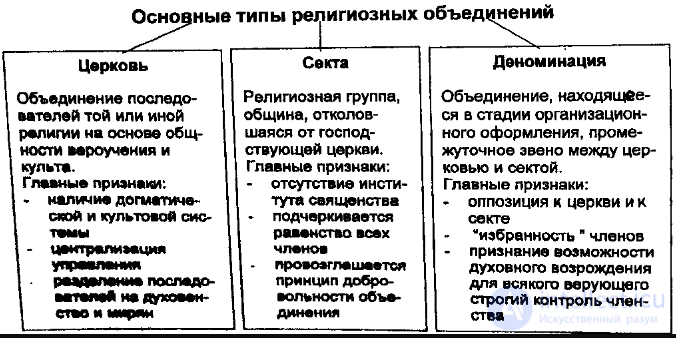
The main type of religious organization is the church. The church is a type of religious organization with a complex, strictly centralized and hierarchized system of interaction between clergy and believers, carrying out the functions of producing, preserving, and transmitting religious information, organizing and coordinating religious activity, and controlling people's behavior. The church has a large number of followers. Membership in the church is determined not by the free choice of the individual, but by tradition. By the fact of his birth into a given religious milieu, on the basis of a certain rite, the individual is automatically included in that religious community. The church lacks permanent and strictly controlled membership.
The sect is another type of religious organization. It arises as a result of the separation from the church of part of the believers and clergy on the basis of a change in doctrine and cult. The characteristic features of a sect are: a comparatively small number of followers, voluntary and constantly controlled membership, a striving to wall itself off from other religious associations and to isolate itself from worldly life, a claim to the exclusivity of its attitudes and values, a manifestation of opposition and intransigence toward dissenters, the absence of a division between clergy and laity, and the proclamation of the equality of all members of the organization.
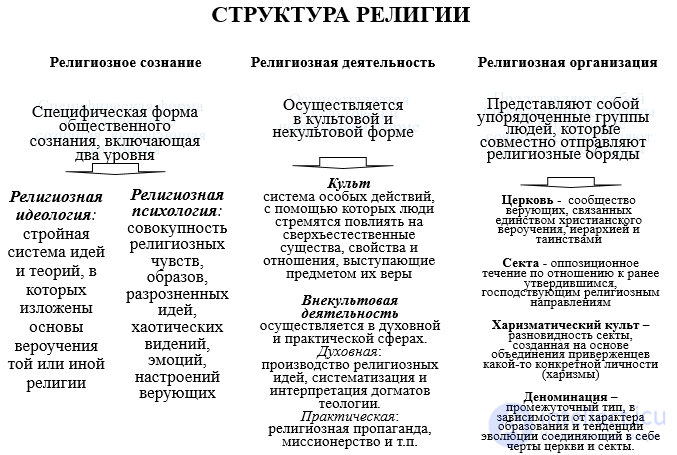
Thus, developed religions represent a fairly complex, structured formation, comprising three basic elements — religious consciousness, cultic activity, and religious organizations. Closely connected and interacting with one another, these elements form an integral religious system.
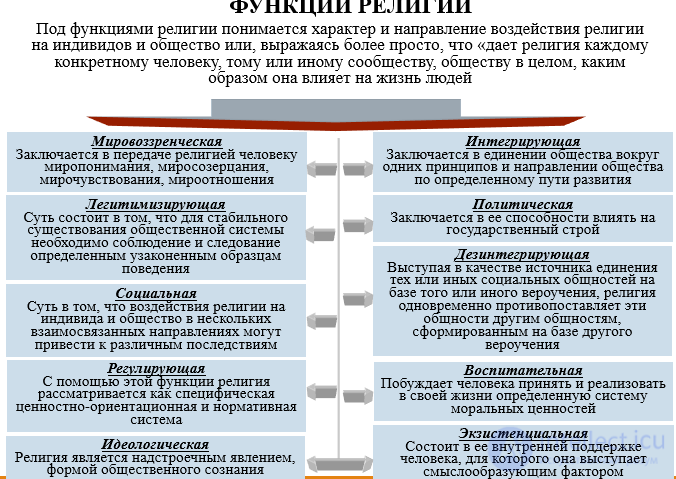
From the standpoint of sociology, religion appears as a necessary constituent part of social life. It acts as a factor in the emergence and formation of social relations. The concept of "the functions of religion" in religious studies refers to the character and direction of religion's influence on individuals and society or, to put it more simply, what religion "gives" to each particular person, to a given community, and to society as a whole, and how it influences people's lives.
One of the most important functions of religion is the worldview function, or, as it is also called, the meaning-positing function. The purpose of the activity of a religious organization is the mental transformation of the world, its organization in consciousness, as a result of which a definite picture of the world, values, ideals, and norms are worked out, and these constitute the basic components of a worldview. A worldview is a set of views, evaluations, norms, and attitudes that determine a person's relation to the world and serve as points of reference and regulators of his behavior.
Religious consciousness, unlike other worldview systems, includes in the "world—man" system an additional formation — a world of imagined beings, connections, and relations. It correlates its conceptions of being in general and of human being in particular with this world. It is this that allows a person to resolve the contradictions of the real world at the worldview level.
However, the function of the religious worldview consists not only in painting a person a definite picture of the world, but above all in enabling him, thanks to this picture, to find the meaning of his life. It is precisely for this reason that the worldview function of religion is also called the meaning-positing function. Religion is what makes human life meaningful, filling it with the most important components of significance.
The second function of religion is the function of integrator and stabilizer of society. Religion helps people to recognize themselves as a moral community, bound together by common values and common goals. Religion gives a person the opportunity to determine his place within the social system and thereby to unite with people who are akin in customs, views, values, and beliefs. It is precisely through the cult that religion constitutes society as a whole: it prepares the individual for social life, trains obedience, strengthens social unity, sustains traditions, and arouses a feeling of satisfaction.
Third, it is necessary to name the regulative function of religion. From this point of view, religion is regarded as a specific value-orientational and normative system. Each religious system develops a definite system of values, the realization of which is carried out by the individual in the process of his activity and relations. The regulative function proper is performed by the value attitude. The value attitude is a kind of program that precedes people's activity and communication, connected with the possibility of choosing among their variants. It represents a socially — determined predisposition of a person toward a predetermined attitude toward a given object, person, event, and so on. The value attitudes of believers are formed within the religious organization in the process of communication among people and are transmitted from generation to generation.
Each religion develops its own system of values, in accordance with the particularities of its doctrine.
The subject of religious studies is the regularities governing the emergence, development, and functioning of religion as one of the forms of worldview, its diffusion, its influence on the political, economic, and cultural life of the Earth's population, as well as the changes in religious traditions and the current state of religious doctrines and church organizations, and their relations with society and the state
The following components are distinguished in the structure of religion:
The Confessional Approach - (from Lat. — ecclesiastical, confessional), that is, religious. Scholars who adhere to this approach belong to specific confessions (churches, religions); in connection with this, in constructing a picture of the development of religion and comparing and juxtaposing different religious doctrines, their ultimate goal is to affirm the truth of their own religion, to prove its superiority over others. It sometimes happens that, in examining the history of religions as a historical process, they do not include information about "their own" religion in the general survey at all, considering that it should be examined separately, outside the general course of history, according to a special methodology. This approach can also be called apologetic (from Gr. — defensive).
The Atheistic Approach - Regards people's belief in God as a mistake, a temporary, transient phenomenon, yet one that occupies a definite place in history. For this approach, what is more important is not so much religion itself as the history of its eradication from human consciousness. As a rule, researchers who take an atheistic position pay great attention to the social, economic, and political side of religious life, while the subtleties of doctrine interest them to a much lesser degree, and sometimes even distract and irritate them as something insignificant or even ridiculous.
The Phenomenological Approach - (from Gr. - phenomenon, givenness) An approach from whose standpoint religion is described and studied without reference to the problem of the existence or non-existence of God. If religion exists as a phenomenon, then it can and must be studied. Historians of culture, archaeologists, ethnographers, and art historians — that is, all researchers whose spheres of interest naturally came into contact with religious life both in antiquity and at present — played a large role in the phenomenological study of religions. They may be interested in the historical role of the church, which they consider, at certain stages, to have been reactionary, hindering human progress, or else positive and progressive , or else neutral toward it.
Forms of religious beliefs are the earliest manifestations of people's faith in someone or something.
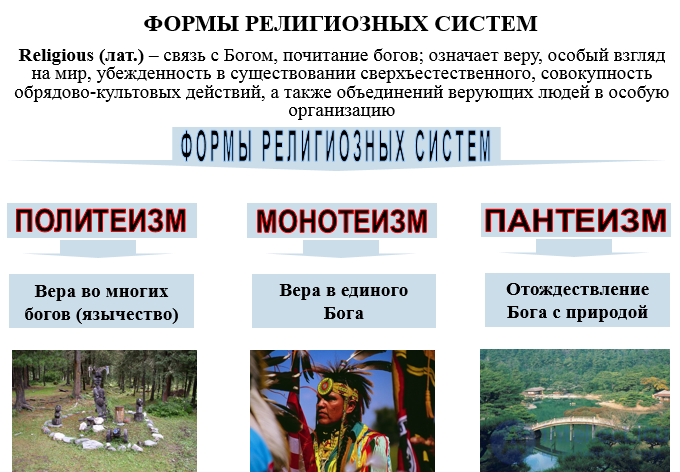
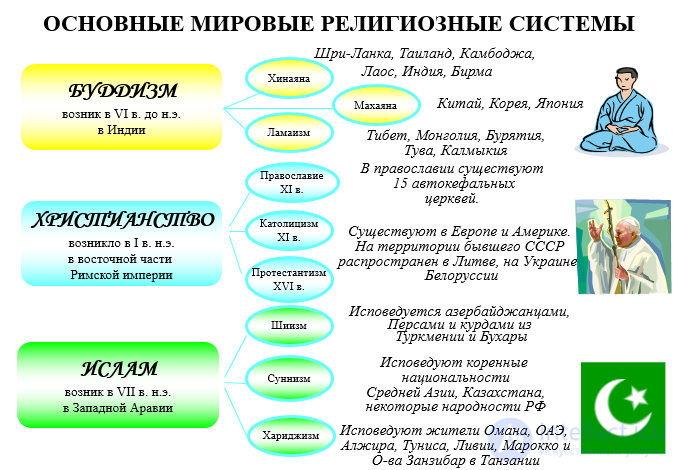

The map of the world is color-coded to indicate the predominant religion in each country
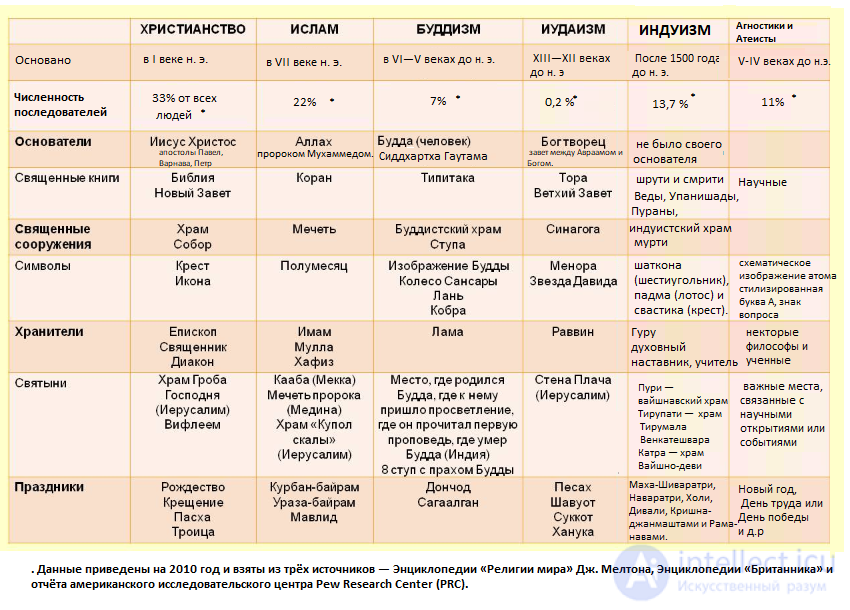
a comparative table of all the main world religions
The identification of the basic models or structures of religion requires the use of various disciplines. Disciplines such as sociology and psychology are applied to carry out comparative research – when only the doctrines of different religions currently in existence are studied. However, they must be supplemented with data from history, philology, archaeology, and other sciences whose specificity is the study of the past. Philosophy strives to analyze the essence of religion, its most general characteristics and concepts, although in this area it is difficult to draw distinctions between the philosophy of religion, religious philosophy, and theology.
1. Historical and Philological Research. The colonial expansion of European countries at the beginning of the 19th century, together with the development of scientific methods in history and philology, made it possible to move to a new stage of humanistic knowledge. The discovery and publication of the sacred texts of various cultures, above all the Egyptian and Indian, had a profound influence on European science and philosophy. A landmark event in the history of religious studies was the publication of the series "The Sacred Books of the East," undertaken by the German-English philologist and anthropologist Max Müller (1823 – 1900), who is rightly considered the founder of scientific religious studies. The comparative analysis of mythology also played a large role in the study of religious traditions. The texts of the Vedas were published, a careful study of which shook the widespread opinion that the origin of polytheism was connected with nature cults. At the end of the 19th century, the study of classical Chinese texts added to knowledge of Eastern religions. The study of the culture of the Middle East at the turn of the 19th – 20th centuries was marked by the discovery of "The Epic of Gilgamesh," the principal source of information about the religious life of Mesopotamia; in Egypt, archaeological data contributed to the study of "The Book of the Dead." Historical and textual research made it possible to trace the evolution of Judaism, the process of the emergence of Islam. In Europe itself, the gathering of information about pre-Christian religions was carried out on the basis of the study of Greek, Roman, Germanic, Scandinavian, and Celtic texts. The text of the Bible and the writings of the Church Fathers were subjected to detailed analysis.
2. Archaeological Research. Archaeological research in Asia Minor, Egypt, Crete, and the territory of Mesopotamia contributed greatly to the formation of knowledge about Greco-Roman and Near Eastern cultures. The discovery of the civilization of the Indus Valley, which existed in the 4th millennium BCE, made it possible to determine the primary layer of the Indian religious tradition. Archaeology also played an important role in the study of prehistoric beliefs. The discovery of prehistoric monuments, including cave paintings in the territory of Southwestern Europe and elsewhere, became the basis for the study of the evolution of religion, beginning with the earliest times of humanity's existence.
3. Anthropological Research. Anthropology is the science of the origin and evolution of man. Anthropology deals with the question of the origin of religion, as a rule on the material of nonliterate and primitive cultures, although more complex societies in terms of their organization have also been studied today. The theory of the origin of religion was influenced by the theory of evolution of Charles Darwin (1809 – 1882). The principal contribution to the establishment of the evolutionary approach to religion was made by the English ethnographer Edward Burnett Tylor (1832 – 1917), who in his work "Primitive Culture" advanced a justification for the so-called animistic theory of religion. Animism, belief in the existence of the soul, is, according to Tylor, not only the original elementary form of religion but also the basis of all religion as a whole. From animism develop ancestor worship, fetishism, totemism, polytheism, and finally monotheism. A prominent place in the development of the theory of religion belongs to the British folklorist James George Frazer (1854 – 1941). In his work "The Golden Bough," he gathered and subjected to comparative analysis material from various historical epochs. In his scheme, magic precedes religion as belief in supernatural beings. With the development of scientific knowledge, religion gives way to science. Magic, religion, science – such is the sequence of historical forms of thought, of means for explaining the world and mastering it.
Other theories developed in parallel with these. The English anthropologist Robert Ranulph Marett brought to the fore the concept of animatism as the basis of religion. Drawing on the study of the beliefs of the peoples of Melanesia, Africa, and America, he spoke of the presence among them of a supernatural force, universal and impersonal, yet capable of concentrating itself in certain people and natural objects. This force received the name "mana" (in accordance with the tradition of the Melanesian peoples). Marett advances the idea of preanimism, the existence of a certain primary stage of religion preceding animism. The problem of the origin of religion was in time superseded by structural-functional studies. These examined social models and institutions in connection with their function in the general cultural context (Claude Lévi-Strauss).
4. Sociological Studies of Religion. Auguste Comte (1798 – 1857), the founder of modern sociology, presented in his work "Course of Positive Philosophy" a scheme of three stages of human history, which are simultaneously stages of human thought: the theological, which uses for the explanation of phenomena not rationally grounded proofs but references to supernatural beings; the metaphysical, philosophical; this is the period of the dominance of abstract constructions; the positivist, connected with science, with the search for objective laws of nature and human society, with the use of scientific and practical methods in cognition. Each of these stages has a corresponding social organization. Comte assigns to religion an integrative function that sustains social ties. Historical progress inevitably leads to the decline of religion, and therefore the question arises of a structure that could perform its functions in society. Initially Comte considers science, headed by sociology, to be such a structure; subsequently he turns to the idea of "positive religion," the cult of Man as a single "Great Being."
Another direction in the sociology of religion is represented by the Marxist theory, developed by K. Marx (1818 – 1883) and F. Engels (1820 – 1895) and their followers V. I. Lenin (1870 – 1924) and K. Kautsky (1854 – 1938). It relies on a sociological interpretation of religion in light of the concept of class struggle – religion is an attribute of class society, it arises under conditions in which the greater part of society is subordinated to the lesser part, and it becomes an instrument of exploitation. Religion is a form of alienation from this world. Religion performs the following functions: the ideological (justification or condemnation of the existing social order), the integrative (with certain exceptions), the compensatory (the promise of a better lot in the afterlife, an apologia for meekness).
In the conception of Émile Durkheim (1858 – 1917), religion is regarded as the foundation of the unity of society. The source of religion is society itself, irrespective of its class structure; religion arises in response to certain requirements connected with the conditions of society's existence. Durkheim considers the main thing in religion to be the division of the sacred and the profane (worldly, everyday) spheres. Durkheim sees the elementary form, a kind of universal characteristic of religion, in totemism. Durkheim understood the totem as a symbol of the sacred and concluded that the sacred itself is venerated as the personification of the social community. He brings the integrative function of religion to the fore. Durkheim predicts the emergence of a new religion in society, a "religion of humanity," which will come to venerate Man. Among the shortcomings of Durkheim's theory are the identification of religion with ideology and the absolutization of the integrative function of religion.
One of the most significant theorists in the field of the sociology of culture is Max Weber (1864 – 1920), who devoted his main attention to the role of religion in the economic and political sphere. In his work "The Protestant Ethic and the Spirit of Capitalism," he examines the connection between the doctrine of Protestantism and the process of the formation of the capitalist economic system. The Calvinist doctrine of predestination, according to which only those initially chosen by God will be saved, together with the conception of the work ethic and discipline that developed within its framework, became, in Weber's view, one of the decisive factors in the development of modern Western civilization. Weber studied Islam, Judaism, and the Indian and Chinese religions, laying the foundations of the comparative sociology of religion; classified types of prophecy; and introduced such concepts as charisma (spiritual authority based on extraordinary personal abilities) and disenchantment (the exclusion from the sphere of human activity of everything connected with magic, and the establishment of a rationalistic mode of action aimed at mastering nature).
5. The Analysis of Religion in Psychology. The psychological approach to the study of religion complements the sociological approach, determining the role and place of religion in a person's inner world. Within the psychology of religion, data are collected and classified, and theories explaining them are constructed and tested. The subject of the psychology of religion is individual religious experience and its effect on people's behavior. The development of the psychology of religion is associated with the name of the American philosopher and psychologist William James (1842 – 1910). In his work "The Varieties of Religious Experience," the emotional and individual nature of religion is affirmed. Religious experience appears as primary and fundamental, whereas the social manifestations of religion are secondary. James advances the concept of the "religious genius" – a personality to whom direct religious experience of apprehending the divine is given. Ordinary people are capable only of perceiving religious feelings from others. Analysis of psychological material allowed James to assert that the nature of religious feeling is unique, that it is distinct from other spheres of perception. Among the attributes of religious feeling are its non-confessional character (it is the same among believers of all confessions), its orientation toward a religious object, and its irrationality. A person's contact with the world beyond radically enriches human experience, expanding the sphere of what is perceived and apprehended. Religion is a necessary condition for practical action, the result of free choice, a person's support in the struggle against the domination of technology and the cult of science.
Within the psychological approach, psychoanalysis became a significant direction. A number of works by Sigmund Freud (1856 – 1939) examine the connection between the subjective drives of the personality and the emergence of religion. One of the key ideas in the understanding of religion becomes the idea of the Oedipus complex (the son's sexual attraction to the mother and the related hostile attitude toward the father). According to Freud, the son's rebellion against the father and the latter's murder gave rise to a feeling of guilt and remorse, and the transference of filial feelings onto the totem, which in the process of evolution turned into God, was intended to ease the psychological conflict that had arisen. The Jewish and Christian God, in psychological terms, is an idealization of the image of the father. This theory of Freud's was subjected to criticism as historically unfounded and inapplicable to non-European religions. On the whole, Freud connects the emergence of religion with the suppression of natural sexual instincts by social norms.
Another modification of the psychoanalytic theory of religion is associated with the works of Carl Gustav Jung (1875 – 1961). In addition to the Freudian individual unconscious, Jung uses the concept of the collective unconscious, representing a storehouse of human experience, of archetypes – foundational ideas and images found in all cultures. He regards the penetration of these images from the unconscious into the sphere of consciousness as the basis of religious experience.
6. The Philosophy of Religion. The formation of the philosophy of religion as a separate branch of philosophical science dates to the middle of the 19th century. In the philosophical analysis of religion, three main tendencies can be traced: 1) analysis of the essence of religion within the framework of a general picture of the world; 2) the conducting of criticism or apologia of particular religious positions in their connection with philosophy; 3) the study of the language of religion.
The conception of religion of the German philosopher Friedrich Schleiermacher (1768 – 1834) is subjective-idealistic in character; religion is derived from the inner experiences of the subject. Being an opponent of Kant's moral theology, Schleiermacher came out against rationalism because, in his conviction, the Deity is unknowable. God, as the identity of thought and being, of the ideal and the real, appears as an unattainable goal toward which all scientific cognition strives. Since God cannot be known, the philosophy of religion is not a doctrine of God but a doctrine of religious feeling, which is understood as "the feeling of absolute dependence." Schleiermacher drew attention to the inner aspects of religion, which had long been ignored by the preceding philosophical tradition.
Georg Wilhelm Friedrich Hegel (1770 – 1831), in his conception of the development of the absolute spirit, also devotes attention to the role of religion in human life. Religion arises as a connection between man and the absolute (the highest spiritual principle); it occupies a subordinate position in relation to philosophy, in which religious truth is contained in a more developed, abstract form.
The development of such philosophical directions as empiricism in England (George Moore and Bertrand Russell) and pragmatism in the USA (W. James), marked a new stage in the philosophy of religion. Within the empirical tradition, an analysis is conducted of the language of religion, pursuing descriptive rather than evaluative aims.
A significant influence on the philosophy of religion was exerted by existentialism, whose leading representatives are the German philosopher Martin Heidegger (1889 – 1976) and the French philosopher and writer Jean-Paul Sartre (1905 – 1980); and by phenomenology, whose founder is the German philosopher Edmund Husserl (1859 – 1938).
7. The History and Phenomenology of Religion. The history and phenomenology of religion are traditionally regarded as non-normative disciplines, that is, they carry out the analysis and description of facts without rendering any evaluation from the standpoint of a particular confession. In 1900, the first congress of specialists in the history of religion took place. Later, the International Association for the History of Religions was created, which employed predominantly non-normative and non-theological approaches in its activity; numerous encyclopedias on this subject were compiled.
The tasks of the phenomenology of religion – the construction of classification schemes for religious phenomena; the description of the religious person's interpretation of his own religious feelings. The main objects of phenomenological research are: sacred objects, space and time, word and text, sacred rites, and conceptions and experiences connected with the sacred.
A landmark in the development of the phenomenology of religion was the work of the German Protestant theologian and scholar of religion Rudolf Otto (1869 – 1937) "The Idea of the Holy," in which he elaborated the concept of "the holy" and analyzed its perception by a person. Religion, according to Otto, is a person's encounter with "the holy." "The holy" is interpreted as a spiritual, otherworldly principle, an object of religious worship, which is in principle unknowable by means of reason and evokes in the believer, through its mysteriousness, both terror and awe at once.
Gerardus van der Leeuw (1890 – 1950), a Dutch scholar of religion, presented a large-scale typological description of religious phenomena, including types of sacrifice, categories of saints, and forms of religious experience. He maintained that phenomenology does not take into account the historical development of religion, since it deals with the timeless essences of religious phenomena.
One of the leading representatives of the phenomenological direction is the Romanian-American scholar Mircea Eliade (1907 – 1986). He synthesized data from a wide spectrum of religions and created a theory of mythology and the historical development of religion. His conception includes two main points: the division of the sacred and the profane; the rejection by archaic religions of a linear, historical view of the world. Eliade presented a description of the functions and properties of religious space and time.
1. Name the religious organizations existing in your city (district) and give a brief description of them. Choose several examples from the history of Russia that would allow you to assess the role of religion and the church in the life of society.

Comments