
Lecture
Protestantism, or Protestantism (from Lat. protestatio — «protest, solemn declaration, proclamation, assurance»), — one of the three, along with Orthodoxy and Catholicism, major branches of Christianity, representing a collection of independent churches, church unions, and denominations.
The term «Protestantism» designates Christian churches whose emergence is connected with the process of the Reformation. From the beginning of the 16th century to the present day, approximately two thousand varieties of Protestant churches have arisen, adapted to the conditions of specific countries and regions.
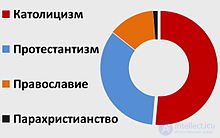
The main reason for the emergence of Protestantism was the development of bourgeois relations in Western Europe. Catholicism, which stood in defense of feudal hierarchical structures, was regarded as an obstacle to the formation of new social relations, as a result of which the Reformation was directed primarily against the Roman Catholic Church.
Protestantism also arose as the result of the formation of specific currents in socio-religious thought that began to take shape within Catholicism. Many thinkers of that time spoke out against the political dominance of the papacy in the life of European countries, as well as demanding reform of the Catholic Church itself.
The term «Protestantism» derives from the Speyer protest of the German princes in defense of Luther. The Edict of Worms of 1521, under pressure from the papal nuncio, declared Martin Luther a criminal heretic. In response, the First Diet of Speyer of 1526, at the demand of the Lutheran princes, resolved to suspend the effect of the Edict of Worms until the next diet. However, the Diet of Speyer of 1529 decided to reinstate the Edict of Worms. In response, the five princes and representatives of fourteen free cities of the Holy Roman Empire present at the diet drew up and proclaimed the «Speyer Protestation.» It was from the name of this document that the supporters of the Reformation came to be called Protestants. And the totality of non-Catholic confessions that arose as a result of the Reformation received the name «Protestantism» .
Two Catholic reformers - the Englishman John Wycliffe (1329-1384) and the Czech Jan Hus (1365-1415) set themselves the task not only of carrying out reform within Catholicism, but also of creating independent churches, free from Rome, close in spirit to early Christianity.
John Wycliffe was a professor of theology at Oxford University. In his works «On Civil Dominion» and «On the Power of the Pope,» he spoke out against the secular power of the popes, against the institution of monasticism, the cult of saints, and the remission of sins. Along with this he demanded that believers be given the right to read and interpret the Bible themselves. The Vatican condemned Wycliffe's views three times and even issued a verdict to burn his writings.
Jan Hus - rector of the University of Prague - was well acquainted with Wycliffe's reformist views. In his lectures and sermons he spoke out against the secular power of the popes and the sale of indulgences, and expressed doubts about the truth of the dogmas concerning the holy sacraments. Hus was first excommunicated from the church, and was then burned alive at the stake.
In the 16th century, the desire of rulers to bring church administration under their own control intensified. In the cities, municipalities began to influence church institutions. This was also aided by the profound changes that the Renaissance produced in the spiritual climate of Europe. Humanists called for the restoration of the simplicity and purity of the teaching of Jesus Christ, and regarded the veneration of relics and pilgrimage as a vulgarization of Christianity.
The trade in indulgences, based on the Catholic teaching on the Pope of Rome's right to grant remission of sins, provided the occasion for the German theologian Martin Luther (1483-1546) to speak out. On October 31, 1517, he nailed to the cathedral doors 95 theses on repentance and the remission of sins, in which he denounced the trade in «heavenly treasures» as contrary to the teaching of Holy Scripture. In the 32nd thesis Luther wrote: «Whoever believes that indulgences guarantee his salvation will be eternally condemned along with his teachers.» Luther subsequently rejected papal authority, the special grace of the priesthood and its mediation in salvation, and put forward the demand to simplify ritual and to subordinate the church to secular rulers.
All this answered the interests of the burghers and part of the nobility, who, under Luther's leadership, formed the moderate wing of the German Reformation. The reform movement in Germany also drew in the peasant-plebeian strata, led by Thomas Muntzer (1490-1525). Muntzer's teaching on the «Kingdom of God on Earth» was a dream of a society without private property. The centers of the Reformation in Switzerland became the cities of Zurich and Geneva, where Ulrich Zwingli (1484-1531) and Jean Calvin (1509-1564) carried out a radical transformation of church structure. Certain rulers were also interested in reform, being displeased at the concentration of landed estates and wealth in the hands of the church, the payment of large sums of money to the popes of Rome, and their interference in politics. A group of German princes carried out evangelical reforms within their domains. In 1529 they lodged a «protest» against the Diet of Speyer's abolition of the right, obtained by them in 1526, to decide the religious affiliation of their subjects. It is with this event that the origin of the term «Protestantism» is connected, a term that came to be used to designate the totality of Christian confessions connected with the Reformation.
Thus, as a result of the Reformation, a group of Protestant churches separated from Catholicism: the Lutheran (in Germany), the Calvinist (in Switzerland), and the Anglican (in England). These churches, along with the churches of the Anabaptists, Mennonites, and Unitarians, are called the original forms of Protestantism. At a later time these varieties of Protestantism spread beyond the countries in which they had arisen. New Protestant movements formed on their basis: Baptism, Adventism, Jehovism, Methodism, Pentecostalism, and others («late Protestantism»).
Protestant doctrine, worship, and organizational structure were formed on the basis of the demand to remove those elements that Catholicism had introduced into dogma and worship for opportunistic reasons and which, for this reason, contradicted early Christian ideals. Protestants insisted on the personal relationship between man and God. They fought for the right of every Christian to read the Bible freely. In Protestantism the Bible is declared the sole source of doctrine, while Sacred Tradition is either rejected or used only insofar as it is recognized as corresponding to Holy Scripture. Special significance was therefore attached to the translation of the Bible into national languages. In those countries where Protestantism displaced Catholicism, churches were deprived of their landholdings and subordinated to secular authorities. Since Protestants rejected the teaching of the church as mediator between God and man, they refused to recognize the primacy of the Pope of Rome and adopted the principle of the universal priesthood. The elective office of pastors and presbyters was introduced, and these no longer possessed the right to remit people's sins in God's name.
Protestants rejected the teaching on purgatory - a part of the world of the departed in which, according to Catholic doctrine, the soul of the deceased undergoes purification from sins before passing into paradise. The Catholic notion of a «treasury of good works,» left behind by the saints, which the church in the person of the pope disposes of at its own discretion and can even bestow on those who have no merits of their own, was likewise discarded.
At the foundation of Protestant teaching lies the notion of attaining heavenly salvation through personal faith, rather than through submission to the authority of the church. Faith is not something that a person may or may not possess; it is inherent in human nature itself. There exists an inner bond between man and the Almighty, and therefore, for a person to be confirmed in faith and to be saved, there is no need to perform the regulated church ceremonies and saving works that it prescribes.
According to Protestant doctrine, on account of the corruption of his nature resulting from original sin, man himself is incapable of doing good, and so it is the Holy Spirit who works all that is good and moral within him. In other words, man can do good only through divine grace, which he receives as a gift, without having any merits of his own. All the other means of attaining salvation highly esteemed by Catholicism - observance of rites, material donations to the church, strict fasting, and the like - are considered secondary.
Protestant worship, compared with the cults of other Christian churches, is simplified, corresponding to the demands of the first ideologues of market relations for a «cheap church.» As a rule, Protestants reject the veneration of the cross and icons, of the Mother of God, and of relics, and oppose the institution of monasticism. Preaching, the singing of spiritual hymns, and collective and individual prayer play a great role in their worship. Of the seven Christian sacraments, the Protestant churches, with the exception of the Anglican, have retained two or three, sometimes four, which are interpreted as simple rites during which nothing miraculous occurs. The renewal of the external forms of religiosity in Protestantism is compensated for by the ideal of inner piety.
According to one of the basic ideas of Protestantism, the church must be continually reformed. But in practice each movement strives to consolidate its own traditions. Doctrinal documents - confessions of faith («confessions») - serve as such a stabilizing instrument. For this reason, independent branches of Christianity that share a common doctrine are called confessions.
The churches subsequently called «Lutheran,» or «Evangelical,» took shape in the northern German principalities and the Scandinavian countries. Their emergence is connected with the name of the Augustinian monk and professor of biblical studies at the University of Wittenberg, Martin Luther.
The basic principles of Lutheran doctrine are set out in the «Augsburg Confession,» composed by M. Luther and his associate P. Melanchthon. This document consists of two parts. The first - «Faith and Doctrine» - contains 21 articles, which set out the basic tenets of the doctrine (God, the Trinity, the God-man, the sacraments, good works, free will, and others). The second part - «Abuses» - consists of 7 articles and is devoted to criticism of Catholicism on questions of church organization and practice, celibacy, and payment for the remission of sins. It was here that the basic principles of Protestantism found their embodiment: the attainment of salvation not through the mediation of the church, not through the prayers of monks, not through the merits of saints, and not even through good works in favor of the church, but through personal faith; the source of doctrine is Scripture alone; the abolition of monasticism and the veneration of saints and their relics, etc.
On questions concerning the sacraments, Lutheranism still makes a number of concessions to Catholicism. Here, in particular, the institution of bishops was preserved. Having retained only two of the seven Christian sacraments - baptism (of infants) and communion - Lutheranism did not develop a unified position regarding confession. Marriage, ordination to holy orders, the anointing of the sick, and confirmation are regarded as simple rites, since through them no grace is conveyed but only faith is strengthened. Lutheran churches have no icons, but the crucifix, clerical vestments, and the altar have been retained.
At present there are approximately 75 million adherents of Lutheranism in the world. This confession is most influential in Germany, the Scandinavian countries, the USA, Austria, Hungary, France, Estonia, and Latvia. About 50 million believers are united in the Lutheran World Federation. In Russia, Lutheranism appeared at the beginning of the 18th century; it is professed mainly by ethnic Germans, Finns, and representatives of certain other peoples.
Calvinism, or Reformed Christianity, arose in the 16th century. Its teaching was developed by the theologian and preacher Jean Calvin, who put it into practice in the city-state of Geneva. Calvinism absorbed the basic Lutheran principles of doctrine, giving them far greater rigor. Calvin, more resolutely than Luther, rejected Christian «tradition» and the institution of the papacy.
Of all the Christian sacraments, Calvinism retained only baptism and communion, which are regarded as symbolic rites. Unlike Lutheranism, Calvinism denies the notion of the «presence» of the body and blood of Christ during communion. Calvinism radically simplified worship, rejecting priestly vestments, the altar, candles, icons, and the cross.
Great significance in Calvinism is attached to the doctrine of predestination, according to which God chose some people for eternal bliss and others for perdition. A person is saved because he is chosen for salvation and receives the gift of faith, being born «from above.» The saving grace of election makes the individual an instrument for the fulfillment of God's designs. From this teaching flow the principles, characteristic of Calvinism, of «worldly calling» and «worldly asceticism.» Calvin taught that man, at any time and in any place, is in the service of the living God and bears the strictest responsibility for the gifts granted to him by God - time, health, property. Life must be understood not as enjoyment, but as the fulfillment of duty and movement toward the goal set by God. In Calvinism the sign of justification becomes energy and the results of one's efforts, capable of testifying to the action, within the believer, of the God who chose him. The Calvinist must believe that success in enterprise can be regarded as evidence of possible election.
Calvinist doctrine was adopted by the Protestants of France (the Huguenots), the Netherlands, certain regions of Germany, Hungary, and Bohemia.
Calvinist ideas played a significant role among the Protestants of England, who demanded a radical reformation, a «purification» (hence «Puritans») of the English church; they won a dominant position in Scotland. Present-day Calvinism, in its various currents - Reformed Christianity, Presbyterianism, Congregationalism - has lost its extreme radicalism and has in many respects drawn closer to Lutheran teaching. At the end of the 19th century, the drive toward unification led to the formation of the World Alliance of Reformed Churches, adhering to the Presbyterian structure, which numbers about 40 million people.
Anglicanism - the third main branch of early Protestantism. In England, royal power, stronger than on the European continent, sought to limit Rome's interference in its affairs. In the mid-14th century, the English ecclesiastical court was forbidden to appeal to a foreign, i.e. papal, court. With the start of the Reformation in Germany, news of Luther's activity and Protestant writings quickly reached England and found fertile ground there. By an act of Parliament in 1534, King Henry VIII was declared head of the church. From this time monasteries began to be closed, the secularization of church lands was carried out, and the cult of saints and relics ceased. A revised translation of the Bible into English, approved by the Archbishop of Canterbury, was published (the «Great Bible»). In 1571 the Articles of Faith, consisting of 39 points, were confirmed. This gave Anglicanism the character of a «middle way» between Catholicism and Lutheranism. This document recognizes Holy Scripture as the principal source of Revelation, but does not reject Sacred Tradition either. The Catholic dogma of salvation through the church was retained, while at the same time the Lutheran postulate of salvation through personal faith was adopted. A characteristic feature of the Anglican Church is its episcopal structure, reminiscent of the Catholic one. Such a compromise became the occasion for the reorientation of part of the followers of the Anglican Church toward union with Calvinism as a movement (Puritanism) that broke with Catholicism more radically and consistently.
At present there are about 70 million Anglicans in the world, united in 25 autonomous churches and 6 church-national bodies. Since the mid-19th century there has existed the Anglican Union of Churches, uniting churches in England, Scotland, the USA, Canada, and New Zealand; it has its own advisory body - the Lambeth Conferences, convened by the Archbishop of Canterbury.
Quakers - another branch of Protestantism. In the 17th century the «Christian Society of Friends of the Inner Light» arose. It was founded by the craftsman John Fox (16241691), who proclaimed that the truth of faith is renewed in the act of illumination by the «inner light.» Fox's followers stressed the need to remain in constant trembling before God, for which they received the name Quakers (from the English - to shake). Considering Holy Scripture the sole source of doctrine, and «illumination» the highest manifestation of faith, the Quakers rejected clergy and external worship, and proclaimed the equality of all members of the community. Their worship consists of inward conversation with God and preaching. Fleeing persecution, the Quakers were forced to flee to America, where they founded several settlements. In these settlements religious tolerance and the equality of all people, including Indians, were established. The Quakers contributed to the abolition of slavery in the USA. At present there are about 200 thousand followers of this movement in the world. Quaker communities exist in the USA, England, Canada, and certain other countries; they have created the «World Committee of Friends.»
The first Baptist communities arose at the beginning of the 18th century. The name of this confession derives from the Greek word «baptizo» - to immerse in water, to baptize. The founders of Baptism were English Congregationalists, i.e. representatives of radical communities (congregations) who fought most actively for the purification of the Anglican Church from episcopacy and elements of Catholic ritual, as well as for the complete confessional and organizational autonomy of each community. Forced to flee to Holland, they created there the first Baptist communities and formed their renewed teaching.
From the very beginning, two branches arose within Baptism, known as «Particular» and «General» Baptism. Their main difference lay in the interpretation of the idea of redemption. The «General Baptists» recognized the participation of human will in salvation and held to the doctrine of the salvation of all who believed in Christ. The «Particular Baptists» believed that Christ redeemed the sins only of the elect, predestined for salvation. This current became predominant within Baptism.
Baptism is regarded by Baptists as an act of conscious conversion to faith, of spiritual rebirth. Candidates for membership in the community are admitted to it only after a probationary period and repentance at a prayer meeting. Only those who have received water baptism are considered full members of the community. Baptism and the breaking of bread are understood as rites symbolizing faith in spiritual union with Christ. Baptism demands active missionary activity from its followers.
While proclaiming the principle of the universal priesthood and admitting all members of the church (including women) to preaching, Baptists nevertheless have permanent ministers of worship. Communities are headed by elected presbyters, assisted by deacons and preachers.
In the first half of the 17th century Baptism appeared in North America. The development of Protestantism in the New World, where there were no dominant religious-ecclesiastical traditions, became an important factor in the strengthening of Baptism in that country. At the beginning of the 19th century, Baptists in the USA took up active missionary work and began to establish their own regional and national organizations to coordinate activity. Baptism became one of the most numerous confessions of Protestantism. Members of Baptist communities number about 35 million people, and including children and youth, followers of Baptism number more than 75 million people. Since 1905 the number of Baptists in the world has increased fivefold. Baptist churches exist in more than 120 countries. The largest organizations have been established in the USA. In 1905, at the first congress in London, the Baptist World Alliance was formed, headed by a president and a general secretary, which at present includes 143 unions.
In the Russian Empire, Baptism began to spread from the second half of the 19th century, initially in Ukraine, Transcaucasia, and the Baltic region. At present, Baptist organizations exist in practically all countries of the CIS.
At the beginning of the 1830s, a religious movement - the Adventists (from Latin - advent) - broke away from Baptism in the USA. Its founder, W. Miller, on the basis of the prophetic books of the Bible, predicted that the Second Coming of Christ would take place on March 21, 1843. Having subsequently abandoned attempts to establish an exact date for the end of the world, the Adventists still consider the idea of the imminent second coming to be central to their teaching.
Unlike other Christian teachings, the Adventists do not consider the human soul immortal. According to their beliefs, at the time of the imminent second coming of Christ, the righteous will be resurrected in body and soul. At the end of the thousand-year reign of Christ on the promised land, the unrighteous will also be resurrected, but only in order to be destroyed forever. This is why a righteous life, in order to earn God's mercy, is the main task that the Adventists set themselves.
Having retained the Baptist symbolic rites (baptism, the breaking of bread, marriage, ordination), the Adventists added a fifth - the washing of feet before the breaking of bread. This rite is meant to symbolize the equality of all members of the community, humility, and readiness to serve one another.
Of the various branches of Adventism, the most widespread are the «Seventh-day Adventists» (SDA), who created a centralized organization. The leading figure of this movement was Ellen White (1827-1915), who proclaimed a «revelation» about the celebration of Saturday instead of Sunday and a «health reform,» according to which believers are forbidden to eat the meat of «unclean animals,» in particular pork, and to consume eggs, coffee, tea, and the like. The doctrine of the Adventists is in many respects similar to that of the Baptists, but differs in the doctrine of the second coming of Christ having already begun. Payment of a tithe from all income in favor of the organization is obligatory for Adventists.
Members of the SDA engage in extensive missionary activity throughout the world, since they believe that the second coming of Christ will occur after all people have heard their preaching. At present there are about 5 million followers of the SDA in the world, more than 22 thousand churches in 184 countries, about 5 thousand theological educational institutions, and 50 publishing houses. The SDA are united in the General Conference of Seventh-day Adventists, headquartered in Washington.
In Russia this confession appeared in the 1860s, but was legalized and organizationally established only in 1905. At present, republican organizations of the SDA exist in most countries of the CIS.
The Protestant movement known as «Pentecostals,» arose in the USA at the end of the 19th century and spread from there to other countries. At the foundation of this confession lies the account, set out in the New Testament book of the «Acts of the Apostles,» of the descent of the Holy Spirit upon the apostles on the 50th day after the resurrection of Jesus Christ. As a result the apostles received nine gifts of the Holy Spirit: wisdom, knowledge, faith, the gift of healing, the ability to work miracles, to prophesy, to discern spirits, to speak in various tongues, and to interpret them. Pentecostals believe in the possibility of the Holy Spirit descending on each of them upon their attaining a religious trance, evidence of which is the acquisition of the gift of «speaking in other tongues» (glossolalia). In everything else their doctrine is no different from the Baptist movement. Like the Baptists, they baptize only adults, perform the rite of the breaking of bread, and, like the Adventists, perform the rite of «the washing of feet,» but not once every three months, rather monthly, and they also believe in the imminent second coming of Christ.
The Pentecostals are divided into several branches. The largest of them - the «Church of God,» the «Assembly of God,» the «United Pentecostal Church» - are widespread in the USA and Latin America. In Europe, communities of Pentecostal Christians of the Evangelical Faith, Christians of the Evangelical Faith, and Evangelical Christians in the Apostolic Spirit are widespread.
The Pentecostals are one of the largest, continually growing confessions in the contemporary world, numbering more than 50 million members and more than 11 million sympathizers, practicing baptism by the Holy Spirit and glossolalia.
Jehovism (Jehovah's Witnesses), which arose in the USA in the 1870s, represents a strictly centralized organization on a world scale. The leadership of this transnational confession is located in Brooklyn, a borough of New York. The Brooklyn headquarters directs religious communities operating in more than 100 countries of the world. The doctrine of the Jehovah's Witnesses is closest to that of the Adventists, but differs from it significantly in many respects. The Jehovah's Witnesses have created entirely new dogmas - about the nature of God, the nature of Christ, and Armageddon. God Jehovah, the Jehovah's Witnesses hold, exists in a single person. Jesus Christ is the son of Jehovah, a divine messenger who was a perfect man on earth, but He is not omnipotent and is not equal to the Father. The Holy Spirit is the power and authority of Jehovah, which participated in the creation of the world and which the Almighty shares with Christ and the angels.
The Jehovah's Witnesses prophesy an imminent Armageddon - a sacred war of Christ against Satan, as a result of which all sinful humanity, with the exception of the Jehovah's Witnesses, will perish. The Jehovah's Witnesses divide this event into two stages: the first stage of Armageddon has already taken place in the form of the First World War, while the second, when Christ will finally defeat the world of Satan, will soon arrive. After this, Christ will establish an earthly paradise for 144 thousand righteous ones, 9 thousand of whom are alive today, while the rest will be chosen from among those who have died previously but who will be resurrected after Armageddon.
The basic organizational unit of this confession is the congregation, which is headed by a council of elders of 5 people. There are about 3 million 600 thousand Jehovah's Witnesses. Their magazines «The Watchtower,» «Awake!» and others are published in many languages in large print runs. Followers of Jehovah are found in our country as well.
Protestantism in Russia is undoubtedly a younger and later phenomenon than Orthodoxy. It was mainly brought in from the West and, in its time, played a significant role in the development of Russian statehood and culture.
The first followers of Martin Luther appeared in Moscow during the reign of Vasily Ivanovich (1524-1533), and in the 1560s natives of Germany founded the first Lutheran community here. In the 18th century more than 20 thousand Lutherans lived in St. Petersburg, and by the beginning of the 20th century their numbers in the territory of Russia already exceeded 1 million. At present there are 4 Lutheran churches in Russia, and the total number of registered Lutheran communities, according to data from 1996, is 141.
The Calvinist branch of Protestantism in Russia is represented by Evangelical-Reformed churches, Presbyterian churches, as well as Congregationalist communities. In Russia before 1917, Reformed communities operated mainly in the northwestern and southwestern provinces. In 1991 the Evangelical-Reformed Church was re-established as the Union of Evangelical-Reformed Communities. American and Korean preachers actively participate in spreading Presbyterianism among Russian citizens. 129 Presbyterian associations have already been registered with the bodies of the Ministry of Justice of the Russian Federation. Some communities operate without registration.
The Anglican Church in Russia traces its beginning to the 16th century, when trade with Britain developed under the rule of Tsar Ivan IV. In 1827 an Anglican chapel was built in Moscow, and in 1884 the Church of St. Andrew, which still stands today, was erected on its site. After the church building was expropriated by the state in 1920, Anglican services were held sporadically in the embassies of Great Britain, Canada, and the USA, and resumed in St. Andrew's Cathedral from 1991.
As of January 1, 1996, the Ministry of Justice of the Russian Federation had registered 48 religious associations of Methodists, 36 of which belong to the Russian United Methodist Church. This church itself is a constituent part of the Northern European Conference, which includes the churches of the Scandinavian and Baltic countries. Besides the Russian United Methodist Church, a number of independent Korean and American-Korean Methodist churches operate in many Russian cities, as a rule numerically small, holding worship services in the style of rock concerts in open venues and oriented mainly toward evangelistic work among young people.
From the mid-19th century, the penetration of Baptism and evangelical Christianity into Russia from the West began. In 1855 Baptists appeared in Finland, in 1860 - in Latvia. The present-day followers of the Evangelical-Baptist brotherhood in Russia consider its beginning to be August 20, 1867, when N.I. Voronin, one of the most active subsequent preachers of Baptism in our country, was baptized in the Kura River in Tbilisi. In the 60s-70s Baptism spread among the Russian and Ukrainian, mainly agricultural, population in the Volga region, in Ukraine, and in the Caucasus. In 1884 the Union of Russian Baptists was created. By 1912 there were about 115 thousand Baptists and about 31 thousand evangelical Christians in the Russian Empire.
The Orthodox Church, relying on the help and support of the state, fought by every means against the Baptists and evangelical Christians, seeing in them a threat to the unlimited spiritual dominance of Orthodoxy. After the February and then the October Revolutions of 1917, relatively favorable conditions arose for the activity and preaching of Baptists and evangelical Christians. A Federative Council of Baptists was created. However, from 1928 persecutions began, the Council was dissolved, and its leaders, many preachers, and ordinary believers were subjected to repression. Only in 1943 was the activity of communities again permitted. In 1944, as a result of the unification of Baptists and evangelical Christians, the Union of Evangelical Christians-Baptists (ECB) was formed. This Union was headed by the All-Union Council of Evangelical Christians-Baptists (AUCECB). In 1961 a group of believers broke away from the Union, subsequently forming the Council of ECB Churches.
At present, the largest Protestant body in Russia is the Union of Evangelical Christians-Baptists of the Russian Federation. The Union of ECB of the RF belongs, on the principle of autonomy and coordination of goals of joint service, to the Euro-Asian Federation of Unions of ECB of the CIS, the European Baptist Federation (EBF), and the Baptist World Alliance (BWA).
Followers of Adventism appeared in Russia at the beginning of the 1880s among the German colonists of the Crimea, southern Ukraine, the northern Caucasus, and the Volga region. In 1890 the first Russian community of Seventh-day Adventist Christians (SDAC) was formed in Stavropol. By the time of the October Revolution of 1917 there were already about 7 thousand of them. Like Adventists throughout the world, Russian Adventists underwent a split in the 1920s over their attitude toward the authorities and toward the question of military service. The breakaway part - the Reformist Adventists - formed the «All-Union Church of Faithful and Free Seventh-day Adventists.» Along with other confessions, in the 1930s Adventist associations were subjected to destruction and repression. Only at the end of the 1970s did a new revival of the church begin. At present two Unions of Associations of SDAC Churches operate in Russia: the West Russian Union of Churches of Seventh-day Adventist Christians and the East Russian Union of SDAC Churches. In total, more than 400 SDA communities operate in the territory of the Russian Federation, numbering more than 5,000 members.
Pentecostalism is one of the late Protestant movements, having arisen at the end of the 19th - beginning of the 20th century in the USA. In Russia, Pentecostal missionaries first appeared on the eve of the First World War. In 1913 in St. Petersburg, A.I. Ivanov and N.P. Smorodin formed the first community, which came to be called the community of evangelical Christians in the apostolic spirit.
However, the more widespread and numerous branch of Pentecostalism in the USSR and Russia became the Christians of the Evangelical Faith, founded by I.E. Voronaev, who adopted the faith in the USA and returned to Ukraine at the beginning of the 1920s. At the same time the first communities of Zionist Pentecostals appeared, calling on their followers to resettle in Palestine, on Mount Zion, and there await the second coming of Christ. In the 1930s Pentecostalism, like other religious movements, was subjected to severe persecution by the authorities. At present the Christians of the Evangelical Faith have created the United Union of Christians of the Evangelical Faith-Pentecostals, which includes the unions of the Christians of the Evangelical Faith of Russia and other countries of the CIS and the Baltic states. At its 2nd Congress (1994), this organization received a new name - the United Eurasian Union of Christians of the Evangelical Faith, which joined the European Committee of the Pentecostal Movement.
One of the late movements in Protestantism, the Jehovah's Witnesses, appeared on the territory of the former USSR in 1939-1940, with the incorporation into it of western Ukraine, western Belorussia, Bukovina, and Bessarabia. At present there are approximately 500 communities in the territory of the CIS, more than 100 of them in Russia. The canonical body for the spiritual oversight of local religious societies operating in the countries of the CIS is the Administrative Center. This Center was created by the Governing Body of Jehovah's Witnesses on the initiative of believing citizens of Russia and other CIS states. In total, the followers of Jehovah's Witnesses in Russia number more than 40 thousand people.
At present, Christians, numbering more than a billion people, belong to more than 20 denominations, the overwhelming majority of which are Protestant. Differences within contemporary Protestantism are often a divergence in doctrine and structure not so much between different churches as between groupings, tendencies within one and the same church. As Protestant ideologues note, liberally oriented Reformed Christians, Lutherans, and Methodists are closer to one another than to the fundamentalist-minded members of their own churches. Since the mid-19th century the major confessions of Protestantism - Anglicanism, Lutheranism, Methodism - have experienced the strong influence of a secularized environment and have undergone a process of internal secularization. The number of people regularly taking part in worship has declined within them. At the same time, circles for the intensive study of the Bible and its interpretation in relation to contemporary conditions have appeared. These processes are proceeding most intensively in American Protestantism, where a type of religiosity has formed which believers themselves single out as a special «evangelical» type. Doctrinal differences among them recede into the background and almost disappear, while what becomes primary is one's own religious experience and the striving to measure one's life against the principles of the Gospel.
By the mid-20th century the development of Protestantism in Africa, Oceania, and Asia becomes more dynamic. Characteristic of this process is the growth of independent African churches. Some researchers are even inclined to consider these churches a fourth major branch of Christianity, alongside Catholicism, Orthodoxy, and Protestantism. In many of them syncretism is observed - a combining of Christian ideas and symbols with ethnic religious ideas and cults, a striving to perceive Christianity in African terms. In the 70s-90s, in the USA and Europe, membership in Protestant churches adhering to a liberal orientation declined, and the number of adherents of fundamentalism, upholding the teaching on the creation of the world by God, on the end of the world, on personal faith, rebirth, the gifts of the Holy Spirit, the Protestant ethic of personal success, and the values of family, community, and public order, increased significantly. An important tenet of contemporary Protestantism is the concept of the «responsible society» - the justification of the responsibility of statesmen in the sphere of politics and economics as a new pan-Christian principle.
Within the framework of Protestant theology and philosophy, the ecumenical (unifying) movement, which arose in 1910 and operates under the leadership of the World Council of Churches, is gaining ground. It sets itself the task of uniting all Protestant churches, while individual ideologues of ecumenism speak of uniting all Christian churches. However, the ideas of ecumenism have so far yielded no notable results and have received no support at all among Catholics and Orthodox.
Christianity is approaching its 2000th anniversary. It has created its own world, with a distinctive cultural cosmos, that affects all of humanity. This world is perhaps not the best of possible worlds, but who would dare to prove that without Christianity it would have been better.

Down:
1. Ideologue of early Protestantism, leader of the Peasants' War in Germany at the beginning of the 16th century.
2. The name of God venerated by the followers of one of the Protestant movements.
3. One of the main currents within Protestantism.
4. The supreme being, endowed with supreme reason and omnipotence, who created the world and governs it.
Across:
5. The largest branch of Protestantism by number of adherents.
6. Members of a Christian community founded in the mid-17th century in England.
7. An ecclesiastical curse considered the highest penalty.
8. A variety of Protestantism that arose at the beginning of the 18th century.
9. Founder of the Adventist movement.

Comments