
Lecture
Lecture Plan
1. The Origin and Evolution of Hinduism. Hindu Literature.
2. Types and Currents of Hinduism
3. The Doctrine of the Gods, Dharma, Transmigration of Souls, and Retribution.
4. Hinduism and the Caste System.
5. The Cult of Sacred Animals.
6. The Main Currents within Hinduism: Shaivism, Vaishnavism, Shaktism, Krishnaism.
7. Temples and the Priesthood. Funerary and Family Rituals.
8. The Reformation of Hinduism in the 19th–20th Centuries. Religious Syncretism in India.
9. The Socio-Political Orientations of Hindu Organizations in Contemporary Conditions.
Hinduism is the common spiritual heritage of the peoples of India, whose core is Sanskrit culture, representing a body of scientific, philosophical, religio-mythological, aesthetic, sociological, legal, and ethical knowledge and norms. Hinduism is adhered to by the majority of the population of India, who recognize the authority of the Vedas, Shastras, Agamas, Tantras, Itihasas, and Puranas, and who are contrasted – as, for example, in the Act of 1955, which codified Hindu civil law – with Muslims, Zoroastrians, Jews, Christians, and sometimes also with Lokayatas, Buddhists, Jains, and Sikhs. In India (where approximately 83 % of the population professes it) and in Nepal, Hinduism holds the status of a national religion. Moreover, Hinduism is one of the most widespread religions (alongside Buddhism, Christianity, and Islam), having numerous adherents in Sri Lanka, Pakistan, Bangladesh, Indonesia (the island of Bali), Southeast Asia, the islands of Fiji and Mauritius, Guyana, and South Africa, and having gained a certain popularity in Europe and America in this century.
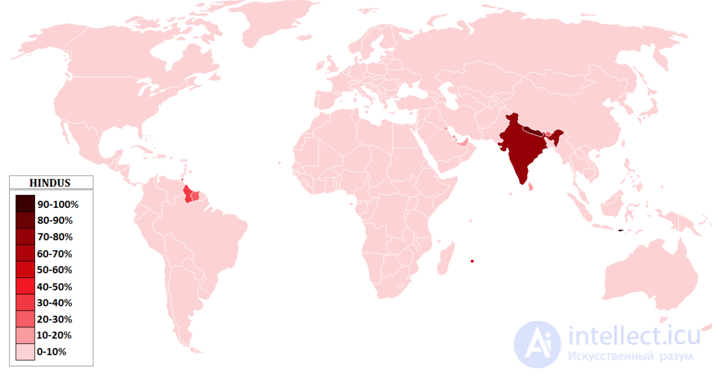
Map of the distribution of Hinduism by country
It is difficult to give a definition of Hinduism because of the breadth of the range of traditions and beliefs it unites. As a rule, the general term «Hinduism» refers to a family of heterogeneous traditions that accept the authority of the Vedas . At the same time, whether a given tradition belongs to Hinduism does not depend on its antiquity or on the extent to which its doctrine and religious practices are actually based on the Vedas . Some currents classified within the sphere of Hinduism do not recognize the Vedas as revelation at all . They are based on their own scriptures and traditions, yet they venerate the same gods and follow the basic moral and ethical tenets of Hinduism. Thus, Hinduism cannot be regarded as a «category» in the classical sense of the word, in which objects either unambiguously belong to it or do not. Not being a single religion, Hinduism constitutes a family of religions and traditions. Hinduism lacks a unified system of beliefs and a common doctrine . Nor does it have a centralized governing body. Unlike other world religions, the history of Hinduism has had no single founder . Despite this, Hinduism possesses its own unique form and features that set it apart as a distinct religion . Hinduism is often compared to a banyan tree, which constantly sends out new roots that in time turn into trunks that in turn send out new shoots . This example vividly illustrates not only the diversity of Hinduism, but also the interconnection that exists among its various currents
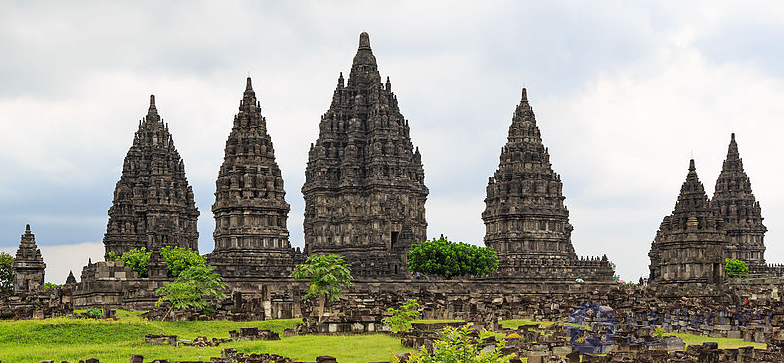
Prambanan — a grandiose Hindu temple complex on the island of Java (Indonesia).
Like the name «India», the term «Hinduism» goes back to the Persian «hidu» (later «hindu», an inhabitant of Sindh, India – as in the inscriptions at Naqsh-e Rustam and Persepolis of the kings Darius, 522-486 BCE, and Xerxes, 486-465 BCE), is geographical in character (the same as «Indianism»), and does not occur in the Indian sacred books. As a term in religious studies, «Hinduism» was introduced by Europeans in the 19th century to designate beliefs that originated in India, and for this reason it is as broad a notion as «European culture» and is marked by extreme amorphousness. The differences between Islam and Christianity, or between Judaism and Zoroastrianism, are less pronounced than those between certain extreme currents within Hinduism itself. Hinduism cannot be reduced either to the concept of «religion» or to the concept of «philosophy»; it is impossible to single out within it either a common creed or a set of dogmas. It has no universally accepted canon, doctrine, Church, or ritual, for it is not a single system but a group of related ideological and religio-philosophical systems, linked to some degree by a shared territory, historical destiny, and literary and cultural heritage.
The oldest and most influential cultural tradition in India calls itself «vaidika dharma» («the Vedic dominion» or «the scientifically ordered socio-cosmos»). Accordingly, clarifying the nature of Hinduism is bound up with resolving the question of the essence of the concept of «Vedic science» (veda, vidya, shastra) and «dominion» (dharma). As a specific socio-cultural formation, Hinduism apparently originates as early as the period of early agricultural cultures (10,000-7,000 BCE), and reaches its apogee in the 3rd millennium BCE, at the time of the greatest civilization of antiquity, now known as the proto-Indian (Indus, or Harappan) civilization. The cultural monuments of the excavated cities of northern India are concentrated mainly in the interfluve of the Indus and the Ganges. This was a highly developed civilization with advanced urban planning, writing, a unified system of standards, a carefully thought-out organization, developed science, and an astronomical-mythological system. It is most likely that the formation of the core nucleus of Hinduism – the grandiose Vedic corpus of scientific and philosophical literature in Sanskrit, which became the backbone of the spiritual, cultural, political, and social unity of this vast state of an urban type – occurred precisely during this period. From roughly the middle of the 2nd millennium BCE, a significant part of the territory of this ancient superstate, particularly the areas adjoining the Indus and its tributaries, fell into decline and desolation under the impact of geotectonic shifts, changes in river courses, and desertification, but above all as a result of the arrival, from the steppes of Central Asia through the passes of the Hindu Kush, of conquerors who called themselves Aryas, or Aryans. The highly developed civilization of Mohenjo-daro and Harappa was conquered and partly destroyed (archaeological excavations attest to extensive destruction). The Aryans intermingled with the proto-Indians, and after some time the flowering of classical Indian culture in the Vedic language and Sanskrit began. In the process, the centers of culture shifted to the Ganges valley, to Central and Asia Minor, and to Eastern and Western Europe. Bearers of Vedic Sanskrit culture called themselves Aryans («ardent», «bright», «enlightened» followers of Indra, the God of the full moon). The term had a purely cultural, rather than ethnographic, meaning. An inevitable consequence of the migration from India was the spread of the Sanskrit language and the Vedic worldview throughout the entire Old World. This is indicated by the degree of cultural and linguistic closeness as a function of distance from India: the farther away, the less similarity and the more differences. The Iranian peoples turn out to be the closest, followed by the Slavic peoples, then the Lithuanians, the Greeks, and the Latins, and finally the Celtic, Germanic, and Romance peoples. Whereas the Iranians are simply difficult to distinguish from the ancient Indians, and many passages in the Avesta are almost identical to Vedic ones, the kinship between the Romance and Indian peoples is far less obvious. Among modern Indo-European languages, the Slavic languages turned out to be closest to Sanskrit. A remarkable trace of Vedic culture in the Belarusian language is the word «vedy», which has not survived in such a pure form anywhere else in Europe. The scientific, artistic, and mythological conceptions of the proto-Indian civilization formed the basis of Hinduism. Although the proto-Indian texts amount to no more than brief inscriptions on seals, vessels, and other archaeological objects, the Indian Aryans preserved in memory the earliest surviving monuments of ancient Indian and Indo-European literature, known as the Vedas. The Vedas («vedas», i.e. sciences) fall into two categories – Shruti («the Word», «that which was heard») and Smriti («Memorials», «that which was remembered») – covering all branches of knowledge of the ancient civilization. Shruti consists of the four Vedas (the «Atharvaveda», the «Rigveda», the «Samaveda», and the «Yajurveda»), associated with the four cardinal directions, the lunar quarters, the seasons of the year, and dedicated respectively to Mercury, Jupiter, Mars, and Venus. Each of the Vedas is represented by a Samhita (a cycle of astronomical-calendrical chronometric formulas – mantras), by Brahmanas (astronomical-mythological explanations for priests), and by Aranyakas and Upanishads (mythological-psychological interpretations of micro- and macrocosmic parallels). Disciplines such as mathematics and astronomy (observational and mathematical), medicine and sexology, philology (with such branches as Vedic textology, etymology, phonetics, grammar, rhetoric, and poetics), law and political science, sociology, and philosophy with all its principal branches (cosmology, mythology, natural philosophy, metaphysics, epistemology, logic, dialectics, psychology, ethics, aesthetics, philosophy of language, theology, eschatology) were systematized within Hinduism during the 2nd-1st millennia BCE at a level that in a certain sense is fully comparable to, and at times even surpasses, the modern one (as in the case of grammar).
The auxiliary Vedas, or sciences, within Hinduism included the following: Ayurveda (medicine), Dhanurveda (military science), Gandharvaveda (music), and Sthapatya-shastra-veda, or Shilpa-shastra (the science of sculpture and architecture). The Vedanga, as a category of the principal Vedic scholarly literature, took shape during the Vedic period but attained its systematically finished form by the 5th-2nd centuries BCE. It comprises six disciplines, represented by collections of sutras (concise rules): the study of ritual (Kalpa), phonetics (Shiksha), grammar (Vyakarana), etymology (Nirukta), prosody (Chandas), and astronomy (Jyotisha). Their purpose is the correct understanding and performance of Vedic texts. The study of ritual (Kalpa) is represented by the Brahmanas and by special treatises, which reflect, to varying degrees, both the logic, analysis, and systematics, and the practice and theory of ritualists, ethicists, and sociologists. It relied on traditional epistemology, the theory of pramanas (sources of valid cognition), and encompassed not only a system of particular rules for the recitation of the Vedas, the methodology, and the analysis of the structure of accompanying rites, but also an explanation (paribhasha) of the meta-rules of their application, a classification of rites, rules of conduct, and the laws governing the organization of an ideal and universal family, society, and state. The Kalpasutras include the Shrauta-sutras (rules pertaining to public festivals), the Shulba-sutras (the measurement of calendrical altars, containing the rudiments of geometry), the Grihya-sutras (rules of domestic rites), and the Dharma-sutras and Dharma-shastras (rules governing the ordering of the chrono-cosmos and calendar, the state, society, and the family) – veritable constitutions covering questions of astronomy, political science, sociology, law, ethics, religion, and pedagogy (and sometimes even rules of etiquette, cosmetics, and the like) for an ideal society and a universal state.
Dharma-shastra (the doctrine of dominion, faith, morality, and law) is regarded as the most important of the ethico-legal disciplines, addressing the four aims of human life (chaturvarga); the others are Artha-shastra (political science, or the philosophy and science of governing the state, drawing on political economy and law, the sciences of agriculture and forestry, chemistry and metallurgy, urban planning and military science, veterinary science and environmental legislation, etc.), Kama-shastra (the philosophy of the satisfaction of desire, systematizing the rules governing relations between the sexes), and Moksha-shastra, the science of liberation or salvation of the soul, represented by the darshanas. The science of phonetics (Shiksha) is defined as the doctrine of sound, intonation, length, stress, pause, and the combination of sounds. The high level of Vedic phonetics is attested both by special treatises and by the Vedic mantras themselves, preserved both in continuous form (Samhita) and in phonetic form (Pada-patha).
A category of auxiliary Vedic literature – the Pratishakhyas – investigated the phonetics, meter, and rules of recitation of each Veda. The Vyakarana – the codification of Sanskrit grammar that concluded a lengthy philological-analytical period – was accomplished by the middle of the 1st millennium BCE in Panini’s work «Ashtadhyayi» and in the works of his commentators Katyayana and Patanjali. As V. K. Shokhin observes, the Indian philologist-exegetes demonstrated a scientific potential fully comparable to the achievements of structural linguistics, and one that surpassed the problem field of many disciplines of European scholarship across more than one era. Vedic etymology, codified by Yaska in the «Nirukta», proceeds from an affirmative answer to the question of the need to compile a continuous commentary on all the Vedas and a dictionary of important Vedic concepts. Having grown out of a compendium of difficult Vedic words and expressions, it develops into the study of religion, consistently interpreting the Vedic gods as metaphors and allegories of celestial phenomena, which brings it close to ancient Euhemerism, Byzantine theology, and the European mythological school of the 19th century. This tradition finds its further development in the extensive tradition of Sanskrit lexicography, represented by several hundred large and small dictionaries (of synonyms, homonyms, analogies, explanatory dictionaries, encyclopedic dictionaries, dictionaries specialized by branch of knowledge, etc.). The «science of Vedic meters», represented by Pingala’s ancient «Chandahsutra» and a number of medieval works (by Kshemendra, Hemachandra, and others), sets out the rules for the use of poetic meters in Vedic recitation. Astronomy and the first calendars began to emerge in India as early as the Stone Age. The proto-Indians devised lunar, solar, lunisolar, and planetary calendars. Among the Vedic Aryans, the science of astronomy, mathematics, and the calendar, which was counted among the Vedangas, was regarded as the «eye of the Vedas», explaining the structure of the universe, the intricacies of Vedic myths, and the metaphors and paradoxes of Vedantic philosophy. Its high level is attested by special treatises (Siddhantas), descriptions of dozens of instruments, and the medieval observatories in Jaipur, Delhi, and other cities, with astonishingly precise instruments that minimized possible errors. In the 7th century, through the mediation of the Arabs, the Indians acquainted Europeans with the achievements of their mathematics and astronomy. Two hymns of the «Atharvaveda» (XIX, 53, 54), along with many subsequent texts, are devoted to Time – personified in the image of all-consuming Kala (and of Eternity, of Great Time, of Shiva Mahakala) – as the principal cosmogonic factor. It is Time that produces the cyclical creations and destructions of the universe described in the Puranas; it is proclaimed the supreme deity in the Itihasas and by Shankara, the outstanding interpreter of Vedanta. An exposition of Kalavada (the doctrine of Time) is contained in the «Manava-dharma-shastra», the «Artha-shastra», the «Mahabharata», the Puranas, and the works of Bhartrihari, while the scientific principles of ancient chronometry are set out in the phonetic treatises and special astronomical treatises. Within the bounds of Hinduism, the Itihasas and Puranas are great mythic epics in which astral and lunar myths serve as a connecting framework for the exposition of the entire body of scientific, philosophical, and artistic disciplines, which makes them veritable encyclopedias of Hinduism (the ancient Greek model of encyclopedic education was borrowed precisely from this Puranic model).
The Puranas set out in detail the cosmogonic myths within which the Vedic personages act; they describe ritual, provide lists of temples and places of pilgrimage, as well as astronomical, philological, philosophical, ethical, legal, social, and other knowledge in connection with calendrical time, age, and social estate. These works were composed over a long period by Brahmanical academies, but are attributed to two divine authors – Valmiki, the first Kavi (composer, poet), the «embodiment of the full moon and, correspondingly, of the sun», who is the symbolic author of the «Ramayana», whose various recensions taken together comprise about 1,000,000 verses and exceed the «Mahabharata» tenfold in volume, and also Veda-Vyasa – the «Compiler, Divider of the Vedas», the embodiment of the moon during the new-moon period, nicknamed Krishna Dvaipayana (the Black Islander) – the symbolic editor of the Vedas and author of the «Mahabharata» (and accordingly of the «Bhagavad Gita» as well), of the 18 Puranas, and of the «Vedanta-sutra», i.e. the principal texts of Vedanta. His symbolic role consists in emphasizing the connection of the Vedic tradition with observational astronomy. Literary theory, poetics, and aesthetics are among the most elaborately developed shastras, encompassing questions of the theory and definition of poetry, the philosophy of language and hermeneutics, the classification of characters, aesthetic experiences (Rasa-shastra), merits and defects, figures of speech (Alankara-shastra), the doctrine of implied meaning (Dhvani-shastra), of styles (Riti-shastra), of imagery (Vakrokti-shastra), of harmony (Auchitya-shastra), and of dramaturgy (Natya-shastra). Its significance for the religious philosophy of Hinduism is determined by the fact that, in the Upanishads, brahman is defined as rasa («uraz», aesthetic impression).
The concept of «philosophy» is expressed in Sanskrit by several synonyms: para-vidya (higher knowledge, metaphysics), brahma-vidya (knowledge of the great first principle), jnana (knowledge), anvikshiki (investigation), darshana (view), mata (theory), samaya (doctrine). Terms such as anvikshiki and darshana are undoubtedly more scientific in character than the European term «philosophy». Anvikshiki («examination, consideration») denotes reflection upon the data of sensory experience or of authoritative testimony, i.e. it is predominantly logical analysis. In the early period (before the 1st century BCE) the term was applied to various currents of thought (Lokayata, Samkhya, Yoga); later it became a synonym for the Nyaya school. Darshana («view») represents a general theoretical generalization of a problem. In the Upanishads, or Vedanta («the crown, the concluding part of the Vedas»), the first generalization of Vedic or Brahmanical philosophy takes place. The word «Upanishad» means «secret doctrine» (literally: «the position of a pupil beside his teacher»). More than 200 texts have survived, of which 108 are considered the most authoritative. Their content is not confined to ritual, mythological, and cosmogonic themes. Ritual is used merely as a metaphor for human existence. The Upanishads analyze questions of the theory of knowledge, ontology, psychophysiology, ethics (i.e. deep and stable convictions, beliefs, ideals) and aesthetics (the nature of artistic perception, aesthetic experiences, and empathy). The central teaching is that of the unity or identity of atman and brahman (parama-atman), i.e. of man and the world. Atman means «nature», one’s own «being» (cf. Greek physis), i.e. the human ensouled body. In the past, and at present, this important concept is often reduced to the «innermost essence of man», the «soul». However, as the Lokayatas insisted, man is a living, ensouled body. It is characteristic that in Vedanta a living person is called shariraka (an embodied, corporeal being), while the soul is called sukshma-sharira (the subtle body). In this connection, parama-atman should be understood as the «supernatural» (or the primordially natural) principle (cf. Greek metaphysics). Brahman signifies the «great» first principle of the universe, giving rise to all living things in the process of its temporal unfolding and expansion. The soul is called prana, which gives life and motion both to nature and to atman, and purusha, an all-pervading substance that animates living beings, sometimes identified with prana. The «Shvetashvatara» mentions a cosmogonic theory according to which the world arose owing to its own natural peculiarity, its «own nature» (svabhava), in which scholars discern the origin of the concept of «natural law». The Upanishads reflect the teachings that formed the basis of Vedanta, Yoga, and other darshanas. Besides the classical Vedic darshanas, the ideas of the Upanishads found reflection in the Middle Ages among early Christian theologians and in the teachings of Iranian Sufis, and, from the 19th century onward, in Western philosophy (in A. Schopenhauer, R. W. Emerson, L. Tolstoy, A. Schweitzer, and others).
Among the shastras based on the Upanishads, the most important are the six darshanas (Mimamsa and Vedanta, Nyaya and Vaisheshika, Samkhya and Yoga), which constitute specialized philosophical disciplines of Vedanta. Their theoretical formation probably took place as early as the proto-Indian period, while the final codification of their foundational texts occurred no later than the beginning of the Common Era. They develop questions of the theory of knowledge, logic, physics and metaphysics, psychology, the textology of the Vedas, and ethics. Later, in the first millennium CE, the darshana of the grammarians took shape, and in the Middle Ages a differentiation of Badarayana's Vedanta occurred, giving rise to numerous schools of various orientations. Purva-mimamsa ("the first reflection or investigation") is the name of the first division of Vedic philosophy, which analyzes the concept of "dharma" as applied to Vedic rites (karma — whence its designations "karma-mimamsa" and "dharma-mimamsa"). Its foundational work is the "Mimamsa-sutra" of Jaimini, together with the "Bhashya" (the primary commentary) of Shabara (c. 3rd century BCE), the "Shlokavarttika" of Kumarila Bhatta, and the "Brihati" of Prabhakara (4th–8th centuries).
Mimamsa investigates and classifies the prescriptions concerning the calendrical ritual contained in the first part of the Vedic canon, and develops questions of epistemology, philosophical semantics, and the textology of the Vedic samhitas and brahmanas. Its field of consideration includes questions of the theory of meaning of Vedic utterances and the eternity of sound together with its associated meaning. This teaching exerted a notable influence on the whole of Indian philosophy, above all on Vedanta. Kumarila Bhatta (7th century) was the foremost philosopher of Mimamsa and the founder of one of its two sub-schools, as well as the author of an extensive three-part commentary on the "Mimamsa-sutra" and the first commentator on Shabara. In the first part of his work (the "Shlokavarttika"), in polemics against Buddhist logic and dialectics (Madhyamaka), Kumarila grounds the epistemology of Mimamsa: in addition to the four pramanas (means of valid cognition) of Nyaya, he also recognizes non-perception and implication, and asserts the anonymity (absence of an author) and infallibility of the Vedas, and so forth. Erroneous knowledge is interpreted by him not as delusion but as incomplete knowledge. Prabhakara (7th–8th centuries) was a pupil of Kumarila, a commentator on the "Shabarabhashya," and the founder of the second branch of Mimamsa. According to Prabhakara, what matters in a Vedic statement is its secondary meaning, rather than the meaning derivable directly from the words. The Vedic Gods are interpreted as symbols of (calendrical) rites.
Vedanta (literally, the culmination of the Vedas), also called Uttara-mimamsa ("the second, higher reflection"), represents the subsequent and concluding philosophy, a "deep ethics" that addresses questions of the essence of life, the purpose of man, the nature of earthly suffering and "heavenly" bliss, good and evil, the proper and the improper, the paths to attaining a sense of peace and happiness, and freedom from ignorance, suffering, and the fear of death. It deals with the concluding part of the Vedic canon — the Upanishads, which are, properly speaking, Vedanta itself. The foundational text, the "Brahma-sutra" (also known as the "Vedanta-sutra," "Sharirika-sutra," "Uttara-mimamsa") of Badarayana (c. 5th–2nd centuries BCE), presents in 555 aphoristic notes a schematic exposition of the most important philosophical positions of the Upanishads and Aranyakas, which is unintelligible without explanation and allows great freedom of interpretation. The first chapter is called Samanvaya ("Summation") and constitutes a compendium of Upanishadic statements about Brahman; the second — Avirodha ("Non-contradiction") — refutes objections that rest on the authority of smriti but contradict shruti; the third — Sadhana ("Attainment") — explains the essence of the science of Brahman (brahma-vidya), the essence of Brahman and the path to its "comprehension," the law of karma, states of consciousness, the nature of prana, the concentration of consciousness, the significance of the stages of life, and the nature of the liberation of consciousness from ignorance, which is likened to the state of an innocent child; the fourth — Phala ("Fruit") — describes the procedure and method of meditation, involving, in particular, the use of cyclical mythological-astronomical symbolism, the result of cognition, liberation from the bonds of karma, the stages of attaining an understanding of one's identity with the dynamically rotating Universe, and the acquisition of one's true essence and supernatural powers. The "Yoga-Vasishtha" is a grandiose Vedantic philosophical-poetic epic of 24,000 verses, composed as a supplement to the "Valmiki-Ramayana" and containing a detailed account of Rama's apprenticeship under Vishvamitra along with an exposition of Vedanta.
In the most sacred song of the "Mahabharata" — the "Bhagavad Gita" — the duties of the kshatriya-warrior are set forth, together with the teaching on three methods (yogas), or paths (margas), of identifying oneself with the supreme spiritual principle: karma-yoga, i.e., union through selfless action and renunciation of its fruits; jnana-yoga — the realization of identity through the knowledge of Vedanta; bhakti-yoga — union attained through love and devotion to the Lord. These three yogas are proclaimed to Arjuna by Krishna on the eve of the great battle.
The most ancient schools of Vedanta are the Brahmanical currents, in which the substance of the world appears in the impersonal form of the great first principle (Brahma): the Advaita (non-duality, non-dualism) of Shankara (8th century), the Bhedabheda (distinguishable non-difference) of Bhaskara (9th century), and that of Yadava Prakasha (10th century). The number of Vedantic schools increased enormously amid the medieval fragmentation of the country. Under the influence of Islam, theistic motifs intensified within Vedanta, and the role of the first principle came to be played by the martial Vishnu, Shiva, and their incarnations. Although all the schools claim to systematize the Upanishads and to correctly interpret Badarayana's "Brahma-sutra" and the "Bhagavad Gita," they recognize the authority of certain other sacred scriptures: the Vaishnavas recognize the "Pancharatra Agamas," the writings of the Tamil Alvars, the "Bhagavata" and other Vaishnava Puranas, while the Shaivas recognize the writings of the Nayanmars, the Naths, and the Shaiva Agamas and Puranas.
Some scholars consider a typology of six principal types of Hinduism, along with a number of its less significant varieties
In Hinduism there is no single, central doctrine authoritative for all Hindu traditions, and many Hindus do not even consider themselves to belong to any particular tradition[22]. Scholars, however, distinguish four main branches within contemporary Hinduism:
Although it is impossible to formulate a flawless definition of Hinduism and a doctrine common to all its branches, there are practices and beliefs that occupy a central place in Hinduism and that can be recognized as typical of it[12]:
The ultimate goal of spiritual practice is designated by such terms as "moksha," "nirvana," or "samadhi," and is understood differently by the various branches of Hinduism:
According to Hindu beliefs, divinity is an extension of Brahman, the universal spirit. Like Brahman, it is boundless and present in every particle of the Universe, manifesting itself in a multitude of different forms. Thus, although there are many gods and many Hindus, all are united in Brahman and constitute a single divinity. The god Krishna says in the Bhagavad Gita: "Whatever form [of the Deity] a person worships with faith, I strengthen that faith." In Hindu families it is customary to worship either Vishnu and Shiva, or one of the Shaktis, the consort or feminine principle of God.
In Hinduism there exist many views on the nature of God, based on monotheism, polytheism, pantheism, and monism.
Shiva (Skt. शिव, śiva IAST, "auspicious," "gracious") — a Hindu deity, the supreme god in Shaivism, who together with Brahma and Vishnu forms part of the divine triad, the Trimurti. The origins of the cult of Shiva reach back to the pre-Vedic and Vedic periods. Shiva embodies cosmic consciousness, the static male principle of the universe (Purusha), opposed to Shakti (Prakriti), the dynamic female principle of the universe.
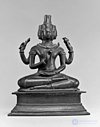
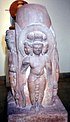
Brahma, archaically also Brama; Skt. ब्रह्मा, Brahmā IAST) — the god of creation in Hinduism. Together with Vishnu and Shiva, he is one of the gods of the Trimurti. Brahma's consort is Sarasvati, the goddess of knowledge and learning. Brahma is often identified with the Vedic deity Prajapati.
Vishnu (Skt. विष्णु, viṣṇu IAST — "the all-pervading one," "the all-encompassing one") — the supreme deity in Vaishnavism. In Hindu mythology, together with Brahma and Shiva, he is one of the gods of the Trimurti (the triad of deities), where he performs the function of preserver of the universe[1][2]. In the various branches of Hinduism, Vishnu is worshipped either directly or through his avatars, the most popular of which are Krishna and Rama. Followers of the Smarta tradition venerate Vishnu as one of the five principal forms of God
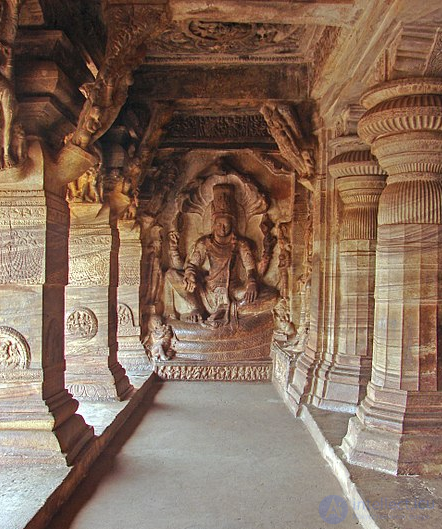
Bas-relief of Vishnu in the gallery of Cave Temple No. 3 (Badami, Karnataka), 578 CE
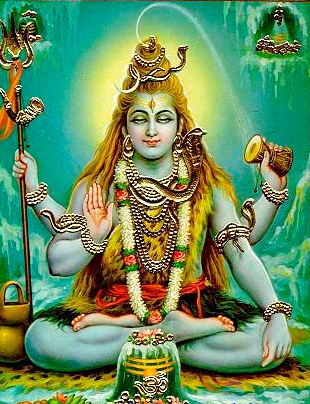
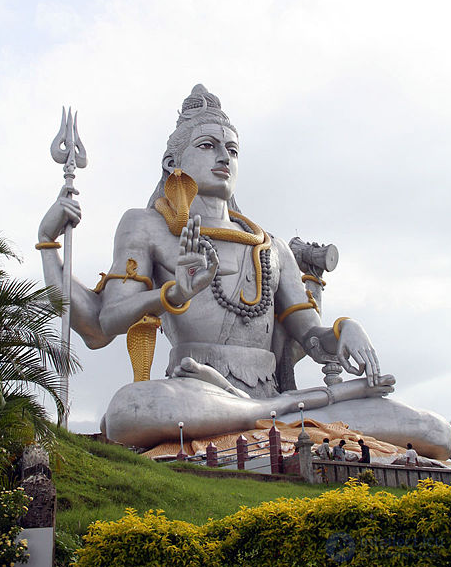
Many-armed Shiva. A giant statue of Shiva in Murudeshwar
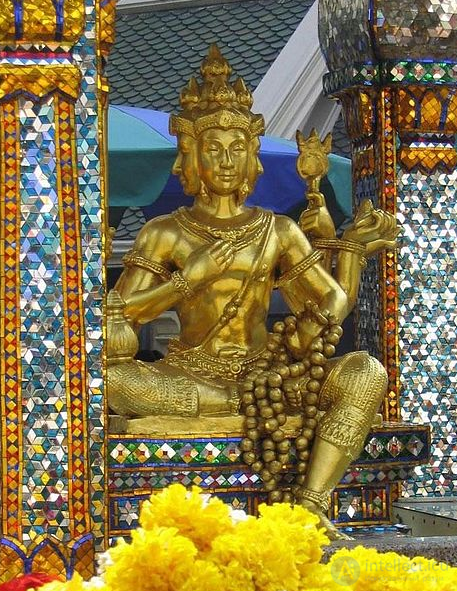
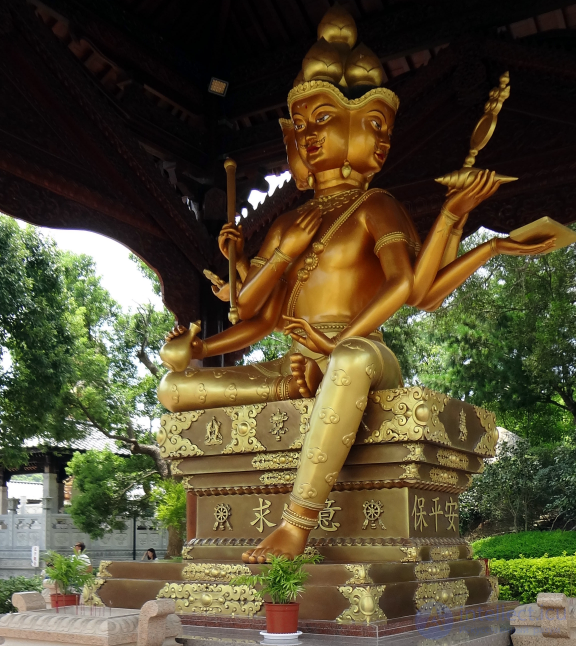
The many-faced and many-armed god Brahma. Statue of the four-faced Brahma, Thailand, Erawan Shrine
Altar of Brahma in China
Because they are mighty beings called upon to maintain balance in the world
The principal Hindu gods are often depicted as many-armed, especially in scenes where they battle evil spirits. This multiplicity of arms signifies, above all, incredible strength and the ability to perform several tasks at once, but that is not all — it also carries a philosophical meaning. Thus, for example, in Shiva's case one pair of arms may symbolize the balance between life and death, another the struggle of good against evil, a third objective and subjective truth, and a fourth the birth of the world and its destruction. Moreover, it is not only the number of arms that is multiplied for the gods. The third eye on Shiva's forehead attests to divine wisdom, the ability to see the present, past, and future, or to simultaneously behold what is happening on earth, in heaven, and beneath the earth. And three heads (in the case of the many-faced god) symbolize different aspects of his nature: divinity, indomitability, and the capacity to abide in eternal bliss. Three heads are by no means the limit. It is said that the god Narayana has a full thousand of them — truly a many-faced being.
There is a legend. Krishna's body is not blue; the color of his body is called shyam, a color that does not exist on Earth. The color shyam resembles the color of a storm cloud. The uniqueness of the color of Krishna's body lies in the fact that He is dark, yet light emanates from Him. This is contrary to all the laws of physics. By this, Krishna makes it clear to people that He, as the Supreme, stands above the laws of nature. All laws are subject to Him. He is the Supreme Law and the Absolute Truth. The name KRISHNA (in Sanskrit) means "the all-attractive one who bestows joy on everyone." Krishna is not entirely black; He is dark blue. Such is the color of His skin in the spiritual world, on Goloka Vrindavana. This color resembles a storm cloud in its hue. Krishna likes this color… It is the color of the cloud that brings liberation to all who languish with thirst…
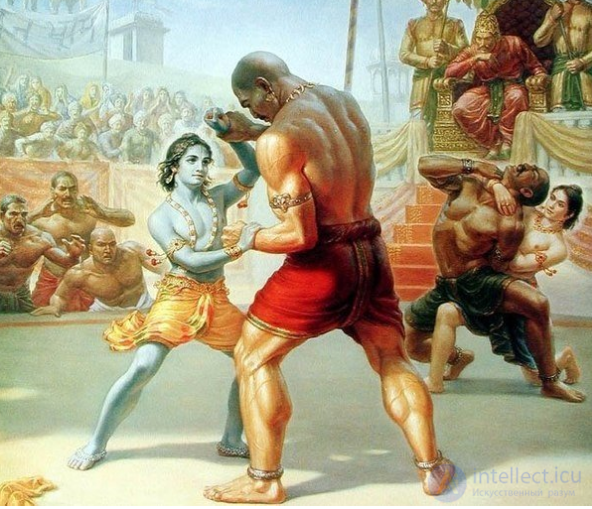
Krishna assumed the form that is reflected in the dark eyes of His Beloved Radha, to whom He is dearer than life.
On our planet one can find people of various shades, from snow-white to blue-black. It turns out that nature is not limited only to white, yellowish, and chocolate shades — there are people in the world with blue skin. These are not inhabitants of the famous Pandora from the film "Avatar," but real people who have lived or live on Earth — for example, one of the first families of blue people, the Fugate family.
The skin turns blue because of an elevated content in the blood — over one percent — of methemoglobin. Methemoglobin is a form of hemoglobin in which the iron of the heme is in a trivalent state and capable of binding tightly to oxygen. As a result, methemoglobin transports oxygen poorly from the lungs to the body's tissues, which promotes the development of tissue hypoxia, and the skin acquires a blue tint.
CONGENITAL AND ACQUIRED METHEMOGLOBINEMIA
Methemoglobinemia can be congenital or acquired. In the congenital form of the disease, the level of methemoglobin in the blood ranges from 20 to 50%.
Methemoglobinemia can also be acquired. The development of this condition is provoked by the overuse of medications such as:
phenacetin, metoclopramide, nitric oxide, novocaine, nitroglycerin, nitroprusside, paracetamol, potassium permanganate, and others.
Methemoglobinemia also develops from poisoning with substances such as: butyl nitrite, silver nitrate, aniline dyes, isobutyl nitrite,
naphthalene, chlorobenzene, nitrophenol, trinitrotoluene.
One can also turn blue from ordinary foods and water containing an elevated content of nitrates.
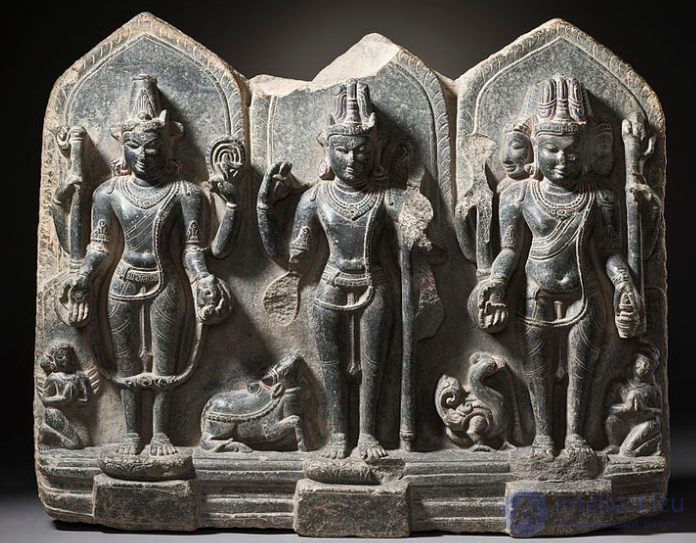
A 10th-century triad — Vishnu, Shiva, and Brahma — from Bihar.
Trimurti
| Gods of the Rigveda | Gods of the Yajurveda | Gods of the Samaveda | Gods of the Atharvaveda |
|---|---|---|---|
|
| Name | Other names | Avatars or related deities | Geography | Image | Early illustrative art |
|---|---|---|---|---|---|
| Vishnu |
Narayana, Jagannatha, Dattatreya |
Matsya, Kurma, Varaha, Narasimha, Vamana, Parashurama, Rama, Krishna, Kalki , Vithoba, Gopala, Balarama, Lady Mohini, Naraenten (那羅延天, Japan) |
India, Nepal, Sri Lanka | 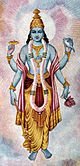 |
 2nd century BCE |
| Shiva | Mahadeva, Pashupati, Tripurantaka, Vishvanatha, Dakshinamurti, Kalantaka, Bhairava, Rudra, Nataraja, Sadashiva, Dattatreya |
Achalanatha (Japan) | India, Nepal, Sri Lanka |  |
 1st century BCE [167] |
| Brahma |
Adi-Prajapati, Virinchi, Vaidyanatha, Vakpati, Varishtha-deva, Kamalaja, Shrashtaa, Kartaa, Dhaataa |
Bonten (Japan), [168] Phra Phrom (Thailand) |
India, Nepal, Sri Lanka, Southeast Asia |
 |
 6th century CE |
| Ganesha | Ganapati, Vinayaka, Lambodara, Gajanana | Kangiten (Japan) | India, Nepal, Sri Lanka | 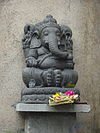 |
 7th century CE |
| Kartikeya | Skanda, Murugan | India, Sri Lanka, Malaysia | 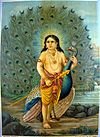 |
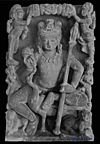 2nd century BCE |
|
| Parvati | Uma, Devi, Gauri, Durga, Kali, Annapurna |
Umahi (烏摩妃, Japan) Devi Sri (Indonesia) [169] |
India, Nepal, Sri Lanka | 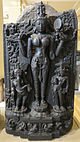 |
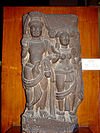 5th century CE |
| Lakshmi | Shri Devi, Gajalakshmi, Kamalasana | Sita, Radha, Kisshoten (Japan), Nang Kwak (Thailand) [170] |
India, Nepal, Sri Lanka | 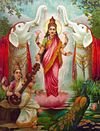 |
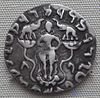 1st century BCE |
| Sarasvati | Vagishvari, Vinapani | Benzaiten (Japan), Biancaitian (China), Thuratadi (Myanmar), Suratsavadi (Thailand) [171] |
India, Nepal, Java, Bali, Sri Lanka | 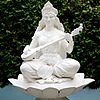 |
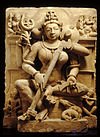 10th century CE |
| Durga | Parvati, Kali, Mahishasuramardini | Betari Durga (Indonesia) [172] | India, Nepal, Sri Lanka | 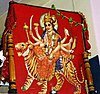 |
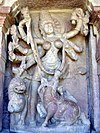 8th century CE |
| Kali | Durga, Parvati | India, Nepal, Sri Lanka | 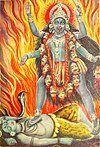 |
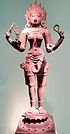 12th century CE |
|
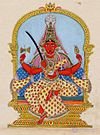
| Mariamman | Durga, Parvati | India (mainly in South India), Southeast Asia, Sri Lanka |
 |
 10th century CE |
|
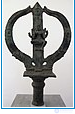
| Harihara (half Vishnu, half Shiva) | India, Sri Lanka | 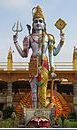 |
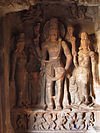 6th century CE |
||
| Ardhanarishvara (half Shiva, half Parvati) | India, Nepal, Sri Lanka | 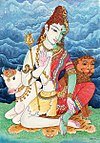 |
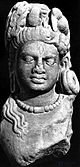 1st century CE |
There are ten principal avatars of Vishnu — the Maha-avatars. The full list of Vishnu's avatars comprises around 30 names.
The Hindu pantheon numbers thousands of gods.[1] In the various branches of Hinduism, deities are regarded either as personal manifestations of the impersonal supreme Brahman, or as avatars of the supreme deity (Ishvara or Bhagavan), or as powerful beings called devas. Hindu deities are, as a rule, depicted in human or semi-human forms, with a set of personal attributes. Many Hindus regard the numerous deities as different manifestations of a single primordial reality (Brahman), as manifold images of the one God.[2] Thus the deities and their worship serve as a means of communion with this one God.
The «Rigveda» describes 33 deities, representing personified natural phenomena.[3] Later sources contain references to 330 million deities.[2] The text uses the word koti, which may be understood as «class», «kind», but also as «10 million». According to one view, claims of millions of gods arise from a misreading of the text, as confirmed by the mention of 33 gods in other sources.[4] According to another, the number 330 million is not the result of a count, but a designation of the infinity and boundlessness of the divine.[
Vishnu most often appears in the role of the Preserver, as distinct from the Creator, Brahma, and the destroyer, Shiva. According to the beliefs of his devotees, the Vaishnavas, Vishnu has repeatedly taken earthly incarnations, avatars, each time in order to save the Universe from catastrophe. Images of Vishnu are usually dark blue; he has four arms and holds a symbolic object in each: a conch shell, a discus, a mace, a lotus. Sometimes Vishnu is depicted reclining upon the coils of the great many-headed serpent, Ananta, together with his consort Lakshmi, the Goddess of prosperity, seated at his feet, while a lotus bearing Brahma grows from Vishnu's navel. On other occasions Vishnu is depicted riding Garuda – the bird that serves as his mount. Vishnu's avatars are the Fish, the Tortoise, the Boar, the Man-Lion, the Dwarf, Rama with the Axe, Rama, Krishna, Buddha, and Kalkin (who has not yet appeared). The inclusion of the Buddha among Vishnu's avatars is typical of Hinduism's tendency to assimilate all religions: Hindus sometimes add Christ to the list of avatars.
The most venerated avatars of Vishnu, especially in northern India, are Rama and Krishna. Prince Rama, the hero of the Ramayana, embodies the image of the perfect ruler, while his consort Sita is the ideal Hindu wife. Krishna, the object of the love and devotion of the bhaktas, is worshipped as a mischievous child endowed nonetheless with immense power, as the dark-skinned lover who plays the flute and engages in amorous games with the milkmaids, the most beloved of whom is called Radha, as well as the mature hero of the epic Mahabharata and the teacher of the Bhagavad Gita.
Shiva embodies the unity of many aspects. His devotees, the Shaivites, believe that destruction must necessarily precede creation, and hence that Shiva participates in the creation and transformation of the world. Shiva is depicted in various ways – sometimes as an ascetic, his body smeared with white ash, seated in the Himalayas on a tiger skin in perpetual meditation. Attached to the knot of matted hair on his head is a crescent moon, from which the sacred river Ganges flows. At other times he is Nataraja («Lord of the Dance»), whirling gracefully, sustaining the Universe through his unceasing dance. Shiva is often depicted together with his consort Parvati and the bull Nandi, which serves as his mount. Shiva is most often worshipped in the form of the lingam, a simple pillar, usually of stone. The lingam is a phallic emblem of Shiva, suggesting that he traces his origin to a fertility deity.
Shakti represents the feminine divine principle, and the term is also used for the consorts of the Gods Vishnu and Shiva. For the worshippers of Shakti (called Shaktas), these Goddesses represent the active power of their consorts. The object of worship most often is Shiva-Shakti, the consort of Shiva. She has many forms: as Parvati, Uma, or Annapurna she is a beautiful woman, yet she may take on a fierce and terrifying appearance when she appears as Durga, Kali, Chandi, or Chamunda. Durga, a warrior with a fierce face, mounted on a lion, holds every kind of deadly weapon in her hundred arms. Kali, a coal-black giantess with a blood-red tongue hanging out, wears a garland of human skulls around her neck and holds a bloodied sword in her hand. Kali is associated with disease, death, and ruin, but at the same time protects those who believe in her. Worship of Kali includes animal sacrifice; she is often venerated as Matri – Mother of the World. In some Shaktist cults, the worship of Kali takes on an «extremist» character. Sects known as Tantric (the Tantras being their sacred texts), in their rites of initiation, violate orthodox prohibitions such as those against eating meat, consuming alcohol, or sexual licentiousness. Tantrics favor magical rituals and the repetition of mystical incantations (mantras), regarding them as the surest path to salvation.
In Hinduism there also exists a whole series of other Gods who are worshipped
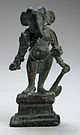
on special occasions or for special purposes. The most popular of them is Ganesha, the elephant-headed son of Shiva, who must be propitiated before undertaking any practical matter. Another son of Shiva is Skanda, or Kartikeya, who enjoys particular popularity in southern India. Many venerate Hanuman with his monkey head, who is described in the Ramayana as the faithful ally of Rama. Widespread is the propitiation of Shitala – the Goddess of smallpox. Although Brahma occupies an important place in mythology as demiurge, he is not customarily worshipped. By contrast, his consort Sarasvati enjoys universal devotion as the Goddess of music, the fine arts, and knowledge.
Besides this, there exists a great multitude of minor local Gods. The Hindu peasant endows with Gods all the hills and streams around his village. The village potter, moreover, worships the God of the potter's wheel, while the ploughman worships the God of the plough.
Despite the contradictions between the various forms of Hinduism, several definite fundamental tenets underlie them all.
Beyond the ever-changing physical world there exists a single universal, unchanging, eternal spirit called Brahman. The soul (atman) of every being in the Universe, including the Gods, is a particle of this spirit. When the flesh dies, the soul does not perish but passes into another body, where it continues a new life.
The fate of the soul in each new life depends on its conduct in previous incarnations. The law of karma states: no sin remains unpunished, no virtue unrewarded; if a person has not received the punishment or reward he deserves in this life, he will receive it in one of the lives to come. A person's conduct determines the higher or lower status of the subsequent incarnation; it depends on the person himself whether he will next be born a human, a God, or, say, an insignificant insect.
For most Hindus, an important element
продолжение следует...
Часть 1 4. Hinduism: the common spiritual heritage of the peoples of India
Часть 2 3. Hinduism and the Caste System - 4. Hinduism: the
Часть 3 7. Reform of Hinduism in the 19th–20th centuries. Religious syncretism

Comments